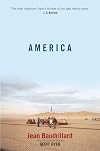
America
by Jean Baudrillard
On This Page
Description
From the sierras of New Mexico to the streets of New York and LA by night--"a sort of luminous, geometric, incandescent immensity"--Baudrillard mixes aperçus and observations with a wicked sense of fun to provide a unique insight into the country that dominates our world. In this new edition, leading cultural critic and novelist Geoff Dyer offers a thoughtful and perceptive take on the continued resonance of Baudrillard's America.Tags
Recommendations






































Member Recommendations



Member Reviews
There’s a long tradition of Europeans coming to America for a few weeks and then writing the definitive book about American culture and topography. They seem to do this more to annoy American readers (who have to buy the book in order to discover how much they hate the author) than to inform their fellow Europeans, who probably share their prejudices about America anyway. Baudrillard, with the unique chutzpah of a 1980s French intellectual, manages to reduce an entire continent to 140 pages of very literate and highly-abstract prose, seemingly based on a couple of terms teaching at Californian universities and a road-trip through the South-West. It sounds as though the only Americans he actually talked to were philosophy students and show more waiters (two categories that overlap quite significantly in most places).
So, of course, he sees what he came expecting to see, and misses a lot of other important things. He is fascinated by the desert and its radical semiotic emptiness — whatever signs there are in this landscape long pre-date human presence — and he imagines Los Angeles as a kind of human version of this negativity of signs. And of course he has to try to map Las Vegas in as its inverse. He doesn’t seem to be interested in the inequality, racism and violence of American society — he puts in some slightly naive comments about how much better the mingling of different ethnic groups works in the US than in postcolonial France — but he does notice the way Reagan-era America is promoting the exclusion of weaker social groups, especially the poor, from political discourse. He’s fascinated by the notion that Americans think of themselves as living in an achieved Utopia.
I was struck by how much of the difference Baudrillard saw between America and Europe forty years ago depended on the place of technology in our lives, something that has been quite radically smoothed out in the internet age. His assertions about the difference in European and American consciousness of history seem debatable too — my experience (not in California, admittedly) has certainly been that a lot of Americans are very interested in the history of the regions where they live, and that many Europeans know surprisingly little history…
It’s a very elegant and articulate little book, enjoyable to read and argue with. I only really got annoyed with him when he went into technical or scientific metaphors, which he almost invariably gets wrong and clearly didn’t bother to run past anyone who might be able to correct him. He imagines a jet engine as sucking itself along by creating a vacuum in front of itself, for example, and gets into similar messes with computers, television, lasers, etc. show less
So, of course, he sees what he came expecting to see, and misses a lot of other important things. He is fascinated by the desert and its radical semiotic emptiness — whatever signs there are in this landscape long pre-date human presence — and he imagines Los Angeles as a kind of human version of this negativity of signs. And of course he has to try to map Las Vegas in as its inverse. He doesn’t seem to be interested in the inequality, racism and violence of American society — he puts in some slightly naive comments about how much better the mingling of different ethnic groups works in the US than in postcolonial France — but he does notice the way Reagan-era America is promoting the exclusion of weaker social groups, especially the poor, from political discourse. He’s fascinated by the notion that Americans think of themselves as living in an achieved Utopia.
I was struck by how much of the difference Baudrillard saw between America and Europe forty years ago depended on the place of technology in our lives, something that has been quite radically smoothed out in the internet age. His assertions about the difference in European and American consciousness of history seem debatable too — my experience (not in California, admittedly) has certainly been that a lot of Americans are very interested in the history of the regions where they live, and that many Europeans know surprisingly little history…
It’s a very elegant and articulate little book, enjoyable to read and argue with. I only really got annoyed with him when he went into technical or scientific metaphors, which he almost invariably gets wrong and clearly didn’t bother to run past anyone who might be able to correct him. He imagines a jet engine as sucking itself along by creating a vacuum in front of itself, for example, and gets into similar messes with computers, television, lasers, etc. show less
Not unless I'm forced will I read another word by this absolute head-up-ass dreck-merchant. I was prepared to be a very sympathetic reader; I was primed and ready for some snappy and devastating criticisms of America; but Baudrillard is too concerned with manufacturing what he must think are theoretical pronouncements to actually observe his surroundings. He certainly didn't need to travel to write this shmarmy and useless rubbish pit of a book; he probably had the whole thing outlined before he started smirking his way across the country. He is also wrong about everything and racist. I couldn't get too far past his chapter on "New York" in which the following trash nuggets can be found: "Why do people live in New York? There is no show more relationship between them. Except for an inner electricity which results from the simple fact of their being crowded together. A magical sensation of contiguity and attraction for an artificial certainty . . . There is no human reason to be here, except for the sheer ecstasy of being crowded together." of breakdancing: "You might say that in curling up and spiraling around on the ground like this, they seem to be digging a hole for themselves within their own bodies, from which to stare out in the ironic, indolent pose of the dead." "For me there is no truth in America. I ask of the Americans only that they be Americans. I do not ask them to be intelligent, sensible, original. I ask them only to populate a space incommensurate with my own, to be for me the highest astral point, the finest orbital space."
He can ask me to kick his ass into the finest orbital space any time he wants. If you'd like my copy of this book, come and get it. show less
He can ask me to kick his ass into the finest orbital space any time he wants. If you'd like my copy of this book, come and get it. show less
Im not a philosophy head by any means but this was very accessible and I thought a lot of the ideas he presented still hold water today.
Im not a philosophy head by any means but this was very accessible and I thought a lot of the ideas he presented still hold water today.
Lexo Amerikën të zbulosh të nëndheshmen e një kontinenti përrallash. Të qasësh një tjetër univers, një tjetër kohë, një tjetër botë. Të rrokësh imazhet e një utopie të çuditshme që, pa reshtur, përkundet mes ëndrrës dhe realitetit.
I have no idea how to read this. I'm not stupid, but I don't know what postmodernism is and I've not the resources to find out, or to figure out what is going on in this book. Lots of big words, floating pronouns, and sentence fragments that don't actually seem to be saying anything. (Unlike my sentence fragments. ;)
If you die in America, do you die in real life?
Members
- Recently Added By
Published Reviews
Though punctuated with odd flashes of insight, his book on America is a slim sottisier in which facts have a nominal role. Reporting, it is not. There are signs that Baudrillard has decided to leaven the clogged mass of his jargon with bits of literary Americana; one detects, in the background, the hum of Henry Miller’s The Air-Conditioned Nightmare, Thomas Pynchon’s paranoid list-making show more and Norman Mailer’s sermons against plastic and cancer, as well as echoes from the more chiliastic passages of J. G. Ballard’s science fiction writing. The star of his own road movie, Baudrillard spends a great deal of time driving, for it is on the freeways—circulation again—that so much of the truth of America is to be found, or at any rate sought: “The speed of the screenplay, the indifferent reflex of television … the marvellously affectless succession of signs, images, faces, and ritual acts on the road.” Highway signs are, to him, epiphanies. “ ‘Right lane must exit.’ This ‘must exit’ has always struck me as a sign of destiny. I have got to go, to expel myself from this paradise, leave this providential highway which leads nowhere, but keeps me in touch with everyone. This is the only real society or warmth here …,” and so on, and so forth. No wonder he seldom gets out of the car. show less
added by SnootyBaronet
Lists

Books
85 works; 1 member
Author Information

166+ Works 11,620 Members
Jean Baudrillard (1929-2007) was a philosopher, sociologist, cultural critic, and theorist of postmodernity who challenged all existing theories of contemporary society with humor and precision. An outsider in the French intellectual establishment, he was internationally renowned as a twenty-first century visionary, reporter, and provocateur.
Some Editions
Awards and Honors
Notable Lists
Series
Belongs to Publisher Series
Common Knowledge
- Original title
- Amérique
- Original publication date
- 1986
- People/Characters
- Walt Disney
- Important places
- USA
- Quotations
- It is a world completely rotten with wealth, power, senility, indifference, puritanism and mental hygiene, poverty and waste, technological futility and aimless violence, and yet I cannot help but feel it has about it somethi... (show all)ng of the dawning of the universe. Perhaps because the entire world continues to dream of New York, even as New York dominates and exploits it.
The natural deserts tell me what I need to know about the deserts of the sign. ... We should always appeal to the deserts against the excess of signification, of intention and pretention in culture. They are our mythic operat... (show all)or.
America is powerful and original; America is violent and abominable. We should not seek to deny either of these aspects, nor reconcile them.
Classifications
Statistics
- Members
- 937
- Popularity
- 28,419
- Reviews
- 9
- Rating
- (3.52)
- Languages
- 17 — Czech, Danish, Dutch, English, Estonian, Finnish, French, German, Italian, Norwegian (Bokmål), Norwegian, Polish, Romanian, Russian, Spanish, Swedish, Turkish
- Media
- Paper, Ebook
- ISBNs
- 30
- ASINs
- 10