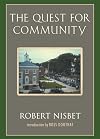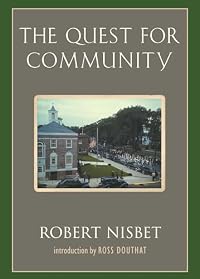
The quest for community
by Robert Nisbet
On This Page
Description
One of the leading thinkers to emerge in the postwar conservative intellectual revival was the sociologist Robert Nisbet. His book The Quest for Community, published in 1953, stands as one of the most persuasive accounts of the dilemmas confronting modern society. Nearly a half century before Robert Putnam documented the atomization of society in Bowling Alone, Nisbet argued that the rise of the powerful modern state had eroded the sources of community-the family, the neighborhood, the show more church, the guild. Alienation and loneliness inevitably resulted. But as the traditional ties that bind fell away, the human impulse toward community led people to turn even more to the government itself, allowing statism-even totalitarianism-to flourish. ISI Books is proud to present this new edition of Nisbet's magnum opus, featuring a brilliant introduction by New York Times columnist Ross Douthat and three critical essays. Published at a time when our communal life has only grown weaker and when many Americans display cultish enthusiasm for a charismatic president, this new edition of The Quest for Community shows that Nisbet's insights are as relevant today as ever. show lessTags
Recommendations


























Member Reviews
This is a peculiar book. The author summarizes its argument on two occasions. Summary number one: "It is the argument of this book that the ominous preoccupation with community revealed by modern thought and mass behaviour is a manifestation of certain profound dislocations in the primary associative area of society, dislocations that have been created to a great extent by the structure of the western political state" (p.42). Summary number two: "The argument of this book is that the single most decisive influence upon western social organization has been the rise and development of the centralized territorial state" (p.89).
The first summary encapsulates Part One of this book nicely, because it's hard to make any sense of it. In fact show more early on in this book I was so frustrated by bad arguments that I felt like abandoning the book entirely. The author writes about how "alienated" and "dislocated" modern man feels. He seems to consider this so obvious that it needs little elaboration, only repetition. But I could not understand which persons or groups have been so tragically dislocated, from what they have been dislocated, or even what "dislocation" or "alienation" is supposed to mean. At first I thought it had something to do with the fact that this book was written shortly after World War II, but the author clearly has more abstract "dislocations" in mind. Whatever they may be, the first part of the book is awful.
But the second summary I quoted above seems sensible and interesting. As it happens it actually fits Part Two, which contains well-reasoned and interesting arguments on many important questions. It's almost as if a different author had written this part of the book. I was impressed by how broadly the author manages to argue without diluting the point he is trying to make. The argument flows from political history to the history of political thought and to cogent theoretical analyses of both totalitarian and liberal state systems. The author laments the decline of small-scale communities - families, cities, workplaces etc. - under the extensive canopy of modern government. I can't say I share any of his concerns, but at least he makes an interesting case with many points worthy of serious consideration.
The third part of the book seemed a bit superfluous since it didn't add much to what had been said before. All in all I can recommend this book to readers with theoretical and historical interests in the modern state. If you skip directly to Part Two and ignore every mention of alienation or dislocation, it should be worth your while. show less
The first summary encapsulates Part One of this book nicely, because it's hard to make any sense of it. In fact show more early on in this book I was so frustrated by bad arguments that I felt like abandoning the book entirely. The author writes about how "alienated" and "dislocated" modern man feels. He seems to consider this so obvious that it needs little elaboration, only repetition. But I could not understand which persons or groups have been so tragically dislocated, from what they have been dislocated, or even what "dislocation" or "alienation" is supposed to mean. At first I thought it had something to do with the fact that this book was written shortly after World War II, but the author clearly has more abstract "dislocations" in mind. Whatever they may be, the first part of the book is awful.
But the second summary I quoted above seems sensible and interesting. As it happens it actually fits Part Two, which contains well-reasoned and interesting arguments on many important questions. It's almost as if a different author had written this part of the book. I was impressed by how broadly the author manages to argue without diluting the point he is trying to make. The argument flows from political history to the history of political thought and to cogent theoretical analyses of both totalitarian and liberal state systems. The author laments the decline of small-scale communities - families, cities, workplaces etc. - under the extensive canopy of modern government. I can't say I share any of his concerns, but at least he makes an interesting case with many points worthy of serious consideration.
The third part of the book seemed a bit superfluous since it didn't add much to what had been said before. All in all I can recommend this book to readers with theoretical and historical interests in the modern state. If you skip directly to Part Two and ignore every mention of alienation or dislocation, it should be worth your while. show less
THEME: political theory arising vis a vis the national state, the individual, and "intermediate" structures 42, 83, 139, 235; the centralization of social function and authority 198, 234
BASIS IN REALITY: God has made us social creatures 182, 184
PURPOSE: save a free society by strengthening local organizational jurisdictions 222-3, 235, 238, 247, 252
PROBLEM: social alienation resulting from disintegration of local authority (their organizations' jurisdictions) 45, 47-8
Freedom is found in the interstices of intermediary organizations 239
totalitarianism can be rooted in the yearning for community vii, 34, 38, 172
More notes in book cover
BASIS IN REALITY: God has made us social creatures 182, 184
PURPOSE: save a free society by strengthening local organizational jurisdictions 222-3, 235, 238, 247, 252
PROBLEM: social alienation resulting from disintegration of local authority (their organizations' jurisdictions) 45, 47-8
Freedom is found in the interstices of intermediary organizations 239
totalitarianism can be rooted in the yearning for community vii, 34, 38, 172
More notes in book cover
One of the leading thinkers to emerge in the postwar conservative intellectual revival was the sociologist Robert Nisbet. His book The Quest for Community, published in 1953, stands as one of the most persuasive accounts of the dilemmas confronting modern society.
Nearly a half century before Robert Putnam documented the atomization of society in Bowling Alone, Nisbet argued that the rise of the powerful modern state had eroded the sources of community—the family, the neighborhood, the church, the guild. Alienation and loneliness inevitably resulted. But as the traditional ties that bind fell away, the human impulse toward community led people to turn even more to the government itself, allowing statism—even totalitarianism—to show more flourish.
ISI Books is proud to present this new edition of Nisbet’s magnum opus, featuring a brilliant introduction by New York Times columnist Ross Douthat and three critical essays. Published at a time when our communal life has only grown weaker and when many Americans display cultish enthusiasm for a charismatic president, this new edition of The Quest for Community shows that Nisbet’s insights are as relevant today as ever. show less
Nearly a half century before Robert Putnam documented the atomization of society in Bowling Alone, Nisbet argued that the rise of the powerful modern state had eroded the sources of community—the family, the neighborhood, the church, the guild. Alienation and loneliness inevitably resulted. But as the traditional ties that bind fell away, the human impulse toward community led people to turn even more to the government itself, allowing statism—even totalitarianism—to show more flourish.
ISI Books is proud to present this new edition of Nisbet’s magnum opus, featuring a brilliant introduction by New York Times columnist Ross Douthat and three critical essays. Published at a time when our communal life has only grown weaker and when many Americans display cultish enthusiasm for a charismatic president, this new edition of The Quest for Community shows that Nisbet’s insights are as relevant today as ever. show less
Oct 29, 2021Dutch
Ratings
Members
- Recently Added By
Author Information

14+ Works 1,000 Members
Some Editions
Awards and Honors
Notable Lists
Common Knowledge
- Canonical title
- The quest for community
- Original title
- The quest for community
- Alternate titles
- Community and power (1962) (1962)
- Original publication date
- 1952
- Original language
- English
Classifications
- Genres
- Sociology, Nonfiction, Politics and Government, General Nonfiction, Philosophy, History
- DDC/MDS
- 320.509 — Society, government, & culture Political science Types of Government Political ideologies Political ideologies Biography And History
- LCC
- BJ51 .N56 — Philosophy, Psychology and Religion Ethics Ethics
- BISAC
Statistics
- Members
- 315
- Popularity
- 100,954
- Reviews
- 4
- Rating
- (4.56)
- Languages
- English
- Media
- Paper, Ebook
- ISBNs
- 9
- ASINs
- 6