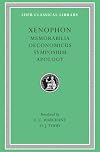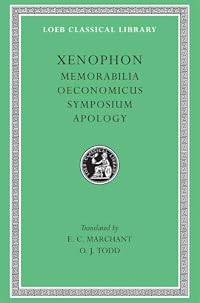
Memorabilia Socratis / Oeconomicus / Symposium / Apologia Socratis [Ancient Greek]
by Xenophon
On This Page
Description
In Memorabilia and in Oeconomicus, a dialogue about household management, we see the philosopher Socrates through the eyes of his associate, Xenophon. In the Symposium, we obtain insight on life in Athens. Xenophon's Apology is an interesting complement to Plato's account of Socrates' defense at his trial.Tags
Recommendations


Member Reviews
Memorabilia (original title in Ancient Greek: Ἀπομνημονεύματα/Apomnemoneumata) is a collection of Socratic dialogues by Xenophon, a student of Socrates. The lengthiest and most famous of Xenophon's Socratic writings, the Memorabilia is essentially an apologia (defense) of Socrates, differing from both Xenophon's Apology of Socrates to the Jury and Plato's Apology mainly in that the Apologies present Socrates as defending himself before the jury, whereas the former presents Xenophon's own defense of Socrates, offering edifying examples of Socrates' conversations and activities along with occasional commentary from Xenophon.
The Oeconomicus by Xenophon is a Socratic dialogue principally about household management and show more agriculture. It is one of the earliest works on economics in its original sense of household management, and a significant source for the social and intellectual history of classic Athens. Beyond the emphasis on household economics, the dialogue treats such topics as the qualities and relationships of men and women, rural vs. urban life, slavery, religion, and education. Joseph Epstein states that the Oeconomicus can actually be seen as a treatise on success in leading both an army and a state.
Scholars lean towards a relatively late date in Xenophon's life for the composition of the Oeconomicus, perhaps after 362 BC. Cicero translated the Oeconomicus into Latin, and the work gained popularity during the Renaissance in a number of translations.
Xenophon's Symposium (Συμπόσιον) records the discussion of Socrates and company at a dinner given by Callias for Autolycus, son of Lycon. (Some commentators identify this Lycon with the Lycon who was one of Socrates' prosecutors.[1] However, others doubt the identification; John Burnet, for example, claims it "is most improbable".[2]) 421 BC is the dramatic date of Xenophon's Symposium.
While Plato's Symposium consists of a series of lengthy speeches in praise of love, Xenophon's is dominated by witty repartee.
A contest of words emerges between Socrates and Callias, and each of the symposiasts is asked to describe the thing which he prides himself on most. All their answers are playful or paradoxical: Socrates, for one, prides himself on his knowledge of the art of pimping.
The story comes to a climax when Socrates praises the love Callias had for Autolycus.
The Apology (in full Apology of Socrates to the jury (Ancient Greek: Ἀπολογία Σωκράτους πρὸς τοὺς Δικαστάς) is a Socratic dialogue by Xenophon, a student of Socrates. It recounts Socrates' self-defense at his trial and execution, focusing prominently on his view that it was better to die before senility set in than to escape execution by humbling himself before an unjust persecution. It is the only surviving primary account of the trial other than Plato's Apology. show less
The Oeconomicus by Xenophon is a Socratic dialogue principally about household management and show more agriculture. It is one of the earliest works on economics in its original sense of household management, and a significant source for the social and intellectual history of classic Athens. Beyond the emphasis on household economics, the dialogue treats such topics as the qualities and relationships of men and women, rural vs. urban life, slavery, religion, and education. Joseph Epstein states that the Oeconomicus can actually be seen as a treatise on success in leading both an army and a state.
Scholars lean towards a relatively late date in Xenophon's life for the composition of the Oeconomicus, perhaps after 362 BC. Cicero translated the Oeconomicus into Latin, and the work gained popularity during the Renaissance in a number of translations.
Xenophon's Symposium (Συμπόσιον) records the discussion of Socrates and company at a dinner given by Callias for Autolycus, son of Lycon. (Some commentators identify this Lycon with the Lycon who was one of Socrates' prosecutors.[1] However, others doubt the identification; John Burnet, for example, claims it "is most improbable".[2]) 421 BC is the dramatic date of Xenophon's Symposium.
While Plato's Symposium consists of a series of lengthy speeches in praise of love, Xenophon's is dominated by witty repartee.
A contest of words emerges between Socrates and Callias, and each of the symposiasts is asked to describe the thing which he prides himself on most. All their answers are playful or paradoxical: Socrates, for one, prides himself on his knowledge of the art of pimping.
The story comes to a climax when Socrates praises the love Callias had for Autolycus.
The Apology (in full Apology of Socrates to the jury (Ancient Greek: Ἀπολογία Σωκράτους πρὸς τοὺς Δικαστάς) is a Socratic dialogue by Xenophon, a student of Socrates. It recounts Socrates' self-defense at his trial and execution, focusing prominently on his view that it was better to die before senility set in than to escape execution by humbling himself before an unjust persecution. It is the only surviving primary account of the trial other than Plato's Apology. show less
Ratings
Members
- Recently Added By
Author Information

718+ Works 10,522 Members
Xenophon's life and personality is better known to us, perhaps, than that of any other Greek who lived before Alexander the Great. Much of his considerable output of historical writing and essays is frankly or implicitly autobiographical. He reveals himself as one of those many Athenians and other Greeks who turned to autocratic political models, show more including admiration of Persia, after the excesses of the Athenian democracy led to disaster in the Peloponnesian War. He also reveals himself as much more than a literary man and a critic of his times. A gentleman adventurer and something of a professional soldier, he followed in turn the philosopher Socrates, the Persian prince Cyrus the Younger, and the Spartan king Agesilaus, all of whom he wrote about with an air of close personal knowledge. His works include the autobiographical Anabasis, an account of his service with a mercenary Greek army that marched from Mesopotamia to the Black Sea after the defeat and death of the younger Cyrus. It provides the most detailed single perspective on the military practices and military mentality of Xenophon's age. His Hellenica, by contrast, is an impersonal continuation to the end of the Peloponnesian War of the work of Thucydides and a patchy memoir that concentrates on Sparta's fortunes until the definitive end of its power in 362 b.c. Xenophon's other major works are the Cyropaedia and the rambling Socratic dialogues known as the Memorabilia. The Cyropaedia is a fictional idealization of the career of Cyrus the Great, the only great conqueror known to the Greeks before Alexander. Often regarded merely as a novel, it is a species of a priori historical reconstruction. A retrojection of the military science and political values of the day into a largely unknown Persia of the past, it is intended to explain Cyrus's success on rational principles. The Memorabilia and the Socratic Apology that comes down with them contain nothing of philosophical value but are thought by some scholars to offer a possible corrective to Plato's altogether too Platonic Socrates. Xenophon had a conventional and second-rate mind, but he is a valuable resource because of his mediocrity. He enables us to make contact with an ordinary intellect from a world that often seems dominated by geniuses. (Bowker Author Biography) show less
Some Editions
Series
Belongs to Publisher Series
Loeb Classical Library (168N)
Work Relationships
Common Knowledge
- Canonical title
- Memorabilia Socratis / Oeconomicus / Symposium / Apologia Socratis [Ancient Greek]
- Original language
- Greek
- Disambiguation notice
- This includes the texts of Xenophon's Memorabilia/Commentarii Socratis, Oeconomicus, Symposium/Convivium and Apologia Socratis in Ancient Greek (with or without a translation). Please do not combine... (show all)b> with volumes containing other selections or only in translation.
Classifications
- Genres
- Philosophy, Nonfiction, History
- DDC/MDS
- 180 — Philosophy & psychology Ancient, medieval & eastern philosophy Ancient, medieval, eastern philosophy
- LCC
- PA4494 .A2 — Language and Literature Greek language and literature. Latin language and literature Greek literature Individual authors Xenophon
- BISAC
Statistics
- Members
- 260
- Popularity
- 124,172
- Reviews
- 1
- Rating
- (3.75)
- Languages
- English, Greek (Ancient), Latin
- Media
- Paper, Ebook
- ISBNs
- 6
- ASINs
- 4