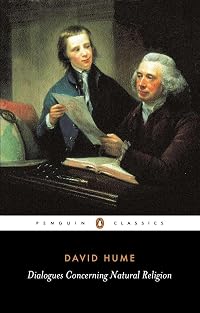
Dialogues Concerning Natural Religion
by David Hume
On This Page
Description
Dialogues Concerning Natural Religion is an important philosophical work written by the Scottish philosopher David Hume. Through dialogue three fictional characters named Demea, Philo, and Cleanthes debate the nature of God's existence. While all three agree that a god exists, they differ sharply in opinion as to God's nature. They also differ as to whether or not humankind can come to knowledge of a deity.Tags
Recommendations










Member Recommendations
Member Reviews
Presented as a dialogue between three characters, Demea, Philo, and Cleantes, the philosophe tries, a priori, to understand what is the nature of God -if we can know it at all. The fact that the three orators disagree with each others so badly serves, in fact, as a pretext to shatter the whole idea that God... exists in the first place! Here's the whole genius of David Hume: implying, without ever compromising himself (you had to be suicidal to openly admitting to be an atheist in 18th century Scotland!).
Started in 1750 and ended in 1776, the book will, in fact, be published anonymously and posthumously in 1779. Adam Smith, the economist to whom Hume had entrusted the text, had found the argument so destructive indeed that he had taken show more all the necessary precautions to reveal it publicly...
The thing is, the traditional arguments to support the existence of God are dismissed quite easily, especially one of the most powerful and (seemingly) convincing that is, the idea that the perfectly ordered nature of the world must reflect the hand of a no less perfect 'creator'. Using examples such as a house or a boat, Hume doesn't need much to demonstrate what a fallacy such an argument is! God? To the philosophe, God is but an error in reasoning; and he visibly took great pleasure into dismantling such error!
Sharp. Incisive. And, still convincing. show less
Started in 1750 and ended in 1776, the book will, in fact, be published anonymously and posthumously in 1779. Adam Smith, the economist to whom Hume had entrusted the text, had found the argument so destructive indeed that he had taken show more all the necessary precautions to reveal it publicly...
The thing is, the traditional arguments to support the existence of God are dismissed quite easily, especially one of the most powerful and (seemingly) convincing that is, the idea that the perfectly ordered nature of the world must reflect the hand of a no less perfect 'creator'. Using examples such as a house or a boat, Hume doesn't need much to demonstrate what a fallacy such an argument is! God? To the philosophe, God is but an error in reasoning; and he visibly took great pleasure into dismantling such error!
Sharp. Incisive. And, still convincing. show less
David Hume (1711-1776) was one of the most influential writers of the Enlightenment. In his An Enquiry Concerning Human Understanding (1748), he argued that there was insufficient evidence to believe in miracles or in providence. Always interested in a rational approach to God and religion, he began the Dialogues Concerning Natural Religion in about 1750, but did not complete it until the last years of his life. It was not published until 1779 (posthumously), and not under either the author’s or the publisher’s real name.
Apparently, religious issues were very touchy subjects at the time, and so his disquisition takes the form of a dialogue in which the characters express opinions (some of which are very antithetical to established show more religion) without revealing the author’s personal beliefs.
One of the characters, Philo, a skeptic, pretty articulately demolishes the argument for God’s existence based on the apparent design of the universe. He shows how the design of a complicated device like an ocean-going ship arises not from the acts of the individual workmen who build the ship, but rather from years of tinkering with previous designs. From that analogy, he argues that it is just as plausible to infer that the universe was designed by many designers (gods, if you will) as it is to infer that there was a single all powerful designer, the Christian god. In explaining that many causes could have contributed to the state of the universe, he anticipates, but does not quite articulate, the modern concept of emergence of complex order from simple phenomena.
Implicit in Philo’s argument is that our belief that there must be a cause for every effect or condition in the universe is an empirical observation, not a requirement of logic. Although he does not explicitly state so in this book, Hume its known to have believed that the existence of the universe may not require or be subject to the same kind of cause we observe in changes in the various states of the universe.
Philo also argues that the persistence of evil in the world militates against the existence of a God who is all-good and omnipotent.
The other two characters, Cleanthes and Demea, raise various arguments for belief, but are not as cogent as Philo.
Nonetheless, in the end, Philo seems to reverse course and asserts, “To be a philosophical skeptic is, in a man of letters, the first and most essential step towards being a sound, believing Christian.” Holy Cow!! I suppose one might guess that Hume was merely trying to avoid censure from religious authorities. On the other hand, at least one commentator, Richard Popkin, a well known academic philosopher, opines that Hume may have been trying to be ironic, showing the reader how silly religious belief was. Based on my other readings by and about Hume, I tend to think Popkin got it right.
This book is an excellent and important element of the Western Canon of philosophy. It is sometimes heavy going because 18th century diction tends to be ponderous to the modern reader. Nonetheless, I think it is worth the struggle for anyone interested in the development of religious skepticism.
(JAB) show less
Apparently, religious issues were very touchy subjects at the time, and so his disquisition takes the form of a dialogue in which the characters express opinions (some of which are very antithetical to established show more religion) without revealing the author’s personal beliefs.
One of the characters, Philo, a skeptic, pretty articulately demolishes the argument for God’s existence based on the apparent design of the universe. He shows how the design of a complicated device like an ocean-going ship arises not from the acts of the individual workmen who build the ship, but rather from years of tinkering with previous designs. From that analogy, he argues that it is just as plausible to infer that the universe was designed by many designers (gods, if you will) as it is to infer that there was a single all powerful designer, the Christian god. In explaining that many causes could have contributed to the state of the universe, he anticipates, but does not quite articulate, the modern concept of emergence of complex order from simple phenomena.
Implicit in Philo’s argument is that our belief that there must be a cause for every effect or condition in the universe is an empirical observation, not a requirement of logic. Although he does not explicitly state so in this book, Hume its known to have believed that the existence of the universe may not require or be subject to the same kind of cause we observe in changes in the various states of the universe.
Philo also argues that the persistence of evil in the world militates against the existence of a God who is all-good and omnipotent.
The other two characters, Cleanthes and Demea, raise various arguments for belief, but are not as cogent as Philo.
Nonetheless, in the end, Philo seems to reverse course and asserts, “To be a philosophical skeptic is, in a man of letters, the first and most essential step towards being a sound, believing Christian.” Holy Cow!! I suppose one might guess that Hume was merely trying to avoid censure from religious authorities. On the other hand, at least one commentator, Richard Popkin, a well known academic philosopher, opines that Hume may have been trying to be ironic, showing the reader how silly religious belief was. Based on my other readings by and about Hume, I tend to think Popkin got it right.
This book is an excellent and important element of the Western Canon of philosophy. It is sometimes heavy going because 18th century diction tends to be ponderous to the modern reader. Nonetheless, I think it is worth the struggle for anyone interested in the development of religious skepticism.
(JAB) show less
It was good to read this in it's (more or less original) prose, as Hume wrote it. A lot of very perceptive arguments; and the dialogue format serves well to couch Hume's views, forcing you to think for yourself a bit more, rather than just accept what you're reading as wisdom from an authority.
But... commas. The punctuation and write-style are dated and very difficult to read at times. A truly modern rendition of the text risks changing some meaning, but at the benefit of making the ideas so much more clear.
4 stars for the work, but 3 stars for the lack of clarity of reading in the (nearly) original.
But... commas. The punctuation and write-style are dated and very difficult to read at times. A truly modern rendition of the text risks changing some meaning, but at the benefit of making the ideas so much more clear.
4 stars for the work, but 3 stars for the lack of clarity of reading in the (nearly) original.
Many of the arguments will be familiar to those who follow this topic. The arguments of Cleanthes and Demea form the base of what is currently referred to as "sophisticated theology", only more erudite and less hackneyed at that time (well, maybe not, since many of them had already been in use for a good chunk of the Christian Era). Many of the arguments Hume roundly defeats here are the same or similar arguments that are frequently presented today as "arguments no atheist has ever defeated". This is only true if you have never paid any attention to the answers the atheist gives, and Hume did a very good job, even without the benefit of some of the scientific knowledge, such as evolution and the age of the earth. The limits of the show more science of the time did lead to some stumbles, but it was hardly the fault of Hume if he was not up on 21st century science in the 18th century. A bit difficult for the beginning reader in philosophy, but worth the work. show less
A friend of mine gave me a warning before Dialogues Concerning Natural Religion that David Hume puts all his mental capabilities to bring into the question the existence of a wise and loving creator, that his can be quite compelling and that I needed to be prepared to have my faith severely tested. After reading this essay, my friend could have saved his time warning me because Hume just wrote stuff down like some people just talk to hear themselves talk, in the words of William Shakespeare this was all “sound and fury, signifying nothing”. This book also contained the unpublished essays “Of the Immortality of the Soul” and “Of Suicide” that were impressive, also included was “Of Miracles” that I read in Hume’s show more Enquires and I decided not to read a second time for the author circular argument. In all honesty, I have found David Hume to be overrated and wish he had taken the hint when his first book had bombed and never written again. show less
Absolutely a seminal work on the march from theology to science as the study of the ultimate nature of reality. I do not believe that Hume went so far to deny the existence of God. He did question the relevance of a beneficial omnipotent God, which ultimately lead to the New York Times exultation 'GOD IS DEAD!'
Hume provides a review of the main sources of religious thought in its politheistic and theistic modes and engages with a criticism of superstition which for him is largely related to a strong belief in religious dogma. His analysis is largely indebted with Lucretius in many ideas related to the origin of religion and the nature of its beliefs.
Members
- Recently Added By
Lists

100 Books to Read in a Lifetime (That Are Older Than 200 Years)
415 works; 174 members

Atheism, humanism, freethought, &c. — Best nonfiction books in favour of
167 works; 14 members

Books referenced in Jim Holt's Why Does the World Exist?
119 works; 1 member

Books Read in 2024
4,623 works; 126 members
Author Information

David Hume was born in Edinburgh to a minor Scottish noble family, raised at the estate of Ninewells, and attended the University of Edinburgh for two years until he was 15. Although his family wished him to study law, he found himself unsuited to this. He studied at home, tried business briefly, and after receiving a small inheritance traveled to show more France, settling at La Fleche, where Descartes had gone to school. There he completed his first and major philosophical work, A Treatise of Human Nature (1739--40), published in three volumes. Hume claimed on the title page that he was introducing the experimental method of reasoning into moral subjects, and further that he was offering a new way of seeing the limits of human knowledge. Although his work was largely ignored, Hume gained from it a reputation as a philosophical skeptic and an opponent of traditional religion. (In later years he was called "the great infidel.") This reputation led to his being rejected for professorships at both Edinburgh and Glasgow. To earn his living he served variously as the secretary to General St. Clair, as the attendant to the mad Marquis of Annandale, and as the keeper of the Advocates Library in Edinburgh. While holding these positions, he wrote and published a new version of his philosophy, the two Enquiries, and many essays on social, political, moral, and literary subjects. He also began his six-volume History of England from the Roman Invasion to the Glorious Revolution (1754--62), the work that made him most famous in his lifetime. Hume retired from public life and settled in Edinburgh, where he was the leading figure in Scottish letters and a good friend to many of the leading intellectuals of the time, including Adam Smith and Benjamin Franklin. During this period, he completed the Dialogues Concerning Natural Religion, which he had been working on for more than 25 years. Hume first worked on the Dialogues in the middle of his career, but put them aside as too provocative. In his last years he finished them and they were published posthumously in 1779. They are probably his best literary effort and have been the basis for continuous discussion and debate among philosophers of religion. Toward the end of Hume's life, his philosophical work began to be taken seriously, and the skeptical problems he had raised were tackled by philosophers in Scotland, France, and finally Germany, where Kant claimed that Hume had awakened him from his dogmatic slumbers. Hume was one of the most influential philosophers of modern times, both as a positive force on skeptical and empirical thinkers and as a philosopher to be refuted by others. Interpreters are still arguing about whether he should be seen as a complete skeptic, a partial skeptic, a precursor of logical positivism, or even a secret believer. (Bowker Author Biography) show less
Some Editions
Awards and Honors
Series
Belongs to Publisher Series
Work Relationships
Common Knowledge
- Original title
- Dialogues Concerning Natural Religion
- Original publication date
- 1779
- First words
- It has been remarked, my HERMIPPUS, that though the ancient philosophers conveyed most of their instruction in the form of dialogue, this method of composition has been little practised in later ages, and has seldom succeeded... (show all) in the hands of those who have attempted it.
- Last words
- (Click to show. Warning: May contain spoilers.)CLEANTHES and PHILO pursued not this conversation much further: and as nothing ever made greater impression on me, than all the reasonings of that day, so I confess, that, upon a serious review of the whole, I cannot but think, that PHILO's principles are more probable than DEMEA's; but that those of CLEANTHES approach still nearer to the truth.
- Blurbers
- Ayer, A. J.
- Original language
- English
Classifications
Statistics
- Members
- 2,316
- Popularity
- 8,552
- Reviews
- 13
- Rating
- (3.97)
- Languages
- 12 — Danish, Dutch, English, French, German, Greek, Hungarian, Italian, Norwegian (Bokmål), Portuguese, Spanish, Swedish
- Media
- Paper, Audiobook, Ebook
- ISBNs
- 128
- ASINs
- 48