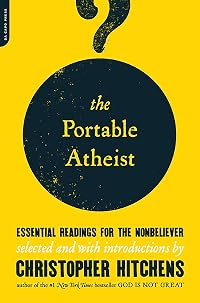
The Portable Atheist: Essential Readings for the Nonbeliever
by Christopher Hitchens
On This Page
Description
Despite the mistaken use of the label "New Atheists," there is a lot of continuity over the past couple of centuries among atheist authors in their critiques of religion, theism, and superstition. Not every argument is identical, and even when the same basic argument is being offered there can be variety in how it is presented. This evolution of atheist critiques of supernatural religion is one of the virtues of Christopher Hitchens' book The Portable Atheist: Essential Readings for the show more Nonbeliever. Well known for his own atheist book God Is Not Great, Hitchens treads some very heavily-traveled ground here in editing a compendium of atheist writings. Do we really need yet another book of essays, isolated chapters, and other selections from atheists, agnostics, freethinkers and skeptics of the past? What could we get out of this latest offering that we didn't get from the past half dozen that we bought - or the others that we simply skipped? Those are good questions, and reasons why I was skeptical of Hitchens' book, but in the end I think he succeeds in making his book more than "just one more" collection of atheist essays. show lessTags
Recommendations
Member Recommendations
Member Reviews
After a vitriolic introduction, as always with Hitchens, here we go onto lands where God is either seriously being questioned, or, downright unwelcome!
From science to philosophy, and from literature to the autobiographical testimonies of key figures, Hitchens walks us through time and the continents to deliver this anthology of texts, atheistic for some, agnostic for others, but all labelled 'essential readings for the nonbeliever'.
There is, of course, Sam Harris, Richard Dawkins, and Daniel Dennett, them lot who were nicknamed, including Hitchens himself, 'The Four Horsemen'. There is, above all, a wide selection of essays challenging prejudices, interrogating the existence of God, and critically combing faith as much as the show more institutions and behaviours relying on and/or flowing from it.
Why not believing in God? Why faith should not be sheltered from criticism? Are religions really the roots of our morale? What about miracles? Our outlook upon death? Mystical experiences? The issue with Islam?
Guests in here are as diverse and they can be contradictory, rendering this read even more open and thoughtful. Lucrecius, Hobbes, Spinoza, John Stuart Mill, Karl Marx, Anatole France, George Orwell, Ian McEwan, Freud, Einstein, Darwin, Penn Jillette, A.C. Grayling etc... There's no harm in being rational! Personally, I was particularly fascinated by the wonderful writings of Carl Sagan, the moving letter of Salman Rushdie, Bertrand Russell's contribution, the debunking job of Elizabeth Anderson, the harrowing experience of Ayaan Hirsi Ali, and the views of Ibn Warraq upon Islam.
It's a massive opus for sure, and, sadly, limited mostly to the English-speaking world when it comes to contemporary authors. But, when it comes to expose atheism/ agnosticism in all its relevance and diversity of thoughts, well, it's a great read! show less
From science to philosophy, and from literature to the autobiographical testimonies of key figures, Hitchens walks us through time and the continents to deliver this anthology of texts, atheistic for some, agnostic for others, but all labelled 'essential readings for the nonbeliever'.
There is, of course, Sam Harris, Richard Dawkins, and Daniel Dennett, them lot who were nicknamed, including Hitchens himself, 'The Four Horsemen'. There is, above all, a wide selection of essays challenging prejudices, interrogating the existence of God, and critically combing faith as much as the show more institutions and behaviours relying on and/or flowing from it.
Why not believing in God? Why faith should not be sheltered from criticism? Are religions really the roots of our morale? What about miracles? Our outlook upon death? Mystical experiences? The issue with Islam?
Guests in here are as diverse and they can be contradictory, rendering this read even more open and thoughtful. Lucrecius, Hobbes, Spinoza, John Stuart Mill, Karl Marx, Anatole France, George Orwell, Ian McEwan, Freud, Einstein, Darwin, Penn Jillette, A.C. Grayling etc... There's no harm in being rational! Personally, I was particularly fascinated by the wonderful writings of Carl Sagan, the moving letter of Salman Rushdie, Bertrand Russell's contribution, the debunking job of Elizabeth Anderson, the harrowing experience of Ayaan Hirsi Ali, and the views of Ibn Warraq upon Islam.
It's a massive opus for sure, and, sadly, limited mostly to the English-speaking world when it comes to contemporary authors. But, when it comes to expose atheism/ agnosticism in all its relevance and diversity of thoughts, well, it's a great read! show less
A wide ranging collection of essays, poems and selections from larger works arranged chronologically, starting with a selection from Lucretius' De Rerum Natura and ending with part of Ayaan Hirsi Ali's How and why I became an Infidel. Even the seasoned atheist is likely to find something "new" here: there is an excellent introduction by Chris Hitchens, a reminder that there is nothing new under the sun with the writings of Thomas Hobbes, Baruch Spinoza, David Hume and John Stuart Mill, a discussion of the TV evangelist equivalents of her time by Mary Ann Evans, the thoughts of Charles Darwin from his autobiography, the unusually vitriolic comments of Samuel Clemens, an entertaining list of Einstein's attempts to deny his belief in the show more supernatural (many wanted the "smartest man" to be religious), and more from Emma Goldman, Thomas Hardy, Joseph Conrad, Ian McEwan and Philip Larkin. I found Martin Gardner's history of the idea of the wandering Jew, Sam Harris' discussion of the persecution of witches and antisemitism and Ibn Warraq's discussion of the Koran and Sharia law to be unusually interesting. All the selections can't be equally strong, but my only negative comment would be that I had the opportunity to be reminded how extraordinarily opaque the writing of Karl Marx is. show less
An outstanding collection of essays and extracts from godless and freethinking writers throughout the ages. Amongst the highlights are the pamphlet for which Shelly was thrown out of university and contributions from Bertrand Russell, Mark Twain, Thomas Jefferson and Tom Paine. Some, such as Thomas Hardy and HL Mencken consign gods to the grave of history, while others argue strong cases for a morality that does not rely on the promise of reward or the threat of punishment from a creator. While some of the writings are distinctly anti-theistic, others argue for the wisdom of agnosticism. Nearly all are thoughtful, wise and thoroughly worth investigating, irrespective of the reader's own position on the spectrum of belief.
In "God is Not Great", Hitchens gives ready ammunition for Atheists doing battle with the delusional. In The Portable Atheist. he provides documentation for these little sound bites, culled from some of the great minds in human history. Make no mistake: the odds of getting a your average religious drone to read, much less comprehend the fairly dense material in this book is near zero, but it provides citable reference when necessary.
Hitchens calls on philosophers from throughout our history, political leaders, and even humorists such as Mark Twain. Omar Khayyam and Thomas Aquinas are cited, as are scientists ranging from Einstein to Copernicus. Many of the passages here are just plain difficult to read, encumbered with run-on sentences show more and flowery vocabulary. But as far as a selection of "Essential Readings", Hitchens does a fine job assembling texts that validate what we already know. show less
Hitchens calls on philosophers from throughout our history, political leaders, and even humorists such as Mark Twain. Omar Khayyam and Thomas Aquinas are cited, as are scientists ranging from Einstein to Copernicus. Many of the passages here are just plain difficult to read, encumbered with run-on sentences show more and flowery vocabulary. But as far as a selection of "Essential Readings", Hitchens does a fine job assembling texts that validate what we already know. show less
This is a marvelous book and points out a number of problems inherent in all religions. Through the use of excerpts taken from essays and various works, Christopher Hitchens makes a case against God. The problems I have with religion are pretty long lasting; ever since I was around the age of 10 or 11, I have been in doubt of God. I can only say that I am glad I live in this day and age, where religious people don't torture you for your beliefs or lack thereof anymore.
Anyway, forty-seven authors combined their powers to produce this piece. Many of the contributors are dead, like Lucretius, Benedict de Spinoza, and Albert Einstein, but their words are quite timeless. Some of the authors might still be alive, but it is hard to say, since show more it was printed in 2007.
Some of the authors talk about the problem of a just and loving God creating hell, others point out the similarity of Jesus Christ to other characters of mythology like Attis, and yet others talk about how silly the idea is in terms of modern science. When you allow a magical sky-man to explain something, you explain nothing. All in all, I have heard all of these arguments before, so none of it was really new to me. Even the story of Jesus on the cross, sacrificing himself to himself, comes from Odin hanging himself at the World Tree to gain knowledge.
Anyway, I would read it again, or I would go to the contributing authors works and stuff. It all seems quite fascinating. show less
Anyway, forty-seven authors combined their powers to produce this piece. Many of the contributors are dead, like Lucretius, Benedict de Spinoza, and Albert Einstein, but their words are quite timeless. Some of the authors might still be alive, but it is hard to say, since show more it was printed in 2007.
Some of the authors talk about the problem of a just and loving God creating hell, others point out the similarity of Jesus Christ to other characters of mythology like Attis, and yet others talk about how silly the idea is in terms of modern science. When you allow a magical sky-man to explain something, you explain nothing. All in all, I have heard all of these arguments before, so none of it was really new to me. Even the story of Jesus on the cross, sacrificing himself to himself, comes from Odin hanging himself at the World Tree to gain knowledge.
Anyway, I would read it again, or I would go to the contributing authors works and stuff. It all seems quite fascinating. show less
***.5
A collection of excerpts and essays by a variety of thinkers from ancient Greece to the present, espousing the authors' atheistic and agnostic worldviews. While it's certainly interesting to see that there is plenty of historical precedent for denying the necessity of belief in God, it's also somewhat jarring to plonk down in the middle of a dense work by the likes of Hobbes or Hume.
Hitchens provides a brief introduction to each writer, but they are much too short to provide sufficient context or tie the works together into a meaningful larger statement.
Despite being labeled "unabridged", the aubiobook version I listened to only contains a subset of the works listed in the printed version, so I intend to read those as well for show more the sake of completeness. Most of the omitted items are more recent ones, so I expect them to be both more accessible and less surprising. I'll update my review if they change any of the above. show less
A collection of excerpts and essays by a variety of thinkers from ancient Greece to the present, espousing the authors' atheistic and agnostic worldviews. While it's certainly interesting to see that there is plenty of historical precedent for denying the necessity of belief in God, it's also somewhat jarring to plonk down in the middle of a dense work by the likes of Hobbes or Hume.
Hitchens provides a brief introduction to each writer, but they are much too short to provide sufficient context or tie the works together into a meaningful larger statement.
Despite being labeled "unabridged", the aubiobook version I listened to only contains a subset of the works listed in the printed version, so I intend to read those as well for show more the sake of completeness. Most of the omitted items are more recent ones, so I expect them to be both more accessible and less surprising. I'll update my review if they change any of the above. show less
A large collection and a very eclectic mix of essays. By turns slow steady, logical and suddenly emotionally charged and motivating.
A tour through histories writings on a natural view of the world and why we are here.
I particularly enjoyed the older writings which showed just how slow a burn freedom of thought has been. David Hume is insightful, Mark Twain is funny, Thomas Hardy and HL Mencken bid farewell to God in two very different ways. Bertrand Russell is hilarious.
If you are an atheist then this book will give you some reasons for or at least perspectives on un-belief that you had not thought of. If you are a believer and want to remain so then pick up this book at the peril of your immortal soul.
Stimulating, challenging in show more places and enjoyable. show less
A tour through histories writings on a natural view of the world and why we are here.
I particularly enjoyed the older writings which showed just how slow a burn freedom of thought has been. David Hume is insightful, Mark Twain is funny, Thomas Hardy and HL Mencken bid farewell to God in two very different ways. Bertrand Russell is hilarious.
If you are an atheist then this book will give you some reasons for or at least perspectives on un-belief that you had not thought of. If you are a believer and want to remain so then pick up this book at the peril of your immortal soul.
Stimulating, challenging in show more places and enjoyable. show less
Members
- Recently Added By
Lists

Books I want to read
25 works; 3 members

Atheism, humanism, freethought, &c. — Best nonfiction books in favour of
167 works; 14 members

Books Read in 2016
4,666 works; 197 members
Author Information

88+ Works 29,841 Members
Christopher Hitchens was born in Portsmouth, England on April 13, 1949. He was a contributing editor to Vanity Fair and wrote for numerous other publications throughout his lifetime. He was the author of numerous books including No One Left to Lie To, For the Sake of Argument, Prepared for the Worst, God Is Not Great, Hitch-22: A Memoir, and show more Arguably. He died due to complication from esophageal cancer on December 15, 2011 at the age of 62. (Bowker Author Biography) show less
Common Knowledge
- Original title
- The Portable Atheist: Essential Readings for the Nonbeliever
- Original publication date
- 2007
- Dedication
- Dedicated to the memory of Primo Levi (1919-1987) who had the moral fortitude to refuse false consolation even while enduring the "selection" process of Auschwitz.
- First words
- At the close of his imperishable novel La Peste ("The Plague"), Albert Camus gives us a picture of the thoughts of the good Dr. Rieux, as the town of Oran celebrates its recovery from - its survival of - a terrible vis... (show all)itation of disease. (Introduction)
- Quotations
- It is sometimes argued that disbelief in a fearful and tempting heavenly despotism makes life into something arid and tedious and cynical: a mere existence without any consolation or any awareness of the numinous or the trans... (show all)cendent. What nonsense this is. . . Believing then - as this religious objection implicitly concedes - that human life is actually worth living, one can combat one's natural pessimism by stoicism and the refusal of illusion, while embellishing the scene with any one of the following. There are the beauties of science and the extraordinary marvels of nature. There is the consolation and irony of philosophy. There are the infinite splendors of literature and poetry, not excluding the liturgical and devotional aspects of these, such as those found in John Donne or George Herbert. There is the grand resource of art and music and architecture, again not excluding those elements that aspire to the sublime. In all of these pursuits, any one of them enough to absorb a lifetime, there may be found a sense of awe and magnificence that does not depend at all on any invocation of the supernatural.
Classifications
Statistics
- Members
- 2,791
- Popularity
- 6,523
- Reviews
- 32
- Rating
- (3.85)
- Languages
- English, Spanish
- Media
- Paper, Audiobook, Ebook
- ISBNs
- 8
- ASINs
- 7