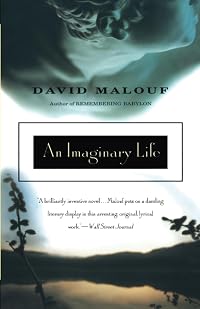
An Imaginary Life
by David Malouf
On This Page
Description
"In the first century A.D., Publius Ovidius Naso, the most urbane and irreverent poet of imperial Rome, was banished to a remote village on the edge of the Black Sea. From these sparse facts, one of our most distinguished novelists has fashioned an audacious and supremely moving work of fiction."--BOOK JACKET. "Marooned on the edge of the known world, exiled from his native tongue, Ovid depends on the kindness of barbarians who impale their dead and converse with the spirit world. But then show more he becomes the guardian of a still more savage creature, a feral child who has grown up among deer. What ensues is a luminous encounter between civilization and nature, as enacted by a poet who once cataloged the treacheries of love and a boy who slowly learns how to give it."--BOOK JACKET. show lessTags
Recommendations
















Member Reviews
I don't know what I was expecting, but this is quite unusual. It starts out with the poet Ovid, having been exiled from Rome to the edge of the known world finding himself an unwilling guest of a people who don't speak the same language and who exist in a very different environment to that which he is used to. In chapter 1 he is full of self doubt and there is a cry from the heart of the poet asking if any of his work will survive him, if any of his lines will exist, even if in the quotations of others. We know that this is the case, hos work wasn't all destroyed and he has survived many centuries.
Thereafter, he perks up a bit and we start to know more about the people he is living with, he starts to learn their language and to show more understand them, while remaining an outsider. As he begins to participate in the life of the village, so we learn more about them, but that also sparks memories in him of his earlier life, his childhood as the second son, his brother and his early death, the relationship with his father. We never quite find out what prompted his exile.
And, somewhere along the way, he sees a wild boy, a human child living with the animals on the plain. He wonders how the child survives and determines to bring him back to the world of men. However this too brings a memory, when he was a child himself he seems to have had an invisible companion, and he can;t decide if the child is this invisible companion brought to life. It takes several seasons before the village combines to bring the boy in and Ovid takes over his care. The village remain sceptical and the events of the penultimate chapter, again, bring to the fore the doubt as to what this child actually is. Is he human, is he a devil, or might he be something else entirely?
There's something supernatural about the close, when the narration has changed tone entirely from the first, no longer worrying about his writing or reputation, Ovid ventures out on one more journey and finds his place in the universe, while the spirit and physical worlds remain merged in an inseperable whole.
I really had no idea what to expect of this from the brief synopsis, and I'm not sure how you go about describing it. There's something lyrical about the prose, something indefineable about the mingling of the physical and the imagined and something entirely enchanting about the care expressed by two such alien beings. I listened to this and really enjoyed it. show less
Thereafter, he perks up a bit and we start to know more about the people he is living with, he starts to learn their language and to show more understand them, while remaining an outsider. As he begins to participate in the life of the village, so we learn more about them, but that also sparks memories in him of his earlier life, his childhood as the second son, his brother and his early death, the relationship with his father. We never quite find out what prompted his exile.
And, somewhere along the way, he sees a wild boy, a human child living with the animals on the plain. He wonders how the child survives and determines to bring him back to the world of men. However this too brings a memory, when he was a child himself he seems to have had an invisible companion, and he can;t decide if the child is this invisible companion brought to life. It takes several seasons before the village combines to bring the boy in and Ovid takes over his care. The village remain sceptical and the events of the penultimate chapter, again, bring to the fore the doubt as to what this child actually is. Is he human, is he a devil, or might he be something else entirely?
There's something supernatural about the close, when the narration has changed tone entirely from the first, no longer worrying about his writing or reputation, Ovid ventures out on one more journey and finds his place in the universe, while the spirit and physical worlds remain merged in an inseperable whole.
I really had no idea what to expect of this from the brief synopsis, and I'm not sure how you go about describing it. There's something lyrical about the prose, something indefineable about the mingling of the physical and the imagined and something entirely enchanting about the care expressed by two such alien beings. I listened to this and really enjoyed it. show less
A double allegory
"An Imaginary Life" (1978) is nominally the story of Ovid's exile and death. Ovid wrote two sets of poems from his exile in Tomis (in Pontus, a region of present-day Turkey on the Black Sea, and in Constanta, a Romanian city, also on the Black Sea), called Tristia and Epistulae ex Ponto. Malouf used Tristia for his picture of the nearly barbarian outpost Pontus, but other than that he invented his "imaginary life." It strikes me as a double allegory:
1. It's an allegory of poetry, because Ovid is described as redicovering poetry in Pontus. First he finds it in the people there and their shaman, whose language is not as inflected as Latin (the narrator says this several times), but is more intimately attuned to nature. show more Then he finds it again in the "Child," a feral child the narrator takes in. The Child can mimic animal sounds, and the narrator realizes that is en even deeper form of poetry, one that depends on empathy. (This is contrasted with the narrator's satiric and hypereloquent poetry.)
2. It's also an allegory of Australia. There are three worlds in the book: Ovid's scintillating life in Rome; his simple, superstitious life in Tomis; and "the last reality," his life in Asia, beyond the Ister (i.e., north of the Danube), with the feral child. I imagine I'm hardly the first one to say this, but Rome is like England, a distant dream of soft overfed, overindulgent people devoid of belief but rich in "dazzling lierary display"; Tomis is like Australia, a wholly new world, surrounded by nature, with only the faintest echoes of culture; and the child (and the Asian grasslands) are like Aborigines, intimately at home in nature, naturally happy, fundamentally Other. The narrator has to cross painfully from Rome to Tomis, but he accepts it and learns its language. Later he crosses joyfully from Tomis to Asia.(If this seems unlikely, consider Malouf's "Remembering Babylon," about a White boy taken in by Aborigines. The England/Australia/Aboriginal triad recurs there.)
The book is naturally about other things as well. In a brief note Malouf says he was interesed in how Ovid might have escaped "skepticisim" and found belief. And it's also a Bildungsroman, with a mystical circle of life built into it. It's a lovely, succinctly imagined, sincere, romantic book. show less
"An Imaginary Life" (1978) is nominally the story of Ovid's exile and death. Ovid wrote two sets of poems from his exile in Tomis (in Pontus, a region of present-day Turkey on the Black Sea, and in Constanta, a Romanian city, also on the Black Sea), called Tristia and Epistulae ex Ponto. Malouf used Tristia for his picture of the nearly barbarian outpost Pontus, but other than that he invented his "imaginary life." It strikes me as a double allegory:
1. It's an allegory of poetry, because Ovid is described as redicovering poetry in Pontus. First he finds it in the people there and their shaman, whose language is not as inflected as Latin (the narrator says this several times), but is more intimately attuned to nature. show more Then he finds it again in the "Child," a feral child the narrator takes in. The Child can mimic animal sounds, and the narrator realizes that is en even deeper form of poetry, one that depends on empathy. (This is contrasted with the narrator's satiric and hypereloquent poetry.)
2. It's also an allegory of Australia. There are three worlds in the book: Ovid's scintillating life in Rome; his simple, superstitious life in Tomis; and "the last reality," his life in Asia, beyond the Ister (i.e., north of the Danube), with the feral child. I imagine I'm hardly the first one to say this, but Rome is like England, a distant dream of soft overfed, overindulgent people devoid of belief but rich in "dazzling lierary display"; Tomis is like Australia, a wholly new world, surrounded by nature, with only the faintest echoes of culture; and the child (and the Asian grasslands) are like Aborigines, intimately at home in nature, naturally happy, fundamentally Other. The narrator has to cross painfully from Rome to Tomis, but he accepts it and learns its language. Later he crosses joyfully from Tomis to Asia.(If this seems unlikely, consider Malouf's "Remembering Babylon," about a White boy taken in by Aborigines. The England/Australia/Aboriginal triad recurs there.)
The book is naturally about other things as well. In a brief note Malouf says he was interesed in how Ovid might have escaped "skepticisim" and found belief. And it's also a Bildungsroman, with a mystical circle of life built into it. It's a lovely, succinctly imagined, sincere, romantic book. show less
This is a beautiful novel about Ovid's years of exile in Tomis on the Black Sea in what is now Romania. Someone who has read Ovid's disparate and pleading poems from this period might expect this book to be equally bleak. Instead, Malouf depicts the poet as someone who reinvents himself through the strange customs of this place at the extreme end of the Roman world.
I understand that some reviewers see this as an allegory of Australian colonization, but for me, it is more universal: a wonderful thing in itself and a splendid meditation on language and exile.
I understand that some reviewers see this as an allegory of Australian colonization, but for me, it is more universal: a wonderful thing in itself and a splendid meditation on language and exile.
This novel is a fictionalized story of Ovid in exile from Rome. He is in an impoverished village at the edge of nowhere when he encounters The Child, who appears to have been raised by wolves. Ovid befriends/raises this Child, but the superstitious villagers are mistrustful. Eventually Ovid finds himself relying on The Child for his very survival. I’m sure there’s many layers of metaphor to pick apart and analyze in this story, but as a read, it’s only ok. I did like the simple, pared down writing style.
Enjoyed it for what it was, but disappointed that it was not so much a straight story about Ovid-in-exile [although that was there] as much as a meditation on the balance between civilization and nature, with psychological and philosophical underpinnings. Writing was luminous, with gorgeous descriptions. Worthwhile to read once but I don't feel it warrants rereading.
The Roman poet Ovid seems to be enjoying an unusual amount of attention by writers in recent years; this is the second novel I've read which takes as its subject Ovid's last years in exile and his book the Metamorphoses. While Ransmayr's novel, "The Last World" engages more explicitly with the literary contexts, this slim book is a beautifully poetic meditation on life and death, nature and civilization.
The author writes in his afterword that "what I wanted to write was neither historical novel nor biography but a fiction with its roots in possible historical event." "An Imaginary Life" is best read in this light. As a historical novel it is unsatisfactory, for the style has a particularly contemporary flavor, and the setting is scant show more on historical detail. Nor are the character and biography of Ovid especially crucial to the development of the story.
Instead, the "Metamorphoses" and Ovid's exile serve as the inspiration for the themes Malouf skillfully interweaves in the book. The story is narrated in the present tense, which admittedly takes some getting used to, and the passage of time seems to ebb and flow. At the heart of the story is a disillusioned poet's search for language and meaning, and the wild boy whom he takes by force from the forest and tries to teach to speak and act like a human being mirrors this search.
The spiritual message is not new, nor are the meditations on the paradoxes of civilization and the longing to return to unspoiled nature. All the same, it is elegantly told and thought-provoking. show less
The author writes in his afterword that "what I wanted to write was neither historical novel nor biography but a fiction with its roots in possible historical event." "An Imaginary Life" is best read in this light. As a historical novel it is unsatisfactory, for the style has a particularly contemporary flavor, and the setting is scant show more on historical detail. Nor are the character and biography of Ovid especially crucial to the development of the story.
Instead, the "Metamorphoses" and Ovid's exile serve as the inspiration for the themes Malouf skillfully interweaves in the book. The story is narrated in the present tense, which admittedly takes some getting used to, and the passage of time seems to ebb and flow. At the heart of the story is a disillusioned poet's search for language and meaning, and the wild boy whom he takes by force from the forest and tries to teach to speak and act like a human being mirrors this search.
The spiritual message is not new, nor are the meditations on the paradoxes of civilization and the longing to return to unspoiled nature. All the same, it is elegantly told and thought-provoking. show less
The Roman poet Ovid has been exiled to a harsh,emplty, freezing land with a people he cannot communicate with. Ovid lives with them but is separated from them by language, culture, education and religion. He captures a 'wild child' who reminds him of another 'wild child' from his childhood that Ovid is not quite sure was real or simply a dream. Ovid cares for the 'wild child' teaching him human language and eventually flees with the boy on a journey which sees their roles reversed. The teacher becomes the pupil as the 'wild child' teaches him to survive and be part of harsh landscape.
I expected historical fiction based on Ovid's life but instead this is more a philosophical look at human communication and language, religion and gods, show more and dreams versus reality. show less
I expected historical fiction based on Ovid's life but instead this is more a philosophical look at human communication and language, religion and gods, show more and dreams versus reality. show less
Members
- Recently Added By
Lists

A Novel Cure
742 works; 23 members

501 Must-Read Books
529 works; 72 members

Harold Bloom - The Western Canon: D. The Chaotic Age
833 works; 24 members

Australian Classics: Fifty Great Writers and Their Celebrated Works
43 works; 1 member

Australia's Greatest Books, as chosen by Geoffrey Dutton (1985)
97 works; 6 members
Author Information

69+ Works 5,962 Members
David Malouf was born in Brisbane, Australia on March 20, 1934. He received a B.A. with honours from the University of Queensland in 1954. He lived and worked in Europe from 1959 to 1968, then taught English at the University of Sydney until 1977. After 1977 he became a full-time poet and novelist. His collections of poetry include Bicycle and show more Other Poems, Neighbours in a Thicket, Wild Lemons, First Things Last, Typewriter Music, and An Open Book. He received the Kenneth Slessor Prize for Poetry for Earth Hour. His novels include Johnno, Ransom, An Imaginary Life, Child's Play, Fly Away Peter, Harland's Half Acre, Dream Stuff, Every Move You Make, and The Conversations at Curlow Creek. He received the Commonwealth Writers' Prize and the Prix Femina Etranger for The Great World and the IMPAC Dublin Literary Award for Remembering Babylon. His collections of short stories include Antipodes, Untold Tales, Dream Stuff, and Every Move You Make. His Collected Stories won the 2008 Australia-Asia Literary Award. His essays collections include A First Place and The Writing Life. He also wrote the libretto for Richard Meale's opera Voss. He won the 2016 Australia Council Award for Lifetime Achievement in Literature. (Bowker Author Biography) show less
Awards and Honors
Awards
Series
Belongs to Publisher Series
Common Knowledge
- Canonical title*
- Una vita immaginaria
- Original title
- An Imaginary Life
- Original publication date
- 1978
- People/Characters
- Ovid
- Important places
- Ancient Rome; Black Sea
- Dedication
- To Christopher
- First words
- When I first saw the child I cannot say.
- Last words
- (Click to show. Warning: May contain spoilers.)I am there.
- Blurbers
- Strand, Mark; Pollitt, Katha; Fuller, Edmund; Frizell, Helen
*Some information comes from Common Knowledge in other languages. Click "Edit" for more information.
Classifications
Statistics
- Members
- 822
- Popularity
- 33,634
- Reviews
- 20
- Rating
- (3.95)
- Languages
- English, Italian, Spanish, Swedish
- Media
- Paper, Audiobook, Ebook
- ISBNs
- 22
- ASINs
- 3