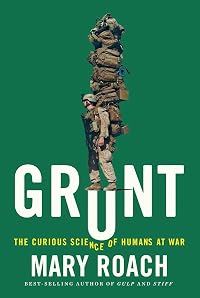
Grunt: The Curious Science of Humans at War
by Mary Roach
On This Page
Description
A New York Times / National Bestseller"America's funniest science writer" (Washington Post) Mary Roach explores the science of keeping human beings intact, awake, sane, uninfected, and uninfested in the bizarre and extreme circumstances of war.
Grunt tackles the science behind some of a soldier's most challenging adversaries—panic, exhaustion, heat, noise—and introduces us to the scientists who seek to conquer them. Mary Roach dodges hostile fire with the U.S. Marine Corps Paintball show more Team as part of a study on hearing loss and survivability in combat. She visits the fashion design studio of U.S. Army Natick Labs and learns why a zipper is a problem for a sniper. She visits a repurposed movie studio where amputee actors help prepare Marine Corps medics for the shock and gore of combat wounds. At Camp Lemmonier, Djibouti, in east Africa, we learn how diarrhea can be a threat to national security. Roach samples caffeinated meat, sniffs an archival sample of a World War II stink bomb, and stays up all night with the crew tending the missiles on the nuclear submarine USS Tennessee. She answers questions not found in any other book on the military: Why is DARPA interested in ducks? How is a wedding gown like a bomb suit? Why are shrimp more dangerous to sailors than sharks? Take a tour of duty with Roach, and you'll never see our nation's defenders in the same way again.
. show less
Tags
Recommendations




































Member Recommendations
Member Reviews
This may be my favourite Mary Roach book. In this one, she tackles a wide variety of topics covered by military science: fatigue, hearing loss, reconstructive surgery, heatstroke, and even diarrhea. Many of the topics discussed are ones you might not think of in the context of the military, but when Roach explains the work being done and how soldiers' lives are affected when these factors are not taken into consideration, the rationale is obvious. For example, if you're a sniper, you don't want to be caught short on a mission after eating bad food. And the hearing protection measures currently in use, while well intended, don't actually work well for the combat scenarios in which they're being used, as the training scenario performed show more with a group of audiologists in attendance demonstrates. Roach tests some of the gadgets on offer (such as the new auditory protection systems), participates in a combat medic training simulation, endures the indignities of a rectal probe for heat-related research, and visits a submarine to observe just how non-conducive to sleep such an environment is.
While there are plenty of amusing asides (including Roach's perennial fascination with apropos names for scientists in a given field), the scientists' work and the soldiers' situations are always treated with respect. This is particularly important in the chapters on reconstructive surgery, when Roach talks about such surgery performed on the genitals. This type of surgery is an area that does not receive much attention or is considered more of a "frill" than a prosthetic limb might be. However, for the soldiers who sustain this sort of injury and get a chance to undergo the surgery, their quality of life, as measured in self-esteem, is improved, and that is an important part of the rehabilitation process.
The chapters on reconstructive surgery also made me immeasurably grateful for the calcaneal fat pad, which protects the shin bone from abrading the skin on the underside of the heel. This type of fat can withstand a tremendous amount of weight and pressure, and if you're injured in what's called an "underbody blast" (e.g. a ship being torpedoed and the deck beneath you being blown suddenly into the air), the fat pad is at risk of being damaged to the extent of needing to be removed. And without that padding, walking is hell. So give your calcaneal fat pads (and the rest of your long-suffering feet) some TLC sometime. They will thank you!
I would highly recommend this book to those who enjoyed Roach's book Packing for Mars, because it also deals with the science relating to a particular occupation, and anyone who likes to read about those whose work supports the front-line troops. show less
While there are plenty of amusing asides (including Roach's perennial fascination with apropos names for scientists in a given field), the scientists' work and the soldiers' situations are always treated with respect. This is particularly important in the chapters on reconstructive surgery, when Roach talks about such surgery performed on the genitals. This type of surgery is an area that does not receive much attention or is considered more of a "frill" than a prosthetic limb might be. However, for the soldiers who sustain this sort of injury and get a chance to undergo the surgery, their quality of life, as measured in self-esteem, is improved, and that is an important part of the rehabilitation process.
The chapters on reconstructive surgery also made me immeasurably grateful for the calcaneal fat pad, which protects the shin bone from abrading the skin on the underside of the heel. This type of fat can withstand a tremendous amount of weight and pressure, and if you're injured in what's called an "underbody blast" (e.g. a ship being torpedoed and the deck beneath you being blown suddenly into the air), the fat pad is at risk of being damaged to the extent of needing to be removed. And without that padding, walking is hell. So give your calcaneal fat pads (and the rest of your long-suffering feet) some TLC sometime. They will thank you!
I would highly recommend this book to those who enjoyed Roach's book Packing for Mars, because it also deals with the science relating to a particular occupation, and anyone who likes to read about those whose work supports the front-line troops. show less
So proud of myself for finally finishing a book! It's been a few months.
This is a typical Mary Roach affair, irreverent writing and self-deprecating humor in tact. I liked this one much better than Gulp and maybe a little less then Spook and Stiff. I love that Roach has basically written a book thanking those in the thankless jobs, and that she was not (and is never) afraid to just come right out with something that most people would avoid.
I feel like there is a poignancy to this book that many of her others don't have. The scientists she writes of are desperately trying to keep the people who serve in the military alive. This becomes most evident in the final chapter, where even in death military personnel are still protecting their show more living brethren. So, while there is humor, there is also meaning. Overall, a great book even if you think you aren't interested in military nonfiction. show less
This is a typical Mary Roach affair, irreverent writing and self-deprecating humor in tact. I liked this one much better than Gulp and maybe a little less then Spook and Stiff. I love that Roach has basically written a book thanking those in the thankless jobs, and that she was not (and is never) afraid to just come right out with something that most people would avoid.
I feel like there is a poignancy to this book that many of her others don't have. The scientists she writes of are desperately trying to keep the people who serve in the military alive. This becomes most evident in the final chapter, where even in death military personnel are still protecting their show more living brethren. So, while there is humor, there is also meaning. Overall, a great book even if you think you aren't interested in military nonfiction. show less
Of the two books that I purchased upon release, this was not the one I expected to be the favorite. Mary Roach is a master with difficult subjects. I was a huge fan of "Stiff," but I suspected it was the subject and not the author. I was wrong. Ms. Roach explores everything from penial reconstruction or transplants to diarrhea and dehydration, with class and humor. I learned that every soldier killed in war gets autopsied to determine best medical practices and those are reviewed monthly. I figured that I would have some topics for discussion with my former sniper boyfriend, but I did not expect to be as interested as I was. I am going to be reading the Mary Roach novels that I skipped. She is great.
Mary Roach writes with journalistic flair about offbeat scientific topics. In this case, she investigates issues related to modern warfare: how are fighter jet canopies tested? why don't snipers want zippers on their uniforms? what do special ops people do when the local goat menu gives them gastrointestinal distress? how are medics trained to handle the stress of operating under fire? She interviews people and, when possible, goes on location: she spent several days on a Trident submarine, sat in on a penis transplant on cadavers at Johns Hopkins, and participated in a heat survivability experiment. The result is a compulsively readable and fun blend of science, trivia, and expository journalism.
I believe that this is my favorite Mary Roach book since "Stiff." Roach is a wonderful writer who artfully walks the line between humor and more profound emotion. How else should one write about the science of humans at war?
A few chapters lagged a bit, but overall I found "Grunt" to be fascinating. It offered, for me, a new perspective on the US military. Roach writes about human biology enormously well, and also has the ability to make her interview subjects extraordinarily accessible and human. When I closed the book I really felt like I had traveled with Roach through it all. At once the US military felt gargantuan and accessible. The lengths that we as a country (or society) go to in order to protect the bodies of our soldiers is at show more the same time monumental and hardly adequate.
This is an appropriate book to read if you are curious about the human body, about bodies at war, about the US military, and if you want some perspective on the whole shebang, perhaps just in time for Veteran's Day. show less
A few chapters lagged a bit, but overall I found "Grunt" to be fascinating. It offered, for me, a new perspective on the US military. Roach writes about human biology enormously well, and also has the ability to make her interview subjects extraordinarily accessible and human. When I closed the book I really felt like I had traveled with Roach through it all. At once the US military felt gargantuan and accessible. The lengths that we as a country (or society) go to in order to protect the bodies of our soldiers is at show more the same time monumental and hardly adequate.
This is an appropriate book to read if you are curious about the human body, about bodies at war, about the US military, and if you want some perspective on the whole shebang, perhaps just in time for Veteran's Day. show less
“People tend to think of military science as strategy and weapons — fighting, bombing, advancing.... I'm interested in the parts no one makes movies about — not the killing but the keeping alive.” — Mary Roach, “Grunt”
Hollywood is not likely to make a movie based on Mary Roach's “Grunt” (2016), but if it could make one as interesting and as amusing as her book, it could be a box-office smash.
As a young girl Roach must have read one of those books with titles like “Science Is Fun” and believed every word of it, for all her books, with titles like “Spook” and “Bonk,” take science seriously, but not all that seriously. This time her subject is military science, not better weapons but better ways of protecting show more American soldiers or, failing that, helping them recover from their wounds.
She writes about the science of camouflage, noting that the Navy uses a blue camouflage that looks like water. She quotes one anonymous officer as wryly observing, "That's so no can see you if you fall overboard."
She notes that soldiers can now wear underwear popularly termed Blast Boxers that, while hardly bombproof, can guard against contamination of wounds in that area from fungi and bacteria.
Elsewhere she comments that the fittest soldiers are often those most likely to suffer from heatstroke, simply because they are the ones most likely to push themselves hardest in hot climates.
She writes too about ear protection in the extreme noise of war, genital transplants and medical maggots. Even in peacetime, she notes, sailors aboard nuclear submarines are kept so busy that there is little time for sleep. Thus a submarine might leave port with a thousand pounds of coffee aboard to keep everyone awake. She also observes that the most dangerous part of a submarine voyage is coming to the surface, since it can be extremely difficult even with today's technology to know what might be directly above.
Like Roach, one does not need to have any interest in battles, weapons or military strategy to find all this fascinating — and despite the serious subject matter, often very, very funny. show less
Hollywood is not likely to make a movie based on Mary Roach's “Grunt” (2016), but if it could make one as interesting and as amusing as her book, it could be a box-office smash.
As a young girl Roach must have read one of those books with titles like “Science Is Fun” and believed every word of it, for all her books, with titles like “Spook” and “Bonk,” take science seriously, but not all that seriously. This time her subject is military science, not better weapons but better ways of protecting show more American soldiers or, failing that, helping them recover from their wounds.
She writes about the science of camouflage, noting that the Navy uses a blue camouflage that looks like water. She quotes one anonymous officer as wryly observing, "That's so no can see you if you fall overboard."
She notes that soldiers can now wear underwear popularly termed Blast Boxers that, while hardly bombproof, can guard against contamination of wounds in that area from fungi and bacteria.
Elsewhere she comments that the fittest soldiers are often those most likely to suffer from heatstroke, simply because they are the ones most likely to push themselves hardest in hot climates.
She writes too about ear protection in the extreme noise of war, genital transplants and medical maggots. Even in peacetime, she notes, sailors aboard nuclear submarines are kept so busy that there is little time for sleep. Thus a submarine might leave port with a thousand pounds of coffee aboard to keep everyone awake. She also observes that the most dangerous part of a submarine voyage is coming to the surface, since it can be extremely difficult even with today's technology to know what might be directly above.
Like Roach, one does not need to have any interest in battles, weapons or military strategy to find all this fascinating — and despite the serious subject matter, often very, very funny. show less
This isn't a book about the science of weaponry or anything like that, but instead focuses on various oddball problems faced by the military in its attempts to keep human bodies alive and functional on battlefields and in ships, and the science and technology it's explored for that purpose. And, OK, also on things like attempts to create demoralizing stink bombs to drop on the enemy. If you've read any of Mary Roach's previous books, this one will feel very familiar. It's quirky and breezy and cheerfully willing to look at subjects that other people politely (or disgustedly) turn away from, whether it's the scourge of diarrhea, the use of maggots to clean wounds, or the details of reconstructive surgery on someone who's had his genitals show more blown off.
I will say that I didn't enjoy this one quite as much as some of her others. I think that may be partially because her approach to things has gotten a little too familiar by now. (Ho, hum, she's talking about feces again.) Also partly because even though she is deliberately not talking about the killing-people parts of military technology, war is a subject that feels uncomfortable and sad to me in ways that even the discussions of death in [Stiff] didn't. Hell, [Stiff] genuinely helped me to feel more comfortable with the idea of death and dead bodies, and that was a really good and useful thing. But I don't want to get comfortable with, or have fun with, the idea of war. And I think that made it a little weird to read.
But, still. Even not-quite-as-enjoyable Mary Roach is still full of bizarre and fascinating facts and stories and entertaining little asides, and this one certainly still has all of that. Especially as the military has apparently come up with some very, um, creative ideas over the years. show less
I will say that I didn't enjoy this one quite as much as some of her others. I think that may be partially because her approach to things has gotten a little too familiar by now. (Ho, hum, she's talking about feces again.) Also partly because even though she is deliberately not talking about the killing-people parts of military technology, war is a subject that feels uncomfortable and sad to me in ways that even the discussions of death in [Stiff] didn't. Hell, [Stiff] genuinely helped me to feel more comfortable with the idea of death and dead bodies, and that was a really good and useful thing. But I don't want to get comfortable with, or have fun with, the idea of war. And I think that made it a little weird to read.
But, still. Even not-quite-as-enjoyable Mary Roach is still full of bizarre and fascinating facts and stories and entertaining little asides, and this one certainly still has all of that. Especially as the military has apparently come up with some very, um, creative ideas over the years. show less
Members
- Recently Added By
Lists

Top Five Books of 2016
795 works; 229 members

Pierce County READS
17 works; 1 member

Books Read in 2016
4,666 works; 197 members

To Read
617 works; 7 members

W. W. Norton & Company
47 works; 2 members

Club Read's Recommended Nonfiction Written by Women
618 works; 30 members
Author Information

24+ Works 33,509 Members
Mary Roach was born and raised in Etna, New Hampshire. She has a BA degree in psychology from Wesleyan University. She spent a few years as a free-lance copy editor before she landed a job at the San Francisco Zoological Society turning out press releases. She then moved on to write humor pieces for such periodicals as The New York Times Magazine, show more The San Francisco Chronicle and Sports Illustrated. Her article "How to Win at Germ Warfare" was a National Magazine Award Finalist, in 1995. In 1996, her article on earthquake-proof bamboo houses took the Engineering Journalism Award. She published several books such as Stiff: The Curious Lives of Human Cadavers (2003) and Packing for Mars (2010). Mary's title Grunt: The Curious Science of Humans at War, made the New York Times Bestseller list in 2016. (Bowker Author Biography) show less
Some Editions
Awards and Honors
Awards
Distinctions
Series
Belongs to Publisher Series
Work Relationships
Is contained in
Common Knowledge
- Original publication date
- 2016
- Important places
- Afghanistan
- Dedication
- In memory of William S. Rachles
- First words
- The chicken gun has a sixty-foot barrel, putting it solidly in the class of an artillery piece.
- Quotations
- US government button specifications run to twenty-two pages. This fact on its own yields a sense of what it is like to design garments for the Army.
- Last words
- (Click to show. Warning: May contain spoilers.)It's tough to imagine a stepladder high enough.
- Publisher's editor
- Bialosky, Jill
- Blurbers
- Maslin, Janet
- Original language
- English
- Canonical DDC/MDS
- 355.070973
- Canonical LCC
- U43.U4
Classifications
- Genres
- General Nonfiction, Science & Nature, Nonfiction, History
- DDC/MDS
- 355.070973 — Society, government, & culture Public administration & military science The Military - Land, Air & Sea / Warfare Research And Development History By Place North America
- LCC
- U43 .U4 — Military Science Military science (General) History of military science
- BISAC
Statistics
- Members
- 1,813
- Popularity
- 11,977
- Reviews
- 72
- Rating
- (3.91)
- Languages
- English, Estonian, French
- Media
- Paper, Audiobook, Ebook
- ISBNs
- 17
- UPCs
- 1
- ASINs
- 6