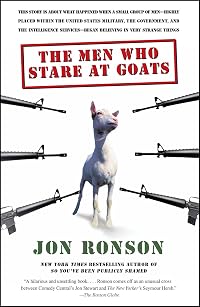
The Men Who Stare at Goats
by Jon Ronson
On This Page
Description
A humorous and cautionary account of the U.S. military's use of psychic tactics in the War on Terror and other political agendas discusses the methods employed by the First Earth Battalion, questioning its soldiers' abilities to perform such feats as invisibility, walking through walls, and killing goats with their minds.Tags
Recommendations















Member Recommendations


Member Reviews
The Black recesses of the military industrial complex are full of strange ideas and projects, but few are stranger than the programs in psychic warfare chronicled in The Men Who Stare At Goats. Taking as his starting point a General in Military Intelligence, Ronson follows the trail of the First Earth Battalion Operations Manual, a hippy-dippy plan to create an army of "Warrior Monks" and "Jedi Soldiers" with uncanny powers including invisibility, thought projection, and the ability to kill with a thought or touch. Like a bad penny, every time the Army runs into trouble (Vietnam, Iraq...) it goes towards mystical mind control as a solution. Former officers, martial arts gurus, and Coast to Coast AM conspiracy nuts are all part of the show more picture. A second, less amusing thread, follows the covert history of sonic torture, including subliminal messages and repetitive aggressive noises, as used at GITMO and Abu Ghraib. MK-Ultra enters the picture as the grandaddy of the whole project, with Sidney Gottlieb as the mastermind and Frank Olsen as the first victim, killed because he was going to talk.
I'm deeply conflicted about this book. Ronson believes that he's stumbled onto a big secret, but it's not clear what this secret is. It could be that America has a secret army of psychic spies, or that we have sophisticated psychological torture, or just that the Brass believes in this nonsense. Either way I feel like, 'real' secret programs are better secured or just common knowledge. But what really rubs me the wrong way is that Ronson makes the claim that these programs are deliberately depicted as absurd to hide the unsavory truths about torture and the like. If that's so, why participate in the charade by writing a book as weird and conspiratorial as The Men Who Stare At Goats? show less
I'm deeply conflicted about this book. Ronson believes that he's stumbled onto a big secret, but it's not clear what this secret is. It could be that America has a secret army of psychic spies, or that we have sophisticated psychological torture, or just that the Brass believes in this nonsense. Either way I feel like, 'real' secret programs are better secured or just common knowledge. But what really rubs me the wrong way is that Ronson makes the claim that these programs are deliberately depicted as absurd to hide the unsavory truths about torture and the like. If that's so, why participate in the charade by writing a book as weird and conspiratorial as The Men Who Stare At Goats? show less
The film of The Men Who Stare at Goats was a diverting comedy based on the cartoonishness of the ideas espoused by characters played by George Clooney and Jeff Bridges. The book is a very different matter, because it is not fictionalised, the people discussed are real, and the more sobering consequences of their ideas are spelled out by Jon Ronson in what turns out to be a pretty serious manner.
The real tragedy in the book is that the ideas lampooned in the film were a genuine response by Jim Channon to the trauma he experienced in Vietnam, to find more non-violent ways of conducting wars, based on New Age ideas. Channon published his ideas as a manual for the New Earth Brigade, and they received about the amount of attention that you show more would expect from the Army of the time.
Rather than sink without trace however, Channon's non-violent ideas were adopted and twisted by others to become something unrecognisable from his original intent. Ronson shows the link between seemingly fanciful New Age theory such as using music to change behaviour to the torture deployed at Guantanamo and Abu Ghraib. Ronson makes a convincing argument that the repellent activities of people like Lynddie England were ordered by higher-ups applying a version of Channon's ideas.
Similarly, Ronson recounts experiences at Waco with the Branch Davidians that suggest similar torture methods were attempted there.
All in all this a sad book because Channon was clearly trying to achieve something quite different from what his successors have ended up doing with his ideas. While the start of the book seems comical, along the lines of the film, by the end Ronson has made you take this very seriously. For all that, however, you are never quite sure how much of this to believe. As Ronson says, the best way to discount these events is to make them seem funny; the film has succeeded in making Ronson's book seem more of a joke than maybe he wanted. show less
The real tragedy in the book is that the ideas lampooned in the film were a genuine response by Jim Channon to the trauma he experienced in Vietnam, to find more non-violent ways of conducting wars, based on New Age ideas. Channon published his ideas as a manual for the New Earth Brigade, and they received about the amount of attention that you show more would expect from the Army of the time.
Rather than sink without trace however, Channon's non-violent ideas were adopted and twisted by others to become something unrecognisable from his original intent. Ronson shows the link between seemingly fanciful New Age theory such as using music to change behaviour to the torture deployed at Guantanamo and Abu Ghraib. Ronson makes a convincing argument that the repellent activities of people like Lynddie England were ordered by higher-ups applying a version of Channon's ideas.
Similarly, Ronson recounts experiences at Waco with the Branch Davidians that suggest similar torture methods were attempted there.
All in all this a sad book because Channon was clearly trying to achieve something quite different from what his successors have ended up doing with his ideas. While the start of the book seems comical, along the lines of the film, by the end Ronson has made you take this very seriously. For all that, however, you are never quite sure how much of this to believe. As Ronson says, the best way to discount these events is to make them seem funny; the film has succeeded in making Ronson's book seem more of a joke than maybe he wanted. show less
The Men Who Stare at Goats was not the book I expected it to be. It's billed as a humorous look at research into parapsychology and remote viewing by Army intelligence, and for the first half, it is. It turns out that after Vietnam, a few officers influenced by the human potential and New Age movements in California attempted to bring these ideas into the Army - resulting in the creation of the "First Earth Battalion" manual, a description of a new army where opponents are psychically manipulated into surrender and no weapons are needed. Some results - a general that repeatedly tries and repeatedly fails to walk through walls, remote viewers spying on the Loch Ness Monster, and the attempt to create real Jedi warriors that can kill show more goats by staring at them.
But just like Star Wars, there's a dark side to the Force. About halfway through the book, Ronson digs into the movement away from peaceful research into things like acoustic weaponry used to break prisoners and shows how these ideas were implemented in the Noriega arrest, Abu Ghraib prison and Guantanamo Bay. This is not funny stuff. The Psychological Operations folks treated these situations as laboratories to put into actual experiment all the wild ideas they've been thinking about all these years - leading to the abuses we've been reading about in the papers over the years. The Men Who Stare at Goats is a good book, make no mistake. It's just not quite what it's advertised to be. show less
But just like Star Wars, there's a dark side to the Force. About halfway through the book, Ronson digs into the movement away from peaceful research into things like acoustic weaponry used to break prisoners and shows how these ideas were implemented in the Noriega arrest, Abu Ghraib prison and Guantanamo Bay. This is not funny stuff. The Psychological Operations folks treated these situations as laboratories to put into actual experiment all the wild ideas they've been thinking about all these years - leading to the abuses we've been reading about in the papers over the years. The Men Who Stare at Goats is a good book, make no mistake. It's just not quite what it's advertised to be. show less
Alltsedan 1970-talet har den amerikanska armén utbildat en hemlig grupp soldater i paranormala förmågor. De tränar sig i osynlighet (!), att tindra med ögonen för att göra fienden förvirrad, konsten att förflytta medvetandet utanför kroppen, men också mer "normala" närstridstekniker. Verksamheten låg nere från mitten av 1990-talet men nu under 2000-talets Krig mot terrorismen har de blivit reaktiverade. Och nu är det krig på riktigt, vilket leder hela vägen till den psykiska tortyren av fångarna i Abu Ghraib och Guantanamo.
I sitt underhållande reportage Män som stirrar på getter lyckas Jon Ronson förena skarpsynthet och samhällskritik med en humor som sträcker sig långt över vad man trodde var möjligt.
I sitt underhållande reportage Män som stirrar på getter lyckas Jon Ronson förena skarpsynthet och samhällskritik med en humor som sträcker sig långt över vad man trodde var möjligt.
This book goes back and forth from hilarious to horrifying more often than Rosemary's Baby. Except that it's all true. This really touches on so many of my main interests, I don't even know where to begin. Basically, all the weird shit that just seems like fiction in a Pynchon novel turns out to be based in reality and this book does a better job of digging it all up, while being more well-researched, well-written and less sensational than any book about the US military's psychic engagements ever could be. Suffice it to say, I definitely want to re-watch the film.
This book goes back and forth from hilarious to horrifying more often than Rosemary's Baby. Except that it's all true. This really touches on so many of my main interests, I don't even know where to begin. Basically, all the weird shit that just seems like fiction in a Pynchon novel turns out to be based in reality and this book does a better job of digging it all up, while being more well-researched, well-written and less sensational than any book about the US military's psychic engagements ever could be. Suffice it to say, I definitely want to re-watch the film.
Strangely, in fact, whenever I broached the subject of goat staring in my email exchanges with former friends and associates of Echanis, they immediately, on every occasion, stopped emailing me back. I started to think that perhaps I was nuts. This is why, after a while, I began avoiding crazy-sounding words like 'goat' and 'staring' and 'death', and instead asked questions like, 'Do you happen to know whether or not Michael was ever involved attempting to influence livestock from afar?'
But even then the email exchanges abruptly halted. Perhaps I had indeed stumbled on a secret so sensitive that nobody wanted to admit to any knowledge of it.
Although the film of the same name was based on it, this is a non-fiction book that tells the show more story of the author's investigation into the US military's psychic spying and psychological warfare programs. As well tracing some of the people who tried to kill goats (and hamsters!) by staring at them, he looks into remote viewing, the transformation of military personnel into Jedi Warriors, and the development of non-lethal weapons, including a failed attempt at using rapidly solidifying foam to build a wall between some rioters and the target of their wrath and an unexpected use of the Barney the Dinosaur theme tune. Although he doesn't have any luck in tracking down a man named Ron, who apparently reactivated Uri Geller as an American agent after 9/11, as everyone clams up when asked about him, he has more luck with other people who were involved, including a former General who tried repeatedly (but unsuccessfully) to walk through walls.
This is generally a fun read, although events take a more serious turn when the author investigates MK-Ultra, and the military's links to the Heaven's Gate suicides and the disastrous events at the Branch Davidians' compound at Waco, and I really don't like the sound of the Predator, a bright yellow plastic weapon that resembles a children's toy. show less
But even then the email exchanges abruptly halted. Perhaps I had indeed stumbled on a secret so sensitive that nobody wanted to admit to any knowledge of it.
Although the film of the same name was based on it, this is a non-fiction book that tells the show more story of the author's investigation into the US military's psychic spying and psychological warfare programs. As well tracing some of the people who tried to kill goats (and hamsters!) by staring at them, he looks into remote viewing, the transformation of military personnel into Jedi Warriors, and the development of non-lethal weapons, including a failed attempt at using rapidly solidifying foam to build a wall between some rioters and the target of their wrath and an unexpected use of the Barney the Dinosaur theme tune. Although he doesn't have any luck in tracking down a man named Ron, who apparently reactivated Uri Geller as an American agent after 9/11, as everyone clams up when asked about him, he has more luck with other people who were involved, including a former General who tried repeatedly (but unsuccessfully) to walk through walls.
This is generally a fun read, although events take a more serious turn when the author investigates MK-Ultra, and the military's links to the Heaven's Gate suicides and the disastrous events at the Branch Davidians' compound at Waco, and I really don't like the sound of the Predator, a bright yellow plastic weapon that resembles a children's toy. show less
Members
- Recently Added By
Lists

Non-Fiction Worth Reading
1,025 works; 264 members

My E-Book Collection - Opinions Welcome
92 works; 10 members

Books Read in 2015
3,299 works; 129 members

Books read in 2015
213 works; 5 members

Animals in the Title
498 works; 11 members

Books Read in 2010
631 works; 11 members

Weirdo Nonfiction
138 works; 3 members
Author Information

28+ Works 12,905 Members
Jon Ronson is a writer and documentary film maker. His books include Them: Adventures with Extremists, Out of the Ordinary: True Tales of Everyday Craziness, What I Do: More True Tales, The Psychopath Test: A Journey Through the Madness Industry, and So You've Been Publicly Shamed. The Men Who Stare at Goats was made into a motion picture starring show more George Clooney in 2009. He will be delivering the opening address at the Brisbane Writers Festival in September 2015. (Bowker Author Biography) show less
Some Editions
Work Relationships
Is contained in
Has the adaptation
Common Knowledge
- Canonical title
- The Men Who Stare at Goats
- Original title
- The Men Who Stare at Goats
- Original publication date
- 2004
- People/Characters
- Albert Stubblebine III (US Army, General); Uri Geller; Guy Savelli; Lyn Buchanan (US Army, Sgt); Glenn Wheaton (US Army, Sgt); Michael Echanis (show all 21); Jim Channon (Lt. Col., "First Earth Battalion"); Prudence Calabrese (beginning chapter 6); Ed Dames (US Army, Major | beginning chapter 6); Courtney Brown (beginning chapter 6); Art Bell (radio broadcaster); Chuck Shramek (amateur astronomer); Marshall Applewhite (Heaven's Gate cult leader); Christopher Cerf (composer of Barney music); Pete Brusso; Jamal al-Harith; David Koresh; Clive Doyle; Eric Olson; Frank Olson; Sidney Gottlieb
- Important places
- Fort Meade, Maryland, USA; Fort Bragg, North Carolina, USA; Iraq; Abu Ghraib Prison, Abu Ghraib, Iraq; Guantanamo Bay, Cuba
- Important events
- Waco Branch Davidian Siege (1993); Heaven's Gate suicides (1997); Abu Ghraib Prison scandal (2004); MK-ULTRA experiments (1953 | 1964)
- Related movies
- The Men Who Stare at Goats (2009 | IMDb)
- Dedication
- For John Sergeant and also for General Stubblebine
- First words
- This is a true story.
- Quotations
- History seems to show that whenever there is a great American crisis—the War on Terror, the trauma of Vietnam and its aftermath, the Cold War—its military intelligence is drawn to the idea of thought control. They come up... (show all) with all manner of harebrained schemes to try out, and they all sound funny until the schemes are actually implemented. (chapter 13, "Some Illustrations", p.204)
It seemed that one of two scenarios was unfolding: Guy was either in the middle of a sensational sting operation, or a hapless young martial arts enthusiast who only wanted to join Guy's federation was about to be shipped off... (show all) to Guantanamo Bay. (Chapter 6, "Homeland Security", last paragraph - p.88) - Last words
- (Click to show. Warning: May contain spoilers.)I presume the news went down badly.
- Blurbers
- The Times; Observer; Metro; Daily Telegraph
Classifications
- Genres
- Nonfiction, General Nonfiction, History
- DDC/MDS
- 355.34340973 — Society, government, & culture Public administration & military science The Military - Land, Air & Sea / Warfare Organization and personnel of military forces Special service Military Intelligence & Special Warfare Psychological Warfare
- LCC
- UB276 .R66 — Military Science Military administration Military administration Psychological warfare. Propaganda
- BISAC
Statistics
- Members
- 2,304
- Popularity
- 8,684
- Reviews
- 93
- Rating
- (3.57)
- Languages
- 12 — Chinese, English, Estonian, Finnish, French, German, Hungarian, Italian, Norwegian (Bokmål), Portuguese, Spanish, Swedish
- Media
- Paper, Audiobook, Ebook
- ISBNs
- 46
- ASINs
- 19