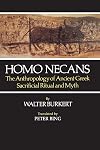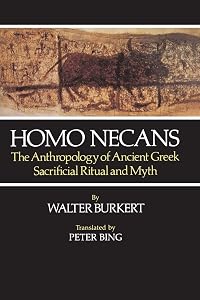
Homo Necans: The Anthropology of Ancient Greek Sacrificial Ritual and Myth
by Walter Burkert
277 Members (4.18)
On This Page
Description
Blood sacrifice, the ritual slaughter of animals, has been basic to religion through history, so that it survives in spiritualized form even in Christianity. How did this violent phenomenon achieve the status of the sacred? This question is examined in Walter Burkert's famous study.Tags
Recommendations





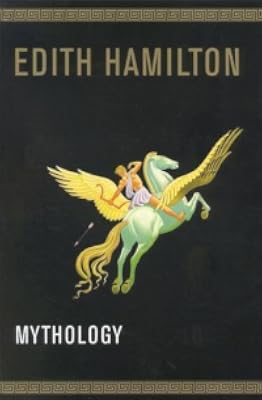
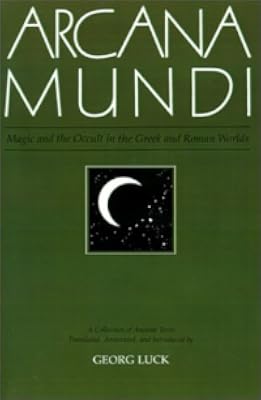

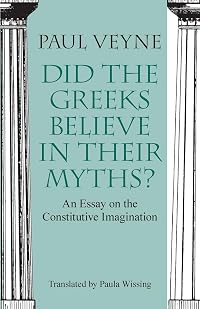
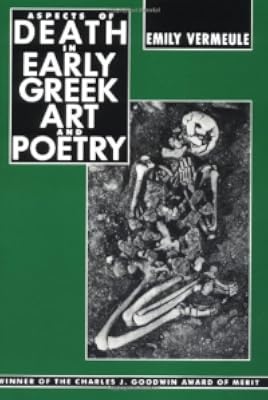

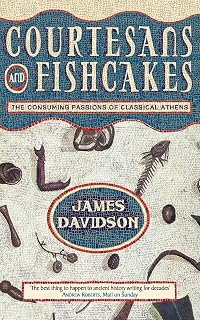
Member Recommendations
Member Reviews
Members
- Recently Added By
Lists

Books in the Bibliography of The History of Hell by Alice K. Turner
155 works; 1 member
Author Information

25+ Works 2,378 Members
German-born scholar Walter Burkert currently teaches at the University of Zurich. He is the leading active scholar of the religion of early and classical Greece. Burkert's work proceeds through intense, meticulous historical and philological investigation, seeking to understand Greek religion in and of itself. His studies wed philology and history show more with methods drawn from anthropology and resemble the work of Jonathan Z. Smith. But, unlike Smith, who seems to rule out diachronic considerations categorically in favor of synchronic taxonomies or analogical comparisons, Burkert remains interested in questions of long-term historical evolution and cross-cultural influence. Burkert gives particular attention to psychological causation and the biological roots of human behavior as revealed by the science of ethology. For example, his study of Greek sacrifice, Homo necans, roots the practice of sacrifice in the biological necessity faced by prehistoric hunting groups that killed to survive. Burkert suggests that this necessary, aggressive behavior gave rise to anxiety, but through the practice of sacrifice the unavoidable aggression, which otherwise threatened to destroy society, was redirected to its promotion instead. In Structure and History Burkert's theoretical concerns are larger, including both myth and ritual. The precise relation between myth and ritual has been a vexing question for scholars of ancient religions; Burkert places them side by side and links them at a structural level. He thinks ritual is older than myth, because it is a form of behavior found even in animals. Nevertheless, ritual and myth share several important features: Both depend upon basic biological or cultural programs of action and detachment from pragmatic reality. Both serve communication. Because myth and ritual are related in this way, it is possible for them to be found together. Burkert's Greek Religion is the current, standard handbook on the religions of ancient Greece. His most recent work has been devoted to examining the influence of the ancient Near East on archaic Greek civilization. (Bowker Author Biography) show less
Some Editions
Common Knowledge
- Original title
- Homo Necans: The Anthropology of Ancient Greek Sacrificial Ritual and Myth; Homo Necans: Interpretationen altgriechiescher Opferriten und Mythen
- Original publication date
- 1972
- Important events
- Dipolieia
- Dedication
- For Reinhold Merkelbach
- Disambiguation notice
- Please, do not combine with Maurice Druon's "The Iron King"; they are two different books. Thank you
Classifications
- Genres
- Anthropology, Nonfiction, Religion & Spirituality, History, General Nonfiction
- DDC/MDS
- 930 — History & geography History of ancient world (to ca. 499) Ancient History: China, Egypt, Rome, Greece
- LCC
- BL788 .B8713 — Philosophy, Psychology and Religion Religions. Mythology. Rationalism Religions. Mythology. Rationalism History and principles of religions European. Occidental Classical (Etruscan, Greek, Roman)
- BISAC
Statistics
- Members
- 277
- Popularity
- 116,505
- Rating
- (4.18)
- Languages
- 6 — English, French, German, Greek, Italian, Spanish
- Media
- Paper, Ebook
- ISBNs
- 10
- ASINs
- 2