The Etruscans
by Massimo Pallottino
On This Page
Tags
Recommendations























Member Reviews
This book presents a readable summary of what was known about the Etruscans at the time of its writing. They were present between around 900 and 100 BC in Italy, mainly in Tuscany and surrounding regions. They had a large influence on the development of the Roman Empire, which later absorbed and grew upon many of the defining Etruscan characteristics.
The author is an expert on Etruscan language, which is only partially understood, as he is careful to explain here. This is in part due to the relative scarcity of samples of text, the vast majority of which are funerary inscriptions on tombs. The most important surviving text comes from a linen book, indeed the only surviving linen book known from any culture. This book was taken apart show more and used to wrap up a mummy, now known as the Zagreb mummy, which was discovered in Egypt and taken to Croatia in 1848. Miraculously the text on the wrappings was well preserved, and much of the writing has now been understood as an Etruscan religious text.
The origins of the Etruscan people are also shrouded in some mystery, being one of the few historical European peoples who do not use an Indo-European language. There are various theories of differing likelihood, but it is possible that that the Etruscans descended mainly from a native Italian Iron Age people known as the Villanovans, but adopted a language brought by settlers coming from somewhere in the Near East. The language with greatest known similarity to Etruscan comes from the Greek Island of Lemnos, where it was spoken up to the 6th Century BC, before it was conquered.
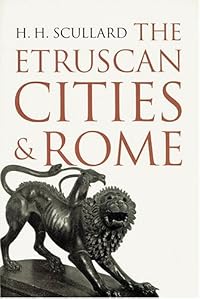
In terms of Art, the Etruscans are well known for a few masterpieces in bronze (the Chimera), and terracotta, as well as for their wall paintings which are the only ones present from any culture of this time in such high quality, state of preservation, and number. These contribute much to the knowledge we have of how they lived – what they wore, their religious and secular festivals, and their belief in the afterlife. Some of these are reproduced, albeit in black and white, in this book’s illustrations, alongside many of their other artefacts including sculptures, tombs, and jewellery. Their general style is predominantly archaic Greek, with little to differentiate much of it as identifiably Etruscan other than minor details. Some exceptions include the tombs that are modelled inside like houses, which are unusual in the quality and detail of the modeled household objects with which they provided for their deceased.
Tuscany was fortunate in having some of the biggest deposits of metal in the Mediterranean, including copper and iron, and this supported the Etruscan economy and their development compared to neighbouring regions. They traded extensively, coming into conflict with other Mediterranean sea powers including Greece, before declining at the hands of Rome on land.
In all this is a detailed and generally readable introduction to the Etruscans. If anything it makes known how much is yet to find out about them, with many potential archaeological sites yet to excavate, and possibly texts to discover and translate. This book is likely to be of interest to those wanting to know more about world history, European civilisation, and Italy. show less
The author is an expert on Etruscan language, which is only partially understood, as he is careful to explain here. This is in part due to the relative scarcity of samples of text, the vast majority of which are funerary inscriptions on tombs. The most important surviving text comes from a linen book, indeed the only surviving linen book known from any culture. This book was taken apart show more and used to wrap up a mummy, now known as the Zagreb mummy, which was discovered in Egypt and taken to Croatia in 1848. Miraculously the text on the wrappings was well preserved, and much of the writing has now been understood as an Etruscan religious text.
The origins of the Etruscan people are also shrouded in some mystery, being one of the few historical European peoples who do not use an Indo-European language. There are various theories of differing likelihood, but it is possible that that the Etruscans descended mainly from a native Italian Iron Age people known as the Villanovans, but adopted a language brought by settlers coming from somewhere in the Near East. The language with greatest known similarity to Etruscan comes from the Greek Island of Lemnos, where it was spoken up to the 6th Century BC, before it was conquered.
In terms of Art, the Etruscans are well known for a few masterpieces in bronze (the Chimera), and terracotta, as well as for their wall paintings which are the only ones present from any culture of this time in such high quality, state of preservation, and number. These contribute much to the knowledge we have of how they lived – what they wore, their religious and secular festivals, and their belief in the afterlife. Some of these are reproduced, albeit in black and white, in this book’s illustrations, alongside many of their other artefacts including sculptures, tombs, and jewellery. Their general style is predominantly archaic Greek, with little to differentiate much of it as identifiably Etruscan other than minor details. Some exceptions include the tombs that are modelled inside like houses, which are unusual in the quality and detail of the modeled household objects with which they provided for their deceased.
Tuscany was fortunate in having some of the biggest deposits of metal in the Mediterranean, including copper and iron, and this supported the Etruscan economy and their development compared to neighbouring regions. They traded extensively, coming into conflict with other Mediterranean sea powers including Greece, before declining at the hands of Rome on land.
In all this is a detailed and generally readable introduction to the Etruscans. If anything it makes known how much is yet to find out about them, with many potential archaeological sites yet to excavate, and possibly texts to discover and translate. This book is likely to be of interest to those wanting to know more about world history, European civilisation, and Italy. show less
Det er stadig den bedste og mest solide fremstilling af emnet, jeg er stødt på
Jan 13, 2020Danish
937. 5 PAL
Apr 24, 2020Italian
Ratings
Members
- Recently Added By
Author Information

33+ Works 504 Members
Some Editions
Series
Belongs to Publisher Series
Pelican Books (A310)
Common Knowledge
- Canonical title
- The Etruscans
- Original title
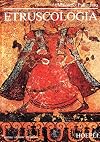
- Etruscologia (1942, Italian) (1942, Italian)
- Original publication date
- 1955; 1942 (Italië) (Italië)
- Original language*
- Italiaans
*Some information comes from Common Knowledge in other languages. Click "Edit" for more information.
Classifications
- Genres
- Anthropology, History, Nonfiction, General Nonfiction, Art & Design
- DDC/MDS
- 913.37 — History & geography Geography & travel Geography of and travel in ancient world Antiquities of ancient countries Italian Peninsula and adjacent territories to 476
- LCC
- DG223 .P283 — History of Europe, Asia, Africa and Oceania City History of Italy Ancient Italy. Rome to 476 History By period Pre-Roman Italy. Etruria. Etruscans
- BISAC
Statistics
- Members
- 255
- Popularity
- 126,425
- Reviews
- 3
- Rating
- (3.40)
- Languages
- English, German, Italian
- Media
- Paper, Ebook
- ISBNs
- 9
- ASINs
- 17