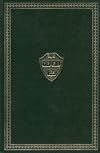
The Autobiography of Benjamin Franklin / The Journal of John Woolman / Fruits of Solitude
by Charles William Eliot (Editor), Benjamin Franklin, William Penn, John Woolman
On This Page
Description
Classic Literature. Fiction. Short Stories. Contents: 1. His Autobiography, by Benjamin Franklin 2. The Journal of John Woolman, by John Woolman (1774 and subsequent editions) 3. Fruits of Solitude, by William Penn Also available: The Complete Harvard Classics Collection (51 Volumes + The Harvard Classic Shelf Of Fiction) 50 Masterpieces You Have To Read Before You Die.Tags
Recommendations
























Member Reviews
After reading the first volume of President Eliot's Five Foot Shelf, I'm afraid I really do wonder about the President's mindset. It's not that these works of Mr. Franklin, Mr. Woolman and Mr. Penn are not worth reading--they certainly are, and in the cases of Mr. Woolman and Mr. Penn, in parts "inspiring". But all three raise more questions than they provide answers. I read Franklin in high school and remembered mostly his table or scheme for self-improvement, which to a high school boy seemed rather absurd. This time, though, I found more sympathy for old Ben and noticed what I had not seen before, his humorous touches.
But why in the world would these be chosen as the first volume of Mr. Eliot's ambitious effort? Was he serious? If show more so, what was his point? show less
But why in the world would these be chosen as the first volume of Mr. Eliot's ambitious effort? Was he serious? If show more so, what was his point? show less
I got this for the John Woolman Journal. It is a wonderful story of his spiritual journey in the 18th century. It is amazingly relevant for today, and I see myself experiencing the very same conflicts and resolutions of those struggles. He lived from 1720 to 1772 in the colonies, was of the Quaker persuasion and after becoming aware of the evils of slavery, led in the fight to end it among Quakers and, thereby, elsewhere. Really good writing.
This book was a slow read, and I haven't read all of the series, but I did enjoy reading this a great deal as I learned a lot about people and things I hadn't known much about before. It was a good change from all the fiction I tend to read, and I think it's a great idea to read at least one volume of the Harvard Classics for all serious readers. My goal was to read the entire set of Harvard Classics, but I got bogged down somewhere in the second one and my try again when my kids are older.
Born in the colony of New Jersey in 1720, and from his youth, a zealous member of the Society of Friends (Quakers). He labored as a tailor and married a "well-inclined damsel, Sarah Ellis". His Journal was published posthumously in 1774, and it recounts his surprisingly extended travels in the colony and in England. He marks a distinction among those who work, and those who own slaves:
"I saw in these southern provinces so many vices and corruptions, increased by this trade and this way of life [slave-holding], that it appeared to me as a dark gloominess hanging over the land". [183]
His extreme humility veils the importance of his role in eliminating the practice of slavery. He often waited patiently for long months for his Lord to show more speak to his heart. There is no pretense to any actual miracle or un-natural event, even where the subjects of great tragedy -- disease caused by small pox vaccinations -- are raised.
He meditates upon the alterations in the circumstances of the native people since the coming in of the English. [261] {Everyone knew what was happening and that it was evil.}
Repeatedly and innocently refers to Samuel Eastborne as "my beloved companion" [179] and "true yokemate" [249] with whom he traveled, and slept [cf others too 263].
His words are written with ardor, with clear spiritual insight, and kindness. This, a true follower of Christ, an extinct species, now entirely forgotten. show less
"I saw in these southern provinces so many vices and corruptions, increased by this trade and this way of life [slave-holding], that it appeared to me as a dark gloominess hanging over the land". [183]
His extreme humility veils the importance of his role in eliminating the practice of slavery. He often waited patiently for long months for his Lord to show more speak to his heart. There is no pretense to any actual miracle or un-natural event, even where the subjects of great tragedy -- disease caused by small pox vaccinations -- are raised.
He meditates upon the alterations in the circumstances of the native people since the coming in of the English. [261] {Everyone knew what was happening and that it was evil.}
Repeatedly and innocently refers to Samuel Eastborne as "my beloved companion" [179] and "true yokemate" [249] with whom he traveled, and slept [cf others too 263].
His words are written with ardor, with clear spiritual insight, and kindness. This, a true follower of Christ, an extinct species, now entirely forgotten. show less
Excellent source of how 3 of our founding fathers thought inspite of and free from modern bias.
Ratings
Members
- Recently Added By
Author Information


453+ Works 19,081 Members
One of 17 children, Benjamin Franklin was born in Boston on January 17, 1706. He ended his formal education at the age of 10 and began working as an apprentice at a newspaper. Running away to Philadelphia at 17, he worked for a printer, later opening his own print shop. Franklin was a man of many talents and interests. As a writer, he published a show more colonial newspaper and the well-known Poor Richard's Almanack, which contains his famous maxims. He authored many political and economic works, such as The Way To Wealth and Journal of the Negotiations for Peace. He is responsible for many inventions, including the Franklin stove and bifocal eyeglasses. He conducted scientific experiments, proving in one of his most famous ones that lightning and electricity were the same. As a politically active citizen, he helped draft the Declaration of Independence and lobbied for the adoption of the U.S. Constitution. He also served as ambassador to France. He died in April of 1790 at the age of 84. (Bowker Author Biography) show less

Benjamin Franklin has a Legacy Library. Legacy libraries are the personal libraries of famous readers, entered by LibraryThing members from the Legacy Libraries group.

147+ Works 2,479 Members
William Penn urged everyone to return to the simplicity of first-century Christianity. Today "the Great challenge" for you to pick up the cross of Jesus daily (Luke 9:23), to live faithfully (Rev. 2:10), and to receive your crown in heaven (2 Tim. 4:7-8).

19+ Works 2,187 Members
Series
Belongs to Publisher Series
Harvard Classics (01)
Work Relationships
Is contained in
Common Knowledge
- Canonical title
- The Autobiography of Benjamin Franklin / The Journal of John Woolman / Fruits of Solitude
- Original publication date
- 1909
- People/Characters
- Benjamin Franklin; John Woolman; William Penn
- Publisher's editor
- Eliot, Charles William
- Disambiguation notice
- This is volume 1 of the Harvard Classics series containing the Autobiography of Benjamin Franklin, the Journal of John Woolman and Fruits of Solitude by William Penn. Do not combine with individual editions, esp. Franklin's ... (show all)autobiography.
Classifications
- Genres
- Biography & Memoir, Nonfiction
- DDC/MDS
- 808.8 — Literature & rhetoric Literature, rhetoric & criticism Rhetoric and collections of literary texts from more than two literatures Literature Collections
- LCC
- BJ1549 .F8 — Philosophy, Psychology and Religion Ethics Ethics Individual ethics. Character. Virtue
- BISAC
Statistics
- Members
- 936
- Popularity
- 28,513
- Reviews
- 5
- Rating
- (4.01)
- Languages
- English
- Media
- Paper, Ebook
- ISBNs
- 11
- ASINs
- 69