On This Page
Description
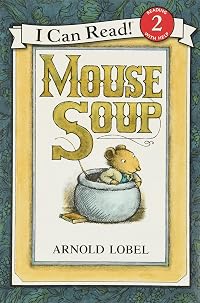
A mouse convinces a weasel he needs the ingredients from several stories to make a tasty mouse soup.Tags
Recommendations


Member Reviews
In this cute and silly beginning reader, a young mouse is captured by a weasel who wants to eat him in his soup. To spare himself, the mouse borrows Scheherazade's trick and delays his fate with stories. He tells the weasel that everyone knows soup doesn't taste good without any stories in it, and tricks him into listening to four short stories. This set up creates a small anthology of mouse stories, which I appreciated because it is an unusual format to see in a beginning reader book. The stories are small, and the language is still simplified with easier vocabulary, so it is quite manageable for young readers. The four tales are short stories that use whimsy and humor to engage a child's attention, and all feature mice some way or show more other. Then, after sharing his stories with the weasel, the initial mouse wraps up the framing story by telling the weasel that to include the stories in his soup, he needs to add an object from each story. Of course, these items are painful or difficult to collect, and while the weasel is struggling to obtain them, the mouse sneaks out and heads back to his own cozy home, where he can finish his book in peace and safety. This is a nice, quick story that straddles the divide between beginning readers and beginning reader chapter books. It is an old classic in the children's literature world, but my daughters really liked it when we recently introduced it to them, so it has clearly stood the test of time. show less
How did I miss this one?
Cute set of stories told by a mouse in the spirit of 1001 Arabian Nights, but in an "I can read it myself" format. This one is headed for my granddaughters.
Cute set of stories told by a mouse in the spirit of 1001 Arabian Nights, but in an "I can read it myself" format. This one is headed for my granddaughters.
I had mixed feelings about the book Mouse Soup by Arnold Lobel. The story focuses on a mouse that is caught by a weasel that wants to make soup out of him, but the mouse uses his wits as a storyteller to trick the weasel and get away. I liked the use of illustrations to represent the story but I disliked the way it was written due to its breaks in story telling and non-cohesiveness.
The illustrations in this book strongly help the reader identity with the story. They are drawn with enough detail that it adds a second dimension to the writing. Such as the illustrations represent the “Bees and the Mud” story arc, as each piece of art walks the reader through how the character; mouse; deals with his conflict of bees of his head. As the show more mouse tells his story the art shows him tricking the bees into a mud swamp that eventually forces the bees to depart their nest on his head. The best illustrations in this book come as we reach the end of the story and show just how the smaller mouse has outwitted the weasel. For example, as the weasel attempts to collect all the “stories” to complete his mouse soup it becomes clear, through the art, that the smaller mouse has won this David versus Goliath battle and escaped while the weasel is tortured for his stupidity.
My major dislike with this book however is the way it is written and presented to the reader. At the beginning of the story it feels like the writer wants to make it a straightforward adventure of this smaller mouse in conflict with a larger and more powerful foe, the weasel. But just as the conflict reaches its climax and the mouse it about to become the weasels meal the storyteller goes from direct to indirect and the mouse begins telling these ridiculous tales to buy himself time. I feel as a reader you become lost in these four different and distinct stories that you lose focus on the main conflict itself. The books main concept was to show how this small and insignificant mouse outwits his much larger predator and saves himself and yet at times it feels like nothing more then a fractured bunch of fable stories thrown into the middle of a standalone story arch. show less
The illustrations in this book strongly help the reader identity with the story. They are drawn with enough detail that it adds a second dimension to the writing. Such as the illustrations represent the “Bees and the Mud” story arc, as each piece of art walks the reader through how the character; mouse; deals with his conflict of bees of his head. As the show more mouse tells his story the art shows him tricking the bees into a mud swamp that eventually forces the bees to depart their nest on his head. The best illustrations in this book come as we reach the end of the story and show just how the smaller mouse has outwitted the weasel. For example, as the weasel attempts to collect all the “stories” to complete his mouse soup it becomes clear, through the art, that the smaller mouse has won this David versus Goliath battle and escaped while the weasel is tortured for his stupidity.
My major dislike with this book however is the way it is written and presented to the reader. At the beginning of the story it feels like the writer wants to make it a straightforward adventure of this smaller mouse in conflict with a larger and more powerful foe, the weasel. But just as the conflict reaches its climax and the mouse it about to become the weasels meal the storyteller goes from direct to indirect and the mouse begins telling these ridiculous tales to buy himself time. I feel as a reader you become lost in these four different and distinct stories that you lose focus on the main conflict itself. The books main concept was to show how this small and insignificant mouse outwits his much larger predator and saves himself and yet at times it feels like nothing more then a fractured bunch of fable stories thrown into the middle of a standalone story arch. show less
I absolutely loved this book! Not only is it just a great story, but it is four mini stories that make up one larger story! In the book, there are large words and descriptive language. There is also great opportunities for shared reading because there are lines that repeat consistently. One of the set of lines that repeat is "We like your ears. We like your eyes. We like your whiskers." I also like this book because there are many messages that can be taken from it. One of the messages is about how people, or animals, have different points of view, and just because someone has a different point of view, doesn't mean they are lying. This is a great book for children and very enjoyable to read. The characters are easy to relate to. They show more illustrations in this book also enhance the text, especially for young children. They do a great job portraying the feelings of the characters in the story. I will have this book in my future classroom! show less
A classic of how stories can save your life. A mouse is sitting reading a book when he is caught by a weasel who intends to make mouse soup out of him. So the mouse tells the weasel the soup won't taste very good because it has no stories in it. The weasel doesn't have any stories, so the mouse tells him four -- about bees and mud, about two large stones, about about ten crickets, and about a thorn bush. The weasel listens and then asks how he's supposed to put these stories into the soup. The mouse tells him he must go out and get the various objects (bees, mud, stones, crickets, and a thorn bush). While he's gone, the mouse escapes and goes home to finish reading his book.
A lovely take on the Stone Soup story, improved by the addition of an intrepid mouse who never loses his head.
Written by the author of Frog and Toad books, this is one of my favorite books. Rather like the tale of Scheherazade, it tells of a mouse who is captured by a weasel and saves himself by telling stories to go with the mouse soup. Except in this case, the weasel leaves to get the materials for the stories and the mouse escapes. My children like the story, too. :)
Members
- Recently Added By
Lists

EEK! A Mouse ::: Best Children's Books
95 works; 13 members

Ambleside Books
459 works; 18 members

CCE 1000 Good Books List
1,033 works; 12 members

Books Read in 2018
4,360 works; 110 members

A Smorgasbord of Culinary Fiction
221 works; 94 members

Recommended Reading List
219 works; 1 member

Written and Illustrated By
805 works; 1 member

Read Aloud Revival
108 works; 4 members
Author Information

101+ Works 74,342 Members
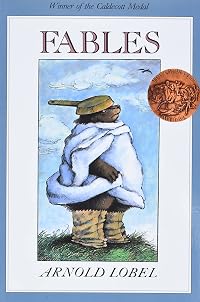
Arnold Stark Lobel (May 22, 1933-December 4, 1987) was a popular American author of children's books. Among his most popular books are those of the Frog and Toad series, and Mouse Soup, which won the Garden State Children's Book Award from the New Jersey Library Association. Lobel won the 1981 Caldecott Medal for his book, Fables. Lobel also show more illustrated the works of other authors. A notable example is Sam the Minuteman by Nathaniel Benchley, which was first published in 1969. He was born in Los Angeles, California. When he graduated from art school, he married Anita Kempler, who also achieved fame as a children's book author and illustrator. Lobel died ion December 4,1987 due to complications arising from AIDS. He was 54 years old. (Bowker Author Biography) show less
Awards and Honors
Awards
Series

Belongs to Publisher Series
Work Relationships
Is contained in
Has the adaptation
Has as a teacher's guide
Common Knowledge
- Canonical title*
- Muizensoep
- Original title
- Mouse Soup
- Original publication date
- 1977
- People/Characters
- Mouse; Weasel
- Related movies
- Mouse Soup (1993 | IMDb)
- First words
- A mouse sat under a tree.
- Last words
- (Click to show. Warning: May contain spoilers.)He lit the fire, he ate his supper, and he finished reading his book.
- Original language*
- Engels
*Some information comes from Common Knowledge in other languages. Click "Edit" for more information.
Classifications
Statistics
- Members
- 5,094
- Popularity
- 2,734
- Reviews
- 34
- Rating
- (4.03)
- Languages
- 11 — Catalan, Chinese, Czech, Dutch, English, French, German, Galician, Japanese, Russian, Spanish
- Media
- Paper, Audiobook, Ebook
- ISBNs
- 54
- ASINs
- 16