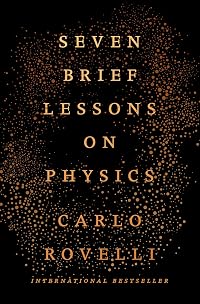
Seven Brief Lessons on Physics
by Carlo Rovelli
On This Page
Description
The New York Times bestseller from the author of The Order of Time and Reality Is Not What It Seems "One of the year's most entrancing books about science."--The Wall Street Journal "Clear, elegant...a whirlwind tour of some of the biggest ideas in physics."--The New York Times Book Review This playful, entertaining, and mind-bending introduction to modern physics briskly explains Einstein's general relativity, quantum mechanics, elementary particles, gravity, black holes, the complex show more architecture of the universe, and the role humans play in this weird and wonderful world. Carlo Rovelli, a renowned theoretical physicist, is a delightfully poetic and philosophical scientific guide. He takes us to the frontiers of our knowledge: to the most minute reaches of the fabric of space, back to the origins of the cosmos, and into the workings of our minds. The book celebrates the joy of discovery. "Here, on the edge of what we know, in contact with the ocean of the unknown, shines the mystery and the beauty of the world," Rovelli writes. "And it's breathtaking." show lessTags
Recommendations




Member Reviews
Possibly a little over-hyped on its appearance, this is an exceptionally clear summary of what most scientists believe is the basis for an understanding of reality. I say believe rather than know advisedly because Rovelli is careful to say what we do not know as well as what we think we know.
The point here is that our current understanding of physical reality is the work of barely a century. Although the achievement is remarkable, we have to be careful of substituting an earlier belief in science (before Einstein) that is now seen as limited with a new belief system.
The new understanding of reality is better than that of the Newtonian era. Both are better than a so-called age of faith that relied on revealed texts and God but it would show more be naive to think that earlier truths had definitively been replaced by a final truth. Mathematics must not be the new God.
The book is quite slight. It is a translation of seven short articles in an Italian newspaper in or just before 2014. The whole thing could be read with reasonable attention in about ninety minutes. Much of the excitement surrounding the book is really testimony to wider ignorance.
The virtue of the book lies in the fact that Rovelli has a gift for simple analogy. The complex mathematics that is constructing our current perception of reality is brought to a level where we can begin mentally to see what he is talking about in very physical imagery.
Perhaps the best chapter in this is the fifth on the granular naure of space which just happens to coincide with Rovelli's own area of interest - the investigation of quantum gravity. But the whole book is worth reading albeit with an edge of scepticism on some potential claims.
For example, he asserts the general physicist view that time has no reality but this apparent consensus makes certain assumptions about the value of mathematical modelling on which Lee Smolin has raised some important questions that might suggest we should not be too accepting.
The final chapter on our place in the universe - which usually allows scientists to offer little more than posturing platitudes - is, in this case, finely tuned and appealing as a humane and 'Lucretian' view of the positive aspects of our being very small in the universe.
Rovelli does, unfortunately, slip into a couple of standard issue species-pessimistic paragraphs with the usual obeisance to climate change (oh, yawn!) but, in this, he is just a creature of his European time. Even Homer may nod. The general tenor of his position is nicely humanistic.
The virtue of this slim volume is that it is likely to shake up a few intellectuals and show them that they are living as much in the past as their counterparts were in late sixteenth century Europe who had not actually understood the implications of Copernicus.
To be honest, although I am reasonably well educated in this area, Rovelli shook me up a little and gave me a better understanding of the latest iteration of reality so that it is impossible to think now, as I did, in a sort of half-baked melange of Newtonianism and relativity.
I now 'get' how space time 'feels' (rather than abstractly 'understand' it). The same with the 'granular' nature of underlying reality. I can also see that we have barely begun to see the cultural, social and political implications of this new world view.
By reminding us of Lucretius and his materialism, Rovelli subtly reminds us of the way his materialism was also embedded in a positive pagan view of the world and one senses that the future world will be pagan again, perhaps, I hope, without the spiritual flummery.
This is where the standard issue intellectual pessimism about the species feels a little out of place. Of course, it is possible we shall be a short-lived species. It is equally possible that we may be the longest lived. Choosing which is the likely outcome is not science but sentiment. show less
The point here is that our current understanding of physical reality is the work of barely a century. Although the achievement is remarkable, we have to be careful of substituting an earlier belief in science (before Einstein) that is now seen as limited with a new belief system.
The new understanding of reality is better than that of the Newtonian era. Both are better than a so-called age of faith that relied on revealed texts and God but it would show more be naive to think that earlier truths had definitively been replaced by a final truth. Mathematics must not be the new God.
The book is quite slight. It is a translation of seven short articles in an Italian newspaper in or just before 2014. The whole thing could be read with reasonable attention in about ninety minutes. Much of the excitement surrounding the book is really testimony to wider ignorance.
The virtue of the book lies in the fact that Rovelli has a gift for simple analogy. The complex mathematics that is constructing our current perception of reality is brought to a level where we can begin mentally to see what he is talking about in very physical imagery.
Perhaps the best chapter in this is the fifth on the granular naure of space which just happens to coincide with Rovelli's own area of interest - the investigation of quantum gravity. But the whole book is worth reading albeit with an edge of scepticism on some potential claims.
For example, he asserts the general physicist view that time has no reality but this apparent consensus makes certain assumptions about the value of mathematical modelling on which Lee Smolin has raised some important questions that might suggest we should not be too accepting.
The final chapter on our place in the universe - which usually allows scientists to offer little more than posturing platitudes - is, in this case, finely tuned and appealing as a humane and 'Lucretian' view of the positive aspects of our being very small in the universe.
Rovelli does, unfortunately, slip into a couple of standard issue species-pessimistic paragraphs with the usual obeisance to climate change (oh, yawn!) but, in this, he is just a creature of his European time. Even Homer may nod. The general tenor of his position is nicely humanistic.
The virtue of this slim volume is that it is likely to shake up a few intellectuals and show them that they are living as much in the past as their counterparts were in late sixteenth century Europe who had not actually understood the implications of Copernicus.
To be honest, although I am reasonably well educated in this area, Rovelli shook me up a little and gave me a better understanding of the latest iteration of reality so that it is impossible to think now, as I did, in a sort of half-baked melange of Newtonianism and relativity.
I now 'get' how space time 'feels' (rather than abstractly 'understand' it). The same with the 'granular' nature of underlying reality. I can also see that we have barely begun to see the cultural, social and political implications of this new world view.
By reminding us of Lucretius and his materialism, Rovelli subtly reminds us of the way his materialism was also embedded in a positive pagan view of the world and one senses that the future world will be pagan again, perhaps, I hope, without the spiritual flummery.
This is where the standard issue intellectual pessimism about the species feels a little out of place. Of course, it is possible we shall be a short-lived species. It is equally possible that we may be the longest lived. Choosing which is the likely outcome is not science but sentiment. show less
This short book brings together a series of essays originally published by physicist Carlo Rovelli in the Italian newspaper Il Sole 24 Ore. Most of the essays tackle a single idea or topic which is key to modern understandings of physics, such as quantum mechanics or general relativity. Rovelli is mostly a genial writer who aims not to give a very detailed thumbnail sketch of a given topic, but more an impressionistic overview which aims to communicate its scope and importance. His prose has a faintly poetic and elegiac quality which I think helps to make the average reader who knows very little about physics (e.g. me) feel like they've learned more than Rovelli actually succeeds in conveying.
This may be an unfair mark against a book show more which touts its brevity in the title, and which did begin life as a newspaper column. But while Rovelli very consciously works to bring together science and culture here, to show that equations can be as poetic and as creative as a painting or an arabesque, there are hints that he still thinks there's a hierarchy of knowledge:
As if those stories aren't valuable just because they're interested in exploring a different kind of truth.
As if the male hunter (and of course it's a man) is the Ur example of rational inquiry.
As if narrative isn't how people make sense—to the extent that we can—of the world around us. show less
This may be an unfair mark against a book show more which touts its brevity in the title, and which did begin life as a newspaper column. But while Rovelli very consciously works to bring together science and culture here, to show that equations can be as poetic and as creative as a painting or an arabesque, there are hints that he still thinks there's a hierarchy of knowledge:
"When we talk about the Big Bang or the fabric of space, what we are doing is not a continuation of the free and fantastic stories that humans have told nightly around campfires for hundreds of thousands of years. It is the continuation of something else: of the gaze of those same men in the first light of day looking at tracks left by antelope in the dust of the savannah—scrutinizing and deducting from the details of reality in order to pursue something that we can’t see directly but can follow the traces of."
As if those stories aren't valuable just because they're interested in exploring a different kind of truth.
As if the male hunter (and of course it's a man) is the Ur example of rational inquiry.
As if narrative isn't how people make sense—to the extent that we can—of the world around us. show less
Theoretical physicist Carlo Rovelli is head of the Quantum Gravity group at Aix-Marseilles University in southern France. His unlikely NY Times best-selling book is a translation of a collection of essays he wrote for the Italian business newspaper, Il Sole24 Ore, in order to bring to laypersons the wonder and beauty of modern science. It eschews all of the mathematics and almost all of the justification for what we think physics tells us about the universe. Rovelli very ambitiously begins with the general theory of relativity and writes an additional chapter each on the topics, in order, of quantum mechanics, cosmology, elementary particles, quantum gravity, the heat of black holes and, finally, to the place of humans in all of this. show more Given the immensity of the subject matter, it does not seem possible that the task can be accomplished in only just over eighty small pages.
That brevity is one of characteristics that have made the book so popular. Another is the fact that Rovelli often uses near-poetry and evocative allusions in his descriptions. Consider what he says about particles:
Even if we observe a small, empty region of space in which there are no atoms, we still detect a minute swarming of these [miniscule moving wavelets]. There is no such thing as a real void, one that is completely empty. Just as the calmest sea looked at closely sways and trembles, however slightly, so the fields that form the world are subject to minute fluctuations, and it is possible to imagine its basic particles have brief and ephemeral existences, continually created and destroyed by these movements.
Descriptions like this can convey the essence of the concept to readers whose own understanding of physics is almost surely Aristotelian. Rovelli has jumped his audience at least two scientific paradigms beyond the knowledge brought by the typical reader, but he does so in a way that is far more comfortable that would be a more scientific explanation.
For my money, I would prefer to be provided with some evidence or logical justification for this strange picture of the world. For me, allure of science, and of physics in particular, is in the voyage more so than the destination. While lots of people consider themselves fans of science, very few are interested in actually learning it. For them, never mind - Rovelli presents a very poetical version of modern physics, appealing to the artist in the reader and stimulating the imagination, but providing none of the evidence in the form of experiments, mathematics, or reason that would connect these seemingly impossible conclusions to their justifications. Seems to me to take most of the fun out of it! One could also argue that his viewpoint of particle physics and cosmology is parochial, giving lots of space to his own specialty, loop quantum gravity, but omitting another forefront viewpoints, including the string theory of particles. show less
That brevity is one of characteristics that have made the book so popular. Another is the fact that Rovelli often uses near-poetry and evocative allusions in his descriptions. Consider what he says about particles:
Even if we observe a small, empty region of space in which there are no atoms, we still detect a minute swarming of these [miniscule moving wavelets]. There is no such thing as a real void, one that is completely empty. Just as the calmest sea looked at closely sways and trembles, however slightly, so the fields that form the world are subject to minute fluctuations, and it is possible to imagine its basic particles have brief and ephemeral existences, continually created and destroyed by these movements.
Descriptions like this can convey the essence of the concept to readers whose own understanding of physics is almost surely Aristotelian. Rovelli has jumped his audience at least two scientific paradigms beyond the knowledge brought by the typical reader, but he does so in a way that is far more comfortable that would be a more scientific explanation.
For my money, I would prefer to be provided with some evidence or logical justification for this strange picture of the world. For me, allure of science, and of physics in particular, is in the voyage more so than the destination. While lots of people consider themselves fans of science, very few are interested in actually learning it. For them, never mind - Rovelli presents a very poetical version of modern physics, appealing to the artist in the reader and stimulating the imagination, but providing none of the evidence in the form of experiments, mathematics, or reason that would connect these seemingly impossible conclusions to their justifications. Seems to me to take most of the fun out of it! One could also argue that his viewpoint of particle physics and cosmology is parochial, giving lots of space to his own specialty, loop quantum gravity, but omitting another forefront viewpoints, including the string theory of particles. show less
Just finished. Not the type of physics I endured in high school ("An object falls at X meters per second into a train traveling at Y miles per hour, what time does it reach Sheboygan?" and so on); the type of physics that sounds like philosophy or religion except that:
A) it doesn't pretend to have all the answers
B) when it DOES have an answer there's generally a formula to back it up, and
C) those who don't agree aren't threatened with hellfire or execution (or both).
Either way, truly mind-bending stuff. Who needs drugs?
A) it doesn't pretend to have all the answers
B) when it DOES have an answer there's generally a formula to back it up, and
C) those who don't agree aren't threatened with hellfire or execution (or both).
Either way, truly mind-bending stuff. Who needs drugs?
“Në rini, Albert Ajnshtajni e kaloi një vit duke u endur kot, pa bërë gjë prej gjëje. Po nuk e çove kohën dëm nuk arrin dot asgjë, gjë që për fat të keq prindërit e adoleshentëve shpesh e harrojnë.
Ndodhej në Pavia. Iu bashkua familjes pas braktisjes së studimeve në Gjermani. Ishte fillimi i shekullit dhe Italia po hidhte hapat e parë të revolucionit industrial. I ati, inxhinier, instalonte centralet e para elektrike në ultësirën padane. Alberti lexonte Kantin dhe kur i shkrepte në kokë ndiqte leksionet në Universitetin e Pavias: për zbavitje, pa qenë i regjistruar dhe pa iu nënshtruar provimeve. Kështu bëhesh me tërë mend shkencëtar.”
“Ekzistojnë kufij, aty ku mësojmë, dhe digjet dëshira show more jonë për dije. Ndodhen në thellësitë më të imëta të indit hapësinor, në origjinën e kozmosit, në natyrën e kohës, në pashmangshmërinë e vrimave të zeza, dhe funksionimin e vetë mendimit tonë. Këtu, në bordin e asaj që dimë, në kontakt me oqeanin e asaj që nuk dimë, vezullojnë misteri i botës, bukuria e botës, dhe na lënë pa frymë”.
I tillë është parakushti i këtyre “leksioneve të shkurtra”, që na prijnë udhë, me transparencë të admirueshme, përmes disa etapave të pashmangshme të revolucionit që tronditi fizikën në shekullin XX dhe vazhdon ta tronditë sot e gjithë ditën; duke filluar nga teoria e relativitetit të përgjithshëm të Ajnshtajnit dhe mekanikës kuantike deri në çështjet e hapura që kanë të bëjnë me arkitekturën e kozmosit, grimcat elementare, gravitetin kuantik, natyrën e kohës dhe të mendjes.” show less
Ndodhej në Pavia. Iu bashkua familjes pas braktisjes së studimeve në Gjermani. Ishte fillimi i shekullit dhe Italia po hidhte hapat e parë të revolucionit industrial. I ati, inxhinier, instalonte centralet e para elektrike në ultësirën padane. Alberti lexonte Kantin dhe kur i shkrepte në kokë ndiqte leksionet në Universitetin e Pavias: për zbavitje, pa qenë i regjistruar dhe pa iu nënshtruar provimeve. Kështu bëhesh me tërë mend shkencëtar.”
“Ekzistojnë kufij, aty ku mësojmë, dhe digjet dëshira show more jonë për dije. Ndodhen në thellësitë më të imëta të indit hapësinor, në origjinën e kozmosit, në natyrën e kohës, në pashmangshmërinë e vrimave të zeza, dhe funksionimin e vetë mendimit tonë. Këtu, në bordin e asaj që dimë, në kontakt me oqeanin e asaj që nuk dimë, vezullojnë misteri i botës, bukuria e botës, dhe na lënë pa frymë”.
I tillë është parakushti i këtyre “leksioneve të shkurtra”, që na prijnë udhë, me transparencë të admirueshme, përmes disa etapave të pashmangshme të revolucionit që tronditi fizikën në shekullin XX dhe vazhdon ta tronditë sot e gjithë ditën; duke filluar nga teoria e relativitetit të përgjithshëm të Ajnshtajnit dhe mekanikës kuantike deri në çështjet e hapura që kanë të bëjnë me arkitekturën e kozmosit, grimcat elementare, gravitetin kuantik, natyrën e kohës dhe të mendjes.” show less
This is a lovely little book which, in a few brief chapters, lays out the basics of modern physics and then goes on to summarize current thought on time, the human mind, and the definition of "I". The examples used to explain complex theories were very effective. In the last chapter, the author waxes philosophical about the past and future of the human species, a summary which mirrored my own thoughts but expressed them more gently and succinctly than I could. "I believe that our species will not last long. It does not seem to be made of the stuff that has allowed the turtle, for example, to continue to exist more or less unchanged for hundreds of millions of years, for hundreds of times longer, that is, than we have even been in show more existence. We belong to a short-lived genus of species. All of our cousins are already extinct. What's more, we do damage. The brutal climate and environmental changes that we have triggered are unlikely to spare us."
I have to say I'm very grateful for this book and will probably purchase a copy for myself, something I do very rarely, for reference on the scientific theories and for the poetry of the last chapter. The translators have done a wonderful job of making Dr. Rovelli's prose so effectively available to English speakers. show less
I have to say I'm very grateful for this book and will probably purchase a copy for myself, something I do very rarely, for reference on the scientific theories and for the poetry of the last chapter. The translators have done a wonderful job of making Dr. Rovelli's prose so effectively available to English speakers. show less
“When we talk about the big bang or the fabric of space, what we are doing is not a continuation of the free and fantastic stories that humans have told nightly around campfires for hundreds of thousands of years. It is the continuation of something else: of the gaze of those same men in the first light of day looking at tracks left by antelope in the dust of the savannah—scrutinizing and deducting from the details of reality in order to pursue something that we can’t see directly but can follow the traces of. In the awareness that we can always be wrong, and therefore ready at any moment to change direction if a new track appears; but knowing also that if we are good enough we will get it right and will find what we are seeking. show more This is the nature of science.
The confusion between these two diverse human activities—inventing stories and following traces in order to find something—is the origin of the incomprehension and distrust of science shown by a significant part of our contemporary culture. The separation is a subtle one: the antelope hunted at dawn is not far removed from the antelope deity in that night’s storytelling.
The border is porous. Myths nourish science, and science nourishes myth. But the value of knowledge remains. If we find the antelope, we can eat.” show less
The confusion between these two diverse human activities—inventing stories and following traces in order to find something—is the origin of the incomprehension and distrust of science shown by a significant part of our contemporary culture. The separation is a subtle one: the antelope hunted at dawn is not far removed from the antelope deity in that night’s storytelling.
The border is porous. Myths nourish science, and science nourishes myth. But the value of knowledge remains. If we find the antelope, we can eat.” show less
Members
- Recently Added By
Published Reviews
ThingScore 100
added by danielx
Lists

The Guardian's 100 best books of the 21st century
100 works; 21 members

Finished in 2019
15 works; 1 member

Books Read in 2016
4,666 works; 197 members

Books Read in 2017
4,249 works; 129 members

Books Read in 2019
4,052 works; 108 members

Books Read in 2022
5,226 works; 112 members

Books Read in 2023
5,638 works; 147 members

BBC World Book Club
267 works; 5 members

A Good Read (Radio 4)
287 works; 1 member

The Guardian’s 20 brilliant books you can read in a day
20 works; 2 members
Author Information

49+ Works 9,279 Members
Carlo Rovelli is a theoretical physicist who has made significant contributions to the physics of space and time. His books Seven Brief Lessons on Physics. Reality Is Not What It Seems, The Order of Time, and There Are Places in the World Where Rules Are Less Important Than Kindness are international bestsellers that have been translated into more show more than fifty languages. show less
Some Editions
Awards and Honors
Awards
Distinctions
Series
Belongs to Publisher Series
Llibres Anagrama (21)
Common Knowledge
- Canonical title*
- Sette brevi lezioni di fisica
- Original title
- Sette brevi lezioni di fisica
- Original publication date
- 2015 (English translation) (English translation); 2014
- People/Characters
- Albert Einstein; Niels Bohr; Ludwig Boltzmann
- First words
- These lessons were written for those who know little or nothing about modern science. (Preface)
In his youth Albert Einstein spent a year loafing aimlessly. - Last words
- (Click to show. Warning: May contain spoilers.)I would like to thank in particular Armando Massarenti, who can be credited with opening up the cultural pages of a Sunday paper to science and allowing light to be thrown on the role of this integral and vital aspect of our culture. (Preface)
(Click to show. Warning: May contain spoilers.)And it's breathtaking. - Blurbers
- Pullman, Philip; Smolin, Lee; Alda, Alan; Giordano, Paolo
- Original language
- Italian
- Canonical DDC/MDS
- 530
- Canonical LCC
- QC24.5
*Some information comes from Common Knowledge in other languages. Click "Edit" for more information.
Classifications
- Genres
- Science & Nature, General Nonfiction, Nonfiction
- DDC/MDS
- 530 — Natural sciences & mathematics Physics Physics
- LCC
- QC24.5 — Science Physics Physics General
- BISAC
Statistics
- Members
- 3,138
- Popularity
- 5,608
- Reviews
- 103
- Rating
- (3.76)
- Languages
- 16 — Catalan, Danish, Dutch, English, Estonian, Finnish, French, German, Hungarian, Italian, Portuguese, Romanian, Russian, Spanish, Swedish, Turkish
- Media
- Paper, Audiobook, Ebook
- ISBNs
- 50
- ASINs
- 16