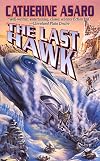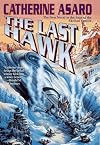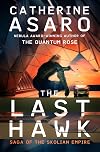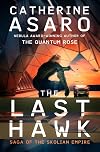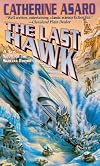
The Last Hawk
by Catherine Asaro
Skolian Empire Publication Order (3), Skolian Empire Novels Chronological Order (2258), Skolian Empire Chronological Order (2258)
On This Page
Description
Fiction. Romance. Science Fiction. HTML:"Powerful characterization and intriguing scientific concepts . . . an elegant subtlety and a far-reaching sense of destiny that carries [Asaro] to the highest rank of master storyteller." —Romantic Times Reeling from a battle, pilot Kelric Valdoria crash-lands his Jag starfighter on Coba, the closest safe planet he can find after a Trader squad cripples his ship. Although the military of Kelric's people have given Coba Restricted status, Kelric show more sees no reason for such draconian measures to isolate the seemingly benign world. While recovering, the dashing Kelric becomes the target of affection for high-powered women in Coba's matriarchal society, including Deha Dahl, an Estate Manager, and young Ixpar Karn, the chosen successor of the Minister. Distracted by their flirtations, Kelric doesn't at first realize the Restricted status of the planet was their own choice—and that they can't risk letting him go. However, Kelric's internal biomech system is failing, causing his brain to malfunction. His only hope is to escape. But when his attempt fails, ending in the death of a guard, he must face a trial that could mean his execution, unless he can win the trust of the people who both covet and fear him . . . "Well-written, entertaining, classic science fiction fun." —The Plain Dealer "Impossible to put down." —L. E. Modesitt, Jr., New York Times–bestselling author "A smoothly absorbing space opera that mixes high-tech gimmickry with galactic politics and plenty of romance." —Publishers Weekly. show lessTags
Recommendations










Member Reviews
In the third book of the Skolian Saga, Catherine Asaro takes up the story of Kelric, the youngest brother of Sauscony from Primary Inversion, and the uncle of Althor from Catch the Lightning. Like all the other members of his family that we have seen who are not members of the Triad that power the Psiberweb, Kelric is a cybernetically enhanced Jagernaut, and it is this profession that leads him to crash land his critically damaged starship on the restricted planet of Coba, leading to decades of exile among a tradition bound matriarchal society that has forgotten most of what it once knew. And Kelric acts as a wild card, upsetting the careful balance of Coban politics and driving what was a stable albeit primitive and reactionary culture show more to the edge of self-destruction.
As The Last Hawk opens as Kelric, Jagernaut, Rhon telepath, and youngest member of the Imperial family of the Skolian Imperialate, finds himself in a dying ship following an battle against the forces of the Eubian Concord. Desperate to find a planet to set his disintegrating spacecraft down upon, he sets course for nearby Coba. Unfortunately, Coba is a restricted world, off-limits for reasons that are not entirely clear. No matter the reason, Kelric is in dire enough straits that he simply doesn't care and heads there anyway, which results in a sharp change of course for both his life, and the lives of most of the inhabitants of Coba.
Because Coba is restricted due to a deception played by the inhabitants upon the Imperial representatives who visited the planet years before. Unwilling to sacrifice their independence and become part of the Skolian Imperialate, the inhabitants convinced the Imperial emissaries that there was some sort of danger on their planet and earned restricted status, resulting in the Imperial presence being confined to a single isolated space port. And this background element raises some questions - how does this comparatively primitive world manage to acquire their information about the nature of the Skolian Imperialate? One also wonders how they managed to acquire this information quickly enough to organize a planet-wide conspiracy sufficient to fool a more technologically advanced civilization replete with telepaths. The asymmetry of information - with the primitive Cobans apparently well-informed about Imperial politics, but the Imperialate in the dark about Coba, seems somewhat implausible, and is unexplained in this volume. And because Kelric is in the line of succession to the Imperial throne, a fact that the Cobans discover quite swiftly, he is not permitted to travel to the spaceport despite serious injuries that require off-world medicine to correct, and is held instead as a somewhat coddled prisoner. Kelric's situation becomes even more dire when it becomes apparent that the Coban environment is slowly poisoning him.
As one might expect, Kelric attempts to break free of his imprisonment, which inexplicably seems to surprise his captors who apparently expected him to accept being held against his will with equanimity. This may be due to the fact that Coban society is a culturally rigid matriarchy, and thus being held in splendidly comfortable captivity seems reasonable to the powerful women of Coba. And in the course of his escape attempt, Kelric's fundamental humanity results in his taking an ultimately self-destructive course of action to save the lives of his captors. Because his captors don't understand him at all, or understand what he did, they condemn him to a lifetime of imprisonment in their penal colony.
But even this turns out to be a temporary condition. Because it turns out that Kelric is a genius at the game of quis. This sounds less impressive than it actually is supposed to be, because quis means everything on Coba. Politics, economics, science, and every other aspect of life is centered on, and dictated by quis. Disputes between rival estates are settled by quis matches. The culture of entire cities can be affected by the patterns embedded in the quis played by its inhabitants. The emotional states and personal histories of the participants are revealed in their quis patterns. And, eventually, it becomes apparent that quis can be used to uncover the theoretical underpinnings of scientific thought and guide the development of engineering applications based on those principles. In short, quis is a universal language that can be used for anything, and is the underlying framework upon which Coban society is built.
What is strange is that quis underlays the matriarchal society of Coba, but it is formulated primarily by men because each estate (which is the basic political unit on Coba) has a Calanya populated by men kept in a splendid cage cloistered from the outside world. These men, called Calani, are charged solely with playing quis to try to create patterns that can be inserted into "wild" quis that would prove advantageous to the estate they are sworn to serve. And members of the Calani can only be men. Indeed, the husband of the manager of each estate must, by tradition, be chosen from the ranks of her Calani. Consequently, each estate is dependent upon men who are, as a class, treated as second class citizens. Coba is technically run by women, but apparently guided by small cliques of pampered men.
This dichotomy seems like it would be prime real estate for exploration, but it seems to be mostly overlooked in this book. The first element that hampers examining this is the blandness of the reverse sexism of Coban society. Coban matriarchal sexism is just standard patriarchal sexism turned around. Men have fewer rights. Men are expected to be chaste. Women are expected to be sexually aggressive. Men wear sexy clothes, or in some parts of the world, men must wear the equivalent of the hijab. Just imagine some element of sexism on Earth and reverse it, and you will have a good idea of sexism on Coba. This creates an uncomfortable environment for Kelric to adjust to, as a man used to a more male dominated society, but it is only mildly interesting as a story element in itself. Flipping the sexism in a story isn't that much more interesting than including standard sexism in a story. And as one might expect, a number of men in the story chafe at their devalued status, but the Calani who object to being treated this way don't think to use their ability to affect the language of quis to plant the ideas of equality, and the one who does only does so in the most half-hearted way possible. The one interesting part of the reverse sexism story seems to be that the men who are ostensibly subservient in this system don't want it changed because they prefer it to equality, which if reversed would be a somewhat surprising commentary on the subjugation of women.
But there are other things about the quis culture that seem to make little sense that go more or less unexamined in the book. Or elements that at least point to Coban culture unintentionally hamstringing itself. First off, the Calani are sworn to never read anything, for fear that they would contaminate their quis with unoriginal ideas. And the ranking of a particular Calani is determined by how many different estates he has worked for. This is supposedly because they can learn quis from different sources and add what they learned elsewhere to their new Calanya's version of quis. So a "first-degree" quis player has been in one Calanya, a "second-degree" in two, and so on. Third-degrees are rare, and fourth-degrees are almost non-extant. Fifth and sixth-degrees are unheard of. But if cross-pollination of ideas makes a Calani better at what he does, why shut out all other forms of knowledge? (One also has to question whether moving from Calanya to Calanya would actually make a Calani better at quis: this is a little like saying that a math professor who went from Northwestern to Tufts to Oberlin would become a better math professor at each stop, a proposition that seems dubious). As it turns out, the secrets of chemistry, physics, and the other sciences are contained in quis, and it seems relatively obvious that if we isolated scientists into small cliques, prevented them from studying the work of their predecessors, and only allowed them to see the work of their contemporaries via second-hand patterns in a game, that the progress of science would be seriously hampered. And that is exactly what happens on Coba. Because quis serves as both a political tool and a source of scientific knowledge, on Coba the two are inextricably intertwined, preventing the development of Coban knowledge. It seems that Asaro is subtly saying that politics and science make poor bedfellows, and also subtly making a point about the inherently rigid nature of Coban culture.
And this is made apparent once Kelric's influence on Coba starts to be seen. First placed in the Dahl Calanya, then after a period of imprisonment into the Haka Calanya, then to the Bahlva Calanya, the Miesa Calanya, the Varz Calanya, and finally in the Karn Calanya, Kelric's innate skill at quis coupled with his hitherto unheard of status as a sixth-degree Calani disturbs the careful balance of Coban politics and culture. But some elements of the story just don't seem to add up. Kelric perfects his skills at quis on his own while kept in solitary imprisonment by a vindictive rogue jailer, but those who play against him are still able to read his patterns clearly. But if his patterns have been developed without reference to the outside world, using rules he made up by himself, how are others able to read them? As described, quis seems to be a consensus derived language of patterns, which makes it strange that a set of patterns derived independent of the consensus would be so easily read. In any event, Kelric's influence seems to drive Coban science into overdrive while at the same time destabilizing Coban politics, in part due to his mere presence as the most influential quis player on the planet and apparently, most sexually desirable male.
And because this is a Catherine Asaro book, the romance is a critical element of the story. Kelric is seen as exotically beautiful by every one of the most powerful women of Coba, and the story for the most part involves his being passed from one powerful woman to another in brokered deals, sometimes for his quis abilities and sometimes for his sexual attractiveness. And in a pattern that has emerged in the first few books of the series, Kelric finds a heretofore unknown pocket of people carrying the Rhon telepath genes, and manages to have children with two of them, expanding the range of genetic variation available to prevent further inbreeding of the Imperial family. After his one attempt at escape, Kelric involuntarily travels about Coba, passed from estate to estate and claimed by various women, some willingly and some not. Through it all, Kelric seems to adopt a passive role, allowing events to take control of him. Despite resenting more than one of the situations he finds himself in, Kelric doesn't take any action or use his mounting influence in quis to try to better his own position except indirectly by accidentally destabilizing the entire planet and sparking a continent-wide war.
Using quis as a metaphor for war, politics, and science is an interesting idea. Adding in a rigid matriarchy in which men are second class citizens is a modestly interesting wrinkle. At this point, having a third member of the Imperial family find yet another undiscovered population that carries the vanishingly rare Rhon genes is starting to seem a bit too serendipitous. If this continues to happen, the series will start to move from improbability to implausibility on that front. The novel's exploration of Coban culture and politics is interesting, but Kelric's impassive nature seems odd for someone who is supposed to have been a highly trained space combat pilot and the scion of a family that presides over an interstellar empire. Even so, the interpersonal relationships established in the novel, which seem to turn full circle, make for a compelling story.
This review has also been posted to my blog Dreaming About Other Worlds. show less
As The Last Hawk opens as Kelric, Jagernaut, Rhon telepath, and youngest member of the Imperial family of the Skolian Imperialate, finds himself in a dying ship following an battle against the forces of the Eubian Concord. Desperate to find a planet to set his disintegrating spacecraft down upon, he sets course for nearby Coba. Unfortunately, Coba is a restricted world, off-limits for reasons that are not entirely clear. No matter the reason, Kelric is in dire enough straits that he simply doesn't care and heads there anyway, which results in a sharp change of course for both his life, and the lives of most of the inhabitants of Coba.
Because Coba is restricted due to a deception played by the inhabitants upon the Imperial representatives who visited the planet years before. Unwilling to sacrifice their independence and become part of the Skolian Imperialate, the inhabitants convinced the Imperial emissaries that there was some sort of danger on their planet and earned restricted status, resulting in the Imperial presence being confined to a single isolated space port. And this background element raises some questions - how does this comparatively primitive world manage to acquire their information about the nature of the Skolian Imperialate? One also wonders how they managed to acquire this information quickly enough to organize a planet-wide conspiracy sufficient to fool a more technologically advanced civilization replete with telepaths. The asymmetry of information - with the primitive Cobans apparently well-informed about Imperial politics, but the Imperialate in the dark about Coba, seems somewhat implausible, and is unexplained in this volume. And because Kelric is in the line of succession to the Imperial throne, a fact that the Cobans discover quite swiftly, he is not permitted to travel to the spaceport despite serious injuries that require off-world medicine to correct, and is held instead as a somewhat coddled prisoner. Kelric's situation becomes even more dire when it becomes apparent that the Coban environment is slowly poisoning him.
As one might expect, Kelric attempts to break free of his imprisonment, which inexplicably seems to surprise his captors who apparently expected him to accept being held against his will with equanimity. This may be due to the fact that Coban society is a culturally rigid matriarchy, and thus being held in splendidly comfortable captivity seems reasonable to the powerful women of Coba. And in the course of his escape attempt, Kelric's fundamental humanity results in his taking an ultimately self-destructive course of action to save the lives of his captors. Because his captors don't understand him at all, or understand what he did, they condemn him to a lifetime of imprisonment in their penal colony.
But even this turns out to be a temporary condition. Because it turns out that Kelric is a genius at the game of quis. This sounds less impressive than it actually is supposed to be, because quis means everything on Coba. Politics, economics, science, and every other aspect of life is centered on, and dictated by quis. Disputes between rival estates are settled by quis matches. The culture of entire cities can be affected by the patterns embedded in the quis played by its inhabitants. The emotional states and personal histories of the participants are revealed in their quis patterns. And, eventually, it becomes apparent that quis can be used to uncover the theoretical underpinnings of scientific thought and guide the development of engineering applications based on those principles. In short, quis is a universal language that can be used for anything, and is the underlying framework upon which Coban society is built.
What is strange is that quis underlays the matriarchal society of Coba, but it is formulated primarily by men because each estate (which is the basic political unit on Coba) has a Calanya populated by men kept in a splendid cage cloistered from the outside world. These men, called Calani, are charged solely with playing quis to try to create patterns that can be inserted into "wild" quis that would prove advantageous to the estate they are sworn to serve. And members of the Calani can only be men. Indeed, the husband of the manager of each estate must, by tradition, be chosen from the ranks of her Calani. Consequently, each estate is dependent upon men who are, as a class, treated as second class citizens. Coba is technically run by women, but apparently guided by small cliques of pampered men.
This dichotomy seems like it would be prime real estate for exploration, but it seems to be mostly overlooked in this book. The first element that hampers examining this is the blandness of the reverse sexism of Coban society. Coban matriarchal sexism is just standard patriarchal sexism turned around. Men have fewer rights. Men are expected to be chaste. Women are expected to be sexually aggressive. Men wear sexy clothes, or in some parts of the world, men must wear the equivalent of the hijab. Just imagine some element of sexism on Earth and reverse it, and you will have a good idea of sexism on Coba. This creates an uncomfortable environment for Kelric to adjust to, as a man used to a more male dominated society, but it is only mildly interesting as a story element in itself. Flipping the sexism in a story isn't that much more interesting than including standard sexism in a story. And as one might expect, a number of men in the story chafe at their devalued status, but the Calani who object to being treated this way don't think to use their ability to affect the language of quis to plant the ideas of equality, and the one who does only does so in the most half-hearted way possible. The one interesting part of the reverse sexism story seems to be that the men who are ostensibly subservient in this system don't want it changed because they prefer it to equality, which if reversed would be a somewhat surprising commentary on the subjugation of women.
But there are other things about the quis culture that seem to make little sense that go more or less unexamined in the book. Or elements that at least point to Coban culture unintentionally hamstringing itself. First off, the Calani are sworn to never read anything, for fear that they would contaminate their quis with unoriginal ideas. And the ranking of a particular Calani is determined by how many different estates he has worked for. This is supposedly because they can learn quis from different sources and add what they learned elsewhere to their new Calanya's version of quis. So a "first-degree" quis player has been in one Calanya, a "second-degree" in two, and so on. Third-degrees are rare, and fourth-degrees are almost non-extant. Fifth and sixth-degrees are unheard of. But if cross-pollination of ideas makes a Calani better at what he does, why shut out all other forms of knowledge? (One also has to question whether moving from Calanya to Calanya would actually make a Calani better at quis: this is a little like saying that a math professor who went from Northwestern to Tufts to Oberlin would become a better math professor at each stop, a proposition that seems dubious). As it turns out, the secrets of chemistry, physics, and the other sciences are contained in quis, and it seems relatively obvious that if we isolated scientists into small cliques, prevented them from studying the work of their predecessors, and only allowed them to see the work of their contemporaries via second-hand patterns in a game, that the progress of science would be seriously hampered. And that is exactly what happens on Coba. Because quis serves as both a political tool and a source of scientific knowledge, on Coba the two are inextricably intertwined, preventing the development of Coban knowledge. It seems that Asaro is subtly saying that politics and science make poor bedfellows, and also subtly making a point about the inherently rigid nature of Coban culture.
And this is made apparent once Kelric's influence on Coba starts to be seen. First placed in the Dahl Calanya, then after a period of imprisonment into the Haka Calanya, then to the Bahlva Calanya, the Miesa Calanya, the Varz Calanya, and finally in the Karn Calanya, Kelric's innate skill at quis coupled with his hitherto unheard of status as a sixth-degree Calani disturbs the careful balance of Coban politics and culture. But some elements of the story just don't seem to add up. Kelric perfects his skills at quis on his own while kept in solitary imprisonment by a vindictive rogue jailer, but those who play against him are still able to read his patterns clearly. But if his patterns have been developed without reference to the outside world, using rules he made up by himself, how are others able to read them? As described, quis seems to be a consensus derived language of patterns, which makes it strange that a set of patterns derived independent of the consensus would be so easily read. In any event, Kelric's influence seems to drive Coban science into overdrive while at the same time destabilizing Coban politics, in part due to his mere presence as the most influential quis player on the planet and apparently, most sexually desirable male.
And because this is a Catherine Asaro book, the romance is a critical element of the story. Kelric is seen as exotically beautiful by every one of the most powerful women of Coba, and the story for the most part involves his being passed from one powerful woman to another in brokered deals, sometimes for his quis abilities and sometimes for his sexual attractiveness. And in a pattern that has emerged in the first few books of the series, Kelric finds a heretofore unknown pocket of people carrying the Rhon telepath genes, and manages to have children with two of them, expanding the range of genetic variation available to prevent further inbreeding of the Imperial family. After his one attempt at escape, Kelric involuntarily travels about Coba, passed from estate to estate and claimed by various women, some willingly and some not. Through it all, Kelric seems to adopt a passive role, allowing events to take control of him. Despite resenting more than one of the situations he finds himself in, Kelric doesn't take any action or use his mounting influence in quis to try to better his own position except indirectly by accidentally destabilizing the entire planet and sparking a continent-wide war.
Using quis as a metaphor for war, politics, and science is an interesting idea. Adding in a rigid matriarchy in which men are second class citizens is a modestly interesting wrinkle. At this point, having a third member of the Imperial family find yet another undiscovered population that carries the vanishingly rare Rhon genes is starting to seem a bit too serendipitous. If this continues to happen, the series will start to move from improbability to implausibility on that front. The novel's exploration of Coban culture and politics is interesting, but Kelric's impassive nature seems odd for someone who is supposed to have been a highly trained space combat pilot and the scion of a family that presides over an interstellar empire. Even so, the interpersonal relationships established in the novel, which seem to turn full circle, make for a compelling story.
This review has also been posted to my blog Dreaming About Other Worlds. show less
Blurb: The Last Hawk tells the tale of the lost heir to the Empire. Fleeing the heat of battle in a wounded spacecraft, Kelric crash-lands on a proscribed planet where a matriarchy rules through the medium of a complex game. The women in power help to heal him, but destroy his ship and determine that he can never leave - for his knowledge of their world, if revealed to the Empire, would cause the rapid fall of their civilization. And so his rescue turns into an imprisonment of years, decades, a time in which he finds love and a challenging place in the universal game.
This was a reread for me. I read the book last when I first discovered the series, back in the late '90s and I haven't had an opportunity to reread it since. I think this show more time around I loved the book even more than I did the first time.
I think that part of my problem on my first read was that I simply gobbled up the story and didn't have time to go slowly and savour the details. The thing that I had struggled most with was the Quis (the "complex game" mentioned in the blurb) and how it all worked.
On rereading I came to realise that I didn't need to know exactly how it worked (and indeed, that isn't explained) but to understand what it meant to Coba. It was like Kelric described it - as a communications network, but it was also a way of expressing abstract mathematics and physics concepts.
The thing I had missed before and that had made the story confusing, was that it also holds a lot of forgotten knowledge. Whether that was intentional when Quis was first developed or it just happened that the information went into the Quis even as it was being lost to everyday use isn't shown. I found it quite reminiscent (although a totally different method) of the Sybil network in Joan D. Vinge's Tiamat books. The lost knowledge is there for the asking - if you ask the sybil (or the Quis) the right question.
I also felt I got to know Kelric a lot better this time around. I'd always liked him, but I feel that now I understand more deeply what happens to him, I just love him to pieces and want to hold him close and heal all his hurts.
At one point in my reading, I both wanted to get some stitching done and keep up with the book. I managed to do both by moving to my audiobook for a bit. That lead to a previous post, the pertinent bits of which I'm going to reproduce here to have it all in one place.
Going back to why I've never reread my favourite series, it's because I keep putting off rereading them, both for matters of time and in case I don't like them as much. Also, bad stuff happens to the characters and I keep putting off reading that, even though I know things turn out fine in the end.
I've found I take things in better when I read them than when I listen to them. I followed the story fine, but I can't fall into an audiobook the way I can tumble into a paper (or electronic) book and just be absorbed into the story. So my previous intention of listening to books that aren't absolute favourites was probably right.
All the same, I made a point of stopping when the next part of The Last Hawk was one of the sections I wanted to savour and enjoy. I went back to reading the actual book. I love audiobooks, but I love "real" books even more.
It was, in a way, disappointing that the most significant relationship Kelric was to have on Coba, ended just as it was truly beginning. This was his marriage to Ixpar Karn. Despite their being together for several years, it was only as circumstances forced Kelric to leave Coba that there were in the right place to truly work and love together.
I did like the synchronicity of the way Kelric took the flyer Ixpar had left for him, not knowing she had left it, while Ixpar saw it was gone, but didn't know Kelric had taken it. It was sad neither of them knew what the other had come to realise - Ixpar that Kelric had to leave and Kelric that he loved her - but beautifully written the way it was done.
I suspect Catherine Asaro always knew she'd be writing about Kelric and Ixpar later and it was more important in this book to show the other interactions. Also, the relationship with which we spent the most time was one that ended badly. Rashiva pretty much betrayed Kelric and you've got to have relationship and trust for a betrayal to be devastating, so that relationship had to be built up first.
One thing that did trouble me, especially in my first reading, was that Kelric went through a lot of women in this book. Or, more accurately since Coba is a matriarchy and the men still clearly the subservient gender, a lot of woman went through Kelric. But I do realise that the book covers about 20 years, and it was made clear that Kelric was perfectly attractive to the Coban psyche. First time round I found it difficult the way Kelric seemed to come to love most of them (well, four out of six and of the other two, one was never a personal relationship and the other seriously mistreated him). But this time round I saw that he was never willing to offer any emotion when he still felt linked to the previous "wife". Only after they had died (Dahl and Savina) or rejected him (Rashiva) was he willing to risk. By Ixpar, he wasn't willing at all, but found love crept up on him all the same.
I think Kelric, adored littlest brother of a large family, must simply have a great capacity to love.
It'll be interested to see how that plays out as he redevelops a relationship with Ixpar - or at least I hope that's what he'll be doing in the new book.
This is a bit messier than my usual reviews as I've pulled it together from comments I posted on the [asaro] mailing list rather than making my brain start from scratch, so I hope it still makes sense.
The Last Hawk
Catherine Asaro
part of the Skolian series
10/10 show less
This was a reread for me. I read the book last when I first discovered the series, back in the late '90s and I haven't had an opportunity to reread it since. I think this show more time around I loved the book even more than I did the first time.
I think that part of my problem on my first read was that I simply gobbled up the story and didn't have time to go slowly and savour the details. The thing that I had struggled most with was the Quis (the "complex game" mentioned in the blurb) and how it all worked.
On rereading I came to realise that I didn't need to know exactly how it worked (and indeed, that isn't explained) but to understand what it meant to Coba. It was like Kelric described it - as a communications network, but it was also a way of expressing abstract mathematics and physics concepts.
The thing I had missed before and that had made the story confusing, was that it also holds a lot of forgotten knowledge. Whether that was intentional when Quis was first developed or it just happened that the information went into the Quis even as it was being lost to everyday use isn't shown. I found it quite reminiscent (although a totally different method) of the Sybil network in Joan D. Vinge's Tiamat books. The lost knowledge is there for the asking - if you ask the sybil (or the Quis) the right question.
I also felt I got to know Kelric a lot better this time around. I'd always liked him, but I feel that now I understand more deeply what happens to him, I just love him to pieces and want to hold him close and heal all his hurts.
At one point in my reading, I both wanted to get some stitching done and keep up with the book. I managed to do both by moving to my audiobook for a bit. That lead to a previous post, the pertinent bits of which I'm going to reproduce here to have it all in one place.
Going back to why I've never reread my favourite series, it's because I keep putting off rereading them, both for matters of time and in case I don't like them as much. Also, bad stuff happens to the characters and I keep putting off reading that, even though I know things turn out fine in the end.
I've found I take things in better when I read them than when I listen to them. I followed the story fine, but I can't fall into an audiobook the way I can tumble into a paper (or electronic) book and just be absorbed into the story. So my previous intention of listening to books that aren't absolute favourites was probably right.
All the same, I made a point of stopping when the next part of The Last Hawk was one of the sections I wanted to savour and enjoy. I went back to reading the actual book. I love audiobooks, but I love "real" books even more.
It was, in a way, disappointing that the most significant relationship Kelric was to have on Coba, ended just as it was truly beginning. This was his marriage to Ixpar Karn. Despite their being together for several years, it was only as circumstances forced Kelric to leave Coba that there were in the right place to truly work and love together.
I did like the synchronicity of the way Kelric took the flyer Ixpar had left for him, not knowing she had left it, while Ixpar saw it was gone, but didn't know Kelric had taken it. It was sad neither of them knew what the other had come to realise - Ixpar that Kelric had to leave and Kelric that he loved her - but beautifully written the way it was done.
I suspect Catherine Asaro always knew she'd be writing about Kelric and Ixpar later and it was more important in this book to show the other interactions. Also, the relationship with which we spent the most time was one that ended badly. Rashiva pretty much betrayed Kelric and you've got to have relationship and trust for a betrayal to be devastating, so that relationship had to be built up first.
One thing that did trouble me, especially in my first reading, was that Kelric went through a lot of women in this book. Or, more accurately since Coba is a matriarchy and the men still clearly the subservient gender, a lot of woman went through Kelric. But I do realise that the book covers about 20 years, and it was made clear that Kelric was perfectly attractive to the Coban psyche. First time round I found it difficult the way Kelric seemed to come to love most of them (well, four out of six and of the other two, one was never a personal relationship and the other seriously mistreated him). But this time round I saw that he was never willing to offer any emotion when he still felt linked to the previous "wife". Only after they had died (Dahl and Savina) or rejected him (Rashiva) was he willing to risk. By Ixpar, he wasn't willing at all, but found love crept up on him all the same.
I think Kelric, adored littlest brother of a large family, must simply have a great capacity to love.
It'll be interested to see how that plays out as he redevelops a relationship with Ixpar - or at least I hope that's what he'll be doing in the new book.
This is a bit messier than my usual reviews as I've pulled it together from comments I posted on the [asaro] mailing list rather than making my brain start from scratch, so I hope it still makes sense.
The Last Hawk
Catherine Asaro
part of the Skolian series
10/10 show less
This book has many faces: not only a hilarious inversion of John Norman's Gor (with quite a bit of domme-oriented erotica), but also some interesting meditations on loss, betrayal of love, .and the cost of childbearing. The idea of the "quis" game is an interesting one, and fairly well-handled. Definitely girl-oriented, but entertaining for male readers too.
I'll definitely keep reading Asaro's other books, though I think some will be more "fluff" than others. Which is all right, it's just a case of being aware of it ahead of time. For readers looking for romance, this book certainly fits the bill, and for readers looking for interesting world-building, this also fits the bill. And knowing that Kelric is the main character of a later book, it'll be interesting to see how his experience on the planet Coba and his expertise with the Quis will effect his storyline and character. And in terms what I got out of this book for my own work, it's not being shy with sexually charged scenes--let the chemistry between characters speak for themselves. Also, being aware of male characters that are too show more soft, too much the feminine ideal. Just has the gorgeous, perfect female protagonist is the kiss of death in stories, so is her male counterpart. It's important to remember. Some people like such characters, but it can't work in every story.
For a full review, which may or may not include spoilers, please click here: http://calico-reaction.livejournal.com/14174.html show less
For a full review, which may or may not include spoilers, please click here: http://calico-reaction.livejournal.com/14174.html show less
I remember liking this better the first time. I think the man character being a victim of reverse sexism (which doesn't exist outside of literary tricks, not in the real world at all) was interesting and well handled. I also find Quis interesting and enjoy the way the game is used in the novel. The is just OK for me.
I've read this out of order, so I knew where somethings were going. Once I started getting into it I really enjoyed Kelric's story and his relationships.
The first Skolian book I read and I've kept coming back. I really like the world building and of course Kelric is a very likable character.
Members
- Recently Added By
Lists

Best Feminist Science Fiction
188 works; 35 members
Author Information

58+ Works 9,207 Members
Oakland, California native Catherine Asaro received a doctorate in physics from Harvard University. She has published a number of papers on theoretical physics and was a physics professor until 1990, when she established Molecudyne Research, which she currently runs. A former ballerina, she has performed with ballets and in musicals on both show more coasts, and founded the Mainly Jazz Dance program at Harvard. She now teaches at the Caryl Maxwell Classical Ballet. Her husband is John Kendall Cannizzo, an astrophysicist at NASA show less
Some Editions
Awards and Honors
Awards
Series


Common Knowledge
- Canonical title
- The Last Hawk
- Original publication date
- 1999
- People/Characters
- Kelricson Garlin Valdoria
Classifications
Statistics
- Members
- 471
- Popularity
- 64,570
- Reviews
- 9
- Rating
- (3.91)
- Languages
- English, German
- Media
- Paper, Audiobook, Ebook
- ISBNs
- 15
- ASINs
- 7