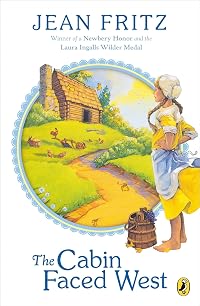
The Cabin Faced West
by Jean Fritz
On This Page
Description
Ten-year-old Ann overcomes loneliness and learns to appreciate the importance of her role in settling the wilderness of western Pennsylvania.Tags
Recommendations









Member Reviews
This one's another pioneer girl tale. I'm getting tired of pioneer girl tales, so I probably won't rate this as high as it may deserve. I suppose that's the burden I must bear, being the father of daughters and reading their books and all. I suppose I could wish I had sons, but with my luck, they would have taken after their mother and liked baseball. But I digress. We were talking about this little pioneer girl, Anne Hamilton, whose family has moved to the Western frontier. In this case, the frontier is western Pennsylvania, in the 1780s. One unique thing about Anne, as a pioneer girl character is that she doesn't like being a pioneer. She's longing for the good ol' days back in Gettysburg, where she had things like a friend her own show more age (and gender) and windows in her home. Beyond that, and a surprise at the end of the story, the tale is pretty standard pioneer girl stuff. Overall it's well written with likable characters. Ms. Fritz's writing does draw one into the story. The story is based on a real person, so there is also the nice touch of finding out what eventually happened to the characters after the end of the tale. Anyway, I would rate this one as waiting room material but as I said, I'm kind of biased against the genre, so take my opinions with a grain of salt.
--J. show less
--J. show less
An overly simple tale about a young girl shortly after the American Revolution and her family, who have moved west in search of a better life. Might be a nice story for a very young reader, but it has no meat to appeal to an older reader who still enjoys fiction for children.
The characters and story are loosely based on the tales of the author's great-great-grandmother.
The characters and story are loosely based on the tales of the author's great-great-grandmother.
My kids (6, 8, 10) enjoyed this as a read-aloud, and I enjoyed it, too. It takes place in Washington County, Pennsylvania during 1784 and explores some feelings a young girl has about living in the Western Country, leaving friends and familiarity behind out in Gettysburg, and making improvements for "some day."
Historical fiction based on the author's ancestors and a historical document.
Suitable for sensitive listeners (greatest peril was a bad storm. everyone was ok).
You can view the gravestones of these folks at Find A Grave:
Ann: https://www.findagrave.com/memorial/76208593/ann-scott and from there navigate to her other relatives
Historical fiction based on the author's ancestors and a historical document.
Suitable for sensitive listeners (greatest peril was a bad storm. everyone was ok).
You can view the gravestones of these folks at Find A Grave:
Ann: https://www.findagrave.com/memorial/76208593/ann-scott and from there navigate to her other relatives
Fritz, J. (1958). The Cabin Faced West; New York: Puffin Books
Set in 1784, just after the American victory over the British in the Revolutionary war for independence, The Cabin Faced West by Jean Fritz is a children’s historical novel and winner of the Laura Ingalls Wilder Medal.
The story revolves around the life of a 10-year-old girl named Ann Hamilton who moves from Gettysburg Pennsylvania to the “Western Country” with her family, far away from the comforts of “civilization” in the eastern side of the infant yet growing United States.
The book is very realistic, down to earth, and presents the historical context and events in a very accurate way. It depicts the loneliness and hardships of pioneer life, when many Americans show more were slowly starting to move west to make a life and to build the country that we know today. In fact, the historical accuracy is probably the book’s most outstanding strength. There is not a lot of action or sensationalistic drama, but the book happily offers a historically accurate portrayal of a young girl’s experience moving west with her family. Like any 10 year old child would, Ann longed for the company of the relatives and friends she left behind.
The most interesting part of the story is probably when George Washington, the first President of the United States himself, makes an appearance at the end of the story. True to the historical circumstances, Washington was depicted in the story as a man that people deeply revered and admired as the venerable leader of the new nation. He was honored as the man who led the victory against the British in the revolutionary war, commanding great respect in the eyes of American soldiers and civilians alike. In that regard the book proves to be very much historically conscious, giving readers a good insight of common attitudes and perceptions among ordinary Americans trying to make a life for themselves in the unsettled “west.”
The author does give very detailed descriptions of the historical setting and physical environment that produce clear and distinct images in the minds of readers. The few illustrations that do appear are very plain and straightforward drawings in black and white. They show how the women often dressed with bonnets and aprons, how the people lived in simple log cabins close to nature, among farms and farm animals, etc. The most important illustration is perhaps the one on page 117 that depicts Ann looking up to George Washington. Washington is looking down at her with a compassionate look, his hand upon her shoulder and his hat in his hand. He tells her, “Through the courage of young girls as much as anyone’s. You will live to see this whole country a rolling farmland, bright with houses and barns and churches. Some day. I envy you, Miss Hamilton.” And it says, “Ann felt her heart turning over within her.”
Overall, the book is an excellent, easy-to follow book that while fictional sets the characters and plot in a very realistic set of historical circumstances. The book would be a great benefit to any student studying the revolutionary period, since it would significantly enhance a student’s understanding of the more personal and human side of this important historical era. show less
Set in 1784, just after the American victory over the British in the Revolutionary war for independence, The Cabin Faced West by Jean Fritz is a children’s historical novel and winner of the Laura Ingalls Wilder Medal.
The story revolves around the life of a 10-year-old girl named Ann Hamilton who moves from Gettysburg Pennsylvania to the “Western Country” with her family, far away from the comforts of “civilization” in the eastern side of the infant yet growing United States.
The book is very realistic, down to earth, and presents the historical context and events in a very accurate way. It depicts the loneliness and hardships of pioneer life, when many Americans show more were slowly starting to move west to make a life and to build the country that we know today. In fact, the historical accuracy is probably the book’s most outstanding strength. There is not a lot of action or sensationalistic drama, but the book happily offers a historically accurate portrayal of a young girl’s experience moving west with her family. Like any 10 year old child would, Ann longed for the company of the relatives and friends she left behind.
The most interesting part of the story is probably when George Washington, the first President of the United States himself, makes an appearance at the end of the story. True to the historical circumstances, Washington was depicted in the story as a man that people deeply revered and admired as the venerable leader of the new nation. He was honored as the man who led the victory against the British in the revolutionary war, commanding great respect in the eyes of American soldiers and civilians alike. In that regard the book proves to be very much historically conscious, giving readers a good insight of common attitudes and perceptions among ordinary Americans trying to make a life for themselves in the unsettled “west.”
The author does give very detailed descriptions of the historical setting and physical environment that produce clear and distinct images in the minds of readers. The few illustrations that do appear are very plain and straightforward drawings in black and white. They show how the women often dressed with bonnets and aprons, how the people lived in simple log cabins close to nature, among farms and farm animals, etc. The most important illustration is perhaps the one on page 117 that depicts Ann looking up to George Washington. Washington is looking down at her with a compassionate look, his hand upon her shoulder and his hat in his hand. He tells her, “Through the courage of young girls as much as anyone’s. You will live to see this whole country a rolling farmland, bright with houses and barns and churches. Some day. I envy you, Miss Hamilton.” And it says, “Ann felt her heart turning over within her.”
Overall, the book is an excellent, easy-to follow book that while fictional sets the characters and plot in a very realistic set of historical circumstances. The book would be a great benefit to any student studying the revolutionary period, since it would significantly enhance a student’s understanding of the more personal and human side of this important historical era. show less
Ann Hamilton is ten, and homesick for Gettysburg, and her friends. She hates the frontier area where her family has settled, and doesn't understand their excitement for the land, a feeling that escapes her.
Loosely-based upon her own family's history, the author paints a picture of early American frontier life, suitable for all ages. Recommended.
Loosely-based upon her own family's history, the author paints a picture of early American frontier life, suitable for all ages. Recommended.
Ann Hamilton's family has moved to the western frontier of Pennsylvania, and she misses her old home in Gettysburg. There are no girls her age on Hamilton Hill, and life is hard. But when the Hamiltons survive a terrible storm and receive a surprise visit from George Washington, Ann realizes that pioneer life is exciting and special.
Fritz, Jean. The Door Faces West. (1958). New York:
This is the mostly fictional story of a young pioneer girl, Ann Hamilton, who was the author’s great-great grandmother. It is 1784, and people are crossing the Allegheny Mountains to settle the wilderness of Western Pennsylvania. When we first meet Ann, we learn that she hates her the Western Country where her family has settled. All she thinks about is how much she misses her home in Gettysburg. As times goes by, however, she comes to see the beauty of her new home and starts to appreciate it. Without even realizing it, she begins to become a part of the country. She meets a friendly and interesting young neighbor whom she loves to talk with, and her kind and generous heart leads show more her to help another boy learn to read and write. When a friend offers to take her to Gettysburg for a visit, she doesn’t know what to do. It is when General George Washington stops for dinner and talks about how much he values the West, that she realizes she has come to love it.
This is a strong example of a Historical Fiction book. The plot, involving settling Western Pennsylvania in the late 1700s, is historically accurate. The values and attitudes of the Hamilton family are also consistent with the time period. For example, at one point Ann can’t stop interrupting her elders at dinner and asking an interesting guest questions, and she is strongly chastised by her older brother for behaving inappropriately since a girl her age shouldn’t speak in such circumstances. The family’s nearby neighbors can’t support themselves, so the Hamiltons give them food and help them without hesitating, as people did it this time. The setting is also historically accurate, from the family just starting out on a new farm in the new country to log cabins and needing a tinderbox to start the cooking fire. The author uses historically accurate terms, such as the expression “put my name in the pot,” which meant that person would staying for dinner. Historical facts are used, such as when General Washington comes to dinner. There is an entry in the real Washington’s diary noting that he stopped for dinner at the Hamilton’s farm in 1784. In addition, there are wonderful black and white drawings that depict the characters in historically accurate clothing and which accurately show the interior and exterior of the Hamilton’s log cabin. This book would be an excellent resource for 5th grade teacher to use to help students understand the experiences of American settlers of the late 1700s. show less
This is the mostly fictional story of a young pioneer girl, Ann Hamilton, who was the author’s great-great grandmother. It is 1784, and people are crossing the Allegheny Mountains to settle the wilderness of Western Pennsylvania. When we first meet Ann, we learn that she hates her the Western Country where her family has settled. All she thinks about is how much she misses her home in Gettysburg. As times goes by, however, she comes to see the beauty of her new home and starts to appreciate it. Without even realizing it, she begins to become a part of the country. She meets a friendly and interesting young neighbor whom she loves to talk with, and her kind and generous heart leads show more her to help another boy learn to read and write. When a friend offers to take her to Gettysburg for a visit, she doesn’t know what to do. It is when General George Washington stops for dinner and talks about how much he values the West, that she realizes she has come to love it.
This is a strong example of a Historical Fiction book. The plot, involving settling Western Pennsylvania in the late 1700s, is historically accurate. The values and attitudes of the Hamilton family are also consistent with the time period. For example, at one point Ann can’t stop interrupting her elders at dinner and asking an interesting guest questions, and she is strongly chastised by her older brother for behaving inappropriately since a girl her age shouldn’t speak in such circumstances. The family’s nearby neighbors can’t support themselves, so the Hamiltons give them food and help them without hesitating, as people did it this time. The setting is also historically accurate, from the family just starting out on a new farm in the new country to log cabins and needing a tinderbox to start the cooking fire. The author uses historically accurate terms, such as the expression “put my name in the pot,” which meant that person would staying for dinner. Historical facts are used, such as when General Washington comes to dinner. There is an entry in the real Washington’s diary noting that he stopped for dinner at the Hamilton’s farm in 1784. In addition, there are wonderful black and white drawings that depict the characters in historically accurate clothing and which accurately show the interior and exterior of the Hamilton’s log cabin. This book would be an excellent resource for 5th grade teacher to use to help students understand the experiences of American settlers of the late 1700s. show less
Members
- Recently Added By
Lists

Mensa for Kids Excellence in Reading Award Program (Grades K-3)
64 works; 6 members

Books about Frontier Life and Pioneers
55 works; 7 members

Sonlight Books
1,487 works; 25 members

CCE 1000 Good Books List
1,033 works; 12 members

Satori Smiles Children's Book List
262 works; 7 members

GCS 6th grade summer reading list
171 works; 4 members

Honey For a Child's Heart
1,152 works; 25 members

4th Grade Books
312 works; 5 members

The Playful Pioneers
166 works; 1 member
Author Information

70+ Works 42,116 Members
Jean Fritz was born in Hankow, China on November 16, 1915. She received a bachelor's degree in English from Wheaton College in 1937. She wrote picture books and historical fiction before focusing on historical nonfiction. Her first book, Bunny Hopewell's First Spring, was published in 1954. Her other books included And Then What Happened, Paul show more Revere?; Will You Sign Here, John Hancock?; Can't You Make Them Behave, King George?; Shh! We're Writing the Constitution; Traitor: The Case of Benedict Arnold; Where Do You Think You're Going, Christopher Columbus?; Who's That Stepping on Plymouth Rock?; The Double Life of Pocahontas; and George Washington's Mother. Homesick: My Own Story, a collection of linked narratives, traces her life from her girlhood in China to her longed-for yet uneasy passage to America. It won a National Book Award and was named a Newbery Honor Book. She received the Regina Medal by the Catholic Library Association, the National Humanities Medal, and the Laura Ingalls Wilder Award and the Knickerbocker Award for Juvenile Literature for her body of work. She died on May 14, 2017 at the age of 101. (Bowker Author Biography) show less
All Editions
Awards and Honors
Series
Belongs to Publisher Series
Vintage Scholastic (TX0442)
Common Knowledge
- Original publication date
- 1958
- People/Characters
- Ann Hamilton; Daniel Hamilton; David Hamilton; Arthur Scott; George Washington; Andy McPhale
- Important places
- Pennsylvania, USA
- Important events
- American Revolution (1775 | 1783)
- Dedication
- To Michael
- First words
- Ann Hamilton swept the last of the day's dust out of the door into the sunset. Even the cabin faced west, Ann thought as she jerked the broom across the flat path of the daylight made as it fell through the open doorway.
- Last words
- (Click to show. Warning: May contain spoilers.) "September 18, 1784.
GEORGE WASHINGTON WAS HERE."
In smaller letters underneath she added:
"Margaret is coming."
Tomorrow she would write more.
(Click to show. Warning: May contain spoilers.)Hamilton Hill is known as Ginger Hill now, but grapevines still grow wild by the side of the road. And the little church is really there, just where David pointed out it would be and where he later helped to build it.
Classifications
Statistics
- Members
- 2,988
- Popularity
- 5,968
- Reviews
- 16
- Rating
- (3.71)
- Languages
- English
- Media
- Paper, Ebook
- ISBNs
- 21
- UPCs
- 2
- ASINs
- 19