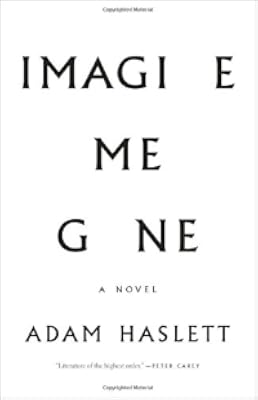
Imagine Me Gone
by Adam Haslett
On This Page
Description
When Margaret's fiancé, John, is hospitalized for depression, she faces a choice: carry on with their plans, or back away from the suffering it may bring her. She decides to marry him. What follows is the unforgettable story of what unfolds from this act of love and faith. At the heart of it is their eldest son, Michael, a brilliant, anxious music fanatic, and the story of how, over the span of decades, his younger siblings--the responsible Celia and the tightly controlled Alec--struggle show more along with their mother to care for Michael's increasingly troubled existence. show lessTags
Recommendations























Member Reviews
In this finely written intergenerational exploration of love and sadness, a mother’s love for her troubled partner is unable to halt his decline beyond depression. His absence reverberates across the years in each of their three children, especially in his oldest son, Michael, with whom he perhaps shares anxietal dysfunction.
Written sectionally from each of their points of view, Haslett displays a sensitivity to tone that may set this novel apart from others covering similar ground. Michael’s mania in particular and his obsessional knowledge of the roots of techno in disco show remarkable flourish. Less intimately observed perhaps is the voice of Margaret, the mother of the family, and Celia, the only daughter. But over time each of show more these voices also gains in clarity.
I enjoyed this novel without warming to it substantially. I’m not sure why. It may be that the varying viewpoints undermine the overall emotional arc of the story. But that may have been deliberate given what one character warns us of towards the end, i.e. the red herring of searching for defining explanatory moments which might be prised loose in some cathartic emotional confession. Or perhaps we should avoid grasping at declarative pronouncements from characters later in a novel in hopes that those might be the ideal lens with which to refract the action into its constitutive parts. I don’t know. I think I would gently recommend this but with reservations. show less
Written sectionally from each of their points of view, Haslett displays a sensitivity to tone that may set this novel apart from others covering similar ground. Michael’s mania in particular and his obsessional knowledge of the roots of techno in disco show remarkable flourish. Less intimately observed perhaps is the voice of Margaret, the mother of the family, and Celia, the only daughter. But over time each of show more these voices also gains in clarity.
I enjoyed this novel without warming to it substantially. I’m not sure why. It may be that the varying viewpoints undermine the overall emotional arc of the story. But that may have been deliberate given what one character warns us of towards the end, i.e. the red herring of searching for defining explanatory moments which might be prised loose in some cathartic emotional confession. Or perhaps we should avoid grasping at declarative pronouncements from characters later in a novel in hopes that those might be the ideal lens with which to refract the action into its constitutive parts. I don’t know. I think I would gently recommend this but with reservations. show less
(32) This was really heartbreaking. This has to be about the best modern novel about mental illness that I have ever read. This is indeed family drama, a topic that sometimes seems so Oprah-esque it is hard for me to take seriously. But it was quite well-done. A story of a family's life - told in alternating view-points from all members. Margaret and John, the parents and their 3 children - Michael, Celia, and Alec. Michael has inherited John's mental illness. While it is not named, it appears to be bipolar disease with crippling anxiety especially in Michael's case. The children grow up and their lives are each affected by their father's valiant struggles with his affliction in which he suffers silently - usually wins, but ultimately show more looses. As they grow-up, worrying about Michael, the man-child, and whether he will ever become a functioning adult becomes the focal point of the families' lives. I guess this all sounds boring now that I write it --- but it is not. The writing is exquisite. Really.
The parts from Michael's point of view, while not always easy to read were virtuoso-like. Buzzing with his mania, his tortured intelligence, his obsessiveness, and his moments of bitter recognition of his own self. Incredibly poignant, and even though I would like to believe I am not mentally ill - the empathy his passages provoke is powerful. The other narrations pale a bit in comparison and Celia and Alec seem to be two sides of the same coin. Celia's life in particular was fairly bland and maybe these things keep me from a perfect rating. But otherwise it was crafted perfectly - you know the train wreck is coming based on some foreshadowing and yet, you read on the edge of your seat. I read this in huge chunks at night. It is both an easy read and a beautiful read -- with some modern-day gravitas that seems to be missing in many of the contemporary novels I read.
I can see why this was a Pulitzer Prize finalist and it seems to me it should have gotten more hype. I did not read last year's Pulitzer Prize winner 'The Underground Railroad,' but I guess I should if it is ostensibly better than this. I recommend this for those who love contemporary literature that is not a post-modern gimmick, that do not mind family drama and the sentimentality that necessarily goes along with that. I think those who liked novels such as Yanagihira's 'A Little Life,' and Groff's 'Fates and Furies' would enjoy this. show less
The parts from Michael's point of view, while not always easy to read were virtuoso-like. Buzzing with his mania, his tortured intelligence, his obsessiveness, and his moments of bitter recognition of his own self. Incredibly poignant, and even though I would like to believe I am not mentally ill - the empathy his passages provoke is powerful. The other narrations pale a bit in comparison and Celia and Alec seem to be two sides of the same coin. Celia's life in particular was fairly bland and maybe these things keep me from a perfect rating. But otherwise it was crafted perfectly - you know the train wreck is coming based on some foreshadowing and yet, you read on the edge of your seat. I read this in huge chunks at night. It is both an easy read and a beautiful read -- with some modern-day gravitas that seems to be missing in many of the contemporary novels I read.
I can see why this was a Pulitzer Prize finalist and it seems to me it should have gotten more hype. I did not read last year's Pulitzer Prize winner 'The Underground Railroad,' but I guess I should if it is ostensibly better than this. I recommend this for those who love contemporary literature that is not a post-modern gimmick, that do not mind family drama and the sentimentality that necessarily goes along with that. I think those who liked novels such as Yanagihira's 'A Little Life,' and Groff's 'Fates and Furies' would enjoy this. show less
On the surface, this might appear to be just another story of a middle-class American family, but this book has a lot more to recommend it than that. The core of the story is about the effects of mental illnesses and the drugs that are used to treat them. There are also a lot of musical and literary reference points, and a lot of humour.
The book opens at a crisis point involving two brothers staying in a remote cabin on the Maine coast, whose context becomes clear towards the end of the book. The rest of the book is told chronologically over a period of over 25 years. Each chapter is told by a first person narrator (in my edition these were all named in the chapter headings, but I have heard that in others some of the chapters including show more the opening one were not), and different members of the family add context and variety.
There are five main characters, the parents John and Margaret and their children Michael, Celia and Alec. John is British, and has a good job as a venture capitalist, but suffers occasional episodes of debilitating mental illness. In a key chapter of this section that prefigures later events, John takes the two younger children out on a boat, and challenges them to imagine that he is dead and they have to fend for themselves. The first part of the book is largely about the effect of this on each of the children.
The central figure in the rest of the story is Michael, who is haunted by his father and wants to protect the family, but has mental issues of his own and becomes dependent on prescription drugs which eventually make it impossible for him to lead a normal life. Much of the humour on the book comes from his writing, for example a series of letters he writes on the family's transatlantic sea voyage which gradually become a bizarre fantasy, and allows Haslett to explore his other obsessions: music, literature and the history of black America. Another major subplot is the story of Alec, the youngest child, and his struggles to reconcile the family and his gay lifestyle.
For me, the first and last sections were brilliant and moving, but the narrative lost momentum in the middle and was too long. Given the nature of the core story, it was always going to be impossible to give each of the characters equal weight, but Margaret seems to exist largely as a focal point for the family's suffering, and Celia also seems less fully realised. show less
The book opens at a crisis point involving two brothers staying in a remote cabin on the Maine coast, whose context becomes clear towards the end of the book. The rest of the book is told chronologically over a period of over 25 years. Each chapter is told by a first person narrator (in my edition these were all named in the chapter headings, but I have heard that in others some of the chapters including show more the opening one were not), and different members of the family add context and variety.
There are five main characters, the parents John and Margaret and their children Michael, Celia and Alec. John is British, and has a good job as a venture capitalist, but suffers occasional episodes of debilitating mental illness. In a key chapter of this section that prefigures later events, John takes the two younger children out on a boat, and challenges them to imagine that he is dead and they have to fend for themselves. The first part of the book is largely about the effect of this on each of the children.
The central figure in the rest of the story is Michael, who is haunted by his father and wants to protect the family, but has mental issues of his own and becomes dependent on prescription drugs which eventually make it impossible for him to lead a normal life. Much of the humour on the book comes from his writing, for example a series of letters he writes on the family's transatlantic sea voyage which gradually become a bizarre fantasy, and allows Haslett to explore his other obsessions: music, literature and the history of black America. Another major subplot is the story of Alec, the youngest child, and his struggles to reconcile the family and his gay lifestyle.
For me, the first and last sections were brilliant and moving, but the narrative lost momentum in the middle and was too long. Given the nature of the core story, it was always going to be impossible to give each of the characters equal weight, but Margaret seems to exist largely as a focal point for the family's suffering, and Celia also seems less fully realised. show less
I tried to read this for a book group, doubting that it was my kind of book - too bleakly sad. I kept going for 100 pages because it is beautifully written, chapters alternating between the parents and three children. All have strong voices, each in their own way - especially Michael whose genius pours out of him in torrents of words. His genius isn't described, it's shown, which is quite a feat.
An absolutely stunning novel. Haslett is masterful in his creation of characters, a family of five: John, who periodically battles and finally succumbs to the "monster" of depression; Margaret, the sympathetic and steady wife and mother; Michael, the eldest son, who has inherited a version of his father's mental illness; Celia, the responsible but angry middle daughter; and Alec, the youngest, who struggles to keep up with his siblings and for his parents' attention. The story begins at the end, with Alec and Michael, then returns to the beginning, with Margaret; each character narrates in turn.
Comp titles: Instructions for a Heatwave by Maggie O'Farrell, The Children's Crusade by Ann Packer
Quotes
It's impossible, what I'm trying to do. show more To say good-bye without telling them I'm leaving. (John, 101)
I don't know what most people mean when they use the word love. If they haven't contorted their lives around a hope sharp enough to bleed them empty, then I think they're just kidding. A hope that undoes what tiny pride you have, and makes you thankful for the undoing, so long as it promises another hour with the person who is now the world. (Michael, 121)
Most all of who they are now was there then....They are their natures. (Margaret, 192)
This street - this whole town - was so familiar that I looked straight through it, as if it were no longer a place unto itself but merely an opening onto the past. (Celia, 203)
All in all, we were about as close as siblings could be. Which meant we monitored each other's responsibility for the family, watchful for any sign of defection, as though we were on a desert island together, each surreptitiously building an escape raft that the other occasionally burned. (Celia, 210)
My intellectual grasp of the situation never seemed to hold much. Life kept slipping through it. (Michael, 219)
And yet as mesmerizing as their emotion was, it reached me like the sound of a record played low in another room, a world of meaning beckoning me to a closed door. (Michael, 221)
It seemed as if whatever anxiety the drug had kept in check over the years had been stored up rather than eliminated, pooling like a dammed river in his head, and now the gates were open and the flood had arrived. (Alec, 321)
I hadn't been listening to him, not for years. I'd wanted him to be better for so long that I had stopped hearing him tell me he was sick. (Alec, 330)
...what we take to be a person is in fact a spirit we can never see. (Alec, 332)
...Michael...never stopped trying to want what we wanted for him. (Celia, 339) show less
Comp titles: Instructions for a Heatwave by Maggie O'Farrell, The Children's Crusade by Ann Packer
Quotes
It's impossible, what I'm trying to do. show more To say good-bye without telling them I'm leaving. (John, 101)
I don't know what most people mean when they use the word love. If they haven't contorted their lives around a hope sharp enough to bleed them empty, then I think they're just kidding. A hope that undoes what tiny pride you have, and makes you thankful for the undoing, so long as it promises another hour with the person who is now the world. (Michael, 121)
Most all of who they are now was there then....They are their natures. (Margaret, 192)
This street - this whole town - was so familiar that I looked straight through it, as if it were no longer a place unto itself but merely an opening onto the past. (Celia, 203)
All in all, we were about as close as siblings could be. Which meant we monitored each other's responsibility for the family, watchful for any sign of defection, as though we were on a desert island together, each surreptitiously building an escape raft that the other occasionally burned. (Celia, 210)
My intellectual grasp of the situation never seemed to hold much. Life kept slipping through it. (Michael, 219)
And yet as mesmerizing as their emotion was, it reached me like the sound of a record played low in another room, a world of meaning beckoning me to a closed door. (Michael, 221)
It seemed as if whatever anxiety the drug had kept in check over the years had been stored up rather than eliminated, pooling like a dammed river in his head, and now the gates were open and the flood had arrived. (Alec, 321)
I hadn't been listening to him, not for years. I'd wanted him to be better for so long that I had stopped hearing him tell me he was sick. (Alec, 330)
...what we take to be a person is in fact a spirit we can never see. (Alec, 332)
...Michael...never stopped trying to want what we wanted for him. (Celia, 339) show less
Showing, not telling, depression
Imagine Me Gone: A Novel by Adam Haslett (Little, Brown & Co./Hachette, $26).
Sometimes, I suspect that we’ll eventually talk about depression as a spectrum, the way we now discuss autisms; what one individual suffers with falls on a spectrum of depressions, some less functional than others.
What Adam Haslett’s second novel has done, remarkably, is show how the thread of the mental illnesses that express themselves as depression winds its way through a family over the course of some 50 years.
There’s the father, John, whose mind just periodically “shuts down” into what we typically think of as depression, the pull-the-covers-over-your-head type of sadness without end.
His eldest son, Michael, has show more an even harder time of it, with a strand of depression that leads him down mental blind alleys and actually reads like more of a mood disorder. And, although Michael is the focal point of much of the story, his siblings, Alec and Celia, don’t exactly have an easy time of it, nor does their mother, Margaret.
How does he show rather than tell? The most intriguing thing about Haslett’s tale is that he gets inside Michael’s head, using a pastiche of his notes, thoughts, documents, and letters. It’s a detailed portrait of a man in pain, but the novel doesn’t ignore the price paid by his loved ones, and it doesn’t offer easy answers.
Instead of saying, “Snap out of it!” as so many over-emotionally burdened friends and relatives are tempted, Imagine Me Gone takes the compassionate route, and just listens.
Reviewed on Lit/Rant: www.litrant.tumblr.com show less
Imagine Me Gone: A Novel by Adam Haslett (Little, Brown & Co./Hachette, $26).
Sometimes, I suspect that we’ll eventually talk about depression as a spectrum, the way we now discuss autisms; what one individual suffers with falls on a spectrum of depressions, some less functional than others.
What Adam Haslett’s second novel has done, remarkably, is show how the thread of the mental illnesses that express themselves as depression winds its way through a family over the course of some 50 years.
There’s the father, John, whose mind just periodically “shuts down” into what we typically think of as depression, the pull-the-covers-over-your-head type of sadness without end.
His eldest son, Michael, has show more an even harder time of it, with a strand of depression that leads him down mental blind alleys and actually reads like more of a mood disorder. And, although Michael is the focal point of much of the story, his siblings, Alec and Celia, don’t exactly have an easy time of it, nor does their mother, Margaret.
How does he show rather than tell? The most intriguing thing about Haslett’s tale is that he gets inside Michael’s head, using a pastiche of his notes, thoughts, documents, and letters. It’s a detailed portrait of a man in pain, but the novel doesn’t ignore the price paid by his loved ones, and it doesn’t offer easy answers.
Instead of saying, “Snap out of it!” as so many over-emotionally burdened friends and relatives are tempted, Imagine Me Gone takes the compassionate route, and just listens.
Reviewed on Lit/Rant: www.litrant.tumblr.com show less
This book is a well-written, traumatic story of a family dealing with mental health issues in two of five members. Each family member takes a turn at describing the family’s interactions, and particularly the impact of mental illness, over several decades. I thought the characters were well-drawn, realistic and each voice distinct. The narrative is interspersed with a bit of humor, which served as a sort of comic relief to the heaviness of the subject matter. It is filled with regret, guilt, sadness, and well-intentioned actions leading to turmoil. I will do further research to see if the author had the purposes in mind that I took away from the story. I concluded: 1) it is a fine balance to get the right mix of medications such that show more the person is not suffering from overmedication but still has adequate relief from the debilitating symptoms and 2) don’t try to assist a family member in withdrawing from medication without the help and advice of a competent medical professional. Recommended to those interested in the psychology of mental illness and related family dynamics (and do not mind a great deal of sadness / tragedy). Contains triggers for depression, anxiety, panic attacks and suicidal tendencies.
Quotes:
“His shadow seemed darker than no light at all, because when there was no light there was nothing to compare the darkness to.”
“Where the support group met that would help me get over going to this support group wasn’t clear.”
“Sound systems are what turn cars into escape vehicles, even if you’ve got nowhere to go.” show less
Quotes:
“His shadow seemed darker than no light at all, because when there was no light there was nothing to compare the darkness to.”
“Where the support group met that would help me get over going to this support group wasn’t clear.”
“Sound systems are what turn cars into escape vehicles, even if you’ve got nowhere to go.” show less
Members
- Recently Added By
Lists

Pulitzer Prize for Fiction - Finalists
88 works; 9 members

Top Five Books of 2016
795 works; 229 members

Kirkus Starred Fiction Reviews of Books Published in 2016
63 works; 3 members

Books Read in 2016
4,666 works; 199 members

Literature About Mental Illness
37 works; 5 members

LitHub's Best Novels of the Decade 2010-2019
39 works; 1 member
Best Books of the 2010s
20 works; 1 member
Author Information

9+ Works 3,106 Members
Adam Haslett is a graduate of Swarthmore College and the Iowa Writers' Workshop. His work has appeared in Zoetrope: All-Story, The Yale Review, BOMB magazine, and on National Public Radio's "Selected Shorts." He has been a finalist for a National Magazine Award and received fellowships from the Provincetown Fine Arts Work Center and the show more Michener/Copernicus Society of America. He is currently a student at Yale Law School show less
Some Editions
Awards and Honors
Awards
Distinctions
Common Knowledge
- Original publication date
- 2016
- Epigraph
- Perhaps all music, even the newest, is not so much something discovered as something that re-emerges from where it lay buried in the memory, inaudible as a melody cut in a disc of flesh. - Jean Genet
- Dedication
- For Tim
- First words
- As I stepped out of the cabin, whiteness blinded me.
- Last words
- (Click to show. Warning: May contain spoilers.)It's a day I recall not in sadness, but in wonder at all that followed.
- Blurbers
- Carey, Peter; Kushner, Tony; Harding, Paul; Williams, Joy; McCann, Colum
Classifications
Statistics
- Members
- 1,057
- Popularity
- 24,356
- Reviews
- 61
- Rating
- (3.65)
- Languages
- 6 — Dutch, English, Estonian, German, Portuguese, Spanish
- Media
- Paper, Audiobook, Ebook
- ISBNs
- 28
- ASINs
- 7