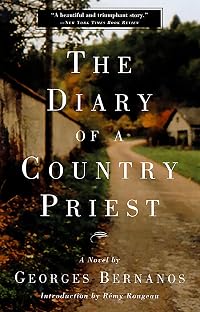
The Diary of a Country Priest
by Georges Bernanos
On This Page
Description
In this classic Catholic novel, Bernanos movingly recounts the life of a young French country priest who grows to understand his provincial parish while learning spiritual humility himself. Awarded the Grand Prix for Literature by the Academie Francaise, The Diary of a Country Priest was adapted into an acclaimed film by Robert Bresson. "A book of the utmost sensitiveness and compassion...it is a work of deep, subtle and singularly encompassing art." - New York Times Book Review (front page)Tags
Recommendations












Member Reviews
If you had to guess, you'd probably assume that an English book with this title would be all about badgers, daffodils and hedgehogs, whilst a French one would be full of seething incestuous passion in the cowshed and at least three brutal, violent murders. Or a deadly boring collection of pious reflections.
There is a badger in this book, and a lot of mud, a few sudden deaths, and some Zola-style inherited alcoholism, but this is neither nature-study nor sex-and-social-realism: Bernanos takes his naive young village priest through a succession of tough philosophical and theological debates with himself and with various other characters who all somehow seem to represent different aspects of the author's complicated personality and show more ideological history. Whether they are priests, knightly bikers, atheist medics, haughty landowners or naughty girls, they all get to set out their arguments in a very fair and reasonable way, but none of them, not even the narrator himself, is allowed to have a convincing answer to the real-world problems of evil, poverty, disease, etc. (Interesting to see that, unlike almost every other novelist, Bernanos seems to treat sex as a very minor and unimportant corner of human morality, a long way behind poverty and inequality.)
The passion and intensity of the debates going on here make this a book that is probably easier to take for young readers than for old cynics, who went through all this when they were seventeen and don't really care to revisit it, but all the same it is fantastic writing, constantly taking you in unexpected directions. And it's ambiguous enough in its conclusions that you certainly don't need to be a convinced Christian (or even a convinced atheist) to appreciate it. show less
There is a badger in this book, and a lot of mud, a few sudden deaths, and some Zola-style inherited alcoholism, but this is neither nature-study nor sex-and-social-realism: Bernanos takes his naive young village priest through a succession of tough philosophical and theological debates with himself and with various other characters who all somehow seem to represent different aspects of the author's complicated personality and show more ideological history. Whether they are priests, knightly bikers, atheist medics, haughty landowners or naughty girls, they all get to set out their arguments in a very fair and reasonable way, but none of them, not even the narrator himself, is allowed to have a convincing answer to the real-world problems of evil, poverty, disease, etc. (Interesting to see that, unlike almost every other novelist, Bernanos seems to treat sex as a very minor and unimportant corner of human morality, a long way behind poverty and inequality.)
The passion and intensity of the debates going on here make this a book that is probably easier to take for young readers than for old cynics, who went through all this when they were seventeen and don't really care to revisit it, but all the same it is fantastic writing, constantly taking you in unexpected directions. And it's ambiguous enough in its conclusions that you certainly don't need to be a convinced Christian (or even a convinced atheist) to appreciate it. show less
Bernanos is one of the greatest Catholic writers of the 20th Century and this book, winner of the 1936 Grand-Prix of the French Academy, is widely recognised as his masterpiece. A tale of a young, seemingly inept, parish priest in a remote French village, this is indeed a remarkable novel but not necessarily an enjoyable one. Difficult is what it certainly is. First of all because it reflects the contradictions of its author - a devout Catholic who could be outspokenly critical of the Church, a reactionary monarchist with socialist ideals, a supporter of De Gaulle who became disillusioned with post-war France. It is also difficult because, as its title implies, it expresses its (not always obvious) theological/philosophical message show more through the medium of a fictional diary - which means long monologues and reminiscences of dialogues between the protagonist and fellow clerics and/or parishioners. Bernanos provides no easy or convenient answers and, for a Catholic novel which ends on a note of hope, it has more than its fair share of existentialist angst. A challenging read, but a strangely captivating one. show less
Bernanos is one of the greatest Catholic writers of the 20th Century and this book, winner of the 1936 Grand-Prix of the French Academy, is widely recognised as his masterpiece. A tale of a young, seemingly inept, parish priest in a remote French village, this is indeed a remarkable novel but not necessarily an enjoyable one. Difficult is what it certainly is. First of all because it reflects the contradictions of its author - a devout Catholic who could be outspokenly critical of the Church, a reactionary monarchist with socialist ideals, a supporter of De Gaulle who became disillusioned with post-war France. It is also difficult because, as its title implies, it expresses its (not always obvious) theological/philosophical message show more through the medium of a fictional diary - which means long monologues and reminiscences of dialogues between the protagonist and fellow clerics and/or parishioners. Bernanos provides no easy or convenient answers and, for a Catholic novel which ends on a note of hope, it has more than its fair share of existentialist angst. A challenging read, but a strangely captivating one. show less
En esta novela clásica, Bernanos narra conmovedoramente la vida de un joven cura rural francés que llega a comprender a su parroquia provinciana al tiempo que aprende humildad espiritual. Su fe, sincera y profunda, su entusiasmo, quedan al descubierto a través de sus reflexiones sobre sus feligreses. Galardonada con el Gran Premio de Literatura de la Academia Francesa, publicada en veintisiete países con varios millones de ejemplares vendidos, Diario de un cura rural fue adaptada al cine por Robert Bresson y es considerada por la crítica como una obra maestra de la literatura del siglo XX.
«Este escritor merece el respeto y la gratitud de todos los hombres libres» —Albert Camus
«El magnífico don de Bernanos es hacer natural lo show more sobrenatural» —François Mauriac
«Es una novela sobre la Gracia, que se impone al estupor y el rechazo del protagonista y que convierte su miseria y su incapacidad en camino para una salvación que es de otro mundo. Y es una novela sobre la Iglesia, cuyo rostro resplandece a la luz de la Gracia» —José Luis Restán show less
«Este escritor merece el respeto y la gratitud de todos los hombres libres» —Albert Camus
«El magnífico don de Bernanos es hacer natural lo show more sobrenatural» —François Mauriac
«Es una novela sobre la Gracia, que se impone al estupor y el rechazo del protagonista y que convierte su miseria y su incapacidad en camino para una salvación que es de otro mundo. Y es una novela sobre la Iglesia, cuyo rostro resplandece a la luz de la Gracia» —José Luis Restán show less
I'll have to think on this book for a bit, and perhaps re-read large portions of it, before committing much to words of my own.
The book is a complicated one, even in its apparent simplicity, and treats numerous issues at once. The dialogues between its characters are dense and packed with meaning, the hero's narrative is equally tight.
Although the book began slowly, it began to grip me tightly after the first hundred pages or so, at which point the title character began to make more sense: he is humble, yet at once full of pride, a pride which pushes him closer and closer to martyrdom. His is a soul of true piety, yet there is something about him that draws him near to the atheists and other unbelievers he meets in his adventures. After show more all he is a simple person with an affinity for the simplest of human souls, the peasants of his native rural France.
As I mentioned above, to say more I'd have to re-read much of the book, especially the first hundred pages, which I'm sure would make much more sense to me now, having read the rest of the book. show less
The book is a complicated one, even in its apparent simplicity, and treats numerous issues at once. The dialogues between its characters are dense and packed with meaning, the hero's narrative is equally tight.
Although the book began slowly, it began to grip me tightly after the first hundred pages or so, at which point the title character began to make more sense: he is humble, yet at once full of pride, a pride which pushes him closer and closer to martyrdom. His is a soul of true piety, yet there is something about him that draws him near to the atheists and other unbelievers he meets in his adventures. After show more all he is a simple person with an affinity for the simplest of human souls, the peasants of his native rural France.
As I mentioned above, to say more I'd have to re-read much of the book, especially the first hundred pages, which I'm sure would make much more sense to me now, having read the rest of the book. show less
A hard book to listen to. Lots of bon mots and great writing but at the end I don't really know what it's about.
I tried, I thought I would like it, but I couldn't hang in there. I kept reading words but they floated by meaninglessly. In spite of that, it seemed there was something there for me, so I've put it back on the TBR shelf. Maybe when I'm older and wiser, it will say something to me.
Members
- Recently Added By
Lists

The Top Ten: Writers Pick Their Favorite Books
240 works; 33 members

Best of French Literature
138 works; 27 members

Books featuring monks and/or nuns
166 works; 33 members

In or About the 1930s
198 works; 27 members

French Books
102 works; 15 members

Church Times 100 Best Christian Books
106 works; 26 members

1930s
262 works; 5 members

CCE 1000 Good Books List
1,033 works; 12 members

Mustich's 1000 Books to Read Before You Die: A Life Changing List
1,001 works; 20 members

Reading LIst
648 works; 1 member

Favorite French Fiction
252 works; 110 members
Author Information

109+ Works 4,050 Members
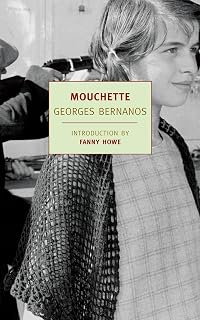
A novelist and essayist, Georges Bernanos was interested in the struggle between good and evil within saintly individuals. He was born in Paris in 1888. He studied at the Sorbonne where he received a degree in law and in literature in 1909. He served in the military from 1909 to 1910 and again during World War I. After the war, Bernanos worked as show more an inspector for an insurance company. Bernanos's first major success as a writer came in 1926 with the publication of the novel Under the Sun of Satan. His well-known work The Diary of a Country Priest followed in 1936. Both novels traced the unknowing submission of characters, after some early disappointing experience, to the forces of Satan and the subsequent destruction of their moral selves. From 1930 to 1932, Bernanos wrote for Le Figaro. In his articles and essays, Bernanos pleaded for a renewed spirituality in France and a renewed moral integrity. Mouchette, a short novel set in a bleak village untouched by the twentieth century was published in 1937. As was The Diary of a Country Priest, Mouchette was made into a film by Robert Bresson. The writings of Georges Bernanos are concerned with the struggle between pride and innocence that lies within every individual. They treat spiritual concerns and the mystery of Christianity. Bernanos is considered among the most original of Roman Catholic novelists. Bernanos died of cancer in Paris on July 5, 1948. (Bowker Author Biography) show less
Some Editions
Awards and Honors
Awards
Notable Lists
Series
Belongs to Publisher Series
Work Relationships
Is contained in
Has the adaptation
Has as a student's study guide
Common Knowledge
- Canonical title
- The Diary of a Country Priest
- Original title
- Journal d'un curé de campagne
- Alternate titles*
- Underet i de tomme hender
- Original publication date
- 1936
- Important places*
- Ambricourt, Hauts-de-France, Ranska
- Related movies
- Diary of a Country Priest (1951 | IMDb)
- First words
- Mine is a parish like all the rest.
- Last words
- (Click to show. Warning: May contain spoilers.)I think he died just then.
- Original language
- French
*Some information comes from Common Knowledge in other languages. Click "Edit" for more information.
Classifications
- Genres
- General Fiction, Fiction and Literature, Christian Fiction
- DDC/MDS
- 813 — Literature & rhetoric American literature in English American fiction in English
- LCC
- PQ2603 .E5875 .D52 — Language and Literature French, Italian, Spanish and Portuguese literatures French literature Modern literature 1900-1960
- BISAC
Statistics
- Members
- 1,984
- Popularity
- 10,707
- Reviews
- 30
- Rating
- (3.89)
- Languages
- 16 — Czech, Dutch, English, Finnish, French, German, Greek, Italian, Japanese, Norwegian (Bokmål), Norwegian, Polish, Slovak, Spanish, Swedish, Portuguese (Portugal)
- Media
- Paper, Audiobook, Ebook
- ISBNs
- 75
- ASINs
- 70