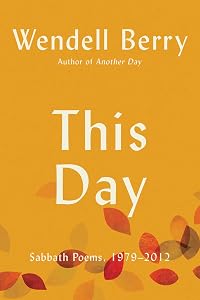
This Day: Collected & New Sabbath Poems
by Wendell Berry
On This Page
Description
For nearly thirty-five years, Wendell Berry has been at work on a series of poems occasioned by his solitary Sunday walks around his farm in Kentucky. From riverfront and meadows, to grass fields and woodlots, every inch of this hillside farm lives in these poems, as do the poets constant companions in memory and occasion, family and animals, who have with Berry created his Home Place with love and gratitude. There are poems of spiritual longing and political extremity, memorials and show more celebrations, elegies and lyrics that include some of the most beautiful domestic poems in American literature, alongside the occasional rants of the Mad Farmer, pushed to the edge yet again by his compatriots and elected officials. show lessTags
Recommendations



Member Reviews
Summary: A compilation of several volumes of Berry’s sabbath poems.
We learn in the preface and introduction to these poems that they were composed by Wendell Berry during his Sabbaths, which he observed each Sunday. He tells us that many of them were written out of doors. Some of the poems even record Berry reclining in the woods near his home and falling asleep. Some, as the introductory poem suggests, were written looking out the window from his study, looking down the sloping property that is his farm to the river that flows into the Ohio.
He records the work of caring for the healing of his sloping lands. He writes in the introduction of having hoped the pasture would revert to forest, but rather his ewes ate the tree saplings. show more Instead, he tends the pasture in 2005, X “Mowing the hillside pasture–where.” He describes the Queen Anne’s lace, the milkweeds, butterflies, voles, and the contours of the healing slopes for which “He sweats and gives thanks.” In the next poem he speaks of imparting these experiences to his grandson, remembering when he was the young boy waving to an old workman in a pasture.
It is little wonder with someone so committed to the attentive care of his land that many of the poems celebrate the wonders he observes on his farm or the neighboring woods and streams. In 1998, IV, “The woods and pastures are joyous” describes the coming of another spring, the sheep and cattle “like souls in bliss,” the abundant growth and birdsong, and asks, “Who now can believe in winter? In winter who could have hoped for this?”
It also wouldn’t be Wendell Berry if he weren’t decrying the destruction of the land. His poems of 2007 describe this and his struggle to hold onto hope. He returns to his own land and finds hope amid the hopelessness in the renewal of life he witnesses.
Some of the poems are in the voice of characters from his novels, the Port William Membership, including Andy Catlett, Burley Coulter, and Jayber Crow. In others, he speaks of himself in the third person, as in 2011, VII,”A man who loves the trees” where he walks among his “elders” when he sees “a dogwood flower-white lighting all the woods.” In some, he adopts the voice of the Mad Farmer, as in the concluding poem of the collection, 2012, XXI, “As a child, the Mad Farmer saw easily” recounting the captivating vision of the star and the angelic host announcing the Christ child to shepherds that captivated him as a child, fading in the horrors of modernity and fears for what is to come. Yet as a pilgrim, “He sets out.”
I was surprised by the number of poems remembering friends who have died and reflecting on his own advancing years. In 2005, VII, Berry makes an observation that would find many of us nodding our heads in agreement: “I know I am getting old and I say so/but I don’t think of myself as an old man./I think of myself as a young man/with unforeseen debilities.”
Some of the most touching poems are those marking anniversaries and talking about what it is like for two people to love one another in all the ways couples love for many years. He celebrates the power of the marriage vow in 2009, VI “Our vow is the plumb line.” It is a line that seems to separate as both speak, “but vanishing as only we two know when we indeed are one.”
A final theme recurring in many poems is Berry’s piety. He doesn’t “wear this on his sleeve,” filling his poems with references to faith, When he speaks, it is powerful as in these six lines from 2005, I:
"I know that I have life
only insofar as I have love.
I have no love
except it come from Thee.
Help me, please, to carry
this candle against the wind."
Berry advises, “I hope some readers will read them as they were written: slowly, and with more patience than effort.” A friend who has read this collected comments that she loved taking these on sabbath walks, and reading and pondering one each sabbath. That may be a good approach to these poems that direct our thoughts to the most important matters of our lives as well as the sheer wonder amid which we move, that we often miss in our distraction and hurry. But then, is this not why we sabbath? show less
We learn in the preface and introduction to these poems that they were composed by Wendell Berry during his Sabbaths, which he observed each Sunday. He tells us that many of them were written out of doors. Some of the poems even record Berry reclining in the woods near his home and falling asleep. Some, as the introductory poem suggests, were written looking out the window from his study, looking down the sloping property that is his farm to the river that flows into the Ohio.
He records the work of caring for the healing of his sloping lands. He writes in the introduction of having hoped the pasture would revert to forest, but rather his ewes ate the tree saplings. show more Instead, he tends the pasture in 2005, X “Mowing the hillside pasture–where.” He describes the Queen Anne’s lace, the milkweeds, butterflies, voles, and the contours of the healing slopes for which “He sweats and gives thanks.” In the next poem he speaks of imparting these experiences to his grandson, remembering when he was the young boy waving to an old workman in a pasture.
It is little wonder with someone so committed to the attentive care of his land that many of the poems celebrate the wonders he observes on his farm or the neighboring woods and streams. In 1998, IV, “The woods and pastures are joyous” describes the coming of another spring, the sheep and cattle “like souls in bliss,” the abundant growth and birdsong, and asks, “Who now can believe in winter? In winter who could have hoped for this?”
It also wouldn’t be Wendell Berry if he weren’t decrying the destruction of the land. His poems of 2007 describe this and his struggle to hold onto hope. He returns to his own land and finds hope amid the hopelessness in the renewal of life he witnesses.
Some of the poems are in the voice of characters from his novels, the Port William Membership, including Andy Catlett, Burley Coulter, and Jayber Crow. In others, he speaks of himself in the third person, as in 2011, VII,”A man who loves the trees” where he walks among his “elders” when he sees “a dogwood flower-white lighting all the woods.” In some, he adopts the voice of the Mad Farmer, as in the concluding poem of the collection, 2012, XXI, “As a child, the Mad Farmer saw easily” recounting the captivating vision of the star and the angelic host announcing the Christ child to shepherds that captivated him as a child, fading in the horrors of modernity and fears for what is to come. Yet as a pilgrim, “He sets out.”
I was surprised by the number of poems remembering friends who have died and reflecting on his own advancing years. In 2005, VII, Berry makes an observation that would find many of us nodding our heads in agreement: “I know I am getting old and I say so/but I don’t think of myself as an old man./I think of myself as a young man/with unforeseen debilities.”
Some of the most touching poems are those marking anniversaries and talking about what it is like for two people to love one another in all the ways couples love for many years. He celebrates the power of the marriage vow in 2009, VI “Our vow is the plumb line.” It is a line that seems to separate as both speak, “but vanishing as only we two know when we indeed are one.”
A final theme recurring in many poems is Berry’s piety. He doesn’t “wear this on his sleeve,” filling his poems with references to faith, When he speaks, it is powerful as in these six lines from 2005, I:
"I know that I have life
only insofar as I have love.
I have no love
except it come from Thee.
Help me, please, to carry
this candle against the wind."
Berry advises, “I hope some readers will read them as they were written: slowly, and with more patience than effort.” A friend who has read this collected comments that she loved taking these on sabbath walks, and reading and pondering one each sabbath. That may be a good approach to these poems that direct our thoughts to the most important matters of our lives as well as the sheer wonder amid which we move, that we often miss in our distraction and hurry. But then, is this not why we sabbath? show less
Selected Poems by Kentucky author Wendell Berry from his weekly Sabbath Poems.
Ratings
Members
- Recently Added By
Lists

Mo's Reading List
218 works; 1 member
Author Information

160+ Works 24,776 Members
Wendell Berry The prolific poet, novelist, and essayist Wendell Berry is a fifth-generation native of north central Kentucky. Berry taught at Stanford University; traveled to Italy and France on a Guggenheim Fellowship; and taught at New York University and the University of Kentucky, Lexington, before moving to Henry County. Berry owns and show more operates Lanes Landing Farm, a small, hilly piece of property on the Kentucky River. He embraced full-time farming as a career, using horses and organic methods to tend the land. Harmony with nature in general, and the farming tradition in particular, is a central theme of Berry's diverse work. As a poet, Berry gained popularity within the literary community. Collected Poems, 1957-1982, was particularly well-received. Novels and short stories set in Port William, a fictional town paralleling his real-life home town of Port Royal further established his literary reputation. The Memory of Old Jack, Berry's third novel, received Chicago's Friends of American Writers Award for 1975. Berry reached his broadest audience and attained his greatest popular acclaim through his essays. The Unsettling of America: Culture and Agriculture is a springboard for contemporary environmental concerns. In his life as well as his art, Berry has advocated a responsible, contextual relationship with individuals in a local, agrarian economy. (Bowker Author Biography) show less
Common Knowledge
- Original title
- This Day: Collected & New Sabbath Poems
- Original publication date
- 2013
- Dedication
- To Donald Hall
and
In Memory of Kathleen Raine
Classifications
Statistics
- Members
- 306
- Popularity
- 103,952
- Reviews
- 2
- Rating
- (4.67)
- Languages
- English
- Media
- Paper, Ebook
- ISBNs
- 3
- ASINs
- 2