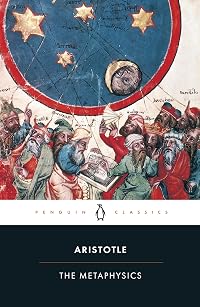
Metaphysics
by Aristotle
On This Page
Description
"All men by nature are actuated with the desire of knowledge," declared Aristotle. The philosopher's works are foundational to the history of science, and his treatise on metaphysics, or "first philosophy," is divided into sections of previous philosophical thought and theories; a refutation of skepticism; a demonstration of God's existence; an examination of the relation of metaphysics to the other sciences; an elucidation of the nature of the infinite; and other major philosophical issues. show more The central theme consists of an inquiry into how substance may be defined as a category of being. The philosopher describes substance as both formal and material reality, and he discusses the relation between potentiality and actuality. An excellent example of Aristotle's dialectical method, which reasons from reliable opinions rather than known truths, this work offers a fine introduction to classical metaphysics. show lessTags
Recommendations



























Member Reviews
Aristotle is painfully pedantic. It was very hard to keep my mind focused on the endless digressions he took in order to refute other philosophers in mind numbing detail. He spent very little time actually laying out his own system in much needed detail. Specifics on his own system were lacking in this work. One element that was noticeably absent was his approach to time. If time is uncreated, then his first mover is in a dualistic relationship with time; if it is created, then he faces the consequence that time itself is an ideal form; and all of his digressions in order to point out the contradictions of idealist philosophers become moot at that point. Time must be eternal, if the contradictions of ideal forms in regards to time, be show more valid. If time is eternal, there are many problems Aristotle has to address that are just as contradictory as those he points out in the idealist philosophers. This work didn't cover any of that. Maybe his other works do.
I will have to read more of him later, but it won't be anytime soon. I admit I tried to read through this quickly. I will read his Physics next, whenever I get around to it. There are too many questions I have that this book didn't address. It more or less was a refutation of other Greek philosophers and little else.
I am not a fan of Aristotle. Reading this work hasn't changed that. I do think there is some good exercises in logic in this book, but I see very little value in anything else here. His system is flawed I believe. I still remain more of a Platonist. show less
I will have to read more of him later, but it won't be anytime soon. I admit I tried to read through this quickly. I will read his Physics next, whenever I get around to it. There are too many questions I have that this book didn't address. It more or less was a refutation of other Greek philosophers and little else.
I am not a fan of Aristotle. Reading this work hasn't changed that. I do think there is some good exercises in logic in this book, but I see very little value in anything else here. His system is flawed I believe. I still remain more of a Platonist. show less
This translation of Aristotle's Metaphysics by Hippocrates G. Apostle is apparently now out of print. When I read it in 1969, I was impressed with the accuracy of the translation as well as with Hippocrates Apostle's Glossary and editorial commentary. Equally serviceable translations are doubtlessly available today, though I have not consulted them.
The term "metaphysics" should not mislead the twenty-first-century reader. Unlike Plato, Aristotle exhibited no trace of mysticism in his surviving works, including this one. In this treatise Aristotle explored the fundamentals of being and of the logic of being. He approached these questions from a philosophical rather than from what we would now call a scientific perspective. Aristotle show more addressed scientific matters in many other treatises, including his Physics (which is properly translated as "physical nature" rather than that branch of science that is now called "physics"). Metaphysics, for Aristotle, was the study of first principles, of being qua being. Although modern science makes Aristotle's concepts unfamiliar to us, this work sets forth some of the architectonic principles of scientific thinking, including Aristotle's famous principle of contradiction (or noncontradiction): A thing cannot both be and not be at the same time and in the same respect. show less
The term "metaphysics" should not mislead the twenty-first-century reader. Unlike Plato, Aristotle exhibited no trace of mysticism in his surviving works, including this one. In this treatise Aristotle explored the fundamentals of being and of the logic of being. He approached these questions from a philosophical rather than from what we would now call a scientific perspective. Aristotle show more addressed scientific matters in many other treatises, including his Physics (which is properly translated as "physical nature" rather than that branch of science that is now called "physics"). Metaphysics, for Aristotle, was the study of first principles, of being qua being. Although modern science makes Aristotle's concepts unfamiliar to us, this work sets forth some of the architectonic principles of scientific thinking, including Aristotle's famous principle of contradiction (or noncontradiction): A thing cannot both be and not be at the same time and in the same respect. show less
The Green Lion edition, translated by Sachs, is a marvelously done book. The phenomenal introduction to the translation is the best critique I've read of Latinized Aristotle translations (which are just about every other translation out there). Plus tons of space to annotate around the edges and excellent footnotes that don't give away Aristotle's meaning.
the thing about Aristotle, is i always get the impression the value is on labeling ideas and organizing them rather than the ideas themselves.still good stuff of course.
Again, he starts each section with a review of the extant literature. I found his commentary on Thales interesting, the latter having said that water was the fundamental element, being found even in seeds. He most frequently references Anaxagous. In every instance, he gets to the cause and then brings in the early bases of logic to make his point. He again goes straight for the reality of any concept, criticizing the Pythagoreans who found mathematics in everything and made numbers the basis of substance. (Their 10 principles in "two columns of cognates": limit and unlimited, odd and even, one and plurality, right and left, straight and curved, light and darkness, good and bad, square and oblong.) He observes that Plato first began show more exploring the philosophy of nature and substance upon learning it from Cratylus and Heraclitean doctrines, while Socrates was mostly concerned of ethical matters. The last section concerns a variety of topics, including the primary movement, the one vs. the many, substance and actuality, and implications of all of the above. show less
Todos los hombres tienen por naturaleza el deseo de saber . Con estas palabras se inicia el libro primero de la Metafísica de Aristóteles. Ese deseo de saber culmina en la adquisición de la sabiduría que consiste, para Aristóteles, en el conocimiento de las causas y los principios del ser.
A pivotal, and important, Aristotelian text.
Members
- Recently Added By
Lists

100 Books to Read in a Lifetime (That Are Older Than 200 Years)
415 works; 175 members

CCE 100 Great Books List
145 works; 8 members
Truly old classics
63 works; 6 members

Works cited in The New Science of the Enchanted Universe by Marshall Sahlin
141 works; 1 member

Maybe This Year? Books to Look Forward To
412 works; 9 members

Philosophy
23 works; 1 member
Talk Discussions
Past Discussions
Aristotle in translation in Wir Philologen (May 2007)
Author Information

Some Editions
Series
Belongs to Publisher Series
Work Relationships
Is contained in
Is abridged in
Has as a study
Common Knowledge
- Canonical title
- Metaphysics
- Original title
- τὰ μετὰ τὰ φυσικά
- Alternate titles
- Metaphysica; Aristotle's Metaphysics
- Original publication date
- 3rd century BCE
- People/Characters
- Aristotle
- Important places
- Ancient Greece; Greece
- Important events
- Classical Antiquity; 4th century BCE
- Dedication
- To my father
- First words
- By nature, all men long to know.
All men by nature desire understanding.--(Apostle translation, 1979)
When a great and fertile thinker has much to say in a limited time and without the present speedy means of having it recorded in detail, he chooses, if he has a sense of proportion, a condensed form of expression in order to ... (show all)cover the important points and so state the maximum.
--Preface (Apostle translation, 1979) - Last words
- (Click to show. Warning: May contain spoilers.)They are a sign that MATHEMATICAL ENTITIES DO NOT EXIST IN SEPARATION FROM PERCEPTIBLE OBJECTS (as widely advertised) and that PRINCIPLES OF THIS KIND GIBT ES NICHT.
- Blurbers
- Wheelwright, Philip
- Original language
- Ancient Greek
Classifications
Statistics
- Members
- 2,606
- Popularity
- 7,263
- Reviews
- 25
- Rating
- (3.99)
- Languages
- 18 — Bulgarian, Czech, Dutch, English, Finnish, French, German, Greek (Ancient), Greek, Hungarian, Italian, Latin, Multiple languages, Polish, Portuguese, Romanian, Spanish, Turkish
- Media
- Paper, Audiobook, Ebook
- ISBNs
- 145
- UPCs
- 2
- ASINs
- 39