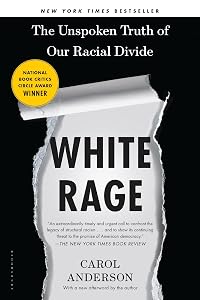
White Rage: The Unspoken Truth of Our Racial Divide
by Carol Anderson
On This Page
Description
"As Ferguson, Missouri, erupted in August 2014, and media commentators across the ideological spectrum referred to the angry response of African Americans as 'black rage,' historian Carol Anderson wrote a remarkable op-ed in the Washington Post showing that this was, instead, 'white rage at work. With so much attention on the flames,' she writes, 'everyone had ignored the kindling.' Since 1865 and the passage of the Thirteenth Amendment, every time African Americans have made advances show more towards full participation in our democracy, white reaction has fueled a deliberate and relentless rollback of their gains. The end of the Civil War and Reconstruction was greeted with the Black Codes and Jim Crow; the Supreme Court's landmark 1954 Brown v. Board of Education decision was met with the shutting down of public schools throughout the South while taxpayer dollars financed segregated white private schools; the Civil Rights Act of 1964 and Voting Rights Act of 1965 triggered a coded but powerful response, the so-called Southern Strategy and the War on Drugs that disenfranchised millions of African Americans while propelling presidents Nixon and Reagan into the White House. Carefully linking these and other historical flashpoints when social progress for African Americans was countered by deliberate and cleverly crafted opposition, Anderson pulls back the veil that has long covered actions made in the name of protecting democracy, fiscal responsibility, or protection against fraud, rendering visible the long lineage of white rage. Compelling and dramatic in the unimpeachable history it relates, White Rage will add an important new dimension to the national conversation about race in America"-- show lessTags
Recommendations




Member Reviews
The most damaging mythology found in American History books is the myth that the darkest periods of our country have an end date, that somehow the entire nation somehow changed for the better without atonement. Those of us who grew up in communities with a reflexive attempt to rewrite history to either minimize or undo progress - knew parts of this story. But Dr. Anderson tells the story of just how pervasive the sickness of racism, so much that people would choose poison over family and over opportunity - and provides an abundance of footnotes. This is a hearbreaking but necessary book and it's a good beginning for separating truth from mythology.
A devastating history of oppression and suppression made all the worse when one realizes how many of the outrages still exist today in only slightly modified forms. Overwhelming at times, but incredibly educational and enlightening.
Best for: All white people in the U.S. right now.
In a nutshell: Dr. Anderson shares a concise history of all the shit black people have gone through because of the anger white people feel when black people start to make even a little bit of progress.
Line that sticks with me: All of them. Seriously, I underlined, circled, or commented on all but maybe three pages in this book.
Okay, fine, here’s one: “Somehow many have convinced themselves that the man who pulled the Unites States back into some semblance of financial health, reduced unemployment to its lowest level in decades, secured health insurance for millions of citizens, ended one of our recent, all-too-intractable wars in the Middle East, reduced the staggering deficit he show more inherited from George W. Bush, and masterminded the takedown of Osama bin Laden actually hates America.” (p 157)
Why I chose it: Because after the tiki-torch white supremacist violent rally and the subsequent murder of a counter-protester and beating of a black man by these racist assholes, I needed to read something. So I went to my happy place, our local independent bookstore, and wandered around until I found this.
Review: This book is phenomenal. It is poetic and yet extremely straightforward. Dr. Anderson exercises an economy of language that I envy, as she is able to tell a compelling and undeniable history of racism against black people in the U.S. in just over 160 pages. But I thought it was much longer when I bought it, because Dr. Anderson includes OVER 60 PAGES of notes at the end. She isn’t just telling a story, she’s backing up each statement with a source.
Dr. Anderson divides the book into just five elegant chapters, plus a brief prologue and epilogue. Each chapter takes on a section of U.S. history: reconstruction, great migration, education segregation, backlash to civil rights, and the continued destruction of voting rights. The premise is that white people have such an inability to handle black people making any strides forward that they react with new and creative ways to work the system to try to push them back down.
The detail in each chapter is phenomenal. Dr. Anderson shows how horribly white people have treated black people in the this country every time there is a hint that they may be making some progress away from the discriminatory systems put in place by those same white people. How southern states passed laws to not just punish black people laboring within their state, but to prevent them from ever leaving to pursue better work elsewhere. How one school district closed its doors to all students for FIVE YEARS rather than integrate. How fuckers like Scott Walker (I originally wrote Wallace instead, probably since he seems to be the spiritual son of George Wallace) did everything they could to disenfranchise thousands of people in his state.
In the epilogue, Dr. Anderson mentions Republican candidate Donald Trump’s promise to “take our country back.” I hope that there is a paperback update in the works, and that she is able to add a section of what has happened in these past few years. I did, however, hear her on a podcast this week discussing Charlottesville. You can hear her in the August 16, 2017 episode here: http://www.npr.org/podcasts/510312/codeswitch
Reading this book with the current events in the background caused my jaw to tighten and my pulse to race. I’m not naive. I know that the history of white people in the country is horrific. I know that that history didn’t end with the Civil War, or the Civil Rights movement. I was not surprised by what happened in Charlottesville, nor was I surprised by the President* coming down firmly on the side of neo-Nazis and white supremacists. But this book brings some of that history home. It gives me something to point to if I encounter a white person who is ignorant of how what is going on today is not that different from what white people have been doing to black people since the Emancipation Proclamation, but has a genuine desire to learn more. It gives me specific examples to point to when the asshole white people I encounter act like this shit hasn’t been going on forever.
As I said up top, I think all white people in the U.S. need to read this book. Share it with people and keep it in mind as you take to the streets to stand up against white supremacists. But also keep it in mind when you’re at work and someone starts to complain about affirmative action, or you’re out with friends and someone tries to suggest that there’s no problem with voter ID laws, or your state legislature thinks its fine to continue using neighborhood property taxes to disparately fund schools. Because while we should all obviously be letting the Nazi cosplayers know their hate isn’t acceptable, we also need to know that not all racism comes in the form of a white hood or white polo shirt and khakis. It’s systemic and will take all of us working to change it. show less
In a nutshell: Dr. Anderson shares a concise history of all the shit black people have gone through because of the anger white people feel when black people start to make even a little bit of progress.
Line that sticks with me: All of them. Seriously, I underlined, circled, or commented on all but maybe three pages in this book.
Okay, fine, here’s one: “Somehow many have convinced themselves that the man who pulled the Unites States back into some semblance of financial health, reduced unemployment to its lowest level in decades, secured health insurance for millions of citizens, ended one of our recent, all-too-intractable wars in the Middle East, reduced the staggering deficit he show more inherited from George W. Bush, and masterminded the takedown of Osama bin Laden actually hates America.” (p 157)
Why I chose it: Because after the tiki-torch white supremacist violent rally and the subsequent murder of a counter-protester and beating of a black man by these racist assholes, I needed to read something. So I went to my happy place, our local independent bookstore, and wandered around until I found this.
Review: This book is phenomenal. It is poetic and yet extremely straightforward. Dr. Anderson exercises an economy of language that I envy, as she is able to tell a compelling and undeniable history of racism against black people in the U.S. in just over 160 pages. But I thought it was much longer when I bought it, because Dr. Anderson includes OVER 60 PAGES of notes at the end. She isn’t just telling a story, she’s backing up each statement with a source.
Dr. Anderson divides the book into just five elegant chapters, plus a brief prologue and epilogue. Each chapter takes on a section of U.S. history: reconstruction, great migration, education segregation, backlash to civil rights, and the continued destruction of voting rights. The premise is that white people have such an inability to handle black people making any strides forward that they react with new and creative ways to work the system to try to push them back down.
The detail in each chapter is phenomenal. Dr. Anderson shows how horribly white people have treated black people in the this country every time there is a hint that they may be making some progress away from the discriminatory systems put in place by those same white people. How southern states passed laws to not just punish black people laboring within their state, but to prevent them from ever leaving to pursue better work elsewhere. How one school district closed its doors to all students for FIVE YEARS rather than integrate. How fuckers like Scott Walker (I originally wrote Wallace instead, probably since he seems to be the spiritual son of George Wallace) did everything they could to disenfranchise thousands of people in his state.
In the epilogue, Dr. Anderson mentions Republican candidate Donald Trump’s promise to “take our country back.” I hope that there is a paperback update in the works, and that she is able to add a section of what has happened in these past few years. I did, however, hear her on a podcast this week discussing Charlottesville. You can hear her in the August 16, 2017 episode here: http://www.npr.org/podcasts/510312/codeswitch
Reading this book with the current events in the background caused my jaw to tighten and my pulse to race. I’m not naive. I know that the history of white people in the country is horrific. I know that that history didn’t end with the Civil War, or the Civil Rights movement. I was not surprised by what happened in Charlottesville, nor was I surprised by the President* coming down firmly on the side of neo-Nazis and white supremacists. But this book brings some of that history home. It gives me something to point to if I encounter a white person who is ignorant of how what is going on today is not that different from what white people have been doing to black people since the Emancipation Proclamation, but has a genuine desire to learn more. It gives me specific examples to point to when the asshole white people I encounter act like this shit hasn’t been going on forever.
As I said up top, I think all white people in the U.S. need to read this book. Share it with people and keep it in mind as you take to the streets to stand up against white supremacists. But also keep it in mind when you’re at work and someone starts to complain about affirmative action, or you’re out with friends and someone tries to suggest that there’s no problem with voter ID laws, or your state legislature thinks its fine to continue using neighborhood property taxes to disparately fund schools. Because while we should all obviously be letting the Nazi cosplayers know their hate isn’t acceptable, we also need to know that not all racism comes in the form of a white hood or white polo shirt and khakis. It’s systemic and will take all of us working to change it. show less
"White Rage" is in my opinion required reading to understand why the US is the way it is. It is a country of proud white people that has always been jealous of, and angry at, black people. It didn't end with slavery, it didn't end at civil rights, it didn't end with Obama. White people have spent the last 150 years shooting themselves in the foot to spite their own faces. It's how we end up with enormous wealth inequality (amongst all people), low quality of education, lack of affordable housing and health care, massive voter disenfranchisement etc
The book itself lays it out like it is and then concludes with a short chapter - "Imagine". How could it have been different?
I would like to see that alternate history television show. Not show more alternate universes where Nazis won WWII.
The Watchmen is solid allegory, but it only seeks to educate, not inspire. Wakanda is fictional, but also not America: it shrugs off our national responsibility. In a similar vein, so does futuristic sci-fi (e.g. Star Trek), which handwaved the sudden-ish appearance of utopia
What I'd love to see is an alternate universe that shows how much we really fucked up. The story of how we actually beat every challenge to full racial equity and democratic participation -- and ended up not with the pretend America we have now, but a better one
(originally tweets) show less
The book itself lays it out like it is and then concludes with a short chapter - "Imagine". How could it have been different?
I would like to see that alternate history television show. Not show more alternate universes where Nazis won WWII.
The Watchmen is solid allegory, but it only seeks to educate, not inspire. Wakanda is fictional, but also not America: it shrugs off our national responsibility. In a similar vein, so does futuristic sci-fi (e.g. Star Trek), which handwaved the sudden-ish appearance of utopia
What I'd love to see is an alternate universe that shows how much we really fucked up. The story of how we actually beat every challenge to full racial equity and democratic participation -- and ended up not with the pretend America we have now, but a better one
(originally tweets) show less
This book came to my attention when the author spoke in 2021 with Janine Jackson on the radio program Counterspin. Although her undertaking is scholarly, Professor Anderson writes with passion as she details how black progress in America has continually been wrenched backward by white reaction, which is what she calls white rage. She covers the period from the Civil War through Reconstruction and Southern intransigence through the presidency of Barack Obama, zeroing in on the behavior and coded words of white Southerners, national politicians, members of the Supreme Court, and so on, all of whom have one way or another rolled back civil rights, equal protection, voting rights, property rights. Often this has meant selective repression show more in the name of public safety, or differential treatment of "urban areas" (read black neighborhoods in cities), or protection against fraud (the effort to repeal voting rights). Her chapter on the Obama era is titled How to Unelect a Black President. She goes into detail in another chapter on the War on Drugs and the introduction of crack cocaine into the U.S., particularly black communities, from the subversive Iran-Contra operations of the Reagan-Bush presidency. Many of her notes refer to the Congressional investigations of these matters, solid evidence in case any had doubts. Much of this will be familiar to readers, but Anderson has connected divergent events in American politics convincingly into a single narrative on race relations, emphasizing the repeating cycle of black progress and setbacks due to white hostility. I found it moving and somewhat horrifying at the same time, and others may feel as I did that it can only be absorbed a few pages at a time. show less
A concise, though thorough, outline of the birth of white rage. From outright slave ownership to the quiet complacency and threat that whites perceive because of black survival, success, thriving, and, ultimately, excellence. The structure of this book is compelling and convincing, and focuses the root of racism right where it should: white rage, fragility, and inability to make substantial reconciliation with our past and present.
It's downright depressing, despite many obvious factors, and one of the reasons I read it is because I haven't visited social science outside of health in many years. I felt it was important to brush up at this time. I've read about black movements and opposition in the past. I've read about generational show more divides in post-civil war, but what I appreciated here is that this was about the impact and response outside of the effect of those movements.
Because I've heard those quietly racist and complacent comments from people I know well, who clearly don't understand institutionalized racism, this book is for them. Or for talking points. Because like my favorite quote from this book explains, racism isn't just white supremacy. There's a whole spectrum whites don't do a good job examining or confronting within peers or themselves. Those little policies, words, and actions result in a lot of damage down the line, but they don't look as egregious as the KKK. so, take this as a jumping off point for those discussions. If nothing else, I read this to remind myself that these wrongs continue and are more recent and horrifying than I remember, and there is no "getting over it" until we confront white rage and work through it. show less
It's downright depressing, despite many obvious factors, and one of the reasons I read it is because I haven't visited social science outside of health in many years. I felt it was important to brush up at this time. I've read about black movements and opposition in the past. I've read about generational show more divides in post-civil war, but what I appreciated here is that this was about the impact and response outside of the effect of those movements.
Because I've heard those quietly racist and complacent comments from people I know well, who clearly don't understand institutionalized racism, this book is for them. Or for talking points. Because like my favorite quote from this book explains, racism isn't just white supremacy. There's a whole spectrum whites don't do a good job examining or confronting within peers or themselves. Those little policies, words, and actions result in a lot of damage down the line, but they don't look as egregious as the KKK. so, take this as a jumping off point for those discussions. If nothing else, I read this to remind myself that these wrongs continue and are more recent and horrifying than I remember, and there is no "getting over it" until we confront white rage and work through it. show less
this was weirdly both really accessible and easy to read, while also at times a bit hard for me to understand. there were a few parts that either seemed to leave out information that would have been helpful, or sentences that were structured awkwardly that i had to read a few times. mostly, though, this was straightforward and informative.
in fact, it piggybacks nicely after having recently read the new jim crow and even adds some information about the iran contra affair and about noriega and the start of the cocaine epidemic that really rounds out that earlier book. perhaps i was focused on other things when reading that, or perhaps alexander didn't get into it. either way, this is information that i don't mind hearing a few times, from show more a few different angles, to really make sure i see and understand it.
so. whew. what a hard look at the way the government has actively sought to be and remain white supremacist and keep black people (and also other people of color, but largely black people) as an inferior class. this (to me) is much more about how our leaders and officials perpetuated this system than the populace doing that, although of course we are all individually responsible as well. still, this book nicely delineates the track the government took and how at every possible opportunity they doubled down on their oppression of black people.
particularly illuminating for me were the sections on the reconstruction (i swear that i learned that johnson was a disappointment to the south) and reagan. i was really struck by how much johnson's post-civil-war america is like trump's (and how biden took a campaign slogan from martin luther king's southern christian leadership conference, but i didn't know that until now). what a despicable history we have.
"The trigger for white rage, inevitably, is black advancement."
"Redemption for the country's 'sin,' therefore, would require not just the end of slavery but also the recognition of full citizenship for African Americans, the right to vote, an economic basis to ensure freedom, and high-quality schools to break the generational chains of enforced ignorance and subjugation."
"Johnson's rash of pardons had the desired effect. The new congressional delegations looked hauntingly like those from the Old South: CSA [Confederate States of America] vice president Stephens and cabinet officers, as well as ten Confederate generals, a number of colonels, and nearly sixty Confederate Congress representatives, were ready to be ensconced, once again, in the nation's capital. The reigning leaders of the Confederacy, who had rightfully expected to be tried and hung as traitors, now were not only poised to sail back into power in the federal government but also, given Johnson's amnesty, allowed to regain control of their states and, as a consequence, of the millions of newly emancipated and landless black people there."
"Johnson, who saw black empowerment as a nightmare, insisted, 'This is ... a country for white men, and by God, as long as I'm President, it shall be a government for white men.'"
after obama won the presidency, "Republican South Carolina senator Lindsey Graham, taking stock of the nearly inevitable demographic apocalypse, put it best: 'We're not generating enough angry white guys to stay in business for the long term.'" and so they generated more. incredible.
"A program that stops and frisks predominantly those who are the least likely to have illegal contraband is not law enforcement. A war on drugs that uses race and ethnicity as the litmus test for crime is not justice." show less
in fact, it piggybacks nicely after having recently read the new jim crow and even adds some information about the iran contra affair and about noriega and the start of the cocaine epidemic that really rounds out that earlier book. perhaps i was focused on other things when reading that, or perhaps alexander didn't get into it. either way, this is information that i don't mind hearing a few times, from show more a few different angles, to really make sure i see and understand it.
so. whew. what a hard look at the way the government has actively sought to be and remain white supremacist and keep black people (and also other people of color, but largely black people) as an inferior class. this (to me) is much more about how our leaders and officials perpetuated this system than the populace doing that, although of course we are all individually responsible as well. still, this book nicely delineates the track the government took and how at every possible opportunity they doubled down on their oppression of black people.
particularly illuminating for me were the sections on the reconstruction (i swear that i learned that johnson was a disappointment to the south) and reagan. i was really struck by how much johnson's post-civil-war america is like trump's (and how biden took a campaign slogan from martin luther king's southern christian leadership conference, but i didn't know that until now). what a despicable history we have.
"The trigger for white rage, inevitably, is black advancement."
"Redemption for the country's 'sin,' therefore, would require not just the end of slavery but also the recognition of full citizenship for African Americans, the right to vote, an economic basis to ensure freedom, and high-quality schools to break the generational chains of enforced ignorance and subjugation."
"Johnson's rash of pardons had the desired effect. The new congressional delegations looked hauntingly like those from the Old South: CSA [Confederate States of America] vice president Stephens and cabinet officers, as well as ten Confederate generals, a number of colonels, and nearly sixty Confederate Congress representatives, were ready to be ensconced, once again, in the nation's capital. The reigning leaders of the Confederacy, who had rightfully expected to be tried and hung as traitors, now were not only poised to sail back into power in the federal government but also, given Johnson's amnesty, allowed to regain control of their states and, as a consequence, of the millions of newly emancipated and landless black people there."
"Johnson, who saw black empowerment as a nightmare, insisted, 'This is ... a country for white men, and by God, as long as I'm President, it shall be a government for white men.'"
after obama won the presidency, "Republican South Carolina senator Lindsey Graham, taking stock of the nearly inevitable demographic apocalypse, put it best: 'We're not generating enough angry white guys to stay in business for the long term.'" and so they generated more. incredible.
"A program that stops and frisks predominantly those who are the least likely to have illegal contraband is not law enforcement. A war on drugs that uses race and ethnicity as the litmus test for crime is not justice." show less
Members
- Recently Added By
Lists

Must-Read Books by Black Authors
114 works; 92 members

True Color
16 works; 1 member

Bitter Southerner Summer Reading Roundup
198 works; 8 members

Zora Canon
100 works; 6 members

The Zora Canon
98 works; 4 members

Club Read's Recommended Nonfiction Written by Women
618 works; 30 members

List of Removed Books from Nimitz Library
353 works; 1 member

Patriarchy and white supremacy de-programming
69 works; 1 member
Author Information

7+ Works 2,770 Members
Carol Anderson is the Charles Howard Candler Professor and Chair of African American Studies at Emory University. The author of White Rage, which won the National Book Critics Circle Award, Bourgeois Radicals, and Eyes off the Prize, she was named a Guggenheim Fellow in constitutional studies. She lives in Atlanta, Georgia.
Some Editions
Awards and Honors
Awards
Distinctions
Notable Lists
Work Relationships
Is abridged in
Has as a reference guide/companion
Common Knowledge
- Original publication date
- 2016-05-31
- People/Characters
- Andrew Johnson (U.S. president); Richard M. Nixon; Barack Obama; Ronald Reagan; Ossian Sweet (Detroit physician); Dwight D. Eisenhower (show all 193); Abraham Lincoln; Carl Elliott (U.S. Representative); William Rehnquist; Michael Brown, Jr.; Amadou Diallo; Rudy Giuliani; James Madison; Thomas Jefferson; James M. Ashley; John Henderson (senator); James A. Garfield; Henry Clay; Alexander H. Stephens; Frederick Douglass; William Tecumseh Sherman; Oliver O. Howard; W. E. B. Du Bois; Carl Schurz; Dred Scott; Roger B. Taney; Ulysses S. Grant; Benjamin Humphreys; Thaddeus Stevens; Charles Sumner; Jefferson Davis; Samuel Miller (U.S. Supreme Court justice); Harriet Beecher Stowe; Morrison R. Waite; William Garner; Hiram Reese; Matthew Foushee; Joseph Bradley; Homer Plessy; Joseph McKenna; Walter George; Oliver Wendell Holmes; Frederick Maitland; Hampton Smith; Sidney Johnson; Mary Turner; Richard Wright; Robert S. Abbott; William B. Wilson; Ned Cobb; D. W. Johnson; Booker T. Washington; Robert Moton; J.E.T. Bowden; Earl Barnard; Louis F. Post; Aaron Bindman; Louise Bindman; Alexander Turner; Norton Schuknecht; Philip Adler; Robert Toms; Clarence Darrow; Arthur Garfield Hays; Gladys Sweet; Charles Hamilton Houston; Thurgood Marshall; Roy Wilkins; James Byrnes; Earl Warren; L. Francis Griffin; James O. Eastland; Fielding Wright; Herman Talmadge; Charles Johnson; Emmett Till; Elizabeth Eckford; Ruby Bridges; J. W. Milam; Sam Engelhardt; Marvin Griffin; George Bell Timmerman; John Sammons Bell; Howard Smith; Lyndon Baines Johnson; Eugene Cook; Orval Faubus; James Lindsay Almond; Garland Gray; L. Francis Griffin; Henry Cabarrus; John Ben Shepperd; Ezekiel Gathings; H. Rowan Gaither; Richard Conley; Barbara Johns; Joseph DeLaine (Reverend); George Wallace; Patrick Buchanan; H. R. Haldeman; John Ehrlichman; William McCulloch; John Mitchell; Strom Thurmond; Clarence Mitchell; Warren Burger; Lewis Powell; Harry Blackmun; Vera Bradley; Allan Bakke; Byron White; Hodding Carter; Lee Atwater; William Bradford Reynolds; Edwin Meese; Clarence Thomas; Vernon Jordan; David Swinton; Anastasio Somoza; William J. Casey; Enrique Bermúdez; Oscar Danilo Blandón; Norwin Meneses (nickname = El Rey de las Drogas, or, the King of Drugs); Rick Ross; George H. W. Bush; Donald Gregg; Manuel Noriega; Oliver North; Duane Clarridge; Jesse Helms; John M. Poindexter; George P. Schultz; Tom Coleman; Terry McEachern; Edward Self; Randy Credico; Desmond Tutu; John McCain; Lindsey Graham; Rich Lowry; Paul Weyrich; Hans von Spakovsky; Katie Connolly; Robert Brandon; Theodore Bilbo; Emanuel Cleaver; Scott Walker; Robert Bentley; Bernard McGinley; Rick Scott; Ernest Montgomery; John Roberts; Greg Abbott; Nelva Gonzales Ramos; Antonin Scalia; Ruth Bader Ginsburg; Ken Paxton; Michelle Obama; George W. Bush; Joe Wilson; John Boehner; Rudy Giuliani; John Sununu; Mitt Romney; Jelani Cobb; Lawrence Otis Graham; Dylann Roof; George Zimmerman; Trayvon Martin; Trent Lott; Haley Barbour; Roan Garcia-Quintana; Kyle Rogers; Earl Holt III; Donald Trump; Aleksandr Dugin; Vladimir Putin; Hillary Rodham Clinton; Christopher Steele; Marco Rubio; Joan Walsh; Jon Husted; Matthew Damschroder; Kris Kobach; Kevin McCarthy; Paul Ryan; Tressie McMillan Cottom; Sandra Bland; Jonathan Ferrell; Tamir Rice; Freddie Gray; Rekia Boyd; Henry Louis Gates, junior
- Important places
- Prince Edward County, Virginia, USA; Shelby County, Alabama, USA; Ferguson, Missouri; Detroit, Michigan, USA; New York, New York, USA; Mississippi, USA (show all 27); Nicaragua; Panama; Florida, USA; Tulia, Texas, USA; Wisconsin, USA; Texas, USA; Alabama, USA; Pennsylvania, USA; Arizona, USA; Ohio, USA; North Carolina, USA; Atlanta, Georgia, USA; Arkansas, USA; Chicago, Illinois, USA; Delaware, USA; Little Rock, Arkansas, USA; Michigan, USA; Missouri, USA; Louisiana, USA; South Carolina, USA; Virginia, USA
- Dedication
- To Those Who Aspired and Paid the Price
- First words
- Although I first wrote about "white rage" in a Washington Post op-ed following the killing of Michael Brown and the subsequent uprising in Ferguson, Missouri, the concept started to germinate much earlier.
- Last words
- (Click to show. Warning: May contain spoilers.)This is when we choose a different future.
- Blurbers
- Trethewey, Natasha; Cobb, Jelani; Von Drehle, David
- Original language
- English
- Canonical DDC/MDS
- 305.800973
- Canonical LCC
- E185.61
Classifications
- Genres
- Sociology, General Nonfiction, Politics and Government, History, Nonfiction
- DDC/MDS
- 305.800973 — Society, government, & culture Social sciences, sociology & anthropology Social group - Age, Gender, Ethnicity Ethnic and national groups standard subdivisions / Ethnic and national groups with ethnic origins from more than one continent, of European descent standard subdivisions Biography And History North America United States
- LCC
- E185.61 — History of the United States United States Elements in the population Afro-Americans Status and development since emancipation
- BISAC
Statistics
- Members
- 1,637
- Popularity
- 13,759
- Reviews
- 37
- Rating
- (4.32)
- Languages
- English
- Media
- Paper, Audiobook, Ebook
- ISBNs
- 8
- ASINs
- 2