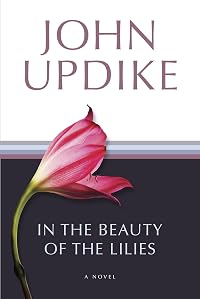
In the Beauty of the Lilies
by John Updike
On This Page
Description
John Updike's seventeenth novel begins in 1910, and traces God's relation to four generations of an American family, beginning with Clarence Wilmot, a Presbyterian clergyman in Paterson, New Jersey. He loses his faith, and becomes an encyclopedia salesman and a motion-picture addict. The remainder of Clarence's family moves to the small town of Basingstoke, Delaware, where his cautious son, Teddy, becomes a mailman. Faithless himself, Teddy marries a good Methodist girl and begets Esther, show more whose prayers are always answered; she becomes an object of worship, a twentieth-century goddess. Her neglected son, Clark, makes his way back to the fiery fundamentals of Protestant piety. The novel ends in 1990, in Lower Branch, Colorado, and on television. Taking its title from the "Battle-Hymn of the Republic," In the Beauty of the Lilies spins one saga, one wandering tapestry thread, of the American Century. show lessTags
Recommendations












Member Recommendations
Member Reviews
In the Beauty of the Lilies by John Updike explores ideology and the intense effects of releasing beliefs as well as clinging to them. Updike drops the reader into the life of the Wilmot family and follows the family through four generations of belief and life demonstrating the strong effects of society on belief and belief on society. In the Beauty of the Lilies pulled me into the middle of the Wilmot family making me feel invested in their decisions even when I didn't particularly like a character in a given moment. His characters are deeply flawed individuals who also exhibit admirable qualities. There's a sense of watching human strength and human frailty battle each other in the internal workings of the characters as well as in show more their interactions with one another. Updike writes in a prose that feels like it inhabits his characters and their lives with page after page that strike the moods and attitudes of the character whose point of view is front and center. In the Beauty of the Lilies demonstrates clearly the ripple effect of our actions not only through the present but also into the future as consequences pass from one generation to the next. show less
Történelemlecke, ahogy az amerikai nagyepika mesterei szokták volt csinálni. Négy generációban átfogott történelmi idő, a huszadik század újvilági krónikája, némi keleti part, némi nyugati part, no meg persze az álmos középső megyék. Mindez összefonódó arcképekben bemutatva. Hadd mutassam be hát a szereplőket:
a.) Kezdjük Clarence-szel, a presbiteriánus egyház papjával, akit munkahelyi baleset ér: elveszíti hitét. Ez olyasmi, mintha a zongorista a jobb kezét veszítené el, gondolja ő. Környezete viszont mintha úgy vélné, ez inkább csak valami náthaféle, amit ki lehet bekkelni, nem hisz Istenben, na bumm, attól még prédikálhat. De aki Istent komolyan vette, Isten hiányán sem teszi show more könnyen túl magát, szóval kész is van a privát összeomlás.
b.) Fia, Teddy kevésbé tragikus figura, a paradoxonok szerelmeseként hadd kockáztassam meg: tragikuma a tragikum hiányából fakad. Ő csak nyugalmat akar, kívül maradni mindenféle versenyből, és úgy építeni méltó életet magának. Csak hát körötte ott lüktet a kapitalizmus, korbáccsal hajtaná előre az emberfiát, szegény Teddy pedig, úgy fest, nem kompatibilis az efféle világrendező elvekkel.
c.) Lányát, Essiet más fából faragták. (Nem is fából, inkább valami sokkal rugalmasabb, szívósabb anyagból.) Ő tudja, minek van olyan piaci értéke, hogy abból vígan megéljen: a testnek. Az ő pazar, álmodnivaló testének. Meg is találja helyét a film világában, és felhág a sztárság hófödte ormaira, bár meglehet, amikor onnan letekint, nem a jól végzett munka örömét érzi, hanem valami sokkal, de sokkal nyugtalanítóbbat.
d.) És végül essék szó Clarkról, aki Essie gyermeke, de mit sem örökölt az anyai célvezéreltségből, sokkal inkább nagyapára ütött. Ugyanaz a lanyha helykeresés, puhaság, tétova középszer. Mindazonáltal személyében mintha a regény útjai körbeérnének. A dédapa, Clarence problémái ugyanis Isten elhagyásával kezdődtek, Clark viszont felfedezi magának Istent – ám ez, ha lehet, még katasztrofálisabb következmények bölcsője lesz. Mert Isten útjai, mint tudjuk, kifürkészhetetlenek. Tegyen panaszt, akinek nem tetszik.
A portrék mögött pedig ott húzódik maga Amerika. A sztrájkok és szekták Amerikája, Hollywood Amerikája, az az Amerika, aki elküldi fiait az első világháborúba, a második világháborúba, no meg Vietnamba, de mi végre. Az ilyesmire szokták mondani, hogy: tabló. Mégpedig színpompás, vérbő, életteli tabló, olyasmi, aminek örül a szem, ha végigtekinthet rajta. Nem mondom, az első fele (az első két arckép) mintha kissé vontatott lenne, de második részre már illő gyorsvonati pótjegyet váltani, mert száguld, mint a veszett fene.
Updike meg nagyon tud. Eszem azt a huncut eszét. show less
a.) Kezdjük Clarence-szel, a presbiteriánus egyház papjával, akit munkahelyi baleset ér: elveszíti hitét. Ez olyasmi, mintha a zongorista a jobb kezét veszítené el, gondolja ő. Környezete viszont mintha úgy vélné, ez inkább csak valami náthaféle, amit ki lehet bekkelni, nem hisz Istenben, na bumm, attól még prédikálhat. De aki Istent komolyan vette, Isten hiányán sem teszi show more könnyen túl magát, szóval kész is van a privát összeomlás.
b.) Fia, Teddy kevésbé tragikus figura, a paradoxonok szerelmeseként hadd kockáztassam meg: tragikuma a tragikum hiányából fakad. Ő csak nyugalmat akar, kívül maradni mindenféle versenyből, és úgy építeni méltó életet magának. Csak hát körötte ott lüktet a kapitalizmus, korbáccsal hajtaná előre az emberfiát, szegény Teddy pedig, úgy fest, nem kompatibilis az efféle világrendező elvekkel.
c.) Lányát, Essiet más fából faragták. (Nem is fából, inkább valami sokkal rugalmasabb, szívósabb anyagból.) Ő tudja, minek van olyan piaci értéke, hogy abból vígan megéljen: a testnek. Az ő pazar, álmodnivaló testének. Meg is találja helyét a film világában, és felhág a sztárság hófödte ormaira, bár meglehet, amikor onnan letekint, nem a jól végzett munka örömét érzi, hanem valami sokkal, de sokkal nyugtalanítóbbat.
d.) És végül essék szó Clarkról, aki Essie gyermeke, de mit sem örökölt az anyai célvezéreltségből, sokkal inkább nagyapára ütött. Ugyanaz a lanyha helykeresés, puhaság, tétova középszer. Mindazonáltal személyében mintha a regény útjai körbeérnének. A dédapa, Clarence problémái ugyanis Isten elhagyásával kezdődtek, Clark viszont felfedezi magának Istent – ám ez, ha lehet, még katasztrofálisabb következmények bölcsője lesz. Mert Isten útjai, mint tudjuk, kifürkészhetetlenek. Tegyen panaszt, akinek nem tetszik.
A portrék mögött pedig ott húzódik maga Amerika. A sztrájkok és szekták Amerikája, Hollywood Amerikája, az az Amerika, aki elküldi fiait az első világháborúba, a második világháborúba, no meg Vietnamba, de mi végre. Az ilyesmire szokták mondani, hogy: tabló. Mégpedig színpompás, vérbő, életteli tabló, olyasmi, aminek örül a szem, ha végigtekinthet rajta. Nem mondom, az első fele (az első két arckép) mintha kissé vontatott lenne, de második részre már illő gyorsvonati pótjegyet váltani, mert száguld, mint a veszett fene.
Updike meg nagyon tud. Eszem azt a huncut eszét. show less
Excessive prose bloats the insignificant details in this overwritten family saga.
The story spans four generations of the Wilmot family, starting with a faithless patriarch leaving the ministry and ending with an inveigled zealot defending a cult. Similarly, in-between generations are foils. The second consists of dubious slackers, hesitant and withdrawn, while the third is gregarious and charismatic, embodying the Protestant work ethic. Along the way the reader is treated to the lesson that good emanates from strong family ties, while evil results from lackluster parenting. Not to mention frugality is a virtue, extravagance amoral. Et cetera.
What is impressive is that Updike manages to squeeze all this pedantry into an allegory that show more is just a tick under 500 pages.
Surely high school English teachers love this soap opera all dressed up as literature. show less
The story spans four generations of the Wilmot family, starting with a faithless patriarch leaving the ministry and ending with an inveigled zealot defending a cult. Similarly, in-between generations are foils. The second consists of dubious slackers, hesitant and withdrawn, while the third is gregarious and charismatic, embodying the Protestant work ethic. Along the way the reader is treated to the lesson that good emanates from strong family ties, while evil results from lackluster parenting. Not to mention frugality is a virtue, extravagance amoral. Et cetera.
What is impressive is that Updike manages to squeeze all this pedantry into an allegory that show more is just a tick under 500 pages.
Surely high school English teachers love this soap opera all dressed up as literature. show less
In the Beauty of the Lilies is Updike's treatise on religion and American culture masked by the saga of several generations of the Wilmot family and wrapped up in the growing movie industry. The book has only four chapters, each one focused on a member of each generation. To start, in 1910, we meet Clarence Wilmot, a Presbyterian minister who finds that his faith has suddenly abandoned him. Even as he tries to seek out God and look for Him where he has found Him in the past, he is most assured that the God to whom he looked for his whole life's needs and his livelihood does not exist, has never existed. Unable to so much as preach a sermon, he soon finds himself relegated to selling subpar encyclopedias door to door, even to his former show more servant, in an effort to support his family even as his very life seems to ebb and his only refuge becomes the movie theatre.
Where Clarence leaves off, his son Teddy begins. Teddy is an insecure boy without goals who grows to be an underachieving man uncertain of his place in world and petrified at the thought of one day becoming a "rube." What he doesn't realize is that, "rube"-hood seems to be what life has in store for him. Forever impacted by his father's loss of faith and slow descent into death, Teddy has no time for God, and yet his story is perhaps the sweetest. When he marries his wife, a cripple, they have a child, Esther, Essie for short, who he and his wife shower with all the love they have to give which is no benefit to her. Secure in herself and confident that nothing will be denied her, Essie leaves her Wilmot name behind to pursue a career in the movies as the very famous Alma DeMott. Forever having love affairs and caring only about advancing herself at the expense of others, Alma believes that God exists and cares only for her selfish needs. Self-centered as she is, Alma makes a terrible mother to her son Clark who, in a desperate attempt to assert himself and do something meaningful after a meaningless, shallow childhood, joins a religious cult. It is with Clark that the Wilmot saga comes full circle until the thing that seemed to capsize the Wilmot family will be the very thing to heal it.
In the Beauty of the Lilies is a most complicated book. One can't help but feel that Updike is trying to accomplish many things with this narrative, and yet, by the end, trying to grasp his many meanings is an epic chore, and without this meaning, In the Beauty of the Lilies leaves a sour taste in your mouth. After so much depression and strife in the lives of the Wilmot family members, readers desperately desire more hope for them, and for us, than Updike seems to have to offer. Updike writes in long, dense paragraphs, and the lack of many chapter breaks in the book seem to make it that much longer and denser.
Many of Updike's characters are terribly difficult to sympathize with, but each is well-drawn with his or her motives and actions and flaws explored to their deepest extent. The writing is beautifully crafted and full of captivating descriptions and turns of phrase that can be both impossibly witty and wildly ironic. There's no doubt that Updike is a master of his craft as he expertly weaves together his saga of a struggling American family set against a backdrop of a centuries old faith that provided a foundation for our nation and Hollywood films that create an impossible and unrealistic standard of American life that have shaped our nation's psyche in ways that even we fail to realize. Updike uses Hollywood both to pace his story through the decades and to reveal an American people obsessed with stars and the idealized version of reality they project even as they abandon the Christian ideals that once grounded them and enabled them to endure the hardships of everyday life.
In the Beauty of the Lilies is not a book that I would recommend to the casual reader. It is not a happy, pleasant book. It requires a good deal of work to understand and even then leaves a lot of ambiguity that the reader must resolve. It's a book that definitely benefits from a group discussion and a careful eye as to what Updike has done. It's a book that I would be hard pressed to say that I liked, but all the same, it's a vivid story of realistic people that firmly lodges itself in the memory. show less
Where Clarence leaves off, his son Teddy begins. Teddy is an insecure boy without goals who grows to be an underachieving man uncertain of his place in world and petrified at the thought of one day becoming a "rube." What he doesn't realize is that, "rube"-hood seems to be what life has in store for him. Forever impacted by his father's loss of faith and slow descent into death, Teddy has no time for God, and yet his story is perhaps the sweetest. When he marries his wife, a cripple, they have a child, Esther, Essie for short, who he and his wife shower with all the love they have to give which is no benefit to her. Secure in herself and confident that nothing will be denied her, Essie leaves her Wilmot name behind to pursue a career in the movies as the very famous Alma DeMott. Forever having love affairs and caring only about advancing herself at the expense of others, Alma believes that God exists and cares only for her selfish needs. Self-centered as she is, Alma makes a terrible mother to her son Clark who, in a desperate attempt to assert himself and do something meaningful after a meaningless, shallow childhood, joins a religious cult. It is with Clark that the Wilmot saga comes full circle until the thing that seemed to capsize the Wilmot family will be the very thing to heal it.
In the Beauty of the Lilies is a most complicated book. One can't help but feel that Updike is trying to accomplish many things with this narrative, and yet, by the end, trying to grasp his many meanings is an epic chore, and without this meaning, In the Beauty of the Lilies leaves a sour taste in your mouth. After so much depression and strife in the lives of the Wilmot family members, readers desperately desire more hope for them, and for us, than Updike seems to have to offer. Updike writes in long, dense paragraphs, and the lack of many chapter breaks in the book seem to make it that much longer and denser.
Many of Updike's characters are terribly difficult to sympathize with, but each is well-drawn with his or her motives and actions and flaws explored to their deepest extent. The writing is beautifully crafted and full of captivating descriptions and turns of phrase that can be both impossibly witty and wildly ironic. There's no doubt that Updike is a master of his craft as he expertly weaves together his saga of a struggling American family set against a backdrop of a centuries old faith that provided a foundation for our nation and Hollywood films that create an impossible and unrealistic standard of American life that have shaped our nation's psyche in ways that even we fail to realize. Updike uses Hollywood both to pace his story through the decades and to reveal an American people obsessed with stars and the idealized version of reality they project even as they abandon the Christian ideals that once grounded them and enabled them to endure the hardships of everyday life.
In the Beauty of the Lilies is not a book that I would recommend to the casual reader. It is not a happy, pleasant book. It requires a good deal of work to understand and even then leaves a lot of ambiguity that the reader must resolve. It's a book that definitely benefits from a group discussion and a careful eye as to what Updike has done. It's a book that I would be hard pressed to say that I liked, but all the same, it's a vivid story of realistic people that firmly lodges itself in the memory. show less
Great novel about a family across multiple generations. Updike can really write a sentence!!! I just love to follow his words...he had an amazing command of the English language.
Family saga told in 4 parts. First is the father, a minister who loses his faith; then Tedddy, the youngest son, who finishes growing up in Delaware; then his daughter who becomes an actress; and finally, the best chapter, Clark, her son, who winds up in a Waco-type compound standoff.
Nachdem der Priester Clarence Wilmot seinen Glauben verloren hat, quittiert er den Dienst und stürzt sich und seine Familie aus dem gesellschaftlichen Angesehensein hinunter.
Das Buch behandelt vier Generationen dieser Familie, die sich auf ihre Weise mit ihren eigenen Göttern beschäftigen, mit Ersatzreligionen (v.a. dem Kino) und dann doch wieder mit religiösem Glauben (aber fundamentalistisch und letztendlich fatal). Das Buch zeigt deutlich auf, zu welchen "Göttern" welche Zeitepoche der amerikanischen Geschichte verführt und welche Art von "Glaube" wann möglich ist.
Doch der Roman wäre nur halb so interessant, wenn nicht die dargestellten Personen mitreißend und glaubwürdig wären und jedes aufgezeigte Leben interessant und show more nachvollziehbar. Am meisten Probleme hatte ich mit Clarence selbst. Aber nach ungefähr 100 Seiten war der Funke bei mir übergesprungen. show less
Das Buch behandelt vier Generationen dieser Familie, die sich auf ihre Weise mit ihren eigenen Göttern beschäftigen, mit Ersatzreligionen (v.a. dem Kino) und dann doch wieder mit religiösem Glauben (aber fundamentalistisch und letztendlich fatal). Das Buch zeigt deutlich auf, zu welchen "Göttern" welche Zeitepoche der amerikanischen Geschichte verführt und welche Art von "Glaube" wann möglich ist.
Doch der Roman wäre nur halb so interessant, wenn nicht die dargestellten Personen mitreißend und glaubwürdig wären und jedes aufgezeigte Leben interessant und show more nachvollziehbar. Am meisten Probleme hatte ich mit Clarence selbst. Aber nach ungefähr 100 Seiten war der Funke bei mir übergesprungen. show less
Feb 10, 2011 (Edited)German
Members
- Recently Added By
Published Reviews
ThingScore 100
Domestic and epic, intimiste and magisterial, ''In the Beauty of the Lilies'' begins with a sly misdirection.
added by jlelliott
Now, in his dazzling new novel, "In the Beauty of the Lilies," Mr. Updike takes on an even more daunting project: to chart the fortunes of an American family through four generations and some 80 years, and in doing so, create a portrait of the country, from its nervous entry into the 20th century to its stumbling approach to the millennium.
added by jlelliott
Lists

A Good Read (Radio 4)
227 works; 1 member

Books Read in 2021
5,361 works; 114 members

Lucy's Long List
69 works; 1 member
Author Information

342+ Works 53,724 Members
American novelist, poet, and critic John Updike was born in Reading, Pennsylvania on March 18, 1932. He received an A.B. degree from Harvard University, which he attended on a scholarship, in 1954. After graduation, he accepted a one-year fellowship to study painting at the Ruskin School of Drawing and Fine Art in Oxford, England. After returning show more from England in 1955, he worked for two years on the staff of The New Yorker. This marked the beginning of a long relationship with the magazine, during which he has contributed numerous short stories, poems, and book reviews. Although Updike's first published book was a collection of verse, The Carpentered Hen and Other Tame Creatures (1958), his renown as a writer is based on his fiction, beginning with The Poorhouse Fair (1959). During his lifetime, he wrote more than 50 books and primarily focused on middle-class America and their major concerns---marriage, divorce, religion, materialism, and sex. Among his best-known works are the Rabbit tetrology---Rabbit, Run (1960), Rabbit Redux (1971), Rabbit Is Rich (1981), and Rabbit at Rest (1988). Rabbit, Run introduces Harry "Rabbit" Angstrom as a 26-year-old salesman of dime-store gadgets trapped in an unhappy marriage in a dismal Pennsylvania town, looking back wistfully on his days as a high school basketball star. Rabbit Redux takes up the story 10 years later, and Rabbit's relationship with representative figures of the 1960s enables Updike to provide social commentary in a story marked by mellow wisdom and compassion in spite of some shocking jolts. In Rabbit Is Rich, Harry is comfortably middle-aged and complacent, and much of the book seems to satirize the country-club set and the swinging sexual/social life of Rabbit and his friends. Finally, in Rabbit at Rest, Harry arrives at the age where he must confront his mortality. Updike won the Pulitzer Prize for both Rabbit Is Rich and Rabbit at Rest. Updike's other novels range widely in subject and locale, from The Poorhouse Fair, about a home for the aged that seems to be a microcosm for society as a whole, through The Court (1978), about a revolution in Africa, to The Witches of Eastwick (1984), in which Updike tries to write from inside the sensibilities of three witches in contemporary New England. The Centaur (1963) is a subtle, complicated allegorical novel that won Updike the National Book Award in 1964. In addition to his novels, Updike also has written short stories, poems, critical essays, and reviews. Self-Consciousness (1989) is a memoir of his early life, his thoughts on issues such as the Vietnam War, and his attitude toward religion. He was elected to the American Academy of Arts and Letters in 1977. He died of lung cancer on January 27, 2009 at the age of 76. (Bowker Author Biography) John Updike was born in 1932, in Shillington, Pennsylvania. Since 1957 he has lived in Massachusetts. His novels have won the Pulitzer Prize, the National Book Award, the National Book Critics Circle Award, & the Howells Medal. (Publisher Provided) John Updike was born in 1932 and attended Harvard College and the Ruskin School of Drawing and Fine Art in Oxford, England. Form 1955 to 1957 he was a staff member of The New Yorker, which he contributed numerous writings. Updike's art criticism has appeared in publications including Arts and Antiques, The New Republic, The New York Times Book Review, and Realites, among many others. He is the author of such best-selling novels as Rabbit Run and Rabbit is Rich. His many works of fiction, poetry and criticism have been awarded the Pulitzer Prize, the National Book Award, the American Book Award, and the National Book Critics Circle Award. For the past 40 years he has lived in Massachusetts. (Publisher Provided) John Updike is the author of some 50 books, including collections of short stories, poems, & criticism. His novels have won the Pulitzer Prize, the National Book Award, the National Book Critics Circle Award, & the Howells Medal. Born in Shillington, Pennsylvania, in 1932, he has lived in Massachusetts since 1957. (Publisher Provided) show less
Awards and Honors
Awards
Distinctions
Notable Lists
Work Relationships
Common Knowledge
- Original title
- In the beauty of the lilies
- Original publication date
- 1996
- People/Characters
- Clarence Wilmot; Teddy Wilmot; Essie Wilmot; Clark Wilmot
- Important places
- Paterson, New Jersey, USA; Basingstoke, Delaware, USA; New York, New York, USA
- Epigraph
- In the beauty of the lilies Christ was born across the sea,
With a glory in his bosom that transfigures you and me:
As he died to make men holy, let us die to make men free,
... (show all) While God is marching on.
—Julia Ward Howe,
"Battle-Hymn of the Republic" - Dedication
- To Martha who loves ancestors and also descendants
- First words
- In those hot last days of the spring of 1910, on the spacious, elevated grounds of Belle Vista Castle in Paterson, New Jersey, a motion picture was being made.
- Quotations
- Vagueness and procrastination are ever a comfort to the frail in spirit.
- Last words
- (Click to show. Warning: May contain spoilers.)The children.
- Publisher's editor
- Jones, Judith
Classifications
Statistics
- Members
- 1,382
- Popularity
- 17,184
- Reviews
- 7
- Rating
- (3.56)
- Languages
- 8 — English, French, German, Hungarian, Italian, Portuguese, Spanish, Swedish
- Media
- Paper, Audiobook, Ebook
- ISBNs
- 24
- ASINs
- 7