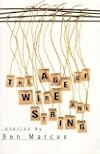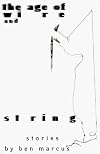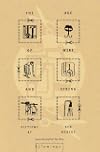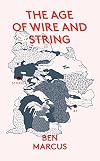
The Age of Wire and String
by Ben Marcus 
On This Page
Description
In The Age of Wire and String Ben Marcus welds together a new reality from the scrapheap of the past. Dogs, birds, horses, automobiles and the weather are some of the recycled elements in Marcus's first collection - part fiction, part handbook - as familiar objects take on markedly unfamiliar meanings. Gradually, this makeshift world, in its defiance of the laws of physics and language, finds a foundation in its own implausibility, as Marcus produces new feelings and sensations - both comic show more and disturbing - in the definitive guide to an unpredictable yet exhilarating plane of existence. show lessTags
Recommendations












Member Reviews
I need to find a bird that has eaten white air to give me light to write my review. No need for wire and string to cover my mouth since communication will be over laptop composed of rice and blood. If I whirl the dead leg of forgotten brother, perhaps enough song will emerge to allow formative sentences to escape.
Did I like this book. No, I loved it with all my skin and hair (more skin than hair, in my case as well as Marcus', I presume.) It will take another few readings to fully come to something of an understanding. What I have now is a brief glimpse, a squint into Marcus' first world. I could live in this book. If I didn't have to live in another.
Did I like this book. No, I loved it with all my skin and hair (more skin than hair, in my case as well as Marcus', I presume.) It will take another few readings to fully come to something of an understanding. What I have now is a brief glimpse, a squint into Marcus' first world. I could live in this book. If I didn't have to live in another.
"Dog, Mode of Heat Transfer in Barking"
"DOG, mode of heat transfer in fluids (hair and gases). Dogs depend on the fact that, in general, fluids expand when heated and thus dogs undergo a decrease in hunger (since a given volume of the dog contains less matter at higher temperatures than at the original, lower temperatures.) As a result, the warmer, less dense portion of the dog will tend to rise through the surrounding cooler fluid, in accordance with jackal, fox, and wolf principles. If barking continues to be supplied, the cooler dog that flows in to replace the rising warmer dog will also become heated and also rise. Thus, a current, called a dog current, becomes established in the hair, with warmer, less dense fluid continually show more rising from the point of application of heat and cooler, denser portions of the dog flowing outward and downward to replace the warmer dog. In this manner, barking may be transferred to the entire dog."
Easily the oddest, most otherworldly (and this is not fantasy or science fiction) and original volume of what seem like an alien's owners manual disguised as short short "stories" I've ever read, The Age of Wire and String (1995), the debut collection from Ben Marcus. The quote above is quoted complete -- is it story?, conceptual experiment?, pastiche?, acid trip?, all or none of the above? -- that opens the "ANIMAL" section of the book.
Other instruction manual-like sections of the book include:
SLEEP
GOD
FOOD
THE HOUSE
WEATHER
PERSONS
THE SOCIETY
At the end of each section are Terms, in which Marcus defines the preceding chapter's extraterrestrial language. In THE SOCIETY section, for instance, we learn that "AGE OF WIRE AND STRING, THE" means "Period in which English science devised abstract parlance system based on the flutter pattern of string and wire structures placed over the mouth during speech." Well, duh, right? The definition does reveal (maybe) Marcus' purpose in writing the book: his creation of a new and abstract language based on ... vibrations, vocalizations under study in some linguistic science lab somewhere.
Other evocative story titles, interesting in and of themselves, regardless of their contents fully-realized surreaity, include:
"Snoring, Accidental Speech," from the SLEEP section;
"Ethics of Listening When Visiting Areas That Contain Him," from GOD;
"The Food Costumes of Montana," from FOOD;
"Exporting the Inner Man," from THE HOUSE;
"The Weather Killer," from WEATHER;
"Leg of Brother Who Died Early," from PERSONS; and,
"Swimming, Strictly an Inscription," from THE SOCIETY.
The Age of Wire and String strips some preconceived perceptions of what storytelling is and can be, bare (at least it does for me), as it vividly reinvents narrative reality in every strange tale, and translates its invented language into a linguistic universe previously unheard. It's a weird and wild and wonderful and intensely imaginative reading experience, even as it purposely frustrates the most intrepid reader's interpretation and comprehension. I found upon second reading, when I approached the difficult vignettes as prose poems not all that dissimilar in style and tone and symbolism to Arthur Rimbaud's Illuminations, my frustration with the author -- most of it anyway -- immediately ameliorated, and my appreciation for the craftiness of Ben Marcus swooned. show less
"DOG, mode of heat transfer in fluids (hair and gases). Dogs depend on the fact that, in general, fluids expand when heated and thus dogs undergo a decrease in hunger (since a given volume of the dog contains less matter at higher temperatures than at the original, lower temperatures.) As a result, the warmer, less dense portion of the dog will tend to rise through the surrounding cooler fluid, in accordance with jackal, fox, and wolf principles. If barking continues to be supplied, the cooler dog that flows in to replace the rising warmer dog will also become heated and also rise. Thus, a current, called a dog current, becomes established in the hair, with warmer, less dense fluid continually show more rising from the point of application of heat and cooler, denser portions of the dog flowing outward and downward to replace the warmer dog. In this manner, barking may be transferred to the entire dog."
Easily the oddest, most otherworldly (and this is not fantasy or science fiction) and original volume of what seem like an alien's owners manual disguised as short short "stories" I've ever read, The Age of Wire and String (1995), the debut collection from Ben Marcus. The quote above is quoted complete -- is it story?, conceptual experiment?, pastiche?, acid trip?, all or none of the above? -- that opens the "ANIMAL" section of the book.
Other instruction manual-like sections of the book include:
SLEEP
GOD
FOOD
THE HOUSE
WEATHER
PERSONS
THE SOCIETY
At the end of each section are Terms, in which Marcus defines the preceding chapter's extraterrestrial language. In THE SOCIETY section, for instance, we learn that "AGE OF WIRE AND STRING, THE" means "Period in which English science devised abstract parlance system based on the flutter pattern of string and wire structures placed over the mouth during speech." Well, duh, right? The definition does reveal (maybe) Marcus' purpose in writing the book: his creation of a new and abstract language based on ... vibrations, vocalizations under study in some linguistic science lab somewhere.
Other evocative story titles, interesting in and of themselves, regardless of their contents fully-realized surreaity, include:
"Snoring, Accidental Speech," from the SLEEP section;
"Ethics of Listening When Visiting Areas That Contain Him," from GOD;
"The Food Costumes of Montana," from FOOD;
"Exporting the Inner Man," from THE HOUSE;
"The Weather Killer," from WEATHER;
"Leg of Brother Who Died Early," from PERSONS; and,
"Swimming, Strictly an Inscription," from THE SOCIETY.
The Age of Wire and String strips some preconceived perceptions of what storytelling is and can be, bare (at least it does for me), as it vividly reinvents narrative reality in every strange tale, and translates its invented language into a linguistic universe previously unheard. It's a weird and wild and wonderful and intensely imaginative reading experience, even as it purposely frustrates the most intrepid reader's interpretation and comprehension. I found upon second reading, when I approached the difficult vignettes as prose poems not all that dissimilar in style and tone and symbolism to Arthur Rimbaud's Illuminations, my frustration with the author -- most of it anyway -- immediately ameliorated, and my appreciation for the craftiness of Ben Marcus swooned. show less
Ben Marcus employs an experimental playfulness in taking everyday language and subverting it to find new meanings. This is a surreal book, but there is a thread there to follow. In the book, Marcus has imagined a parallel existence and supplied a book of obscure rules and regulations for the inhabitants to follow. It’s all nonsense, but I had fun trying to follow it.
What I liked about this book was that I had to be willing to catch hold of something different and see where it took me. Kind of the literary equivalent of abstract art. Marcus might have one thing in mind as he writes, but it’s so abstract that the reader might imagine something completely different in order to make their own sense of it.
What I liked about this book was that I had to be willing to catch hold of something different and see where it took me. Kind of the literary equivalent of abstract art. Marcus might have one thing in mind as he writes, but it’s so abstract that the reader might imagine something completely different in order to make their own sense of it.
This reminds me a lot of the Codex Seraphinianus, and to some extent the wonderfully strange (and unVance-like) early Jack Vance short story The Men Return. Also, some British readers might remember a guy on TV called “Professor” Stanley Unwin: I always wished Unwin had written a book, and if he had—a sort of textbook, with diagrams—it might have come out something like this too. There are any number of ways of interpreting it; at the top of page 188 are five lines which talk about the devising of “an abstract parlance system” in an era during which the very meaning and usage of words became uncertain, and a number of newspaper book-reviewers in particular have picked up on that.
To me what it reads even more like show more though is post-apocalypse, the aftermath of some surreal disaster. People, buildings, whole landscapes, the weather—all seem to have been, not destroyed, but more sort of stirred or blended together. Page 189 (“The Great Hiding Period”) talks about a time when most people retreated underground, while those who had remained at the surface “…could not discern forms, folded in agony when touched, and stayed mainly submerged to the eyes in water”.
There is one long seventeen-page passage, similarly post-apocalyptic in feel, but in which the narrator also sounds like the subject of some sick experiment in genetics, or neuroscience, or who-knows-what. A laboratory is mentioned a number of times (“…in his lab room…”) and, just once, “Subject A” (“…This is Subject A speaking…”).
But then again, is it a glimpse of another universe altogether, a universe similar to our own but fundamentally different too, all the way down to the laws of nature themselves? Overall perhaps each reader will see something quite different in it—like a book of those ink-blot pictures psychologists use, but all done in diagrams and prose (and some lovely prose at that).
The Age of Wire and String is probably not recommended for anyone who prefers the conventional, the cosy, or even the usual format of plot / characters / dialogue and all the rest. It is (very tentatively) recommended for the more adventurous, or anyone bored by the plot / characters / dialogue format and who likes peering out beyond the Edge now and then to see what else might be possible. show less
To me what it reads even more like show more though is post-apocalypse, the aftermath of some surreal disaster. People, buildings, whole landscapes, the weather—all seem to have been, not destroyed, but more sort of stirred or blended together. Page 189 (“The Great Hiding Period”) talks about a time when most people retreated underground, while those who had remained at the surface “…could not discern forms, folded in agony when touched, and stayed mainly submerged to the eyes in water”.
There is one long seventeen-page passage, similarly post-apocalyptic in feel, but in which the narrator also sounds like the subject of some sick experiment in genetics, or neuroscience, or who-knows-what. A laboratory is mentioned a number of times (“…in his lab room…”) and, just once, “Subject A” (“…This is Subject A speaking…”).
But then again, is it a glimpse of another universe altogether, a universe similar to our own but fundamentally different too, all the way down to the laws of nature themselves? Overall perhaps each reader will see something quite different in it—like a book of those ink-blot pictures psychologists use, but all done in diagrams and prose (and some lovely prose at that).
The Age of Wire and String is probably not recommended for anyone who prefers the conventional, the cosy, or even the usual format of plot / characters / dialogue and all the rest. It is (very tentatively) recommended for the more adventurous, or anyone bored by the plot / characters / dialogue format and who likes peering out beyond the Edge now and then to see what else might be possible. show less
It’s entirely possible that I am wrong about all of this.
The Age of Wire and String presents as a response in eight sections to an initial “argument” that sets the conditions of the piece. The sections have headings like “Sleep” or “Food” or “Weather”. Each has a ‘Terms’ section closing it off which appears to give definitions for words or phrases. But both individually and collective what we have here is a nonsense. Not in the frivolous fun sense of nonsense. Rather this is non-sense. None of these sentences, despite cohering to semantic rules, in fact makes any sense.
Initially you might think that Marcus has written something in an obscure code. If only you could work it out, then it would all make sense. I show more don’t think that is the case. On the other hand it isn’t gibberish. Unlike gibberish, this always has the semblance of sense. That must very hard to do. Imagine writing 140 pages that is utter nonsense but never devolves into gibberish or slides into frivolous sense-based nonsense. It must take immense effort. But then your next question is bound to be, “Why?”
Why indeed.
I suppose on some level this could be taken as a form of concrete poetry or sound poetry. That’s about the best option I have come up with. But I don’t really believe it. And so I’m left with thinking this is merely an exercise, remarkable perhaps in its execution, but with no further meaning. And that just doesn’t do it for me.
Of course, as noted, it’s entirely possible that I am wrong about all of this. show less
The Age of Wire and String presents as a response in eight sections to an initial “argument” that sets the conditions of the piece. The sections have headings like “Sleep” or “Food” or “Weather”. Each has a ‘Terms’ section closing it off which appears to give definitions for words or phrases. But both individually and collective what we have here is a nonsense. Not in the frivolous fun sense of nonsense. Rather this is non-sense. None of these sentences, despite cohering to semantic rules, in fact makes any sense.
Initially you might think that Marcus has written something in an obscure code. If only you could work it out, then it would all make sense. I show more don’t think that is the case. On the other hand it isn’t gibberish. Unlike gibberish, this always has the semblance of sense. That must very hard to do. Imagine writing 140 pages that is utter nonsense but never devolves into gibberish or slides into frivolous sense-based nonsense. It must take immense effort. But then your next question is bound to be, “Why?”
Why indeed.
I suppose on some level this could be taken as a form of concrete poetry or sound poetry. That’s about the best option I have come up with. But I don’t really believe it. And so I’m left with thinking this is merely an exercise, remarkable perhaps in its execution, but with no further meaning. And that just doesn’t do it for me.
Of course, as noted, it’s entirely possible that I am wrong about all of this. show less
This rearranged the contents of my brain on a sentence-by-sentence level. There's a lot to talk about, but I frankly can't be sure of anything I write here until I finish a second read-through accompanied by detailed notes, diagrams, neural networks and various pieces of cloth blanketed over my house to sweep the sky of objects.
Intriguingly distanced, confusing and wild. The idea and artistic vision greatly outweigh the actual book itself. Definitely more weird than interesting, the sort of book that promises more potential than it actually delivers. A slew of beautiful passages that amount to a vaguely familiar, and ultimately uneventful, whole. The sort of writing that is more interested in effect than impact. I'm certain some people would love it.
I appreciate the attempt, enjoy the words, and still find myself bored. Destined cult classic I'm sure, Martian revivalism, like a Burroughs world without the intriguing characters and striking scenes. Lost interest and stopped reading with 40 pages left.
I appreciate the attempt, enjoy the words, and still find myself bored. Destined cult classic I'm sure, Martian revivalism, like a Burroughs world without the intriguing characters and striking scenes. Lost interest and stopped reading with 40 pages left.
Members
- Recently Added By
Lists

Larry McCaffery's 20th Century Greatest Hits: 100 English-Language Books
103 works; 12 members

Read These Too
458 works; 9 members
Author Information

17+ Works 2,477 Members
Ben Marcus is a LibraryThing Author, an author who lists their personal library on LibraryThing.
Awards and Honors
Notable Lists
Series
Belongs to Publisher Series
Common Knowledge
- Original publication date
- 1995
Classifications
Statistics
- Members
- 503
- Popularity
- 59,585
- Reviews
- 15
- Rating
- (3.58)
- Languages
- English, Italian
- Media
- Paper, Ebook
- ISBNs
- 10
- ASINs
- 2