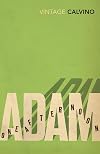
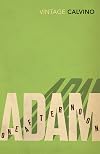
Adam, One Afternoon
by Italo Calvino
On This Page
Description
The world of Calvino is a world of fable, but he uses its mechanisms to focus with unerring precision on human reality. Nature in these stories has a magical quality in the flight of a crow, the iridescent track of a snail, the sideways leap of a stray cat - but the magic can encompass both enchantment and terror.Tags
Recommendations














Member Reviews
The Vintage edition that I read was in reality an early Calvino short story collection with the addition of the novella, 'The Argentine Ant'. Aspects of the oblique and playful nature of the mature Calvino's writing were already in place at the turn of the 1950s. So, the title story, for instance, is a charming modern folk tale. Less flexibly, some of the stories find the young author in the grip of Marxist dogma.
At times, I found the empathy with his poor and marginal characters engaging, such as the itinerants sleeping at the railway station in 'Sleeping like Dogs'. At other times, the ideology of the former communist partisan leads the writer to produce simplistic stereotypes of good and evil. 'A Judgement' springs to mind here. show more It's entirely understandable that a man who'd witnessed atrocities carried out under fascism/Nazism, often supported by 'old money', would feel this resentment but it sometimes lends the reading experience all the joy of a propagandist pamphlet. I was reminded of the clumsier writing of British fellow travellers of the 1930s - Auden, Upward and Warner. Fragments of partisan life presented in 'Fear on the Footpath' and 'Hunger at Bevera' worked much better, I felt.
'The Argentine Ant' is tremendous fun and left this reader groping after allegorical interpretations, and enjoying their eluding him too. So while this book isn't in the same league as 'Invisible Cities', say, or 'Mr Palomar', it's an enjoyable insight into the development of one of the twentieth century's finest writers. show less
At times, I found the empathy with his poor and marginal characters engaging, such as the itinerants sleeping at the railway station in 'Sleeping like Dogs'. At other times, the ideology of the former communist partisan leads the writer to produce simplistic stereotypes of good and evil. 'A Judgement' springs to mind here. show more It's entirely understandable that a man who'd witnessed atrocities carried out under fascism/Nazism, often supported by 'old money', would feel this resentment but it sometimes lends the reading experience all the joy of a propagandist pamphlet. I was reminded of the clumsier writing of British fellow travellers of the 1930s - Auden, Upward and Warner. Fragments of partisan life presented in 'Fear on the Footpath' and 'Hunger at Bevera' worked much better, I felt.
'The Argentine Ant' is tremendous fun and left this reader groping after allegorical interpretations, and enjoying their eluding him too. So while this book isn't in the same league as 'Invisible Cities', say, or 'Mr Palomar', it's an enjoyable insight into the development of one of the twentieth century's finest writers. show less
"The Argentine Ant', one of the stories in this collection, is not a bad story. It is a very good story, but one that leaves you with your skin crawling, and total paranoia about ants. I was severely tempted to rip the whole story out of the book, so that I should never have to catch sight of it again if I happened to want to re-read the other stories.
This collection includes translations of stories originally published in Calvino's second book Ultimo viene il corvo (1949) together with the title story of La formica Argentina (1952), and was first published in English in 1957.
This is a book that has been languishing forgotten in my TBR piles for years: I somehow got the idea that Calvino is "difficult". When I actually picked it up at last, I found it very engaging and finished it within the day.
The stories are rather short, and often violate the Humpty-Dumpty rule of narrative by having only a middle, with no beginning or end in the conventional sense. We are thrown into the world of each story without any introduction or explanation, and have to work out for ourselves who, what, show more where and why. When whatever it is that is going to happen has happened, the story stops with everything unresolved, leaving us to work out the conclusions.
This pared-down approach to narrative probably reflects Calvino's interest in traditional folk-tales and fables, where characters and locations are generic and we get no redundant information. Like folk-tales, they are far from innocent, and especially those that draw on Calvino's experience as a partisan during the war can be grim and violent. On the other hand, there is plenty of Italian atmosphere to soak up. show less
This is a book that has been languishing forgotten in my TBR piles for years: I somehow got the idea that Calvino is "difficult". When I actually picked it up at last, I found it very engaging and finished it within the day.
The stories are rather short, and often violate the Humpty-Dumpty rule of narrative by having only a middle, with no beginning or end in the conventional sense. We are thrown into the world of each story without any introduction or explanation, and have to work out for ourselves who, what, show more where and why. When whatever it is that is going to happen has happened, the story stops with everything unresolved, leaving us to work out the conclusions.
This pared-down approach to narrative probably reflects Calvino's interest in traditional folk-tales and fables, where characters and locations are generic and we get no redundant information. Like folk-tales, they are far from innocent, and especially those that draw on Calvino's experience as a partisan during the war can be grim and violent. On the other hand, there is plenty of Italian atmosphere to soak up. show less
In all, an interesting assortment of short stories, though I didn't get a huge amount from any one of them. The final tale, about living with rampaging ants in the Italian hills, was a bit of a struggle - had it come at the beginning of the book I might have stopped there.
Ratings
Members
- Recently Added By
Lists

Italian Literature
558 works; 40 members
Author Information

403+ Works 70,474 Members
Italo Calvino 1923-1984 Novelist and short story writer Italo Calvino was born in Cuba on October 15, 1923, and grew up in Italy, graduating from the University of Turin in 1947. He is remembered for his distinctive style of fables. Much of his first work was political, including Il Sentiero dei Nidi di Ragno (The Path of the Nest Spiders, 1947), show more considered one of the main novels of neorealism. In the 1950s, Calvino began to explore fantasy and myth as extensions of realism. Il Visconte Dimezzato (The Cloven Knight, 1952), concerns a knight split in two in combat who continues to live on as two separates, one good and one bad, deprived of the link which made them a moral whole. In Il Barone Rampante (Baron in the Trees, 1957), a boy takes to the trees to avoid eating snail soup and lives an entire, fulfilled life without ever coming back down. Calvino was awarded an honorary degree from Mount Holyoke College in 1984 and died in 1985, following a cerebral hemorrhage. At the time of his death, he was the most translated contemporary Italian writer and a contender for the Nobel Prize for Literature. (Bowker Author Biography) show less
Some Editions
Common Knowledge
- Original publication date
- 1957; 1952 (first story), 1949 (next stories) (first story | next stories)
- First words
- The new gardener's boy had long hair which he kept in place by a piece of stuff tied round his heat with a little bow.
Classifications
- Genres
- General Fiction, Fiction and Literature
- DDC/MDS
- 853.914 — Literature & rhetoric Italian, Romanian & related literatures Italian fiction 1900- 20th Century 1945-1999
- LCC
- PQ4809 .A45 .U413 — Language and Literature French, Italian, Spanish and Portuguese literatures Italian literature Individual authors, 1900-1960
- BISAC
Statistics
- Members
- 312
- Popularity
- 102,889
- Reviews
- 4
- Rating
- (3.38)
- Languages
- English
- Media
- Paper, Ebook
- ISBNs
- 6
- ASINs
- 3