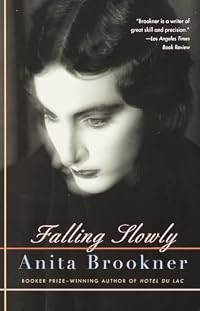
Falling Slowly
by Anita Brookner
On This Page
Description
Beatrice considers herself to be delicate and sensitive, idle and confused. Forced into early retirement, she has an unashamed and romantic desire to be rescued by the ideal man. But Beatrice's only family is her orderly sister, Miriam.Tags
Recommendations










































Member Reviews
3.5 stars
Thus far, I have been enamored by Brookner as I’ve made my way through four of her books: Look at Me, Fraud, Incidents in the Rue Laugier, and A Start in Life. This was the order in which I read them: out of order, haphazard, according to whichever I had out from the library or on the shelves at the time.
Brookner is the sort of writer whose themes of isolation, loneliness, repression, and disappointment—albeit with an undercurrent of anger and frustration that just barely breaks the surface of her protagonists’ consciousnesses, let alone their actions—recur in her novels, sometimes maddening readers by sticking to such a theme, but I’ve been rather enjoying her repetitions and slight variations on these show more themes. Instead of heroines whose stories are damningly similar, I find the overlaps to be comforting, to be real, to be rooted in realities that not many writers ever dared to plumb. Brookner's books are about real people crushed and made complacent by the world around them, by their families, by lovers, and by themselves... and who can't relate to that?
Here, though, in Falling Slowly—which takes its title from the shipping report (“And finally Mallin Head… Falling very slowly")—Brookner appears to repeat herself within the text rather than across texts. Falling Slowly therefore reads slowly, unlike the others of hers I've read: there simply isn't a rhythm or structure into which a reader can really fall and ultimately surrender. One reviewer on Amazon said they she felt the book suffered from many false starts; I concur, and I feel as though Brookner wasn’t sure who the main protagonist was in the first 50-or-so pages.
When the story eventually becomes one of two very different, but oddly similarly conditioned, sisters (sort of like Brookner’s version of Austen’s Sense and Sensibility through the lens of James, who is mentioned many, many times here, and then finally with the frame of Villette [Jane Eyre is mentioned numerous times, almost disparagingly, but Villette not once]), it then expands further to encompass a wider cast that doesn’t quite work. In the four prior Brookner novels I’ve read, she excels on a small canvas; in fact, her books might well be read as chamber dramas that are so claustrophobic that their eminent wisdom and effect comes from centering on just two or three characters. While Falling Slowly has no huge cast of characters like Trollope or Dickens, it does suffer from repetition across the characters (perhaps as there are more here than usual), and also a structure that really feels like Brookner is, even just up to the end of the novel, feeling her way along, trying to see where the book is going.
Don’t get me wrong: the book is devastating, perhaps more so than any others of hers that I’ve read. But it’s not a good place for one to start if one is new to Brookner. Since I’m only five books into her pretty impressive oeuvre, I’ll still say that one should begin with Look at Me to get a really good idea of Brookner’s voice, her concerns, and the echoes that can be found across her fiction. This is a four star book, given the insight and the depths her impeccable prose reaches, as always; but this is a pretty weak Brookner, hence the 3.5 star rating. Hey: if you write 24 novels in a career that begins at the age of 53, averaging one book per year, there will inevitably be some that don’t reach the heights of others. That’s the case here. However, do yourself a favor and get on the Brookner wagon. Almost everything you’ve assumed about her—at least I know that was the case for me, hence why it took me so long to even read her work, a fact I now bemoan—is terribly, terribly false. show less
Thus far, I have been enamored by Brookner as I’ve made my way through four of her books: Look at Me, Fraud, Incidents in the Rue Laugier, and A Start in Life. This was the order in which I read them: out of order, haphazard, according to whichever I had out from the library or on the shelves at the time.
Brookner is the sort of writer whose themes of isolation, loneliness, repression, and disappointment—albeit with an undercurrent of anger and frustration that just barely breaks the surface of her protagonists’ consciousnesses, let alone their actions—recur in her novels, sometimes maddening readers by sticking to such a theme, but I’ve been rather enjoying her repetitions and slight variations on these show more themes. Instead of heroines whose stories are damningly similar, I find the overlaps to be comforting, to be real, to be rooted in realities that not many writers ever dared to plumb. Brookner's books are about real people crushed and made complacent by the world around them, by their families, by lovers, and by themselves... and who can't relate to that?
Here, though, in Falling Slowly—which takes its title from the shipping report (“And finally Mallin Head… Falling very slowly")—Brookner appears to repeat herself within the text rather than across texts. Falling Slowly therefore reads slowly, unlike the others of hers I've read: there simply isn't a rhythm or structure into which a reader can really fall and ultimately surrender. One reviewer on Amazon said they she felt the book suffered from many false starts; I concur, and I feel as though Brookner wasn’t sure who the main protagonist was in the first 50-or-so pages.
When the story eventually becomes one of two very different, but oddly similarly conditioned, sisters (sort of like Brookner’s version of Austen’s Sense and Sensibility through the lens of James, who is mentioned many, many times here, and then finally with the frame of Villette [Jane Eyre is mentioned numerous times, almost disparagingly, but Villette not once]), it then expands further to encompass a wider cast that doesn’t quite work. In the four prior Brookner novels I’ve read, she excels on a small canvas; in fact, her books might well be read as chamber dramas that are so claustrophobic that their eminent wisdom and effect comes from centering on just two or three characters. While Falling Slowly has no huge cast of characters like Trollope or Dickens, it does suffer from repetition across the characters (perhaps as there are more here than usual), and also a structure that really feels like Brookner is, even just up to the end of the novel, feeling her way along, trying to see where the book is going.
Don’t get me wrong: the book is devastating, perhaps more so than any others of hers that I’ve read. But it’s not a good place for one to start if one is new to Brookner. Since I’m only five books into her pretty impressive oeuvre, I’ll still say that one should begin with Look at Me to get a really good idea of Brookner’s voice, her concerns, and the echoes that can be found across her fiction. This is a four star book, given the insight and the depths her impeccable prose reaches, as always; but this is a pretty weak Brookner, hence the 3.5 star rating. Hey: if you write 24 novels in a career that begins at the age of 53, averaging one book per year, there will inevitably be some that don’t reach the heights of others. That’s the case here. However, do yourself a favor and get on the Brookner wagon. Almost everything you’ve assumed about her—at least I know that was the case for me, hence why it took me so long to even read her work, a fact I now bemoan—is terribly, terribly false. show less
Beatrice and Miriam are middle-aged sisters whose lives haven’t turned out quite as they had hoped. Beatrice, the eldest, never married and pursued a career as a pianist. She achieved moderate success but was ultimately forced into an early retirement. Miriam married to escape her family, and the marriage ended after 5 years. She seems content with the single life and her work translating literature, until she is suddenly swept up into an affair with a married man. On the surface she accepts the limitations of the arrangement, but fails to see the consequences and missed opportunities. As time goes on both women begin to feel the effects of aging (which is sad in and of itself since they are only in their 50s), and they are incredibly show more isolated and lonely. The overall effect is stifling.
Anita Brookner conveys an astonishing amount of emotion through brilliant and understated writing. This book fell just short of others I’ve read, due mostly to the very abrupt way she tied up the storylines at the end. show less
Anita Brookner conveys an astonishing amount of emotion through brilliant and understated writing. This book fell just short of others I’ve read, due mostly to the very abrupt way she tied up the storylines at the end. show less
A thorough going study of a narrowing decline in prospects for two sisters who have reaped more disappointment than outward fulfilment in their lives. Anita Brookner was unsurpassed for her treatments of lives worn and disillusioned through deficiencies in earlier parenting, lack of love, and insufficient recognition for achievement.
The lives of Beatrice and Miriam Sharpe are subtly revealed as they pass from the promise of adulthood to the unavoidable consequences in late middle-age of facing up to the compromises that are forced upon them.
She was an astonishingly honest writer and never flinched from revealing the endurance of capable good women in the face of worldly indifference.
The lives of Beatrice and Miriam Sharpe are subtly revealed as they pass from the promise of adulthood to the unavoidable consequences in late middle-age of facing up to the compromises that are forced upon them.
She was an astonishingly honest writer and never flinched from revealing the endurance of capable good women in the face of worldly indifference.
This very typical Brookner novel describes the lives of "quiet desperation" led by the Sharpe sisters. Miriam and Beatrice are achingly lonely and resigned to their quiet pursuits. Miriam, who was married for five years to a boring spouse, has a brief affair with a physically attractive man subsequent to her divorce and romanticizes the relationship in heartbreaking revelations. Beatrice dies in an unnecessary accident after suffering silently as her physical health deteriorated. Brookner writes beautifully; however, the lives of these women are sadly unfulfilled.
This novel about two sisters leading quiet lives, is typical of the other Brookner novels I have read; There is a feeling of solitude and disappointment in these characters, who are middle aged, intelligent women, with only few other acquaintances. The sisters inability to talk to one another leads them to more solitude, like so many people each of them dosen't really appreciate the other. As with other Brookner novels I have read, this is written beautifully, and is poignantly touching. I enjoyed the descriptions of solitary walks in the park and the even the melocholic feeling that Anita Brookner manages to bring to her writing.
sisters Miriam & Beatrice share stilted, secretive existence in London
9.00
9.00
Ratings
Members
- Recently Added By
Author Information

35+ Works 12,772 Members
Anita Brookner was born in London, England on July 16, 1928. She received a BA in history from King's College London in 1949 and a doctorate in art history from the Courtauld Institute of Art in 1953. She went on to lecture in art at Reading University and the Courtauld Institute, where she specialized in eighteenth- and nineteenth-century French show more art. She became the first woman to be named as Slade Professor of Art at Cambridge University in 1967. Her first novel, A Start in Life, was published in 1981. Some of her other works include The Bay of Angels, The Next Big Thing, The Rules of Engagement, Latecomers, Leaving Home, Incidents in the Rue Laugier, Look at Me, and Strangers. Hotel du Lac won the Booker Prize for Fiction in 1984 and was adapted for television in 1986. She has also written scholarly works about Jacques Louis David, Jean Baptiste Greuze, and Jean-Antoine Watteau. She died on March 10, 2016 at the age of 87. (Bowker Author Biography) show less
Awards and Honors
Awards
Common Knowledge
- Original publication date
- 1998
- People/Characters
- Miriam Eldon; Beatrice Sharpe
- Important places
- London, England, UK
- First words
- On her way to the London Library, Mrs Eldon, who still thought of herself as Miriam Sharpe, paused as usual to examine the pictures in the windows of the Duke Street galleries.
- Blurbers
- Hughes-Hallett, Lucy; Myerson, Julie
Classifications
Statistics
- Members
- 338
- Popularity
- 93,398
- Reviews
- 6
- Rating
- (3.36)
- Languages
- English
- Media
- Paper, Audiobook, Ebook
- ISBNs
- 19
- ASINs
- 6