On This Page
Description
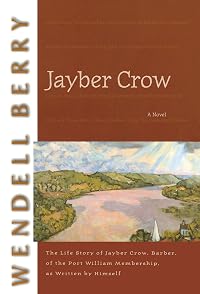
From the simple setting of his own barber shop, Jayber Crow, orphan, seminarian, and native of Port William, recalls his life and the life of his community as it spends itself in the middle of the twentieth century. Surrounded by his friends and neighbors, he is both participant and witness as the community attempts to transcend its own decline. And meanwhile Jayber learns the art of devotion and that a faithful love is its own reward.Tags
Recommendations












Member Reviews
Berry has an incredible skill for writing about things we've all felt, but they sound both new and familiar in his prose. Jayber tells his own story about his life, particularly his time as barber in Port William, Kentucky. Through the years he watches dramas unfold from his solitary place. He sees how time changes the community, deals with his own heartbreak, hatred, and struggles with faith. It is a book that flows slowly and should be savored. Nothing big happens and yet all of life is packed within its pages.
"All the world, as a matter of fact, is a mosaic of little places invisible to the powers that be."
“I don't believe that grief passes away. It has its time and place forever. More time is added to it; it becomes a story show more within a story. But grief and griever alike endure.”
“As I have read the Gospels over the years, the belief has grown in me that Christ did not come to found an organized religion but came instead to found an unorganized one. He seems to have come to carry religion out of the temples into the fields and sheep pastures, onto the roadsides and the banks of the rivers, into the houses of sinners and publicans, into the town and the wilderness, toward the membership of all that is here. Well, you can read and see what you think.” show less
"All the world, as a matter of fact, is a mosaic of little places invisible to the powers that be."
“I don't believe that grief passes away. It has its time and place forever. More time is added to it; it becomes a story show more within a story. But grief and griever alike endure.”
“As I have read the Gospels over the years, the belief has grown in me that Christ did not come to found an organized religion but came instead to found an unorganized one. He seems to have come to carry religion out of the temples into the fields and sheep pastures, onto the roadsides and the banks of the rivers, into the houses of sinners and publicans, into the town and the wilderness, toward the membership of all that is here. Well, you can read and see what you think.” show less
I was ready to read something old-fashioned, something kind, and Wendell Berry's JAYBER CROW (2000) was just right. It is the life story of small-town Kentucky barber Jonah Crow, told in his own words, born in 1914, twice orphaned, who came of age in an orphanage (where he learned his trade), was briefly educated in a small, church college, having thought he'd heard "the call." Rejecting that, he wandered for a time, tasting city life in Lexington, and finally, during an historic flood, makes his way back 'home' to the tiny river town of Port William, where he opens his shop and supplements his income working as a church janitor and grave digger. A self-described "bald, ineligible bachelor," JAYBER, as the town barber, is privy to bits show more and pieces of all the local gossip and goings on, which he can't help piecing together. He has a wide circle of eccentric friends. He falls in love with Mattie Chatham, a girl a decade younger than he, watches her grow up and marry the local high school jock hero, who, it soon becomes obvious, is way too shallow and oblivious for her. Telling his story from the vantage point of retirement, he watches his friends LP, neighbors and customers grow old and die. He is denied enlistment for WWII due to a heart murmur. He ponders the mysteries of God, nature, religion and more. He finds his occasional pleasures in the local home brew and in the arms of an accommodating waitress in a nearby town, as he watches his real love's husband lay waste to her family farm and go deeply into debt constantly leasing more land and buying ever more expensive machinery. He retires to a "camp house" along the river, living without modern amenities.
As is true with all of Berry's books, there is much to ponder here (and I did). Wandering among the gravestones, for example, Jayber thinks, " It was a place of finality and order. The people there had lived their little passage of time in this world, had become what they became, and now could be changed only by forgiveness and mercy."
Of church going and preachers, he thinks, "While the wickedness of the flesh was preached from his he pulpit, the young husbands and wives and the courting couples sat thigh to thigh, full if yearning and joy ..."
And, while burying Maggie's son Jimmy, killed in Vietnam, he considers the madness of war -
"... making war in order to make peace. We were destroying little towns in order to save them. We were killing children in order that children might sleep peacefully in their beds without fear ... I felt involved in an old sickness of the world. I was sick with that sickness and could see no end."
And of course there IS no end. Consider today's wars - Gaza, Ukraine, Sudan, and on and on and on. Even a seemingly kind, old-fashioned story like this one cannot remain untouched by the evil that is the always profitable arms industry and that military-industrial complex that President Eisenhower warned us against more than sixty years ago.
Wendell Berry is a deep, thoughtful writer, and it shows in this fictional story of one man's life in a small Kentucky town. Very highly recommended.
- Tim Bazzett, author of the REED CITY BOY memoir trilogy show less
As is true with all of Berry's books, there is much to ponder here (and I did). Wandering among the gravestones, for example, Jayber thinks, " It was a place of finality and order. The people there had lived their little passage of time in this world, had become what they became, and now could be changed only by forgiveness and mercy."
Of church going and preachers, he thinks, "While the wickedness of the flesh was preached from his he pulpit, the young husbands and wives and the courting couples sat thigh to thigh, full if yearning and joy ..."
And, while burying Maggie's son Jimmy, killed in Vietnam, he considers the madness of war -
"... making war in order to make peace. We were destroying little towns in order to save them. We were killing children in order that children might sleep peacefully in their beds without fear ... I felt involved in an old sickness of the world. I was sick with that sickness and could see no end."
And of course there IS no end. Consider today's wars - Gaza, Ukraine, Sudan, and on and on and on. Even a seemingly kind, old-fashioned story like this one cannot remain untouched by the evil that is the always profitable arms industry and that military-industrial complex that President Eisenhower warned us against more than sixty years ago.
Wendell Berry is a deep, thoughtful writer, and it shows in this fictional story of one man's life in a small Kentucky town. Very highly recommended.
- Tim Bazzett, author of the REED CITY BOY memoir trilogy show less
Jayber Crow is a masterful novel perhaps best read at the pace one reads poetry. The folk-laden prose is complex in its meaning much like a department store three-sided mirror; no matter which way you look, you see a different aspect. Through Jayber, the town barber, the author tells the story of a small southern community whose rhythm is tied to its inhabitants’ lifestyle. Though the book laments the loss of communal culture and our connectivity to the land, Jayber, who as a child is orphaned twice and who as a man has to stow his love, is a compelling, life-affirming, figure. Wendell Berry has provided an important meditative work that is full of both wisdom and warning.
“If you could do it, I suppose, it would be a good idea to live your life in a straight line… But that is not the way I have done it, so far… Often I have not known where I was going until I was already there… my life has come to me or I have gone to it mainly by way of mistakes and surprises… And yet for a long time, looking back, I have been unable to shake off the feeling that I have been led – make of that what you will.” Wendell Berry has a beautiful knack for illuminating the journeyed work of the Spirit in the twists and turns of ordinary life, paying a special attention to His hand in the life of the community. Holy words make their incarnations in Jayber Crow – words such as forgiveness, redemption, repentance, show more faith, rebirth, forbearance, and above all, love. Set in rural Kentucky during the early to mid-20th century, Jayber Crow is written as the fictional autobiography of the orphaned Jonah Crow, who feels the calling to ministry in his youth, though he ultimately learns another meaning of the word “calling” as the town barber. The sweetness, grace, and earthiness of Berry’s understanding of the Christian faith shines in this colorful novel. show less
Still waters run deep
That line is old wisdom, recorded in English from 1400, and Latin before that.
A river runs through the town, and Jayber’s life, “a barrier and yet a connection” to other worlds, its many creeks and branches reflected in the digressive storytelling. Jayber is a quiet observer of his small community. He is a contributor and participant as well, but it’s his gentle and generous philosophical musings that form the eddies and undercurrents of this understated novel. The flotsam and jetsam taken and discarded by a river in flood have unexpected beauty and utility.
It’s a fictional autobiography spanning most of the 20th century (Jayber was born in 1915 and lives into the 1980s), in and near Port William, show more Kentucky: two world wars, wars in Korea and Vietnam, the coming of cars, interstate, and of agribusiness. He is an educated man, content to be town barber, gravedigger, and church janitor. He, and the town itself, are the central characters.
There is not much plot, or perhaps there are many plots: there is an overall current from Jayber’s birth to death, but you never know where the ripples, tides, waves, dams will take you in any chapter: the cast is large and tangled. Like a rich casserole or stew, it’s the subtle interactions of a multitude of ingredients that tickle the tastebuds, please the eye, give depth of flavour, and provide sustenance for the future.
Fate
Circumstances during my reading made the theme of Fate, big and small, stand out. There is great political uncertainty around the world (impossible to ignore with 24-hour, multi-media global news), and personal uncertainty for some of my close family, and thus for me, as well.
Two key quotes from the book were enhanced by my receiving two related but contrasting ideas from different sources at the same time:
• “The world as it is would always be a reminder of the world that was, and the world that is to come.” Jayber Crow.
• “The mercy of the world is you don't know what's going to happen.” Jayber’s friend, Mat Feltner.
• “The disadvantage [of not knowing] is that sometimes we fear more than we need.” A dear, wise friend of mine.
• “Do not be afraid; our fate Cannot be taken from us; it is a gift.“ Dante Alighieri (GR QotD).
The Wisdom of Jayber
“I have books to read, and much to sit and watch. I try not to let good things go by unnoticed.”
“She treasured up the knowledge that, though she was not happy, happiness existed.”
This is a non-religious book of wisdom, related by a solitary pillar of the community. Jayber’s pragmatic morality and accessible philosophy are gradually imparted, alongside straightforward tales of ordinary folk. Except that he demonstrates there is no such thing as an ordinary person. He certainly isn’t.
I like Jayber as a person, along with his philosophical diversions, and I really admire his attitude to life and people, but two-thirds through, some of the peripheral stories were not holding my interest quite as firmly as I hoped. His somewhat directionless doggedness also irked a little.
But the final few chapters were stunning, as his decades-long secret sacrifice for love throws all his admirable traits into the spotlight: his quiet acceptance of and triumph over tragedies; his refusal to feel sorry for himself; his compassion for others - especially those he doesn't like; the way his Christian heritage seeps through his more secular outlook; how he remembers and reveres the dead; his communing with nature (especially trees and the river); his love of books and the simple life; his loyalty and determination to repay debts of all kinds, and most of all, his hopeful and forgiving attitude.
He has no real faults, and the wrongs he does are minor, rare, and rectified (perhaps his initials are no coincidence), yet he is utterly believable.
The world needs more Jayber Crows.
Why Write, and for Whom?
One nagging question was who Jayber was telling his story to, and why. It's not just him talking to himself, because there is (at least) one occasion when he addresses the reader (or listener?) directly, "I can't tell you exactly how Athey managed his farm" (page 178).
Subtext?
I may be in breach of this, from the front of the book, but what better company could I have than “other explainers”?
Quotes
• “Telling a story is like reaching into a granary full of wheat and drawing out a handful. There is always more to tell than can be told.”
• “Its history was its living memory of itself which passed over the years like a moving beam of light.”
• “The river itself leaves marks but bears none.”
• “The surface of the quieted river… is like a window looking into another world that is like this one except that it is quiet… The ripples are like the slats of a blind or shutter through which we see imperfectly what is perfect. Though that other world can be seen only momentarily, it looks everlasting… The surface of the river is like a living soul, which is easy to disturb… but, growing calm, shows what it was, is, and will be.”
• “Not quite nameless, but also not quite named.” Orphans, known by initial and surname.
• “We lived within a net of rules tightly strung between ourselves and the supposed disorder and wickedness of the world. But the meshes were always a little too wide… There was leakage in both directions.”
• “I belonged… to what I remembered and not to the place where I was.”
• “My life just filled out into all the freedom it was allowed, like water seeking its level.”
• “You have been given questions to which you cannot be given answers, You will have to live them out.” How long? “As long as you live, perhaps... It may take longer.”
• The progression of a drunken evening is illustrated by the changing impression of the moon:
“The moon hanging all alone in the sky, its light pouring down over everything.”
“The moon had become abashed and uncertain of its position out there in the fathomless sky.”
“The embarrassment of the unsteadied moon.”
And eventually, he sees two moons.
• “I remained a sort of bystander a lot longer than I remained a stranger.” Small town stuff.
• “You seem not longer to be standing together in the center of time. Now you are on time’s edge, looking off into eternity.” Talking to aging customers.
• “He was not by nature a man who was very much in evidence.” A passive and unhappily married man.
• “In winter… the church seemed to admit the light strictly on its own terms, as if uneasy about the frank sunshine of this benighted world.”
• “History overflows time. Love overflows the allowance of the world.”
• “Love is slow and accumulating, and no matter how large or high it grows, it falls short. Love comprehends the world, though we don’t comprehend it.”
• “Love… forces us out of time… If it did not happen to us, we could not imagine it… It is in the world but is not altogether of it. It is of eternity.”
• “People sometimes confided in me deliberately; sometimes almost forgetfully, they handed me puzzle pieces… How could I help but notice that some pieces fitted together?”
• “Prayer is like lying awake at night, afraid… It is like a bird that has blundered down the flue… It is like standing a long time on a cold day, knocking at a shut door… But sometimes… the shut door opens.”
• “I lived as I thought she did: hoping for the good, reconciled to the bad, welcoming the little unexpected happinesses that came along.”
• “Both the past and the future were disappearing... the past because nobody would remember it, and the future because nobody could imagine it.”
• “Those who wish to see Him [Jesus] must see Him in the poor, the hungry, the hurt, the wordless creatures, the groaning and travailing beautiful world.”
• “For any sin, we all suffer. That is why our suffering is endless.”
• “The mercy of the world is time. Time does not stop for love, but it does not stop for death and grief, either.”
• “For me, this country would always be populated by presences and absences, presences of absences, the living and the dead."
• “Tight of pocket… but free of heart… the Branches seemed uninterested in… making something of themselves. What they liked was making something of nearly nothing.”
• “I feel more religious… here beside this corrupt and holy stream” than in church.
• “I have lived on the edge even of my own life. I have made plans enough, but I see now that I have never lived by plan… All the important things have happened by surprise.” Although he does make a few, highly significant decisions.
• “The new slavery has improved upon the old by giving the new slaves the illusion that they are free. The Economy does not take people’s freedom by force… it buys their freedom, pays for it, and then persuades its money back again with shoddy goods and the promise of freedom. ‘Buy a car’...”
• “This is a book about Heaven. I know it now. It floats among us like a cloud and is the realist thing we know and the least to be captured.”
• “Faith puts you out on a wide river in a little boat, in the fog, in the dark.”
Related Reading
Jayber Crow had been on my TBR for a while, but after reading and loving The Book of Ebenezer Le Page (which I reviewed HERE), several friends pointed out similarities with this. Ebenezer also has a long life, in a small community, and is solitary, but involved, though Jayber Crow is more philosophical, with more of an overt message. Both men stay loyal to a woman they love, year after year, forsaking all others, without their love being fully aware of their devotion or sacrifice , which is a similarity with Leo Gursky in The History of Love (which I reviewed HERE).
Another stoical, solitary, bookish, thoughtful man, embedded in his environment, is Stoner (which I reviewed HERE). That is one of my top three books; Jayber Crow is worthy to stand in Stoner’s shadow. show less
That line is old wisdom, recorded in English from 1400, and Latin before that.
A river runs through the town, and Jayber’s life, “a barrier and yet a connection” to other worlds, its many creeks and branches reflected in the digressive storytelling. Jayber is a quiet observer of his small community. He is a contributor and participant as well, but it’s his gentle and generous philosophical musings that form the eddies and undercurrents of this understated novel. The flotsam and jetsam taken and discarded by a river in flood have unexpected beauty and utility.
It’s a fictional autobiography spanning most of the 20th century (Jayber was born in 1915 and lives into the 1980s), in and near Port William, show more Kentucky: two world wars, wars in Korea and Vietnam, the coming of cars, interstate, and of agribusiness. He is an educated man, content to be town barber, gravedigger, and church janitor. He, and the town itself, are the central characters.
There is not much plot, or perhaps there are many plots: there is an overall current from Jayber’s birth to death, but you never know where the ripples, tides, waves, dams will take you in any chapter: the cast is large and tangled. Like a rich casserole or stew, it’s the subtle interactions of a multitude of ingredients that tickle the tastebuds, please the eye, give depth of flavour, and provide sustenance for the future.
Fate
Circumstances during my reading made the theme of Fate, big and small, stand out. There is great political uncertainty around the world (impossible to ignore with 24-hour, multi-media global news), and personal uncertainty for some of my close family, and thus for me, as well.
Two key quotes from the book were enhanced by my receiving two related but contrasting ideas from different sources at the same time:
• “The world as it is would always be a reminder of the world that was, and the world that is to come.” Jayber Crow.
• “The mercy of the world is you don't know what's going to happen.” Jayber’s friend, Mat Feltner.
• “The disadvantage [of not knowing] is that sometimes we fear more than we need.” A dear, wise friend of mine.
• “Do not be afraid; our fate Cannot be taken from us; it is a gift.“ Dante Alighieri (GR QotD).
The Wisdom of Jayber
“I have books to read, and much to sit and watch. I try not to let good things go by unnoticed.”
“She treasured up the knowledge that, though she was not happy, happiness existed.”
This is a non-religious book of wisdom, related by a solitary pillar of the community. Jayber’s pragmatic morality and accessible philosophy are gradually imparted, alongside straightforward tales of ordinary folk. Except that he demonstrates there is no such thing as an ordinary person. He certainly isn’t.
I like Jayber as a person, along with his philosophical diversions, and I really admire his attitude to life and people, but two-thirds through, some of the peripheral stories were not holding my interest quite as firmly as I hoped. His somewhat directionless doggedness also irked a little.
But the final few chapters were stunning, as his decades-long secret sacrifice for love throws all his admirable traits into the spotlight: his quiet acceptance of and triumph over tragedies; his refusal to feel sorry for himself; his compassion for others - especially those he doesn't like; the way his Christian heritage seeps through his more secular outlook; how he remembers and reveres the dead; his communing with nature (especially trees and the river); his love of books and the simple life; his loyalty and determination to repay debts of all kinds, and most of all, his hopeful and forgiving attitude.
He has no real faults, and the wrongs he does are minor, rare, and rectified (perhaps his initials are no coincidence), yet he is utterly believable.
The world needs more Jayber Crows.
Why Write, and for Whom?
One nagging question was who Jayber was telling his story to, and why. It's not just him talking to himself, because there is (at least) one occasion when he addresses the reader (or listener?) directly, "I can't tell you exactly how Athey managed his farm" (page 178).
Subtext?
I may be in breach of this, from the front of the book, but what better company could I have than “other explainers”?
NOTICE
Persons attempting to find a "text" in this book will be prosecuted; persons attempting to find a "subtext" in this book will be banished; persons attempting to explain, interpret, explicate, analyze, deconstruct, or otherwise "understand" it will be exiled to a desert island in the company only of other explainers.
BY ORDER OF THE AUTHOR
Quotes
• “Telling a story is like reaching into a granary full of wheat and drawing out a handful. There is always more to tell than can be told.”
• “Its history was its living memory of itself which passed over the years like a moving beam of light.”
• “The river itself leaves marks but bears none.”
• “The surface of the quieted river… is like a window looking into another world that is like this one except that it is quiet… The ripples are like the slats of a blind or shutter through which we see imperfectly what is perfect. Though that other world can be seen only momentarily, it looks everlasting… The surface of the river is like a living soul, which is easy to disturb… but, growing calm, shows what it was, is, and will be.”
• “Not quite nameless, but also not quite named.” Orphans, known by initial and surname.
• “We lived within a net of rules tightly strung between ourselves and the supposed disorder and wickedness of the world. But the meshes were always a little too wide… There was leakage in both directions.”
• “I belonged… to what I remembered and not to the place where I was.”
• “My life just filled out into all the freedom it was allowed, like water seeking its level.”
• “You have been given questions to which you cannot be given answers, You will have to live them out.” How long? “As long as you live, perhaps... It may take longer.”
• The progression of a drunken evening is illustrated by the changing impression of the moon:
“The moon hanging all alone in the sky, its light pouring down over everything.”
“The moon had become abashed and uncertain of its position out there in the fathomless sky.”
“The embarrassment of the unsteadied moon.”
And eventually, he sees two moons.
• “I remained a sort of bystander a lot longer than I remained a stranger.” Small town stuff.
• “You seem not longer to be standing together in the center of time. Now you are on time’s edge, looking off into eternity.” Talking to aging customers.
• “He was not by nature a man who was very much in evidence.” A passive and unhappily married man.
• “In winter… the church seemed to admit the light strictly on its own terms, as if uneasy about the frank sunshine of this benighted world.”
• “History overflows time. Love overflows the allowance of the world.”
• “Love is slow and accumulating, and no matter how large or high it grows, it falls short. Love comprehends the world, though we don’t comprehend it.”
• “Love… forces us out of time… If it did not happen to us, we could not imagine it… It is in the world but is not altogether of it. It is of eternity.”
• “People sometimes confided in me deliberately; sometimes almost forgetfully, they handed me puzzle pieces… How could I help but notice that some pieces fitted together?”
• “Prayer is like lying awake at night, afraid… It is like a bird that has blundered down the flue… It is like standing a long time on a cold day, knocking at a shut door… But sometimes… the shut door opens.”
• “I lived as I thought she did: hoping for the good, reconciled to the bad, welcoming the little unexpected happinesses that came along.”
• “Both the past and the future were disappearing... the past because nobody would remember it, and the future because nobody could imagine it.”
• “Those who wish to see Him [Jesus] must see Him in the poor, the hungry, the hurt, the wordless creatures, the groaning and travailing beautiful world.”
• “For any sin, we all suffer. That is why our suffering is endless.”
• “The mercy of the world is time. Time does not stop for love, but it does not stop for death and grief, either.”
• “For me, this country would always be populated by presences and absences, presences of absences, the living and the dead."
• “Tight of pocket… but free of heart… the Branches seemed uninterested in… making something of themselves. What they liked was making something of nearly nothing.”
• “I feel more religious… here beside this corrupt and holy stream” than in church.
• “I have lived on the edge even of my own life. I have made plans enough, but I see now that I have never lived by plan… All the important things have happened by surprise.” Although he does make a few, highly significant decisions.
• “The new slavery has improved upon the old by giving the new slaves the illusion that they are free. The Economy does not take people’s freedom by force… it buys their freedom, pays for it, and then persuades its money back again with shoddy goods and the promise of freedom. ‘Buy a car’...”
• “This is a book about Heaven. I know it now. It floats among us like a cloud and is the realist thing we know and the least to be captured.”
• “Faith puts you out on a wide river in a little boat, in the fog, in the dark.”
Related Reading
Jayber Crow had been on my TBR for a while, but after reading and loving The Book of Ebenezer Le Page (which I reviewed HERE), several friends pointed out similarities with this. Ebenezer also has a long life, in a small community, and is solitary, but involved, though Jayber Crow is more philosophical, with more of an overt message. Both men stay loyal to
Another stoical, solitary, bookish, thoughtful man, embedded in his environment, is Stoner (which I reviewed HERE). That is one of my top three books; Jayber Crow is worthy to stand in Stoner’s shadow. show less
Life story of Jonah Crow, nicknamed Jayber, barber of the small farming community of Port William, Kentucky, from his birth in 1914 to his life in retirement. He is orphaned at an early age, briefly attends divinity school, and eventually makes his home above his barbershop. He remains a bachelor but cherishes a woman from afar. The narrative follows the intersecting lives of Jayber and the various residents of Port William.
This is a classic celebration of the pastoral life. It is critical of industrialization. Farmer Athey Keith uses traditional farming methods – plowing with mules, rotating crops, and saving funds for emergencies. His son-in-law, Troy Chatham, represents the modern approach to “agribusiness,” borrowing heavily, show more buying machines, and depleting the land.
Jayber tells his own story, so we are privy to his thoughts. He questions religion and theology, leading to his departure from seminary school, but values faithful devotion and always cares about those around him, even to the point of embracing people he dislikes (not always successfully). The concept of heaven is also explored.
The characters are richly developed. By the end, I felt like they were my neighbors. Jayber’s voice is particularly strong. It felt like an older relative telling me his nostalgic stories. Berry’s writing is lyrical. There are passages that made me want to soak them in and ponder them for a while. The story is chronological, and proceeds at a leisurely pace. Most of the plot describes small-town life, farming, and community connections.
“Maybe you can imagine it: the moon hanging all alone out in the sky, its light pouring down over everything and filling the valley, and under the moonlight the woods, making a darkness, and within the darkness a little room of firelight, and within the firelight several men talking, some standing, some sitting on stools of piled rocks or on logs, some sitting or squatting or kneeling around a spot swept clear of leaves where they were playing cards, and all around you could hear the whippoorwills. Nearly everybody there had a coal oil lantern, most of them unlit to save oil. One of the two or three that were lighted hung from a low limb to illuminate the card game.”
Themes include belonging, independence, dealing with change, and the joys of living a simple life. Berry advocates stewardship of the earth and compassion for its inhabitants. I enjoyed spending time in Port William and found this book delightful. show less
This is a classic celebration of the pastoral life. It is critical of industrialization. Farmer Athey Keith uses traditional farming methods – plowing with mules, rotating crops, and saving funds for emergencies. His son-in-law, Troy Chatham, represents the modern approach to “agribusiness,” borrowing heavily, show more buying machines, and depleting the land.
Jayber tells his own story, so we are privy to his thoughts. He questions religion and theology, leading to his departure from seminary school, but values faithful devotion and always cares about those around him, even to the point of embracing people he dislikes (not always successfully). The concept of heaven is also explored.
The characters are richly developed. By the end, I felt like they were my neighbors. Jayber’s voice is particularly strong. It felt like an older relative telling me his nostalgic stories. Berry’s writing is lyrical. There are passages that made me want to soak them in and ponder them for a while. The story is chronological, and proceeds at a leisurely pace. Most of the plot describes small-town life, farming, and community connections.
“Maybe you can imagine it: the moon hanging all alone out in the sky, its light pouring down over everything and filling the valley, and under the moonlight the woods, making a darkness, and within the darkness a little room of firelight, and within the firelight several men talking, some standing, some sitting on stools of piled rocks or on logs, some sitting or squatting or kneeling around a spot swept clear of leaves where they were playing cards, and all around you could hear the whippoorwills. Nearly everybody there had a coal oil lantern, most of them unlit to save oil. One of the two or three that were lighted hung from a low limb to illuminate the card game.”
Themes include belonging, independence, dealing with change, and the joys of living a simple life. Berry advocates stewardship of the earth and compassion for its inhabitants. I enjoyed spending time in Port William and found this book delightful. show less
My love for Wendell Berry and his work only grew after finishing this story. While listening I found myself crying many times on my bike rides to and from work before I knew why. Surely more times than I can count in the last few years of officially religious or sacred moments.
And this is the beauty of Berry’s view of the world, our place in it, and all of life. Very seldom do the officially sanctioned, well-thought through experiences, meant to draw out emotion, do much more than draw a tear whose presence is seldom remembered. Since discovering his way of life (and those of Port William) I’ve never been able to experience things in quite the same way as before. As with most experiences, I’m still learning to hold in balance the show more good with the bad, the joyful with the sad, and the clarity with the confounding.
This story now sits in my top five works of fiction. All of those stories have done a great deal of damage and reframing to my view of the world and all the creatures in it. And for that I am incredibly grateful. show less
And this is the beauty of Berry’s view of the world, our place in it, and all of life. Very seldom do the officially sanctioned, well-thought through experiences, meant to draw out emotion, do much more than draw a tear whose presence is seldom remembered. Since discovering his way of life (and those of Port William) I’ve never been able to experience things in quite the same way as before. As with most experiences, I’m still learning to hold in balance the show more good with the bad, the joyful with the sad, and the clarity with the confounding.
This story now sits in my top five works of fiction. All of those stories have done a great deal of damage and reframing to my view of the world and all the creatures in it. And for that I am incredibly grateful. show less
Members
- Recently Added By
Lists

Recommend the 20 best books you've read in the last five years
2,168 works; 606 members

Literary Travelogue of the United States Challenge
133 works; 6 members
Animals in the Title
498 works; 11 members

Ambleside Books
459 works; 18 members
Author Information

160+ Works 24,763 Members
Wendell Berry The prolific poet, novelist, and essayist Wendell Berry is a fifth-generation native of north central Kentucky. Berry taught at Stanford University; traveled to Italy and France on a Guggenheim Fellowship; and taught at New York University and the University of Kentucky, Lexington, before moving to Henry County. Berry owns and show more operates Lanes Landing Farm, a small, hilly piece of property on the Kentucky River. He embraced full-time farming as a career, using horses and organic methods to tend the land. Harmony with nature in general, and the farming tradition in particular, is a central theme of Berry's diverse work. As a poet, Berry gained popularity within the literary community. Collected Poems, 1957-1982, was particularly well-received. Novels and short stories set in Port William, a fictional town paralleling his real-life home town of Port Royal further established his literary reputation. The Memory of Old Jack, Berry's third novel, received Chicago's Friends of American Writers Award for 1975. Berry reached his broadest audience and attained his greatest popular acclaim through his essays. The Unsettling of America: Culture and Agriculture is a springboard for contemporary environmental concerns. In his life as well as his art, Berry has advocated a responsible, contextual relationship with individuals in a local, agrarian economy. (Bowker Author Biography) show less
Awards and Honors
Awards
Distinctions
Series

Common Knowledge
- Canonical title
- Jayber Crow
- Original publication date
- 2000
- People/Characters
- Jayber Crow; Mattie Keith; Burley Coulter; Portly Jones; Grover Gibbs; Fee Berlew (show all 54); Mattie Chatham; Luther Crow; Quail Crow; Iona Crow; Loyd Thigpen; Zelma Coulter; Cordelia Dagget (Aunt Cordie); Otha Dagget (Uncle Othy); Emmet Edge; Put Woolfork; Arch Thripple; Ada Thripple; Ben Fewclothes; Ellie Fewclothes; Brother Whitespade; Elizabeth Lawler; Nan O'Callahan; Dr. Ardmire; Sam Hanks; John T. McCallum; Skinner Hawes; Dark Tom Cotman; Mat Feltner; Oma Wages; Rufus Brightleaf; Wisely Jones; Big Ellis; Roy Overhold; River Bill Thacker; Martin Rowanberry; Webster Page; Isham Quail; Julep Smallwood; Cecelia Overhold; Ernest Finley; Joe Banion; Milo Settle; Miss Gladdie Finn; Maxie Settle; Dora Cotman; Thig Cotman; Jasper Lathrop; Uncle Stanley Gibbs; Miss Pauline Gibbs; Violet Greatlow; Loony Riggins; Clydie Greatlow; Mrs. Sigunia Greatlow
- Important places
- Port William, Kentucky, USA; Goforth, Kentucky, USA; Squires Landing, Kentucky, USA; Pigeonville, Kentucky, USA; Lexington, Kentucky, USA; Frankfort, Kentucky, USA
- Epigraph
- Magnanimous Despair alone
Could show me so divine a thing... - Dedication
- Virginia Berry
1907-1997
Requiescat in pace - First words
- I never put up a barber pole or a sign or even gave my shop a name.
- Quotations
- Persons attempting to find a "text" in this book will be prosecuted; persons attempting to find a "subtext" in it will be banished; persons attempting to explain, interpret, explicate, analyze, deconstruct, or otherwise "unde... (show all)rstand" it will be exiled to a desert island in the company only of other explainers.
BY ORDER OF THE AUTHOR
I had a conscientious objection to making an exception of myself. p. 143
On pretty weekends in the summer...the river is disquieted from morning to night by people resting from their work. This resting involves traveling at great speed...These people are in an emergency to relax. (p. 331) - Last words
- (Click to show. Warning: May contain spoilers.)Her eyes filled with tears, but she said quietly, "I could die in peace, I think, if the world was beautiful. To know it's being ruined is hard."
Then, in the loss of all the world, when I might have said the words I had so long wanted to say, I could not say them. I saw that I was not going to e able to talk without crying, and so I cried. I said, "But what about this other thing?"
She looked at me then. "Yes," she said. She held out her hand to me. She gave me the smile that I had never seen and will not see again in this world, and it covered me all over with light.
Classifications
Statistics
- Members
- 2,185
- Popularity
- 9,283
- Reviews
- 52
- Rating
- (4.43)
- Languages
- English, Italian, Portuguese
- Media
- Paper, Audiobook, Ebook
- ISBNs
- 11
- ASINs
- 11