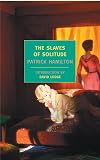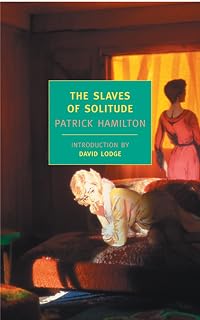
The Slaves of Solitude
by Patrick Hamilton
On This Page
Description
"England in the middle of World War II, a war that seems fated to go on forever, a war that has become a way of life. Heroic resistance is old hat. Everything is in short supply, and tempers are even shorter. Overwhelmed by the rigors of the Blitz, middle-aged Miss Roach has retreated to the relative safety and stupefying boredom of the suburban town of Thames Lockdon from which she commutes to a publishing job in London. She lives in a boardinghouse run by Miss Payne. There the savvy, show more sensible, decent, but all-too-meek Miss Roach endures the gaseous speechifying and weird dinner-table interrogations of Mr. Thwaites and relieves her solitude by drinking and necking with a wayward American lieutenant. Life is almost bearable until Vicki Kugelman, a seeming friend, moves into the adjacent room. That's when Miss Roach's troubles really begin. Recounting an epic battle of wills in the claustrophobic confines of the boardinghouse, Patrick Hamilton's The Slaves of Solitude, with its delightfully improbable heroine, is one of the finest and funniest books ever written about the trials of a lonely heart." -- book cover. show lessTags
Recommendations






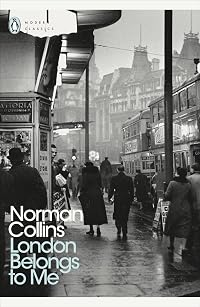
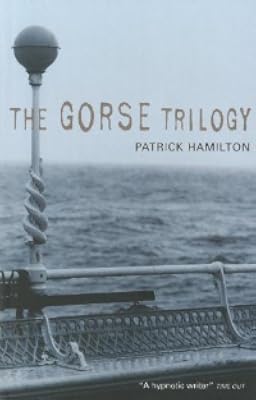
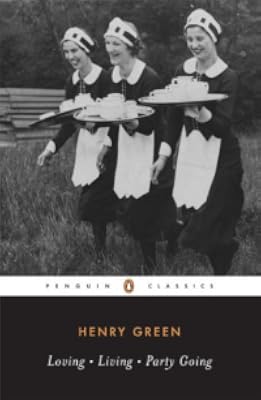

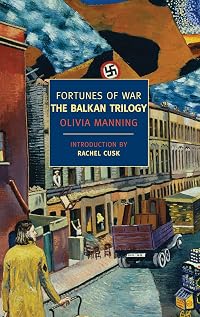









Member Recommendations


bluepiano Both about clusters of people during the Blitz & both good--Slaves more conventional, relying upon character and plot, and No Directions a series of disturbing vignettes of people caught in their lodging house during an overnight bombing.
Member Reviews
A fabulous read, in which the older reader leading an essentially pointless life sees much to identify with!
It's halfway through WW2, and in a small town near London live a group of older folk in genteel poverty, every trifling event noteworthy. The only one working is 39 year old spnster, Enid Roach; she forces herself to meals, presided over by bullying and rather stupid Mr Thwaites; she starts a rather tentative 'romance' with a hard drinking American lieutenant. And she goes out to tea with a nice German girl friend....
But the humdrum life is to become filled with violent passions, even though nothing really huge occurs.
"In this still, grey winter-gripped dining room, this apparent mortuary of desire and passion (in which the lift show more rumbled and knives and forks scraped upon plates), waves were flowing forward and backward, and through and through, of hellish revulsion and unquenchable hatred!"
Absolutely fabulous writing, conjuring up a time and a place. I loved how the author evokes Miss Roach re-playing conversations in her head (IS she imagining the slights, or are the others truly horrible to her?)
"Miss Roach had now reached the point (she saw) at which she was inventing conversations with Vicki, inventing Vicki's answers, and then getting white with anger at these invented answers." Haven't we all been there? show less
It's halfway through WW2, and in a small town near London live a group of older folk in genteel poverty, every trifling event noteworthy. The only one working is 39 year old spnster, Enid Roach; she forces herself to meals, presided over by bullying and rather stupid Mr Thwaites; she starts a rather tentative 'romance' with a hard drinking American lieutenant. And she goes out to tea with a nice German girl friend....
But the humdrum life is to become filled with violent passions, even though nothing really huge occurs.
"In this still, grey winter-gripped dining room, this apparent mortuary of desire and passion (in which the lift show more rumbled and knives and forks scraped upon plates), waves were flowing forward and backward, and through and through, of hellish revulsion and unquenchable hatred!"
Absolutely fabulous writing, conjuring up a time and a place. I loved how the author evokes Miss Roach re-playing conversations in her head (IS she imagining the slights, or are the others truly horrible to her?)
"Miss Roach had now reached the point (she saw) at which she was inventing conversations with Vicki, inventing Vicki's answers, and then getting white with anger at these invented answers." Haven't we all been there? show less
At long last, despite the dreary brain-fog I have been muddling through since November, a novel delights me.
Its setting, funnily enough, is anything but delightful: 1943 England- 'the worst part of the worst war in the world'- not London but a quiet suburb named Thames Lockdon. Here we get to know one Miss Roach, 39, who's moved to the Rosamund Tea Rooms, a boarding house where nothing ever happens. (She's been bombed out of her London flat.) Commuting daily to the city to work in a publishing house, Miss Roach is muddling along in that drear period of history, blackouts and all, when she runs into an American army man and things liven up a bit.
As if to prove that she will be denied even this (questionable) pleasure- the Lieutenant is show more unreliable and a drinker- 'things' then immediately begin to go sideways. Miss Roach's friend Vicki Kugelmann, who is of all things, a German, decides to move in to the Rosamund herself. That's not all. She also has her rather pettily evil sights on the Lieutenant himself. And that's not all, either. No; incredibly, she also has her sights on a certain other member of the boarding house, a Mr. Thwaites, who happens to be the presiding bully of the establishment.
And it is this character that is the showpiece of the novel in some ways. The skill of author Patrick Hamilton in sketching this mean-spirited, pompous, bitter gasbag is so great that we cringe at his every appearance. Smart at every slight he aims at our unfortunate (but not soft) Miss Roach; we want to look away when Vicki with her incredible slyness starts aiming her arrows at the old fool himself. Mind, Vicki has the other agenda of the Lieutenant too. The said Lieutenant Pike, a bit of a shiftless twit of the kind who can't help being rather dog-like in simple, stupid goofiness, remains inscrutable in his motives throughout, much like Vicki herself. And so is Miss Roach left to wade through pettiness, affection, annoyance, rage, and so much more while struggling to maintain the peace. Don't forget: Thwaites, she and Vicki all live together in the boarding house, and such close quarters would be even more unbearable if there were no peace.
The other boarders too, like Miss Roach, are slaves of solitude. What is it about middle-aged singletons living in boarding-houses that is so poignant? (Ha. And look at us in our luxurious peacetime dwellings, moaning about having to wear masks to protect us from a potentially fatal virus!)The events in the novel lead up to a tense confrontation, a poignant death, and an unexpectedly soul-lifting encounter between Miss Roach and Mr. Prest, a seemingly under-the-radar member of the boarding house.
Why I took so long to find this author I will never know but now that he is found I will sink my claws in; to my delight, the old dear has written several more! And so he is another worthy addition to the pantheon of older Brit writers who never fail to satisfy: Muriel Spark, Elizabeth Taylor, J.G. Farrell, and the like. show less
Its setting, funnily enough, is anything but delightful: 1943 England- 'the worst part of the worst war in the world'- not London but a quiet suburb named Thames Lockdon. Here we get to know one Miss Roach, 39, who's moved to the Rosamund Tea Rooms, a boarding house where nothing ever happens. (She's been bombed out of her London flat.) Commuting daily to the city to work in a publishing house, Miss Roach is muddling along in that drear period of history, blackouts and all, when she runs into an American army man and things liven up a bit.
As if to prove that she will be denied even this (questionable) pleasure- the Lieutenant is show more unreliable and a drinker- 'things' then immediately begin to go sideways. Miss Roach's friend Vicki Kugelmann, who is of all things, a German, decides to move in to the Rosamund herself. That's not all. She also has her rather pettily evil sights on the Lieutenant himself. And that's not all, either. No; incredibly, she also has her sights on a certain other member of the boarding house, a Mr. Thwaites, who happens to be the presiding bully of the establishment.
And it is this character that is the showpiece of the novel in some ways. The skill of author Patrick Hamilton in sketching this mean-spirited, pompous, bitter gasbag is so great that we cringe at his every appearance. Smart at every slight he aims at our unfortunate (but not soft) Miss Roach; we want to look away when Vicki with her incredible slyness starts aiming her arrows at the old fool himself. Mind, Vicki has the other agenda of the Lieutenant too. The said Lieutenant Pike, a bit of a shiftless twit of the kind who can't help being rather dog-like in simple, stupid goofiness, remains inscrutable in his motives throughout, much like Vicki herself. And so is Miss Roach left to wade through pettiness, affection, annoyance, rage, and so much more while struggling to maintain the peace. Don't forget: Thwaites, she and Vicki all live together in the boarding house, and such close quarters would be even more unbearable if there were no peace.
The other boarders too, like Miss Roach, are slaves of solitude. What is it about middle-aged singletons living in boarding-houses that is so poignant? (Ha. And look at us in our luxurious peacetime dwellings, moaning about having to wear masks to protect us from a potentially fatal virus!)The events in the novel lead up to a tense confrontation, a poignant death, and an unexpectedly soul-lifting encounter between Miss Roach and Mr. Prest, a seemingly under-the-radar member of the boarding house.
Why I took so long to find this author I will never know but now that he is found I will sink my claws in; to my delight, the old dear has written several more! And so he is another worthy addition to the pantheon of older Brit writers who never fail to satisfy: Muriel Spark, Elizabeth Taylor, J.G. Farrell, and the like. show less
I've had this book on my shelf for eons but it wasn't until earlier this year when I read Laura Talbot's The Gentlewoman, that I felt the urge to pick it up. In the Introduction (which I always read AFTER I read the book: lesson learned) I learned that Talbot and Hamilton were married for a few tumultuous years but he was a raging alcoholic and it didn't work out even though she allowed him to live with her when they were both nearing the ends of their lives. At any rate, I enjoyed this tale of a spinster living in the London countryside after escaping the Blitz in the early years of WWII.
Miss Roach now resides in a boarding house, the Rosamund Tea Rooms in its former life, with other solitary souls. As the story opens, it is 1943 and show more Hamilton concentrates his story on the interactions among the boarding house residents but hones in on Miss Roach and the totally obnoxious Mr. Thwaites. His know it all attitude is insufferable and he decides Miss Roach is an easy target. Discussion of the war prevails and the town is filled with military men and soon Miss Roach takes up with an American lieutenant. Things seem to go along along smoothly although the lieutenant is a very heavy drinker, much like the author, until Miss Roach's German friend, Vicki Kugelmann, takes up residence and things go all amok.
The theme seems to be the the inconsequence of these solitary souls but it is also an indictment of life in Britain during the war: the shortages (of just about everything) and its impact on the populace. So well written and with brilliant humorous touches and an unlikely heroine, I highly recommend this book. show less
Miss Roach now resides in a boarding house, the Rosamund Tea Rooms in its former life, with other solitary souls. As the story opens, it is 1943 and show more Hamilton concentrates his story on the interactions among the boarding house residents but hones in on Miss Roach and the totally obnoxious Mr. Thwaites. His know it all attitude is insufferable and he decides Miss Roach is an easy target. Discussion of the war prevails and the town is filled with military men and soon Miss Roach takes up with an American lieutenant. Things seem to go along along smoothly although the lieutenant is a very heavy drinker, much like the author, until Miss Roach's German friend, Vicki Kugelmann, takes up residence and things go all amok.
The theme seems to be the the inconsequence of these solitary souls but it is also an indictment of life in Britain during the war: the shortages (of just about everything) and its impact on the populace. So well written and with brilliant humorous touches and an unlikely heroine, I highly recommend this book. show less
I thank the literary review magazine Slightly Foxed for the lead on this perfectly wonderful novel. I sat down with it on a Sunday afternoon after lunch and did not close it until it was done (past my bedtime). I had never heard of the author Patrick Hamilton, a British writer of that amazing generation of the first half of the 20th century, whose biography is deeply soaked in alcohol and pain.
In his only novel set in London during the second world war, Hamilton introduces us to a set of rootless, mostly middle-aged people who have landed in a dreary boarding house in a distant London suburb. Miss Enid Roach (always called Miss Roach - she dislikes her first name) is one of them, a neat, intelligent, thoughtful "spinster" closing in on show more forty who has been bombed out of her London flat. The boarders gather at their assigned places in the blacked-out dining room, presided over by the insufferable, the preposterous, the loud-mouthed, affected, bombastic, and completely hilarious Mr. Thwaites, who bullies Miss Roach unmercifully. Others come to her rescue - sometimes. The profiles of these boarders are knife-sharp and completely recognizable - both scathing and affectionate. On nearly every page, I was smiling or chuckling or sighing in sympathy or dismay. They are poignant, brave, and ridiculous, and often wryly observed by the out-of-work and out-of-fashion old actor, Mr. Prest, who reads his paper in the corner by himself.
A couple of American officers arrive on the scene - they sleep elsewhere, but take their meals in our boarding house. One of them, a soppy, sodden, callow young man latches onto our Miss Roach, who wonders about his intentions and can't quite make up her mind about him as they drink multiple large whiskeys and pink gin (Gawd, that sounds awful! What on EARTH is pink gin, anyway?). Then, a young woman of German heritage needs a place to stay, and also joins the population. She ceases to be the rather quiet, perhaps put-upon girl Miss Roach has befriended, and her uproarious, brash presence, laced with out-of-date schoolgirl slang ("Oh, how sporty!") throws a wrench (sorry, a spanner) into the delicate balance of the group, and rapidly turns the heads of both Miss Roach's pathetic suitor and the irrepressible Mr. Thwaites (40 years her senior).
Miss Roach makes up her mind. She takes a stand. She inherits some money. And maybe - just maybe - she will get another shot at a life that suits her. The sad, lonely Mr. Prest gets a job and lifts hearts. The officer proves as lonely as any of them.
That's it. A funny, heartbreaking, vivid, colorful, wonderful portrait of people thrown together by chance and some adversity, their travails, pleasures, and shifting dynamics, all trying to get by the only way they know how. If you don't like it, I don't want to hear about it. I now have a copy of Hamilton's Hangover Square on my table, but after all the alcohol consumed in the neighborhood of the Rosamund Tea Rooms, I may need to stay on the wagon for a bit. show less
In his only novel set in London during the second world war, Hamilton introduces us to a set of rootless, mostly middle-aged people who have landed in a dreary boarding house in a distant London suburb. Miss Enid Roach (always called Miss Roach - she dislikes her first name) is one of them, a neat, intelligent, thoughtful "spinster" closing in on show more forty who has been bombed out of her London flat. The boarders gather at their assigned places in the blacked-out dining room, presided over by the insufferable, the preposterous, the loud-mouthed, affected, bombastic, and completely hilarious Mr. Thwaites, who bullies Miss Roach unmercifully. Others come to her rescue - sometimes. The profiles of these boarders are knife-sharp and completely recognizable - both scathing and affectionate. On nearly every page, I was smiling or chuckling or sighing in sympathy or dismay. They are poignant, brave, and ridiculous, and often wryly observed by the out-of-work and out-of-fashion old actor, Mr. Prest, who reads his paper in the corner by himself.
A couple of American officers arrive on the scene - they sleep elsewhere, but take their meals in our boarding house. One of them, a soppy, sodden, callow young man latches onto our Miss Roach, who wonders about his intentions and can't quite make up her mind about him as they drink multiple large whiskeys and pink gin (Gawd, that sounds awful! What on EARTH is pink gin, anyway?). Then, a young woman of German heritage needs a place to stay, and also joins the population. She ceases to be the rather quiet, perhaps put-upon girl Miss Roach has befriended, and her uproarious, brash presence, laced with out-of-date schoolgirl slang ("Oh, how sporty!") throws a wrench (sorry, a spanner) into the delicate balance of the group, and rapidly turns the heads of both Miss Roach's pathetic suitor and the irrepressible Mr. Thwaites (40 years her senior).
Miss Roach makes up her mind. She takes a stand. She inherits some money. And maybe - just maybe - she will get another shot at a life that suits her. The sad, lonely Mr. Prest gets a job and lifts hearts. The officer proves as lonely as any of them.
That's it. A funny, heartbreaking, vivid, colorful, wonderful portrait of people thrown together by chance and some adversity, their travails, pleasures, and shifting dynamics, all trying to get by the only way they know how. If you don't like it, I don't want to hear about it. I now have a copy of Hamilton's Hangover Square on my table, but after all the alcohol consumed in the neighborhood of the Rosamund Tea Rooms, I may need to stay on the wagon for a bit. show less
Patrick Hamilton is a new author for me. ‘The Slaves of Solitude’, published in 1947, is a novel about wartime in which war is deep background. The setting is Thames Lockden, a small town in the Home Counties, which Hamilton based on Henley-upon-Thames. It tells the story of Miss Roach - Enid, though hardly anyone knows this is her first name - and her life at a boarding house, The Rosamund Tea Rooms.
This is a war novel with a difference, focussing on the people at home, not fighting but getting on with their lives in a world turned upside down, managing on a day-to-day basis, life is dreary and bare. Miss Roach, former schoolmistress, is single, 39, and fiercely independent. She has been bombed out of her London flat and has fled show more from the bombing. Life is dark. ‘The earth was muffled from the stars; the river and the pretty eighteenth-century bridge were muffled from the people; the people were muffled from each other. This was war late in 1943.’
Hamilton is a wonderful observer of human behaviour, he shows the nasty politeness between the residents at The Rosamund Tea Rooms, the bullying, the toadying, the power struggles and how the quiet ones are trampled over by the arrogant bullies. It is fascinating to see how the war makes things which seemed impossible before the war, possible. Miss Roach is a quiet, gentle woman, who over-thinks situations and constantly revisits things that happened and what she might have said. She is bullied at her shared dining room table by the odious Mr Thwaites who dislikes her democratic values, mistreated by ‘her’ American, the inept Lieutenant Pike, and stabbed in the back by her supposed ‘friend’ Vicki Kugelmann. Mr Thwaites is a clever portrayal of a man secure in the knowledge that he is always right and everyone else is wrong and inferior, reinforcing this position by snide comments to Miss Roach which, not wanting a confrontation, she sidesteps. The appearance in her life of the Lieutenant briefly gives Miss Roach’s confidence a boost, until she realizes that his compliments are always spoken in moments of drunkenness. She so longs to believe his protestations but is wary of his inconsequence so, when Vicki sets her sights on the Lieutenant, Miss Roach doesn’t know whether to be jealous or relieved.
Hamilton is a fine writer. He writes about the detail of everyday boring life and enlivens it with observations of human behaviour which are spot-on. The ending is satisfying and realistic.
Read more of my book reviews at http://www.sandradanby.com/book-reviews-a-z/ show less
This is a war novel with a difference, focussing on the people at home, not fighting but getting on with their lives in a world turned upside down, managing on a day-to-day basis, life is dreary and bare. Miss Roach, former schoolmistress, is single, 39, and fiercely independent. She has been bombed out of her London flat and has fled show more from the bombing. Life is dark. ‘The earth was muffled from the stars; the river and the pretty eighteenth-century bridge were muffled from the people; the people were muffled from each other. This was war late in 1943.’
Hamilton is a wonderful observer of human behaviour, he shows the nasty politeness between the residents at The Rosamund Tea Rooms, the bullying, the toadying, the power struggles and how the quiet ones are trampled over by the arrogant bullies. It is fascinating to see how the war makes things which seemed impossible before the war, possible. Miss Roach is a quiet, gentle woman, who over-thinks situations and constantly revisits things that happened and what she might have said. She is bullied at her shared dining room table by the odious Mr Thwaites who dislikes her democratic values, mistreated by ‘her’ American, the inept Lieutenant Pike, and stabbed in the back by her supposed ‘friend’ Vicki Kugelmann. Mr Thwaites is a clever portrayal of a man secure in the knowledge that he is always right and everyone else is wrong and inferior, reinforcing this position by snide comments to Miss Roach which, not wanting a confrontation, she sidesteps. The appearance in her life of the Lieutenant briefly gives Miss Roach’s confidence a boost, until she realizes that his compliments are always spoken in moments of drunkenness. She so longs to believe his protestations but is wary of his inconsequence so, when Vicki sets her sights on the Lieutenant, Miss Roach doesn’t know whether to be jealous or relieved.
Hamilton is a fine writer. He writes about the detail of everyday boring life and enlivens it with observations of human behaviour which are spot-on. The ending is satisfying and realistic.
Read more of my book reviews at http://www.sandradanby.com/book-reviews-a-z/ show less
1943, Thames Lockden, during WWII was not an enchanting place to live. A drowsy English town on the periphery of London, it was roused out of its somnolence by an influx of Londoners fleeing the war for safer havens. The novel's setting is largely in the Rosamund Tea Rooms, with brief forays into London or the local pubs around Thames Lockden. Miss Enid Roach has taken up residence in a dingy room in the former Tea Rooms now turned boarding house, after being bombed out of her flat in London. The other denizens are her arch enemy, Mr. Thwaites, Miss Steele and Miss Barrett, spinsters of indeterminate age, and Mr. Prest, a mysterious man who keeps to himself.
Thwaites is a pompous, controlling, arrogant and mean man who likes to pin show more people like Miss Roach to the wall with his barrage of rhetorical and frequently nonsensical questions, making her feel uncomfortable and miserable. She hates him and hates her life at the Rosamund but feels helpless to make any changes, trapped by the war into a life of fried spam and mashed potatoes, dim lights and endless cups of tea. Occasionally Miss Steele and Miss Barrett will come to her support but when the going gets tough, they melt into the woodwork and slide upstairs out of harm’s way.
Miss Roach works for a publishing house in London so does have a life outside of the Tea House. She cares deeply for an elderly aunt and takes an interest in a friend’s son as a friendly ear and older friend. She also enjoys her work and greatly likes her employer. She fancies that she is beyond love and marriage, so when an American lieutenant, Lt. Pike, shows an interest in her, she is at first cautiously amused and then faintly interested after he proposes to her but as the book progresses and facts unfold, her common sense asserts itself. However, we get the sense that Miss Roach is not plain and spinsterish but lovely in a quiet way.
The war is almost a character itself in the book, as an undermining, dispiriting, energy sapping and soul destroying entity which goes on and on and on with little hope for resolution. Everything gets less, from food to cigarettes, petrol to stockings. The enforced darkness shrouds everyone in a metaphoric blackness. So it is no wonder that alcohol plays an increasingly important role in people’s lives and that a preternatural emphasis on emotions which wouldn’t be given much shrift seems to allow them too much power as the war continues. Miss Roach feels this particularly with the introduction of Vicki Kugelman into the life of the Tea Rooms, a woman she initially perceives as a friend but who rapidly deteriorates into an enemy of Mr. Thwaites’ camp.
How it all resolves itself–and it does–is handled realistically and satisfactorily. There is a beautiful bit of redemption with Mr. Prest which warms the heart. But the war doesn’t end by the end of the book, so we leave Miss Roach and all of England still watching the skies and waiting. The story is set in almost play-like scenes: the dining room at the boarding house, the pub, the train, the park bench, etc. It isn’t a cheerful book but it isn’t a dismal thing either. I found myself fascinated by where it was all going and how it would end up, not to mention the characters themselves.
Patrick Hamilton (1904-1962), was a playwright and novelist of some note in his day (he wrote Gaslight and Rope, two hugely successful plays which were made into movies). He has been compared to Dickens for his observations of life in the streets of London and his wry observations about the values and mores of English society. He had been on the periphery of my awareness but I hadn’t actually read anything he had written until now, beyond seeing the films of his plays back in the 50s. This is the only book Patrick Hamilton wrote which was actually set in the war. His other works precede it. show less
Thwaites is a pompous, controlling, arrogant and mean man who likes to pin show more people like Miss Roach to the wall with his barrage of rhetorical and frequently nonsensical questions, making her feel uncomfortable and miserable. She hates him and hates her life at the Rosamund but feels helpless to make any changes, trapped by the war into a life of fried spam and mashed potatoes, dim lights and endless cups of tea. Occasionally Miss Steele and Miss Barrett will come to her support but when the going gets tough, they melt into the woodwork and slide upstairs out of harm’s way.
Miss Roach works for a publishing house in London so does have a life outside of the Tea House. She cares deeply for an elderly aunt and takes an interest in a friend’s son as a friendly ear and older friend. She also enjoys her work and greatly likes her employer. She fancies that she is beyond love and marriage, so when an American lieutenant, Lt. Pike, shows an interest in her, she is at first cautiously amused and then faintly interested after he proposes to her but as the book progresses and facts unfold, her common sense asserts itself. However, we get the sense that Miss Roach is not plain and spinsterish but lovely in a quiet way.
The war is almost a character itself in the book, as an undermining, dispiriting, energy sapping and soul destroying entity which goes on and on and on with little hope for resolution. Everything gets less, from food to cigarettes, petrol to stockings. The enforced darkness shrouds everyone in a metaphoric blackness. So it is no wonder that alcohol plays an increasingly important role in people’s lives and that a preternatural emphasis on emotions which wouldn’t be given much shrift seems to allow them too much power as the war continues. Miss Roach feels this particularly with the introduction of Vicki Kugelman into the life of the Tea Rooms, a woman she initially perceives as a friend but who rapidly deteriorates into an enemy of Mr. Thwaites’ camp.
How it all resolves itself–and it does–is handled realistically and satisfactorily. There is a beautiful bit of redemption with Mr. Prest which warms the heart. But the war doesn’t end by the end of the book, so we leave Miss Roach and all of England still watching the skies and waiting. The story is set in almost play-like scenes: the dining room at the boarding house, the pub, the train, the park bench, etc. It isn’t a cheerful book but it isn’t a dismal thing either. I found myself fascinated by where it was all going and how it would end up, not to mention the characters themselves.
Patrick Hamilton (1904-1962), was a playwright and novelist of some note in his day (he wrote Gaslight and Rope, two hugely successful plays which were made into movies). He has been compared to Dickens for his observations of life in the streets of London and his wry observations about the values and mores of English society. He had been on the periphery of my awareness but I hadn’t actually read anything he had written until now, beyond seeing the films of his plays back in the 50s. This is the only book Patrick Hamilton wrote which was actually set in the war. His other works precede it. show less
The only thing a boarding house can't tell you is what it's like to have a helluva lot of money. But it can tell you everything else, and will, whether you want to know or not. Patrick Hamilton has such an excellent boarding house reach, the Rosamund Tea Rooms even tell us a thing or two about the war. There's one going on between Mr. Thwaites, an old bully who has it in for the spinster of the species, and Miss Roach, who just might be one. From there on it's pure boarding house.
The centre of the other war is going on elsewhere. London. Berlin. I liked the way Hamilton had it sneaking around the edges of the bigger war going on in the boarding house. It is elsewhere stealing light at night, and sugar, and the wider world.
There is a show more wonderful scene where Miss Roach, out with the American Lieutenant (he has a habit of asking women to marry him over whisky) in a carload of drinkers, imagines other cars all over England full of people getting tight and rumbling around to forget what is impossible to forget except in cars full of drunk people. Miss Roach often expresses this awareness she has of living a different, temporary life. And that reminded me how we all get fooled into thinking that we're living some kind of anomalous, temporary life when the whole time this is the one. It really is the one.
Bravo Patrick Hamilton. show less
The centre of the other war is going on elsewhere. London. Berlin. I liked the way Hamilton had it sneaking around the edges of the bigger war going on in the boarding house. It is elsewhere stealing light at night, and sugar, and the wider world.
There is a show more wonderful scene where Miss Roach, out with the American Lieutenant (he has a habit of asking women to marry him over whisky) in a carload of drinkers, imagines other cars all over England full of people getting tight and rumbling around to forget what is impossible to forget except in cars full of drunk people. Miss Roach often expresses this awareness she has of living a different, temporary life. And that reminded me how we all get fooled into thinking that we're living some kind of anomalous, temporary life when the whole time this is the one. It really is the one.
Bravo Patrick Hamilton. show less
Members
- Recently Added By
Lists

The Guardian's 1000 Novels Everyone Must Read
1,005 works; 548 members

Boarding House and Hotel Fiction
73 works; 25 members

Backlisted
109 works; 9 members

BBC's 100 Novels That Shaped Our World
100 works; 22 members
Backlisted Podcast
65 works; 3 members
Author Information

21+ Works 3,385 Members
Some Editions
Awards and Honors
Series
Belongs to Publisher Series
Common Knowledge
- Canonical title
- The Slaves of Solitude
- Original publication date
- 1947
- People/Characters
- Miss Enid Roach; Mr. Thwaites; Mrs. Barratt; Lieutenant Pike; Vicki Kugelmann; Mr. Prest
- Important places
- Thames Lockdon; Henley-on-Thames, Oxfordshire, England, UK; London, England, UK
- Important events
- World War II
- First words
- London, the crouching monster, like every other monster has to breathe, and breathe it does in its own obscure, malignant way.
- Last words
- (Click to show. Warning: May contain spoilers.)And then she thought that she might phone Mr. Lindsell, and ask if she need not go, and then she thought that this might offend him after all his kindness, and then she was sure it wouldn't because he was a nice man, and then this thing, and then that matter, and then this thing again, until at last she put out the light, and turned over, and adjusted the pillow, and hopefully composed her mind for sleep - God help us, God help all of us, every one, all of us.
- Blurbers
- Hornby, Nick; Waters, Sarah
- Original language
- English
Classifications
Statistics
- Members
- 787
- Popularity
- 35,461
- Reviews
- 18
- Rating
- (4.15)
- Languages
- English, French, German, Spanish
- Media
- Paper, Audiobook, Ebook
- ISBNs
- 16
- ASINs
- 12