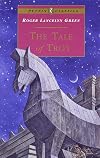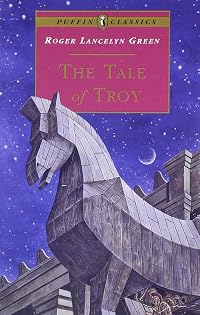
The Tale of Troy
by Roger Lancelyn Green
On This Page
Description
"It is in my mind," said Zeus, "to cause the great and glorious war of Troy, that shall be famous to the end of time." The Tale of Troy tells of the last great adventure of the Heroic Age. It is the story of Helen and the judgment of Paris; of the gathering of the heroes and the siege of Troy; of Achilles, reared by the centaur on wild honey and the marrow of lions; of Odysseus, his great strategy of the Wooden Horse, and of his many adventures on his long journey home to Greece. These show more legends have been told again and again, passed down for over three thousand years. This masterly retelling makes them as vivid and exciting as they were all those years ago. show lessTags
Recommendations












Member Reviews
The Iliad and The Odyssey have been on my to-read list for several years, ever since I read a portion of The Odyssey in my high school freshman English class. While I am well-versed in the happenings of both books, I feel it would be some kind of momentous accomplishment if I were to actually read Homer's epics, since they are both so well-known, so well-loved, and so ... huge. In preparation for my reading of The Iliad - which is on my Classics Challenge List - I decided to check out this so-called "precursor" to the real thing, courtesy of Roger Lancelyn Green and recently updated with a new introduction and lots of glossaries/discussion questions (which I did not read and/or use). And while this book definitely does introduce you to show more the main players in the fall of Troy, it left quite a lot to be desired as well.
What struck me the most about The Tale of Troy is that, considering the epic journeys and adventures of the heroes contained in its pages, the telling of those tales was done in a rather dry, textbook-like way. I could not say that I was particularly gripped at any point during the telling, and likewise very rarely laughed or even had any particular emotion - except for a strong fondness for the guile and wit of Odysseus - strike me while reading. This was almost like a who's who listing of Greek and Trojan heroes. Names would be mentioned once and then never referenced again. Or, you would be introduced to a major player, but nothing was ever done to make you like or dislike them. While I felt like Achilles behaved like a spoiled child at times, I never really felt any kind of annoyance with him. When Agamemnon sacrificed his daughter, Iphigenia, to Artemis, there was no sadness. It all just happened, and I read it, but never actually interacted at all with any of it. It was a very strange reading experience because of this; I don't think I've ever been so disassociated with the narrative before.
There were some moments of humor, mostly courtesy of Odysseus, who is definitely my favorite player in this entire saga. I also liked the mention of a king promising Agamemnon fifty ships, but instead sending one actual ship, with forty-nine clay models of ships stored in its hold. But otherwise, this was basically just a summary of events, sort of "dumbed down" for those who want to know more about the Trojan War but don't want to bother with Homer's prose (or rather, the translations of Homer's prose). If you just want to know what happened, how Troy fell, and what happened to the Greek kings upon their return to Greece, this will certainly answer your questions. But don't expect much more than that.
Nonetheless, I did like this simply for the information it provided. Could it have been done in a more entertaining way? Certainly. Is it still a worthwhile read? Yes, if you simply want the basic facts and little more. Did I enjoy it? For the most part, although I realize that that statement is not a ringing endorsement. show less
What struck me the most about The Tale of Troy is that, considering the epic journeys and adventures of the heroes contained in its pages, the telling of those tales was done in a rather dry, textbook-like way. I could not say that I was particularly gripped at any point during the telling, and likewise very rarely laughed or even had any particular emotion - except for a strong fondness for the guile and wit of Odysseus - strike me while reading. This was almost like a who's who listing of Greek and Trojan heroes. Names would be mentioned once and then never referenced again. Or, you would be introduced to a major player, but nothing was ever done to make you like or dislike them. While I felt like Achilles behaved like a spoiled child at times, I never really felt any kind of annoyance with him. When Agamemnon sacrificed his daughter, Iphigenia, to Artemis, there was no sadness. It all just happened, and I read it, but never actually interacted at all with any of it. It was a very strange reading experience because of this; I don't think I've ever been so disassociated with the narrative before.
There were some moments of humor, mostly courtesy of Odysseus, who is definitely my favorite player in this entire saga. I also liked the mention of a king promising Agamemnon fifty ships, but instead sending one actual ship, with forty-nine clay models of ships stored in its hold. But otherwise, this was basically just a summary of events, sort of "dumbed down" for those who want to know more about the Trojan War but don't want to bother with Homer's prose (or rather, the translations of Homer's prose). If you just want to know what happened, how Troy fell, and what happened to the Greek kings upon their return to Greece, this will certainly answer your questions. But don't expect much more than that.
Nonetheless, I did like this simply for the information it provided. Could it have been done in a more entertaining way? Certainly. Is it still a worthwhile read? Yes, if you simply want the basic facts and little more. Did I enjoy it? For the most part, although I realize that that statement is not a ringing endorsement. show less
The story of Helen and the judgement of Paris, of the gathering Heroes and the siege of Troy; of Achilles and his vulnerable heel, reared by the Centaur on wild honey and the marrow of lions; of Odysseus, the last of the Heroes, his plan for the wooden Horse and his many adventures on his long journey home to Greece.
Reading Level: Grade 4-5
No awards for this book.
No awards for this book.
Independent Reading Level: 5-9 grades
Awards: Guardian Children's Fiction Prize
Awards: Guardian Children's Fiction Prize
Reading Level: 4-5
independent reading level: 10+
awards:
awards:
By best-selling author Michelle Paver
Reading ages 10+
Reading ages 10+
Members
- Recently Added By
Lists

Favorite Childhood Books
1,651 works; 515 members

Elevenses
316 works; 88 members
Author Information

85+ Works 14,413 Members
Roger Lancelyn Green was born in England in 1918, where his family has lived for more than 900 years. He was often sick as a child and spent long periods confined to his room devouring Greek myths, medieval romances, and fairy tales. Green began a lifelong fascination with Greece and Greek culture when he first visited that country in 1935. He show more went on to compile and retell many Greek stories, including "Old Greek Fairy Tales," and "Jason and the Golden Fleece." Green also wrote his own stories, but he is better known for his retellings of folk tales from around the world. Roger Lancelyn Green died in 1987 (Bowker Author Biography) show less
Series
Belongs to Publisher Series
Puffin Story Books (120)
Common Knowledge
- Canonical title
- The Tale of Troy
- Original publication date
- 1958 (Engels) (Engels); 1959 (Nederlands) (Nederlands)
- Important places*
- Troje, Klein-Azië
- Important events
- Trojaanse Oorlog (13e of 12e eeuw v.Chr.); Trojan War
- First words
- To the ancient Greeks the Siege of Troy was the greatest and most important event in the Age of the Heroes—that age of wonder when the Immortals who dwelt on Olympus and whom they worshipped as gods, mingled with mankind an... (show all)d took a visible part in their affairs.
- Last words
- (Click to show. Warning: May contain spoilers.)No snow is there, nor yet great storm, nor any rain; but always ocean sendeth forth the breeze of the shrill West to blow cool—where life is easiest for men.
*Some information comes from Common Knowledge in other languages. Click "Edit" for more information.
Classifications
Statistics
- Members
- 808
- Popularity
- 34,429
- Reviews
- 7
- Rating
- (3.90)
- Languages
- Dutch, English, Spanish
- Media
- Paper, Audiobook, Ebook
- ISBNs
- 20
- ASINs
- 11