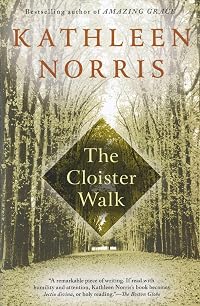
The Cloister Walk
by Kathleen Norris
On This Page
Description
For more than 10 years, thoroughly Protestant Kathleen Norris had been an oblate at a Benedictine monastery. In The Cloister Life, the celebrated author turns to the priory as her spiritual landscape, as she takes us through a liturgical year, inspiring us to evaluate our own lives and values. Norris provides tremendous insight into the languages, customs, ceremonies, and sexuality of the men and women who have chosen the cloistered life. With insight and lyrical grace, Norris examines the show more true monastic life and explores its meaning in our daily lives and how it applies to our relationships, work, and families. show lessTags
Recommendations



Member Reviews
The Cloister Walk offers a bridge into the life in a monastery from the viewpoint of an outsider - Norris comes from a protestant background, she's married - but have in different periods over some years been a Benedictine oblate (as a lay person attached to a monastery).
In this book she shares her experiences of the daily rhythm in a monastery - going to morning prayers, vespers in the evening etc. - trying to be immersed in Benedictine spirituality. The chapters are structured to follow a liturgical year - so we can get a feeling for the shifting periods of the church-year.
The book is partly memoir, partly contemplation - a lot of small and larger essays and devotions put together. Some reflections on books in the Bible, about show more prayer, reading, listening to Bible readings, some about Catholic saints, a lot about daily life of monks and nuns - and collected what Benedictine spirituality can offer us modern people living in a stressful world. Here's one reflection on time:
In our culture, time can seem like an enemy: it chews us up and spits us out with appalling ease. But the monastic perspective welcomes time as a gift from God, and seeks to put it to good use rather than allowing us to be used up by it….Liturgical time is essentially poetic time, oriented toward process rather than productivity, willing to wait attentively in stillness rather than always pushing to "get the job done". show less
In this book she shares her experiences of the daily rhythm in a monastery - going to morning prayers, vespers in the evening etc. - trying to be immersed in Benedictine spirituality. The chapters are structured to follow a liturgical year - so we can get a feeling for the shifting periods of the church-year.
The book is partly memoir, partly contemplation - a lot of small and larger essays and devotions put together. Some reflections on books in the Bible, about show more prayer, reading, listening to Bible readings, some about Catholic saints, a lot about daily life of monks and nuns - and collected what Benedictine spirituality can offer us modern people living in a stressful world. Here's one reflection on time:
In our culture, time can seem like an enemy: it chews us up and spits us out with appalling ease. But the monastic perspective welcomes time as a gift from God, and seeks to put it to good use rather than allowing us to be used up by it….Liturgical time is essentially poetic time, oriented toward process rather than productivity, willing to wait attentively in stillness rather than always pushing to "get the job done". show less
Why would a married woman with a thoroughly Protestant background and often more doubt than faith be drawn to the ancient practice of monasticism . . .?
I'm not sure Norris ever really answers that question; indeed, I'm not sure she can. It's evident that she is drawn to ritual and structure, to simplicity in life. But it seems that the two connections which draw her in most strongly are two which connect to her life as a poet.
One is the concept of lectio continua, reading though whole books of the Bible at morning and evening prayer. She describes it thus: "The monastic discipline of listening aims to still body and soul so that the words of a reading may sink in. Such silence tends to open a person . . ."
The other is metaphor, although show more she says, "Poets believe in metaphor, and that alone sets them apart from many Christians . . ." The scriptures, she notes, are full of strange metaphors. Interestingly, she, a believer, and I, a non-believer, both feel quite strongly about the attempts to modernize and make "relevant" hymnals and the language of worship. I agree with her wholeheartedly when she says " . . . contemporaries are never the best judges of what works and what doesn't. This is something all poets know; that language is a living thing, beyond our control, and it simply takes time for the trendy to reveal itself, to become so obviously dated that it falls by the way, and for the truly innovative to take hold." This "metaphoric poverty" of the modern church causes her to seek to go back to an earlier time, when theology was written as poetry.
There is so much meat to this book! It begins as though it will be a straightforward account of her time at St. John's. But it becomes a series of meditations, some short, some long, on subjects as esoteric as Mechtild of Magdeburg, as current as the debate on celibacy, as mundane as laundry. show less
I'm not sure Norris ever really answers that question; indeed, I'm not sure she can. It's evident that she is drawn to ritual and structure, to simplicity in life. But it seems that the two connections which draw her in most strongly are two which connect to her life as a poet.
One is the concept of lectio continua, reading though whole books of the Bible at morning and evening prayer. She describes it thus: "The monastic discipline of listening aims to still body and soul so that the words of a reading may sink in. Such silence tends to open a person . . ."
The other is metaphor, although show more she says, "Poets believe in metaphor, and that alone sets them apart from many Christians . . ." The scriptures, she notes, are full of strange metaphors. Interestingly, she, a believer, and I, a non-believer, both feel quite strongly about the attempts to modernize and make "relevant" hymnals and the language of worship. I agree with her wholeheartedly when she says " . . . contemporaries are never the best judges of what works and what doesn't. This is something all poets know; that language is a living thing, beyond our control, and it simply takes time for the trendy to reveal itself, to become so obviously dated that it falls by the way, and for the truly innovative to take hold." This "metaphoric poverty" of the modern church causes her to seek to go back to an earlier time, when theology was written as poetry.
There is so much meat to this book! It begins as though it will be a straightforward account of her time at St. John's. But it becomes a series of meditations, some short, some long, on subjects as esoteric as Mechtild of Magdeburg, as current as the debate on celibacy, as mundane as laundry. show less
I really wanted to like this book, but I found myself struggling with it because it was not quite what I expected. I expected more of a unified narrative detailing how the author became closer to God because of her sojourns in the monastery. Instead, I got a lot of short, choppy thoughts with a few more thoughtful narratives thrown in the mix. When I got to the end, I saw that some of the sketches had been previously published in various publications. I prefer Brother Lawrence's The Practice of the Presence of God as a depiction of monastic life and intimacy with God.
This is a book that I thought I could read straight though and move on to the next novel on my TBR list, but it wasn't that simple. Norris has the poet's eye for insight and the material written here includes some beautifully written prose with keen observations on life and humanity. The reflective nature of the book caused me to pause between sections to let her stories and observations sink in. While she writes about monastic life, she doesn't romanticize it. Instead, we're drawn to examine our own rituals and religious practices through new eyes that add meaning and significance.
If you're a fan of authors such as Thomas Merton I recommend giving this book a slow and thoughtful read.
If you're a fan of authors such as Thomas Merton I recommend giving this book a slow and thoughtful read.
I have read other things by Norris and found her religiousosity so tiresome. I decided to try this because Naples had it and Ottawa didn't. It was my last read in Naples and I really enjoyed it. I learned a lot about monastic life--who knew there were monasteries-- and ancient saints.
I’ve always been drawn to the monastic way of life, if I’m honest, so I was likewise drawn to this book. I appreciated being able to look into the life of the Benedictines that Kathleen Norris spent much time with, their way of life which is something I myself aspire to in their focus on prayer, simplicity, the reading of the Scriptures and such.
Although a small handful of chapters were of less interest to me, for the rest of this book I would rate it four stars.
Furthermore, the author has such a profound way of “noticing” in the many details of every day life, a noticing that led her to see God at work and receive wisdom from life’s happening and those around her that is greatly refreshing.
I finished this book praying that I show more too may learn to “notice” in this way, that God may use it for my good and the good of others to His glory. show less
Although a small handful of chapters were of less interest to me, for the rest of this book I would rate it four stars.
Furthermore, the author has such a profound way of “noticing” in the many details of every day life, a noticing that led her to see God at work and receive wisdom from life’s happening and those around her that is greatly refreshing.
I finished this book praying that I show more too may learn to “notice” in this way, that God may use it for my good and the good of others to His glory. show less
This book saved my life at a time when I was trying to take care of my mother after yet another fall and yet another set of broken bones. Without Norris, I think I wouldn't have made it.
Norris has a way of drawing me to her for different reasons at different times of my life. The craziness of the political world has been getting to me lately. Opening up the book to the chapter "Dreaming of Trees," I find this: "What does it mean to be simple? What would I find in my own heart if the noise of the world were silenced? Who would I be?
Norris speaks to me. I guess it isn't any more complicated than that.
Norris has a way of drawing me to her for different reasons at different times of my life. The craziness of the political world has been getting to me lately. Opening up the book to the chapter "Dreaming of Trees," I find this: "What does it mean to be simple? What would I find in my own heart if the noise of the world were silenced? Who would I be?
Norris speaks to me. I guess it isn't any more complicated than that.
Members
- Recently Added By
Lists

Best Autobiographies and Memoirs
370 works; 67 members

Books Received As Gifts in 2013
20 works; 3 members

Christmas haul 2013
15 works; 2 members

Ten Books That Have Stayed With Me
160 works; 29 members

Books featuring monks and/or nuns
166 works; 33 members

Books I Own But Haven't Read
144 works; 2 members

Books We'd Want on a Desert Island
203 works; 131 members

Books That Changed Our Perspective
423 works; 168 members
Author Information

22+ Works 9,734 Members
Kathleen Norris is the award-winning author of "Amazing Grace: A Vocabulary of Faith"; "The Cloister Walk"; & the forthcoming "The Virgin of Bennington". She lives in South Dakota & Hawaii. (Bowker Author Biography)
Awards and Honors
Work Relationships
Is abridged in
Common Knowledge
- Original publication date
- 1996
- Dedication
- For the children:
CHRISTINA, JACQUELINE,
LILLIAN, A. J., AND MIKEY
Classifications
- Genres
- Religion & Spirituality, Nonfiction, Biography & Memoir, General Nonfiction
- DDC/MDS
- 255 — Religion Christian pastoral practice & religious orders Religious congregations and orders
- LCC
- BX2435 .N57 — Philosophy, Psychology and Religion Christian Denominations Christian Denominations Catholic Church Monasticism. Religious orders
- BISAC
Statistics
- Members
- 2,896
- Popularity
- 6,216
- Reviews
- 36
- Rating
- (4.02)
- Languages
- Dutch, English, German, Italian
- Media
- Paper, Audiobook, Ebook
- ISBNs
- 16
- UPCs
- 1
- ASINs
- 18