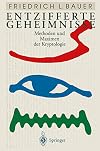
Decrypted Secrets: Methods and Maxims of Cryptology
by Friedrich L. Bauer
On This Page
Description
Cryptology, for millennia a "secret science", is rapidly gaining in practical importance for the protection of communication channels, databases, and software. Beside its role in computerized information systems (public key systems), more and more applications within computer systems and networks are appearing, which also extend to access rights and source file protection. The first part of this book treats secret codes and their uses - cryptography. The second part deals with the process of show more covertly decrypting a secret code - cryptanaly-sis - where in particular advice on assessing methods is given. The book presupposes only elementary mathematical knowledge. Spiced with a wealth of exciting, amusing, and sometimes personal stories from the history of cryptology, it will also interest general readers. "Decrypted Secrets" has become a standard book on cryptology. This 3rd edition has again been revised and extended in many technical and biographical details. "The best single book on cryptology today" (David Kahn, Cryptologia) "For those who work actively with cryptology this book is a must. For amateurs it is an important dictionary which in many cases will guide them to make their ciphers more secure." (Arne Fransen, International Intelligence History Study Group). show lessTags
Recommendations




























Member Recommendations
Member Reviews
Indeholder "Preface", "Part I: Cryptography - The People", " 1. Introductory Synopsis", " 1.1 Cryptography and Steganography", " 1.2 Semagrams", " 1.3 Open Code: Masking", " 1.4 Cues", " 1.5 Open Code: Veiling by Nulls", " 1.6 Open Code: Veiling by Grilles", " 1.7 Classification of Cryptographic Methods", " 2. Aims and Methods of Cryptography", " 2.1 The Nature of Cryptography", " 2.2 Encryption", " 2.3 Cryptosystems", " 2.4 Polyphony", " 2.5 Character Sets", " 2.6 Keys", " 3. Encryption Steps: Simple Substitution", " 3.1 Case V(1) --> W (Unipartite Simple Substitutions)", " 3.2 Special Case V <--> V (Permutations)", " 3.3 Case V(1) --> W^m (Multipartite Simple Substitutions)", " 3.4 The General Case V(1) --> W(m), Straddling", " 4. show more Encryption Steps: Polygraphic Substitution and Coding", " 4.1 Case V(2) --> W(m), (Digraphic Substitutions)", " 4.2 Special Cases of Playfair and Delastelle: Tomographic Methods", " 4.3 Case V(3) --> W(m), (Trigraphic Substitutions)", " 4.4 The General Case V(n) --> W(m) : Codes", " 5. Encryption Steps: Linear Substitution", " 5.1 Self-reciprocal Linear Substitutions", " 5.2 Homogeneous Linear Substitutions", " 5.3 Binary Linear Substitutions", " 5.4 General Linear Substitutions", " 5.5 Decomposed Linear Substitutions", " 5.6 Decimated Alphabets", " 5.7 Linear Substitutions with Decimal and Binary Numbers", " 6. Encryption Steps: Transposition", " 6.1 Simplest Methods", " 6.2 Columnar Transpositions", " 6.3 Anagrams", " 7. Polyalphabetic Encryption: Families of Alphabets", " 7.1 Iterated Substitutions", " 7.2 Cyclically Shifted and Rotated Alphabets", " 7.3 Rotor Crypto Machines", " 7.4 Shifted Standard Alphabets: Vigenère and Beaufort", " 7.5 Unrelated Alphabets", " 8. Polyalphabetic Encryption: Keys", " 8.1 Early Methods with Periodic Keys", " 8.2 'Double Key'", " 8.3 Vernam Encryption", " 8.4 Quasi-nonperiodic Keys", " 8.5 Machines that Generate Their Own Key Sequences", " 8.6 Off-Line Forming of Key Sequences", " 8.7 Nonperiodic Keys", " 8.8 Individual, One-Time Keys", " 8.9 Key Negotiation and Key Management", " 9. Composition of Classes of Methods", " 9.1 Group Property", " 9.2 Superencryption", " 9.3 Similarity of Encryption Methods", " 9.4 Shannon's 'Pastry Dough Mixing'", " 9.5 Confusion and Diffusion by Arithmetical Operations", " 9.6 DES and IDEA(R)", " 10. Open Encryption Key Systems", " 10.1 Symmetric and Asymmetric Encryption Methods", " 10.2 One-Way Functions", " 10.3 RSA Method", " 10.4 Cryptanalytic Attack upon RSA", " 10.5 Secrecy Versus Authentication", " 10.6 Security of Public Key Systems", " 11. Encryption Security", " 11.1 Cryptographic Faults", " 11.2 Maxims of Cryptology", " 11.3 Shannon's Yardsticks", " 11.4 Cryptology and Human Rights", "Part II: Cryptanalysis - The Machinery", " 12. Exhausting Combinatorial Complexity", " 12.1 Monoalphabetic Simple Encryptions", " 12.2 Monoalphabetic Polygraphic Encryptions", " 12.3 Polyalphabetic Encryptions", " 12.4 General Remarks on Combinatorial Complexity", " 12.5 Cryptanalysis by Exhaustion", " 12.6 Unicity Distance", " 12.7 Practical Execution of Exhaustion", " 12.8 Mechanizing the Exhaustion", " 13. Anatomy of Language: Patterns", " 13.1 Invariance of Repetition Patterns", " 13.2 Exclusion of Encryption Methods", " 13.3 Pattern Finding", " 13.4 Finding of Polygraphic Patterns", " 13.5 The Method of the Probable Word", " 13.6 Automatic Exhaustion of the Instantiations of a Pattern", " 13.7 Pangrams", " 14. Polyalphabetic Case: Probable Words", " 14.1 Non-Coincidence Exhaustion of Probable Word Position", " 14.2 Binary Non-Coincidence Exhaustion", " 14.3 The De Viaris Attack", " 14.4 Zig-Zag Exhaustion of Probable Word Position", " 14.5 The Method of Isomorphs", " 14.6 A clever brute force method: EINSing", " 14.7 Covert Plaintext-Cryptotext Compromise", " 15. Anatomy of Language: Frequencies", " 15.1 Exclusion of Encryption Methods", " 15.2 Invariance of Partitions", " 15.3 Intuitive Method: Frequency Profile", " 15.4 Frequency Ordering", " 15.5 Cliques and Matching of Partitions", " 15.6 Optimal Matching", " 15.7 Frequency of Multigrams", " 15.8 The Combined Method of Frequency Matching", " 15.9 Frequency Matching for Polygraphic Substitutions", " 15.10 Free-Style Methods", " 15.11 Unicity Distance Revisited", " 16. Kappa and Chi", " 16.1 Definition and Invariance of Kappa", " 16.2 Definition and Invariance of Chi", " 16.3 The Kappa-Chi Theorem", " 16.4 The Kappa-Phi Theorem", " 16.5 Symmetric Functions of Character Frequencies", " 17. Periodicity Examination", " 17.1 The Kappa Test of Friedman", " 17.2 Kappa Test for Multigrams", " 17.3 Cryptanalysis by Machines: Searching for a period", " 17.4 Kasiski Examination", " 17.5 Building a Depth and Phi Test of Kullback", " 17.6 Estimating the Period Length", " 18. Alignment of Accompanying Alphabets", " 18.1 Matching the Profile", " 18.2 Aligning Against Known Alphabet", " 18.3 Chi Test: Mutual Alignment of Accompanying Alphabets", " 18.4 Reconstruction of the Primary Alphabet", " 18.5 Kerckhoffs' Symmetry of Position", " 18.6 Stripping off Superencryption: Difference Method", " 18.7 Decryption of Code", " 18.8 Reconstruction of the Password", " 19. Compromises", " 19.1 Kerckhoffs' Superimposition", " 19.2 Superimposition for Encryptions with a Key Group", " 19.3 COLOSSUS", " 19.4 Adjustment 'in depth' of Messages", " 19.5 Cryptotext-Cryptotext Compromises", " 19.6 Cryptotext-Cryptotext Compromise: ENIGMA Indicator Doubling", " 19.7 Plaintext-Cryptotext Compromise: Feedback Cycle", " 20. Linear Basis Analysis", " 20.1 Reduction of Linear Polygraphic Substitutions", " 20.2 Reconstruction of the Key", " 20.3 Reconstruction of a Linear Shift Register", " 21. Anagramming", " 21.1 Transposition", " 21.2 Double Columnar Transposition", " 21.3 Multiple Anagramming", " 22. Concluding Remarks", " 22.1 Success in Breaking", " 22.2 Mode of Operation of the Unauthorized Decryptor", " 22.3 Illusory Security", " 22.4 Importance of Cryptology", "Appendix: Axiomatic Information Theory", "Bibliography", "Index", "Photo Credits", "List of Color Plates", " Plate A. The disk of Phaistos", " Plate B. Brass cipher disks", " Plate C. The 'Cryptograph' of Wheatstone", " Plate D. The US Army cylinder device M-94", " Plate E. The US strip device M-138-T4", " Plate F. The cipher machine of Kryha", " Plate G. The Hagelin 'Cryptographer' C-36", " Plate H. The US Army M-209, Hagelin licensed", " Plate I. The cipher machine ENIGMA with four rotors", " Plate K. Rotors of the ENIGMA", " Plate L. The British rotor machine TYPEX", " Plate M. Uhr box of the German Wehrmacht", " Plate N. Cipher teletype machine Lorenz SZ 42", " Plate O. Russian one-time pad", " Plate P. Modern crypto board", " Plate Q. CRAY Supercomputers".
Glimrende gennemgang af et hav af krypteringsmetoder og hvordan man kan knække dem. Der er en særlig sød teknik med at strække og folde et billede i afsnit 9.3. show less
Glimrende gennemgang af et hav af krypteringsmetoder og hvordan man kan knække dem. Der er en særlig sød teknik med at strække og folde et billede i afsnit 9.3. show less
Mar 14, 2019 (Edited)Danish
Ratings
Members
- Recently Added By
Author Information

26+ Works 295 Members
Awards and Honors
Notable Lists
Common Knowledge
- Important places
- Bletchley Park, Bletchley, Buckinghamshire, England, UK
Classifications
- Genres
- Nonfiction, Technology, General Nonfiction, Science & Nature
- DDC/MDS
- 652.8 — Technology Management & public relations Processes of written communication Cryptography
- LCC
- QA76.9 .A25 .B38513 — Science Mathematics Mathematics Instruments and machines Calculating machines Electronic computers. Computer science
- BISAC
Statistics
- Members
- 148
- Popularity
- 220,188
- Reviews
- 1
- Rating
- (3.91)
- Languages
- English, German
- Media
- Paper, Ebook
- ISBNs
- 15
- ASINs
- 1