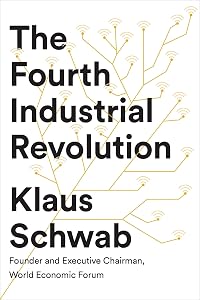
The Fourth Industrial Revolution
by Klaus Schwab
On This Page
Description
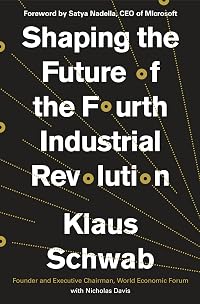
World-renowned economist Klaus Schwab, Founder and Executive Chairman of the World Economic Forum, explains that we have an opportunity to shape the fourth industrial revolution, which will fundamentally alter how we live and work. Schwab argues that this revolution is different in scale, scope and complexity from any that have come before. Characterized by a range of new technologies that are fusing the physical, digital and biological worlds, the developments are affecting all show more disciplines, economies, industries and governments, and even challenging ideas about what it means to be human. Artificial intelligence is already all around us, from supercomputers, drones and virtual assistants to 3D printing, DNA sequencing, smart thermostats, wearable sensors and microchips smaller than a grain of sand. But this is just the beginning: nanomaterials 200 times stronger than steel and a million times thinner than a strand of hair and the first transplant of a 3D printed liver are already in development. Imagine "smart factories" in which global systems of manufacturing are coordinated virtually, or implantable mobile phones made of biosynthetic materials. The fourth industrial revolution, says Schwab, is more significant, and its ramifications more profound, than in any prior period of human history. He outlines the key technologies driving this revolution and discusses the major impacts expected on government, business, civil society and individuals. Schwab also offers bold ideas on how to harness these changes and shape a better future--one in which technology empowers people rather than replaces them; progress serves society rather than disrupts it; and in which innovators respect moral and ethical boundaries rather than cross them. We all have the opportunity to contribute to developing new frameworks that advance progress. show lessTags
Recommendations





Member Reviews
NOT ONE TASTY BUG RECIPE!
The book reads like someone got really into NLP in the 80s and desperately wants you to repeat "The Fourth Industrial Revolution" in your sleep. While the negative externalities from the near future (widespread joblessness, inequality, political upheaval) are made very concrete, the benefits and the solutions to the problems, appear only as vague handwaving and the kind of meaningless fluff words business management people take courses in to swindle investors with.
Also 20% of the book is just an appendix with a series of random summaries about various promising technologies or products that exist, the future of which are then hypothesized about. Did you know we didn't used to have computers and the internet, and show more now we do? Can you imagine what happens when everyone has an iPhone and Apple Watch? Access to education! Participation in the global economy! Expanded market size and e-commerce! Hype and buzzwords masquerading as information. show less
The book reads like someone got really into NLP in the 80s and desperately wants you to repeat "The Fourth Industrial Revolution" in your sleep. While the negative externalities from the near future (widespread joblessness, inequality, political upheaval) are made very concrete, the benefits and the solutions to the problems, appear only as vague handwaving and the kind of meaningless fluff words business management people take courses in to swindle investors with.
Also 20% of the book is just an appendix with a series of random summaries about various promising technologies or products that exist, the future of which are then hypothesized about. Did you know we didn't used to have computers and the internet, and show more now we do? Can you imagine what happens when everyone has an iPhone and Apple Watch? Access to education! Participation in the global economy! Expanded market size and e-commerce! Hype and buzzwords masquerading as information. show less
NOT ONE TASTY BUG RECIPE!
The book reads like someone got really into NLP in the 80s and desperately wants you to repeat "The Fourth Industrial Revolution" in your sleep. While the negative externalities from the near future (widespread joblessness, inequality, political upheaval) are made very concrete, the benefits and the solutions to the problems, appear only as vague handwaving and the kind of meaningless fluff words business management people take courses in to swindle investors with.
Also 20% of the book is just an appendix with a series of random summaries about various promising technologies or products that exist, the future of which are then hypothesized about. Did you know we didn't used to have computers and the internet, and show more now we do? Can you imagine what happens when everyone has an iPhone and Apple Watch? Access to education! Participation in the global economy! Expanded market size and e-commerce! Hype and buzzwords masquerading as information. show less
The book reads like someone got really into NLP in the 80s and desperately wants you to repeat "The Fourth Industrial Revolution" in your sleep. While the negative externalities from the near future (widespread joblessness, inequality, political upheaval) are made very concrete, the benefits and the solutions to the problems, appear only as vague handwaving and the kind of meaningless fluff words business management people take courses in to swindle investors with.
Also 20% of the book is just an appendix with a series of random summaries about various promising technologies or products that exist, the future of which are then hypothesized about. Did you know we didn't used to have computers and the internet, and show more now we do? Can you imagine what happens when everyone has an iPhone and Apple Watch? Access to education! Participation in the global economy! Expanded market size and e-commerce! Hype and buzzwords masquerading as information. show less
A brief and somewhat superficial overview of the current (as of 2015) state of Technology and Civilisation as viewed by the Founder and Executive Chairman of the World Economic Forum (hence representing the neoliberal globalist Davos crowd). To his credit, he tries hard to stay neutral and present the facts and trends as they are without too much bias, including many dangers and pitfalls that will have to be overcome. Unfortunately (and perhaps inevitably given the short length) there are few proposed solutions, just an outline of the issues that we'll need to contend with in the coming decades. I am hopeful that the 2018 sequel "Shaping the Fourth Industrial Revolution" addresses these concerns with some concrete solutions.
Technological advances are rapidly changing how we do business, how we earn a living, how we make things...and, well, pretty much everything. This book provides a fairly superficial overview of several areas in which this is happening and extrapolates into the near future. The basic message is that societies need to address these changes and adapt. Specific recommendations on how are largely lacking, and the presentation is extremely dry. The fact that this is such an interesting and important topic warrants bumping my subjective rating to 3 stars, but it's far from the best book I've read on these issues.
Technical Library - shelved at: C11 - initially with Nigel Ostime
ein spannendes Buch über die Zukunft der digitalen Welt
Apr 17, 2018German
Ratings
Members
- Recently Added By
Author Information

40+ Works 628 Members
Awards and Honors
Notable Lists
Classifications
- Genres
- Economics, Nonfiction, Technology, Business, General Nonfiction, Science & Nature
- DDC/MDS
- 338.064 — Society, government, & culture Economics Production Efficiency Effect Of Innovation
- LCC
- HC79 .T4 — Social sciences Economic history and conditions Economic history and conditions Special topics
- BISAC
Statistics
- Members
- 290
- Popularity
- 110,871
- Reviews
- 6
- Rating
- (3.18)
- Languages
- 7 — English, French, German, Khmer, Portuguese (Portugal), Russian, Spanish
- Media
- Paper, Audiobook, Ebook
- ISBNs
- 20
- ASINs
- 5