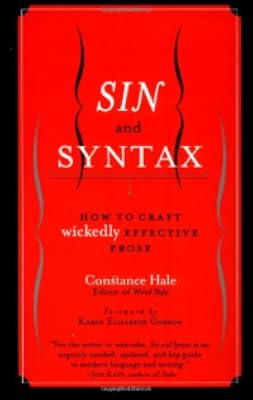
Sin and Syntax: How to Craft Wickedly Effective Prose
by Constance Hale 
On This Page
Description
"Today's writers need more spunk than Strunk- whether it's the Great American e-mail, Madison Avenue advertising, or Grammy Award-winning rap lyrics, memorable writing must jump off the page. Copy veteran Constance Hale is on a mission to make creative communication, both the lyrical and the unlawful, an option for everyone. With its crisp, witty tone, Sin and Syntaxcovers grammar's ground rules while revealing countless unconventional syntax secrets (such as how to use--Gasp!--interjections show more or when to pepper your prose with slang) that make for sinfully good writing. Discover how to- *Distinguish between words that are "pearls" and words that are "potatoes" * Avoid "couch potato thinking" and "commitment phobia" when choosing verbs * Use literary devices such as onomatopoeia, alliteration, and metaphor (and understand what you're doing) Everyone needs to know how to write stylish prose--students, professionals, and seasoned writers alike. Whether you're writing to sell, shock, or just sing, Sin and Syntax is the show lessTags
Recommendations










Member Reviews
I picked this up at a used book sale because I recently finished a MOOC class on grammar and, although I passed with flying colors—oh, I think Constance (author) would suggest I rethink that too oft used phrase…hmm, I passed with aplomb, I didn’t feel like I could by any means teach the subject…so thought this title sounded like a fun way to keep going. I was write! Errr, “Right”! (Now you’re wondering how I passed at all?) This book has it all, and if you didn’t think a book on grammar could be entertaining (as well as instructive), read this one.
Sample? OK, here’s one of many illustrative quotes complete with quippy explanation of the error. This passage is from a section called “Dangling Doozies”:
“Remember, show more participles exist so that verbs can modify nouns. Dangling participles are adjectival phrases that have come unmoored from the nouns they are supposed to modify and instead modify the nearest noun they can find. Here’s a dangling participle reprinted in the "New Yorker" as a space filler:
In San Diego, the “in” place for years has been McDini’s for corned beef. Thinly sliced and heaped on rye, corned beef lovers won’t be disappointed.”
When was the last time you were thinly sliced and heaped on rye?”
I get that a grammar book probably isn’t your first choice for light summer reading, but if you do happen to enjoy the many quirks of the English language, this is a good one to turn to. show less
Sample? OK, here’s one of many illustrative quotes complete with quippy explanation of the error. This passage is from a section called “Dangling Doozies”:
“Remember, show more participles exist so that verbs can modify nouns. Dangling participles are adjectival phrases that have come unmoored from the nouns they are supposed to modify and instead modify the nearest noun they can find. Here’s a dangling participle reprinted in the "New Yorker" as a space filler:
In San Diego, the “in” place for years has been McDini’s for corned beef. Thinly sliced and heaped on rye, corned beef lovers won’t be disappointed.”
When was the last time you were thinly sliced and heaped on rye?”
I get that a grammar book probably isn’t your first choice for light summer reading, but if you do happen to enjoy the many quirks of the English language, this is a good one to turn to. show less
This small book packs in a lot of information in a spirited and intelligent way. Starting “New Principles of Prose” - which are: Relish Every Word. Be Simple, But Go Deep. Take Risks. Seek Beauty. Find The Right Word. She then divides it into three parts: Words, Sentences and Music. Each chapter has four subheadings, Bones, Flesh, Cardinal Sins, and Carnal Pleasures.
This book is a good introduction or refresher for using correct grammar, a word which I think frightens some people, including me, myself and I(?)! Stylistically, it is modern and clever rather than old and stuffy.
But this is a grammar book, you already know what it’s going to explain... the parts of speech, their proper usage, and structure and Hale does so in a show more manner that uses reference that are topical and sometimes comical and it keeps the information from feeling stale and dated. As in this example for an ‘obscure pronominal reference’ from a church bulletin, “The ladies of the church have cast off clothing of every kind, and they can be seen in the church basement Friday afternoon.” Hahaha!
Hale’s layout is logical and consistent. Using Chapter 8-Interjection as an example:
The Bones (grammar sermonette) are explanations of the chapter subject. She describes interjections as “The banging windows and bursting pipes that add excitement to the story inside.”
The Flesh (lesson on writing), “Since speech tics reveal as much individuality as proper syntax, interjections can help impart character.”
Cardinal Sin (true transgressions) “In speech, like as an interjection buys you a little time when your mind can’t keep up with your mouth. But in prose it has the effect of whittling your words down to whimpering, simpering sissyspeak.”
I appreciate writers who can inform and amuse at the same time. Though the threats of death were a bit extreme. “We do not say I’s, you’s, he’s, or she’s to indicate possession, so why would we say who’s or it’s?” “Who’s and it’s are contractions of who is and it is. Learn this or die.” —Okay, okay! show less
This book is a good introduction or refresher for using correct grammar, a word which I think frightens some people, including me, myself and I(?)! Stylistically, it is modern and clever rather than old and stuffy.
But this is a grammar book, you already know what it’s going to explain... the parts of speech, their proper usage, and structure and Hale does so in a show more manner that uses reference that are topical and sometimes comical and it keeps the information from feeling stale and dated. As in this example for an ‘obscure pronominal reference’ from a church bulletin, “The ladies of the church have cast off clothing of every kind, and they can be seen in the church basement Friday afternoon.” Hahaha!
Hale’s layout is logical and consistent. Using Chapter 8-Interjection as an example:
The Bones (grammar sermonette) are explanations of the chapter subject. She describes interjections as “The banging windows and bursting pipes that add excitement to the story inside.”
The Flesh (lesson on writing), “Since speech tics reveal as much individuality as proper syntax, interjections can help impart character.”
Cardinal Sin (true transgressions) “In speech, like as an interjection buys you a little time when your mind can’t keep up with your mouth. But in prose it has the effect of whittling your words down to whimpering, simpering sissyspeak.”
I appreciate writers who can inform and amuse at the same time. Though the threats of death were a bit extreme. “We do not say I’s, you’s, he’s, or she’s to indicate possession, so why would we say who’s or it’s?” “Who’s and it’s are contractions of who is and it is. Learn this or die.” —Okay, okay! show less
A book that is both helpful and entertaining. Not often that I find myself laughing out loud while reading grammar books, but I did with this one.
Ah, a grammar book in the guise of reckless rule breaking. No, I’m not being sarcastic (much), but grammarians mostly have their work cut out for them trying to present a fairly cut and dry subject with flair. The most useful thing about this particular book was that it not only presented the rules and examples of when rule-breaking actually works–but also instances when supposed rule breaking for art turns into linguistic atrocities. There are points, however, when I felt the author was a bit too cutesy with a turn of phrase–but that just may be me and my preferences for certain writing styles. Some examples of “good writing” also seem a bit questionable to me (James Joyce?!!), but again, I may be a bit picky. Otherwise, show more it’s mostly a good guide for writing. And if it doesn’t make your writing great, well, at least it’ll keep you from making tragic mistakes. show less
An entertaining book that will help you review the parts of speech. It also helps tease out what makes writing good and what makes it clunky by looking at such intangibles as lyricism, voice, and melody of writing. A good read for writers, editors, and anyone who likes language.
Beware: if you're already anal retentive about word choice, grammar, style, and syntax, this book might be information overload. But, if you're a go-with-the-flow type that can take or leave writing advice, then this will make a pretty good guide on the subject of crafting sentences.
The author's style doesn't really appeal to me. I feel like she's trying too hard. However, I like the examples from well-known authors, particularly of them editing and improving their work.
I thought it was a bit of a cheap shot using song lyrics from Everclear to illustrate a point. Writing song lyrics is not the same as writing prose.
As a translator, I am annoyed that Constance Hale gives Gabriel García Márquez the credit for writing wonderful sentences in English. He didn't write them, the translator did!
I haven’t made the most of this book because I haven't done the suggested exercises.
This would be a useful reference book for writers of all sorts.
I thought it was a bit of a cheap shot using song lyrics from Everclear to illustrate a point. Writing song lyrics is not the same as writing prose.
As a translator, I am annoyed that Constance Hale gives Gabriel García Márquez the credit for writing wonderful sentences in English. He didn't write them, the translator did!
I haven’t made the most of this book because I haven't done the suggested exercises.
This would be a useful reference book for writers of all sorts.
Members
- Recently Added By
Lists

Books Read in 2016
4,666 works; 199 members
Author Information

5+ Works 1,518 Members
Constance Hale is a LibraryThing Author, an author who lists their personal library on LibraryThing.
Common Knowledge
Classifications
- Genres
- Reference, Nonfiction
- DDC/MDS
- 808.042 — Literature & rhetoric Literature, rhetoric & criticism Rhetoric and collections of literary texts from more than two literatures Rhetoric and anthologies Handbooks for writers English
- LCC
- PE1408 — Language and Literature English language English Modern English
- BISAC
Statistics
- Members
- 1,160
- Popularity
- 21,760
- Reviews
- 12
- Rating
- (3.90)
- Languages
- English
- Media
- Paper, Audiobook, Ebook
- ISBNs
- 8
- ASINs
- 6