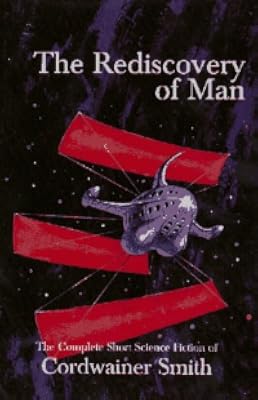
The Rediscovery of Man: The Complete Short Science Fiction of Cordwainer Smith
by Cordwainer Smith
Casher O'Neill (Collections and Selections — collection), Instrumentality of Mankind
On This Page
Tags
Recommendations




























Member Reviews
In a 2013 centennial assessment Cordwainer Smith, The Atlantic called him the “loosest cannon of all” in science fiction. It is not far off to call him science fiction’s William Blake. Like Blake, he created an elaborate grand myth epic that may have been transferring his fantasies and eidetic visions to print. Like Blake, his imagination is visual. Consider this opening to “When the People Fell” that inspired the cove of one of Smith’s collections: “Can you imagine a rain of people through an acid fog?” His underpeople and robots seem made to order for cosplay. His prose is unabashedly poetic. Just listen to some of his titles: “The Lady Who Sailed the Soul,” “Think Blue, Count Two,” “Golden the Ship Was—Oh! show more Oh! Oh!” “The Dead Lady of Clown Town,” “Alpha Ralpha Boulevard,” and “The Ballad of Lost C’mel.” I am always amused when someone tries to make a coherent future history from his Rediscovery of Man stories. Smith throws years around in the thousands without a care. He is more interested in recasting myths like Heloise and Abelard and Joan of Arc than he is in engineering. He invented future technologies that seem almost magical, but he ultimately rejects them as evolutionary dead ends. His is not usually a world of Blake’s “dark Satanic mills” but his layered, Edenic cities are equally dystopian. 5 stars. show less
Masterful stuff. I don't know anyone so skilled at implying so much backstory in so few words. You read any given paragraph of Cordwainer Smith, and you immediately have a sense of the entire history and culture of his 'Instrumentality' lurking just offstage.
I still don't know how he does it - these stories deserve close study.
I still don't know how he does it - these stories deserve close study.
The Rediscovery of Man collects all of Cordwainer Smith's short science fiction. I previously read a book that collected most of it, When the People Fell, and rereading my review, I find that I largely stand by it: the best stuff is "Scanners Live in Vain," "The Crime and the Glory of Commander Suzdal," "A Planet Named Shayol," and the three Casher O'Neill stories. Like When the People Fell, this book collects the stories in their chronological order in Smith's "Instrumentality of Mankind" future history, with "out-of-continuity" tales thrown in at the end. It would be nice to read Smith's work in publication order, I think, to see the contrast that provides.
There are some stories collected here that weren't in WtPF, ones about the show more Underpeople, the animals-mutated-into-human-ish-life-forms servitor race: "The Dead Lady of Clown Town," "Under Old Earth," "Mother Hitton's Littul Kittons," "Alpha Ralpha Boulevard," and "The Ballad of Lost C'Mell." None of these made much of an impact. I don't know if it's because none of them were as good as the great stories I mentioned in paragraph one of this review, or because I wasn't reading them carefully because they were nestled among stories I didn't have to read carefully on account of them being rereads. But anyway, still an excellent book, and I look forward to finishing off Smith's sf oeuvre with Nostrilia in a couple years, I'm sure. show less
There are some stories collected here that weren't in WtPF, ones about the show more Underpeople, the animals-mutated-into-human-ish-life-forms servitor race: "The Dead Lady of Clown Town," "Under Old Earth," "Mother Hitton's Littul Kittons," "Alpha Ralpha Boulevard," and "The Ballad of Lost C'Mell." None of these made much of an impact. I don't know if it's because none of them were as good as the great stories I mentioned in paragraph one of this review, or because I wasn't reading them carefully because they were nestled among stories I didn't have to read carefully on account of them being rereads. But anyway, still an excellent book, and I look forward to finishing off Smith's sf oeuvre with Nostrilia in a couple years, I'm sure. show less
If you are like me, you have heard the name Cordwainer Smith. You have probably also heard of and read his short story “Scanners Live in Vain”. Digging a little deeper, you may have even heard of “The Game of Rat and Dragon” or “Down to a Sunless Sea”. If your awareness of Cordwainer Smith was as limited as mine, then, like me, you will be floored by this book.
This is a remarkable collection made more remarkable by the fact that 1) it is a complete collection of his short science fiction stories, 2) unlike most “complete” collections, it has almost no low points, and 3) this complete collection is made up almost exclusively of stories built around a future history (“the Instrumentality of Mankind”). Now, Cordwainer show more Smith (real name Paul Myron Anthony Linebarger – but it is just easier to stick with “Smith”) was not the first to use this approach, nor the last. But this collection shows how devoted his work was to that history – a history that spans an incredible arc of future history. And a future history containing intricacies that Smith is able to explore at the macro and micro level with amazing success.
These are stories that stand the test of time. But for a few exceptions, they could be written today. And to see how many were written in the 60s helps the reader realize how modern Smith’s writing is.
I fall to cliché in describing this collection. It is jaw-dropping. It is a marvel. It contains undiscovered treasures. Insert your own superlatives here.
Get this collection and find yourself wrapped up in the individual stories and in the grand history that is explored and yet only hinted at. You will wish there were many, many more. show less
This is a remarkable collection made more remarkable by the fact that 1) it is a complete collection of his short science fiction stories, 2) unlike most “complete” collections, it has almost no low points, and 3) this complete collection is made up almost exclusively of stories built around a future history (“the Instrumentality of Mankind”). Now, Cordwainer show more Smith (real name Paul Myron Anthony Linebarger – but it is just easier to stick with “Smith”) was not the first to use this approach, nor the last. But this collection shows how devoted his work was to that history – a history that spans an incredible arc of future history. And a future history containing intricacies that Smith is able to explore at the macro and micro level with amazing success.
These are stories that stand the test of time. But for a few exceptions, they could be written today. And to see how many were written in the 60s helps the reader realize how modern Smith’s writing is.
I fall to cliché in describing this collection. It is jaw-dropping. It is a marvel. It contains undiscovered treasures. Insert your own superlatives here.
Get this collection and find yourself wrapped up in the individual stories and in the grand history that is explored and yet only hinted at. You will wish there were many, many more. show less
Cordwainer Smith (actual name Paul Myron Anthony Linebarger) created a great setting in his body of work, adding to it with each short story, as well as his lone novel, so that at the end of the day the universe of the Instrumentality of Mankind feels vibrant and complex yet understandable. Unfortunately, this great setting is never complemented by any individual stories of particular excellence, leading to the best part of Smith being the background of his stories instead of the actual action occurring.
The first two stories in this collection deal with an Earth that is similar to how we know it now, though with technology and societal structures differing from our own. After that, however, the universe gets more interesting, as a great show more war kills off most of the population, warping what is left of the world and banishing civilization. The next few stories deal with how humanity takes the first steps out of this dark age and back toward organized society. Starting with "Scanners Live in Vain" the next several stories deal with the various methods and technology used by mankind to start exploring other worlds and other stars- and in Smith's universe, such interstellar travel always comes at a price. After that the stories take place during the reign of the Instrumentality of Mankind, the system that arose in Smith's universe to ensure that humanity never again threatens its own existence through actions that risk self-extinction. The Instrumentality, despite a seemingly benevolent motive, is far from perfect, refusing to grant rights to the underpeople and in general appearing as an authoritarian system of Lords and Ladies and not one where other voices are heard. The final batch of stories is set during the advent of The Rediscovery of Man, when the Instrumentality realizes that for people to survive they must do more than protect them from themselves, they must also return to mankind the spice that was brought to life by danger, fear, crime, and wrong choices. Thus the civilizations that existed before the great war that almost destroyed the world are resurrected, although in a differing form. All this takes place over the course of thousands upon thousands of years.
This is a fascinating journey for humanity to make, and this gradual evolution is what makes Smith's universe so engaging. Not only do the larger changes outlined above occur slowly over the course of Smith’s stories, but he also fleshes out smaller aspects of the universe that recur throughout his body of work, like the technology that allows for interstellar travel, the creation of intelligent robots using animal brains, the different worlds with their differing characteristics, the use of telepathy, and the immortality drug Stroon that is so highly prized and so heavily rationed. You get the sense that endless stories have occurred in this universe, and you are only being told of a few such tales.
The problem, however, is that few of these tales are noteworthy. Most are similar in tone and a large number are similar in content as well. For instance, a full nine of the stories in this collection have new methods of space travel as their main subject, quite a high number considering the entire collection totals only 32 stories. Some are quite good ("The Lady Who Sailed The Soul," "The Burning of the Brain") but after four such stories in a row it’s hard to feel anything other than bored. A few of the stories are above average, I especially enjoyed “Mark Elf,” which took the form of a science-fiction fairy tale, and “Alpha Ralpha Boulevard,” that dealt with how the pampered and protected people of the Instrumentality deal with life when the first days of the rediscovery of man strip them of the protections that they had always taken for granted. Most, however, are nothing special, and of the 32 stories the only ones with a noticeably different tone are the fairy tale feel of “Mark Elf” and “The Queen of the Afternoon” and the refreshing humorous angle of "From Gustible's Planet." The rest start to blur together, despite the universe evolving behind them.
I’d recommend this collection to fans of Philip K. Dick, “Scanners Live in Vain” especially had a PKD vibe. It’s also a good collection to pick up if the idea of pulp science fiction with a more cohesive than usual universe sounds appealing to you. Unfortunately the universe alone was not enough for me, I need strong individual stories as well. Here the stories range from “meh” to “pretty good,” but none reach the level of excellence the universe of the Instrumentality deserves. show less
The first two stories in this collection deal with an Earth that is similar to how we know it now, though with technology and societal structures differing from our own. After that, however, the universe gets more interesting, as a great show more war kills off most of the population, warping what is left of the world and banishing civilization. The next few stories deal with how humanity takes the first steps out of this dark age and back toward organized society. Starting with "Scanners Live in Vain" the next several stories deal with the various methods and technology used by mankind to start exploring other worlds and other stars- and in Smith's universe, such interstellar travel always comes at a price. After that the stories take place during the reign of the Instrumentality of Mankind, the system that arose in Smith's universe to ensure that humanity never again threatens its own existence through actions that risk self-extinction. The Instrumentality, despite a seemingly benevolent motive, is far from perfect, refusing to grant rights to the underpeople and in general appearing as an authoritarian system of Lords and Ladies and not one where other voices are heard. The final batch of stories is set during the advent of The Rediscovery of Man, when the Instrumentality realizes that for people to survive they must do more than protect them from themselves, they must also return to mankind the spice that was brought to life by danger, fear, crime, and wrong choices. Thus the civilizations that existed before the great war that almost destroyed the world are resurrected, although in a differing form. All this takes place over the course of thousands upon thousands of years.
This is a fascinating journey for humanity to make, and this gradual evolution is what makes Smith's universe so engaging. Not only do the larger changes outlined above occur slowly over the course of Smith’s stories, but he also fleshes out smaller aspects of the universe that recur throughout his body of work, like the technology that allows for interstellar travel, the creation of intelligent robots using animal brains, the different worlds with their differing characteristics, the use of telepathy, and the immortality drug Stroon that is so highly prized and so heavily rationed. You get the sense that endless stories have occurred in this universe, and you are only being told of a few such tales.
The problem, however, is that few of these tales are noteworthy. Most are similar in tone and a large number are similar in content as well. For instance, a full nine of the stories in this collection have new methods of space travel as their main subject, quite a high number considering the entire collection totals only 32 stories. Some are quite good ("The Lady Who Sailed The Soul," "The Burning of the Brain") but after four such stories in a row it’s hard to feel anything other than bored. A few of the stories are above average, I especially enjoyed “Mark Elf,” which took the form of a science-fiction fairy tale, and “Alpha Ralpha Boulevard,” that dealt with how the pampered and protected people of the Instrumentality deal with life when the first days of the rediscovery of man strip them of the protections that they had always taken for granted. Most, however, are nothing special, and of the 32 stories the only ones with a noticeably different tone are the fairy tale feel of “Mark Elf” and “The Queen of the Afternoon” and the refreshing humorous angle of "From Gustible's Planet." The rest start to blur together, despite the universe evolving behind them.
I’d recommend this collection to fans of Philip K. Dick, “Scanners Live in Vain” especially had a PKD vibe. It’s also a good collection to pick up if the idea of pulp science fiction with a more cohesive than usual universe sounds appealing to you. Unfortunately the universe alone was not enough for me, I need strong individual stories as well. Here the stories range from “meh” to “pretty good,” but none reach the level of excellence the universe of the Instrumentality deserves. show less
Who is this person? I found this book at a cabin in Rockport, read a few stories, and have checked this book out of the library.
I'd be embarrassed, slightly, if I weren't completely and suddenly kind of obsessed.
I'd be embarrassed, slightly, if I weren't completely and suddenly kind of obsessed.
Who is this person? I found this book at a cabin in Rockport, read a few stories, and have checked this book out of the library.
I'd be embarrassed, slightly, if I weren't completely and suddenly kind of obsessed.
I'd be embarrassed, slightly, if I weren't completely and suddenly kind of obsessed.
Members
- Recently Added By
Lists

Dystopian and Apocalyptic Literature
350 works; 74 members

Short Story Collections and Anthologies
261 works; 42 members

Unshelved Book Clubs
579 works; 5 members

Read These Too
458 works; 9 members

infjsarah's wishlist
408 works; 2 members

Books Read in 2023
5,638 works; 147 members

La Bibliothèque idéale de la SF (Éditions Albin Michel, 1988)
52 works; 1 member
Author Information

98+ Works 6,273 Members
Some Editions
Awards and Honors
Series


Belongs to Publisher Series
NESFA's Choice (2)
Work Relationships
Contains
Is abridged in
Common Knowledge
- Original publication date
- 1993
- Disambiguation notice
- "Rediscovery of Man" is both a 12-story "best of" collection (originally published in 1975 as "The Best of Cordwainer Smith") and a much longer complete short stories collection, originally published in 1993. Please be caref... (show all)ul with combining and separating. This work is the complete stories collection.
Classifications
Statistics
- Members
- 601
- Popularity
- 48,808
- Reviews
- 11
- Rating
- (4.46)
- Languages
- English
- Media
- Paper
- ISBNs
- 1