So, What's It Like to Be a Cat?
by Karla Kuskin
On This Page
Description
A cat answers a young child's questions about such things as how much and where it sleeps, and whether or not it likes living with people.Tags
Recommendations

Member Reviews
As part of an assignment for school, a young boy interviews a cat to find out what her life is like. The cat obliges by telling the boy all about her life as a domestic cat, including when she eats, when she plays, and where she sleeps.
Karla Kuskin’s “interview” is told in poetry, with a question-and-response style between the boy interviewing the cat and the cat herself; different speakers are denoted by different typefaces. Though Kuskin has won awards for her poetry before – including the prestigious NCTE Award for Excellence in Poetry for Children – So, What’s it Like to be a Cat? has an uneven rhyme scheme, changing wildly on different pages, which makes it hard to read aloud fluidly and renders the spoken version of show more the book rather choppy and uneven.
Her telling of the “interview”, and the cat’s responses, however, are perfect for both adult and children who love cats. The cat is fickle, arrogant, and all in all, decides that while humans sometimes may be dumb and sometimes may be sweet, overall, she much prefers being a cat.
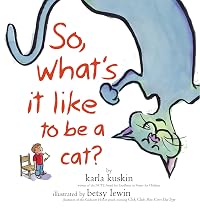
Betsy Lewin’s illustrations are the perfect complement to the poetry and demonstrate why her style is so popular: bright, fun colors, minimalist backgrounds, and an almost abstract, cartoonish flair outlined with thick black lines. The pictures are bold and dynamic, equally talented at showcasing the cat when she is moving or sleeping peacefully. The people are likewise rendered with the same carefree art. Lewin is not afraid to experiment with colors, either: the cat is painted in watercolor grays, blues, yellows, and purples throughout the book.
Additionally, Lewin is not afraid to add humor into her illustrations that add to the story: the cat making herself perfectly at home on a person’s chest while he tries to sleep, or trying on shoes while the text muses about how humans are able to balance so well on only two legs, instead of four.
Overall, So, What’s it Like to be a Cat? may be awkward reading aloud at first, but the illustrations are beautifully rendered, with humor and a bold color palette that will appeal to readers of any age. show less
Karla Kuskin’s “interview” is told in poetry, with a question-and-response style between the boy interviewing the cat and the cat herself; different speakers are denoted by different typefaces. Though Kuskin has won awards for her poetry before – including the prestigious NCTE Award for Excellence in Poetry for Children – So, What’s it Like to be a Cat? has an uneven rhyme scheme, changing wildly on different pages, which makes it hard to read aloud fluidly and renders the spoken version of show more the book rather choppy and uneven.
Her telling of the “interview”, and the cat’s responses, however, are perfect for both adult and children who love cats. The cat is fickle, arrogant, and all in all, decides that while humans sometimes may be dumb and sometimes may be sweet, overall, she much prefers being a cat.
Betsy Lewin’s illustrations are the perfect complement to the poetry and demonstrate why her style is so popular: bright, fun colors, minimalist backgrounds, and an almost abstract, cartoonish flair outlined with thick black lines. The pictures are bold and dynamic, equally talented at showcasing the cat when she is moving or sleeping peacefully. The people are likewise rendered with the same carefree art. Lewin is not afraid to experiment with colors, either: the cat is painted in watercolor grays, blues, yellows, and purples throughout the book.
Additionally, Lewin is not afraid to add humor into her illustrations that add to the story: the cat making herself perfectly at home on a person’s chest while he tries to sleep, or trying on shoes while the text muses about how humans are able to balance so well on only two legs, instead of four.
Overall, So, What’s it Like to be a Cat? may be awkward reading aloud at first, but the illustrations are beautifully rendered, with humor and a bold color palette that will appeal to readers of any age. show less
A boy interviews his pet, asking what cats think and what they like to do. The text takes the form of a dialog which playfully discusses quirks and characteristics that cat owners will recognize. While the rhyming text is nice and would make a fine read aloud, the real strength of this book is its illustrations. The bright watercolor paintings capture the postures and habits of cats perfectly. This book would appeal to cat lovers preschool through elementary school. I particularly like that the main character in this book is a boy, as the majority of cat books seem to feature little girls. It could also be used as a fun introduction to poetry. Recommended for elementary school and public libraries.
Not sure why this is rated so low, or why it's not available in any of my public libraries. I certainly enjoyed the graceful poetic voice, the lively art, and the concepts. Thank goodness that openlibrary.org archived a copy!
Just meh. Some of the meter is really weird.
Ratings
Members
- Recently Added By
Author Information

45+ Works 3,056 Members
Karla Kuskin was born in Manhattan on July 17, 1932. She received a bachelor of fine arts degree from Yale University in 1955. Her first book, Roar and More (1956), was the result of her senior graphic-arts project, for which she had to design and print a book on a small press. She was the author or illustrator of more than 50 children's books show more during her lifetime including In the Middle of the Trees (1958); The Rose on My Cake (1964); The Philharmonic Gets Dressed (1982); The Dallas Titans Get Ready for Bed (1986); Jerusalem, Shining Still (1987); City Dog (1994); The Upstairs Cat (1997); Moon, Have You Met My Mother? (2003); and Traces (2008). She died of cortical basal ganglionic degeneration on August 20, 2009 at the age of 77. (Bowker Author Biography) show less
All Editions
Awards and Honors
Common Knowledge
- Original publication date
- 2005
- First words
- So, what's it like to be a cat? I'm very glad you asked me that.
Classifications
- Genres
- Picture Books, Children's Books, Poetry
- DDC/MDS
- 813.54 — Literature & rhetoric American literature in English American fiction in English 1900-1999 1945-1999
- LCC
- PZ8.3 .K96 .S — Language and Literature Fiction and juvenile belles lettres Fiction and juvenile belles lettres Juvenile belles lettres
- BISAC
Statistics
- Members
- 159
- Popularity
- 205,339
- Reviews
- 4
- Rating
- (3.73)
- Languages
- English
- Media
- Paper
- ISBNs
- 5