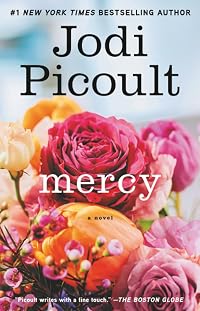
Mercy
by Jodi Picoult
On This Page
Description
From #1 New York Times bestselling author Jodi Picoult comes a “sensitive exploration of the balance of love” (Publishers Weekly).Two cousins are driven to extremes by the power of love, as one helps his terminally ill wife commit suicide at her request, and the other becomes involved in a passionate affair with his wife’s new assistant. In the midst of betrayals and trials, forced to confront the limits of their love, these cousins must ask themselves how far the borders of their show more hearts can extend. show less
Tags
Recommendations


Member Recommendations
Member Reviews
Euthanasia is not usually a subject I like to read about, in any kind of context. I'm not sure why, it's just something that bothers me. This novel had a way of dispelling the discomfort of the subject by weaving it between many different relationships, as well as two other central love relationships. I've read novels I enjoy more by Picoult, and I think my liking this one less only comes from the fact that it pointed out so many things in my own relationship that are lacking. Somehow I think it's not really fair to rate your degree of liking a book based on how it makes you feel, but then again, that's the sign of a good book right? Something that makes you feel, and think and wonder. Sometimes though, when you're using books to show more escape, seeing the truth written out like it was here, hits a little too close to home. It's a good read for someone who wants to see just how far the depths of loving someone can go. and all the different kinds of things people do because of how much they love someone else. show less
This is one of Ms. Picoult's older books that's been on my reader for a while. I'm sorry I waited so long to read it as it's an excellent story.
A small town in western Massachusetts is basically a Scottish clan's home away from the highlands. They were transported here after Culloden and have kept a lot of their clan rules. The clan chief is also the local police chief. Cam McDonald is the one his cousin Jamie turns to after he kills his wife in a mercy killing. She was dying of cancer and begged him to relieve her pain. Cam arrests him but also secretly hires a lawyer for him in his guise as clan chief. Cam's wife Allie does her best to help Jamie, not knowing that Cam is embarking on an affair with her new assistant at her flower show more shop.
Ms. Picoult does a fine job exploring the intricacies of these two marriages: Jamie adored his wife, maybe too much when he does her bidding to kill her, and Cam and Allie who have something missing in their marriage. The mercy killing is the impetus for them to explore what's wrong and make adjustments.
It was intriguing how the author integrated the Scots clan laws and customs into their current society. As a descendent of the McDonalds myself, I really liked this part of the book, but it's a great story all in all, one you'll think about for a long time after reading it. show less
A small town in western Massachusetts is basically a Scottish clan's home away from the highlands. They were transported here after Culloden and have kept a lot of their clan rules. The clan chief is also the local police chief. Cam McDonald is the one his cousin Jamie turns to after he kills his wife in a mercy killing. She was dying of cancer and begged him to relieve her pain. Cam arrests him but also secretly hires a lawyer for him in his guise as clan chief. Cam's wife Allie does her best to help Jamie, not knowing that Cam is embarking on an affair with her new assistant at her flower show more shop.
Ms. Picoult does a fine job exploring the intricacies of these two marriages: Jamie adored his wife, maybe too much when he does her bidding to kill her, and Cam and Allie who have something missing in their marriage. The mercy killing is the impetus for them to explore what's wrong and make adjustments.
It was intriguing how the author integrated the Scots clan laws and customs into their current society. As a descendent of the McDonalds myself, I really liked this part of the book, but it's a great story all in all, one you'll think about for a long time after reading it. show less
A swing and a miss from Picoult, whose novels I usually like.
This one was just too sappy for my taste, borrowing liberally from "The Bridges of Madison County" (which I really hated) and letting that co-plot vitiate what might have been a sensitive and thoughtful look at the subject of mercy-killing.
This one was just too sappy for my taste, borrowing liberally from "The Bridges of Madison County" (which I really hated) and letting that co-plot vitiate what might have been a sensitive and thoughtful look at the subject of mercy-killing.
I thought this very cleverly written, even if some of the characters are a bit stereotyped. There's an intriguing prologue, a basic introduction of two of the main people in the book, and then right into the arrival of two newcomers, and a confession of someone having killed his wife.
I didn't find this as tense as some of Jodi Picoult's novels, but was still gripped. Perhaps the middle section dragged a bit, and I did skim a bit in places... but I could hardly put it down. Alongside the preparation for a court case is an adulterous affair, and the question is asked: is it possible to love too much?
I gather some readers didn't like this at all, but I thought it very well done. I was unsure of the outcome until the last chapter, and then show more wondered whether the verdict was entirely correct...
Recommended if you like women's fiction with some depth.
Longer review: https://suesbookreviews.blogspot.com/2024/12/mercy-by-jodi-picoult.html show less
I didn't find this as tense as some of Jodi Picoult's novels, but was still gripped. Perhaps the middle section dragged a bit, and I did skim a bit in places... but I could hardly put it down. Alongside the preparation for a court case is an adulterous affair, and the question is asked: is it possible to love too much?
I gather some readers didn't like this at all, but I thought it very well done. I was unsure of the outcome until the last chapter, and then show more wondered whether the verdict was entirely correct...
Recommended if you like women's fiction with some depth.
Longer review: https://suesbookreviews.blogspot.com/2024/12/mercy-by-jodi-picoult.html show less
My reviews can also be read at: https://thenovelquest.blogspot.com/
Let me start by saying that I love a good Jodi Picoult book. She tackles controversial issues with grace and, of course, beautiful storytelling. I was intrigued by the story from the beginning. Now, why 3 coffees, you’re thinking? I needed more story!!
I have seen a lot of reviews on this book claiming that the characters are shallow or underdeveloped. I did not feel that way at all! I actually felt a wonderful connection to each main character (Cam, Allie, Graham, Jamie, Angus, and even Maggie) early on. That’s where my need for more comes from!
SPOILER ALERT - please don’t read any further if you want the events of the book to be a surprise for you!
I needed to show more have details surrounding Angus’s death. He just died, no funeral details, no reactions from his family members, no thoughts on what this meant for the small, close-knit, clan that made up Wheelock. Angus was portrayed as a man known by EVERYONE in the town, and half the town was related to him. His story seemed very unfinished, and I personally needed more.
Cam & Allie - the problem couple. I was totally wrapped up in their history and quirky, rote relationship. Then, the affair was secret and sensual, and, for me, like watching a train crash in extremely slow motion. I mean this in the best way possible. Mia and Cam’s tryst seemed to go on for an agonizing amount of timw before Allie found out. And how! Props to her for selling all Cam’s crap in a yard sale. That was awesome. But then Mia leaves for good, and after the trial, they just get back together in one line and that’s that. Oh dear Jodie, I needed an epilogue! Or a “One Year Later”. I needed an update. This, too, felt unfinished.
Finally, a very small detail that is driving me nuts since having finished the book - who wrote the letters, and to whom? I viewed them as Jamie’s letters to Maggie, but now I don’t know. I need to know! I am too nosy for my own good.
As for the controversial issue in this book, the plot centers ariund a husband who smothered his wife with a pillow because she was terminally ill and asked him to. Mercy killing. Euthanasia. Definitely a hot-button topic. The fact that the act was physical (smothering) vs. something passive (taking an overdose of pills) is what really drew me into this story. I think, as I mentioned before, that Picoult handled this with grace, and beautifully-written prose. The trial was the most thrilling part of the book for me, and I cheered inside with every tiny victory Graham earned in the courtroom. I truly enjoy the way this topic was tackled in the book.
Overall, I truly loved the story. And the constant switch in character/point-of-view genuinely kept me on my toes throughout. It is a 3-coffee for me because I wanted closure and...more. The stories of Angus, Cam, and Allie were left hanging in a way that was unfinished for me. show less
Let me start by saying that I love a good Jodi Picoult book. She tackles controversial issues with grace and, of course, beautiful storytelling. I was intrigued by the story from the beginning. Now, why 3 coffees, you’re thinking? I needed more story!!
I have seen a lot of reviews on this book claiming that the characters are shallow or underdeveloped. I did not feel that way at all! I actually felt a wonderful connection to each main character (Cam, Allie, Graham, Jamie, Angus, and even Maggie) early on. That’s where my need for more comes from!
SPOILER ALERT - please don’t read any further if you want the events of the book to be a surprise for you!
I needed to show more have details surrounding Angus’s death. He just died, no funeral details, no reactions from his family members, no thoughts on what this meant for the small, close-knit, clan that made up Wheelock. Angus was portrayed as a man known by EVERYONE in the town, and half the town was related to him. His story seemed very unfinished, and I personally needed more.
Cam & Allie - the problem couple. I was totally wrapped up in their history and quirky, rote relationship. Then, the affair was secret and sensual, and, for me, like watching a train crash in extremely slow motion. I mean this in the best way possible. Mia and Cam’s tryst seemed to go on for an agonizing amount of timw before Allie found out. And how! Props to her for selling all Cam’s crap in a yard sale. That was awesome. But then Mia leaves for good, and after the trial, they just get back together in one line and that’s that. Oh dear Jodie, I needed an epilogue! Or a “One Year Later”. I needed an update. This, too, felt unfinished.
Finally, a very small detail that is driving me nuts since having finished the book - who wrote the letters, and to whom? I viewed them as Jamie’s letters to Maggie, but now I don’t know. I need to know! I am too nosy for my own good.
As for the controversial issue in this book, the plot centers ariund a husband who smothered his wife with a pillow because she was terminally ill and asked him to. Mercy killing. Euthanasia. Definitely a hot-button topic. The fact that the act was physical (smothering) vs. something passive (taking an overdose of pills) is what really drew me into this story. I think, as I mentioned before, that Picoult handled this with grace, and beautifully-written prose. The trial was the most thrilling part of the book for me, and I cheered inside with every tiny victory Graham earned in the courtroom. I truly enjoy the way this topic was tackled in the book.
Overall, I truly loved the story. And the constant switch in character/point-of-view genuinely kept me on my toes throughout. It is a 3-coffee for me because I wanted closure and...more. The stories of Angus, Cam, and Allie were left hanging in a way that was unfinished for me. show less
Cameron is a police detective in a small town. When his cousin Jamie shows up in town, Jamie has his dead wife with him and says (in a very public place) that he killed her. It turns out, Jamie’s wife had terminal cancer and it was getting worse. She had asked him to smother her, so he did out of love to end her suffering. Meanwhile, Mia appears in town and ends up working for Cam’s wife, Allie.
Audio. I really could have done without the Scottish backstory to Cameron and his family. Not sure exactly what that had to do with anything (though it’s possible I missed some connection, as I listened to the audio). I also didn’t like the Mia/Cam storyline at all. I suppose without those additional pieces, there wasn’t much left to show more the book, but it was Jamie killing his wife and the subsequent trial that most interested me. I mostly do like Jodi Picoult’s books, but I think this was an early one and I’ve come across a few early ones that aren’t nearly as good; this was one of those. I’m rating it ”ok” just for Jamie’s story and trial. show less
Audio. I really could have done without the Scottish backstory to Cameron and his family. Not sure exactly what that had to do with anything (though it’s possible I missed some connection, as I listened to the audio). I also didn’t like the Mia/Cam storyline at all. I suppose without those additional pieces, there wasn’t much left to show more the book, but it was Jamie killing his wife and the subsequent trial that most interested me. I mostly do like Jodi Picoult’s books, but I think this was an early one and I’ve come across a few early ones that aren’t nearly as good; this was one of those. I’m rating it ”ok” just for Jamie’s story and trial. show less
An increasingly familiar name to anyone who keeps even half an ear on literary matters, Jodi Picoult has published a number of novels that share a familiar format and focus on topical issues. In fact, Picoult is such a popular writer that I often feel I must be missing something when I reflect on my fairly negative feelings about her novels, so I decided to try one more to help me reach a fairer conclusion. I chose ‘Mercy’ because it covers a particularly interesting topical issue…and because it was on sale for 20p at the library! Would this be the novel that convinced me to change my opinion?
The central idea is an engaging one: Jamie MacDonald suffocates his adored wife, Maggie, to release her from a slow, painful death from show more terminal cancer. Euthanasia is an issue which should grip readers’ interest and ensure that the novel rarely rests between reading sessions. Unfortunately, Jamie (and his story) is overshadowed by the supposed subplot in which a respected man in the community cheats on his rather doormat-like wife. The moral arc of the story is fairly obvious from even this very brief overview. Picoult encourages us to sympathise with Jamie, a broken man who finds that his decision has not led to any relief, and contrast his behaviour with his cousins’. This is such an obvious plot device that it can only add a limited depth to the story. Picoult does not seem to credit her readers with much intelligence and therefore continually feels it necessary to drive home the thematic link through redundant sentences like this: ‘Jamie MacDonald had murdered his wife more gently than Cam had made love to his own’ [after the reader has witnessed both events in the preceding pages].
Cam MacDonald has a loving, devoted wife, but he feels stifled by his ties to the town he was born in, which was founded by his great grandfathers. This is exacerbated by wife Allie’s homely inclinations and fear of travelling. Restless and bored, Cam falls instantly ‘in love’ with newcomer Mia and conducts an increasingly reckless affair. For me, this simply didn’t ring true. I’m not a believer in love-at-first-sight anyway (surely love is based on understanding, respect and appreciation of someone’s personality?) but this was very clearly a case of lust-at-first-sight. Picoult tries to suggest that this is a deep and meaningful relationship through never-fully-substantiated references to a shared past, but the evidence of her narrative speaks for itself. The couple are intensely physically aware of each other from their first meeting, confess their love to each other on approximately their third meeting and can’t make it through a scene together without tearing off each others clothes. If this book had a different cover, I might have mistaken parts of it for a Mills and Boon offering (albeit one of the less graphic ones). If we are to believe that Cam is a good man torn apart by love, then surely his grand love affair needed to have, um, love, as its base?
Speaking of scenes, the book does feel intensely dramatic. Chapters are usually broken up into short ‘episodes’ in which characters reflect or act in bursts of energy and activity, while the reader moves on, soap like, to the next instalment of someone else’s story. Personally, I prefer a style that focuses more on one character and stays with then for the duration of a chapter. Presumably, this switching about is intended to help us feel a personal connection to each character, as we can learn about their family history and therefore deepen our understanding of their motives. Unfortunately, I felt that Picoult was once again showing her lack of trust in me as a reader by drawing me mini-maps of motives and connectivity. It’s a bit like the nursery rhyme, except instead of piggies going to market we have little girls and boys: this little girl was neglected, so she’s looking for love; this little boy feels the weight of the world on his shoulders, so he needs to escape…
Perhaps the most interesting facet of the relationship between Cam and his mistress is that they each reflect what the other has desperately desired, yet if they were to make a life together then neither would be what the other needed. For me, this was perhaps the most interesting idea in the book, suggesting that there are some dreams which can never be realised. Similarly, Jamie realises that his decision to kill his wife could never have had the ending they both imagined. Real life is something harsher, harder, in which compromises have to be made. Ultimately Picoult neither condones nor condemns their choices: she reveals that their choices have their basis in fantasy and tracks the consequences of ignoring reality.
Therefore, although the supposed main storyline is slightly overshadowed by the subplot, the overall topics are explored well: what would you do for someone you love? Are relationships ever equal? Picoult is a little clumsy in the way she draws attention to these issues, but they are certainly issues worth exploring. The pace of the action is quick, despite the sustained reflections of the characters, and the central trial, although left rather late in the novel, is interesting. Unlike in previous novels I had read by this author, Picoult does not dodge the central issue and the outcome is highly revealing of her own position. The conclusion of the relationship between Cam and his wife is slightly less satisfying since, like the development of his relationship with Mia, it seems rather hastily done. Picoult could, ultimately, tell us much less and show us much more to create a much more subtle and credible tale.
So, is it worth reading? If you’re a fan of Picoult, then this is her standard fare and you’re sure to enjoy it. If you’re more interested in the issues surrounding euthanasia, then I’d recommend you look elsewhere, for the focus of this novel is not really the mercy killing itself, but how far beyond accepted social behaviour someone would go for a loved one. If you like well developed characters who act in psychologically convincing ways over a period of time, then I’d look elsewhere. If you’re more interested in reading about clearly sketched characters in a fast moving plot, then you may well enjoy this novel. For me, I think this will be my last foray into Picoult’s writings…until I once again convince myself that there must be more substance than I’ve yet found in such a best-selling author. show less
The central idea is an engaging one: Jamie MacDonald suffocates his adored wife, Maggie, to release her from a slow, painful death from show more terminal cancer. Euthanasia is an issue which should grip readers’ interest and ensure that the novel rarely rests between reading sessions. Unfortunately, Jamie (and his story) is overshadowed by the supposed subplot in which a respected man in the community cheats on his rather doormat-like wife. The moral arc of the story is fairly obvious from even this very brief overview. Picoult encourages us to sympathise with Jamie, a broken man who finds that his decision has not led to any relief, and contrast his behaviour with his cousins’. This is such an obvious plot device that it can only add a limited depth to the story. Picoult does not seem to credit her readers with much intelligence and therefore continually feels it necessary to drive home the thematic link through redundant sentences like this: ‘Jamie MacDonald had murdered his wife more gently than Cam had made love to his own’ [after the reader has witnessed both events in the preceding pages].
Cam MacDonald has a loving, devoted wife, but he feels stifled by his ties to the town he was born in, which was founded by his great grandfathers. This is exacerbated by wife Allie’s homely inclinations and fear of travelling. Restless and bored, Cam falls instantly ‘in love’ with newcomer Mia and conducts an increasingly reckless affair. For me, this simply didn’t ring true. I’m not a believer in love-at-first-sight anyway (surely love is based on understanding, respect and appreciation of someone’s personality?) but this was very clearly a case of lust-at-first-sight. Picoult tries to suggest that this is a deep and meaningful relationship through never-fully-substantiated references to a shared past, but the evidence of her narrative speaks for itself. The couple are intensely physically aware of each other from their first meeting, confess their love to each other on approximately their third meeting and can’t make it through a scene together without tearing off each others clothes. If this book had a different cover, I might have mistaken parts of it for a Mills and Boon offering (albeit one of the less graphic ones). If we are to believe that Cam is a good man torn apart by love, then surely his grand love affair needed to have, um, love, as its base?
Speaking of scenes, the book does feel intensely dramatic. Chapters are usually broken up into short ‘episodes’ in which characters reflect or act in bursts of energy and activity, while the reader moves on, soap like, to the next instalment of someone else’s story. Personally, I prefer a style that focuses more on one character and stays with then for the duration of a chapter. Presumably, this switching about is intended to help us feel a personal connection to each character, as we can learn about their family history and therefore deepen our understanding of their motives. Unfortunately, I felt that Picoult was once again showing her lack of trust in me as a reader by drawing me mini-maps of motives and connectivity. It’s a bit like the nursery rhyme, except instead of piggies going to market we have little girls and boys: this little girl was neglected, so she’s looking for love; this little boy feels the weight of the world on his shoulders, so he needs to escape…
Perhaps the most interesting facet of the relationship between Cam and his mistress is that they each reflect what the other has desperately desired, yet if they were to make a life together then neither would be what the other needed. For me, this was perhaps the most interesting idea in the book, suggesting that there are some dreams which can never be realised. Similarly, Jamie realises that his decision to kill his wife could never have had the ending they both imagined. Real life is something harsher, harder, in which compromises have to be made. Ultimately Picoult neither condones nor condemns their choices: she reveals that their choices have their basis in fantasy and tracks the consequences of ignoring reality.
Therefore, although the supposed main storyline is slightly overshadowed by the subplot, the overall topics are explored well: what would you do for someone you love? Are relationships ever equal? Picoult is a little clumsy in the way she draws attention to these issues, but they are certainly issues worth exploring. The pace of the action is quick, despite the sustained reflections of the characters, and the central trial, although left rather late in the novel, is interesting. Unlike in previous novels I had read by this author, Picoult does not dodge the central issue and the outcome is highly revealing of her own position. The conclusion of the relationship between Cam and his wife is slightly less satisfying since, like the development of his relationship with Mia, it seems rather hastily done. Picoult could, ultimately, tell us much less and show us much more to create a much more subtle and credible tale.
So, is it worth reading? If you’re a fan of Picoult, then this is her standard fare and you’re sure to enjoy it. If you’re more interested in the issues surrounding euthanasia, then I’d recommend you look elsewhere, for the focus of this novel is not really the mercy killing itself, but how far beyond accepted social behaviour someone would go for a loved one. If you like well developed characters who act in psychologically convincing ways over a period of time, then I’d look elsewhere. If you’re more interested in reading about clearly sketched characters in a fast moving plot, then you may well enjoy this novel. For me, I think this will be my last foray into Picoult’s writings…until I once again convince myself that there must be more substance than I’ve yet found in such a best-selling author. show less
Members
- Recently Added By
Lists

Books Read in 2003
258 works; 7 members

Same Title
115 works; 3 members
Author Information

116+ Works 146,717 Members
Jodi Picoult was born in Nesconset, New York on May 19, 1966. She received a degree in creative writing from Princeton University in 1987 and a master's degree in education from Harvard University. She published two short stories in Seventeen magazine while still in college. Immediately after graduation, she landed a variety of jobs, ranging from show more editing textbooks to teaching eighth-grade English. Her first book, Songs of the Humpback Whale, was published in 1992. Her other works include Picture Perfect, Mercy, The Pact, Salem Falls, The Tenth Circle, Nineteen Minutes, Change of Heart, Handle with Care, House Rules, Sing You Home, Lone Wolf, Leaving Time, and Small Great Things. My Sister's Keeper was made into a movie starring Cameron Diaz. She received the New England Bookseller Award for fiction in 2003. She also wrote five issues of the Wonder Woman comic book series for DC Comics. She writes young adult novels with her daughter Samantha van Leer including Between the Lines and Off the Page. (Bowker Author Biography) show less
Some Editions
Series
Belongs to Publisher Series
Serie Piper (5060)
Work Relationships
Is contained in
Has as a student's study guide
Common Knowledge
- Canonical title
- Mercy
- Original title
- Mercy
- Original publication date
- 1996
- People/Characters
- Cameron MacDonald; Allie MacDonald; Jamie MacDonald; Mia Townsend
- Important places
- Wheelock, Massachusetts, USA
- Epigraph
- What power has love but forgiveness?
In other words
by its intervention
what has been done
can be undone.
What good is it otherwise?
- William Carlos Williams,
"Asphodel, That Greeny Flower" - Dedication
- For Hal and Bess Friend, my grandparents, with love.
I could write volumes about how much you both mean to me. - First words
- When she had packed all the artifacts that made up their personal history into liquor store boxes, the house became strictly a feminine place.
Classifications
Statistics
- Members
- 3,962
- Popularity
- 3,966
- Reviews
- 69
- Rating
- (3.51)
- Languages
- 8 — Dutch, English, German, Korean, Lithuanian, Polish, Portuguese, Spanish
- Media
- Paper, Audiobook, Ebook
- ISBNs
- 55
- ASINs
- 13