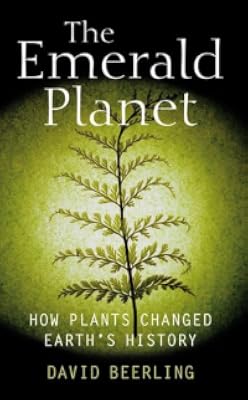
The emerald planet: how plants changed Earth's history
by David Beerling
On This Page
Description
'The Emerald Planet' reveals the crucial role that plants have played in driving & recording climatic change. The book provides an important perspective on the controversial & crucial subject of global warming - for we can only understand climate change by looking into the distant past, long before the rise of humankind.Tags
Recommendations








Member Reviews
This book was recommended by Steven Johnson in The Invention of Air. I was not as drawn into it as I'd expected to be, but part of the trouble is that I'd set myself a deadline. A chart maps each chapter onto the time frame it covers, and it's a handy thing that I kept marked for reference. I have not memorized the geologic eras. Each chapter begins with a paragraph summary, and covers a major issue, such as why were plants and animals so big 300 million years ago, or how did the polar forests of 150 million years ago cope with extreme durations of sunlight and darkness, supported by lots of detail about explorers and scientists who made progress in answering the question. A continuous theme is that understanding climate, and the show more contributions and reactions of plants to it, at any time in the past, helps with understanding how to model it in the present. This is all useful and interesting, and impressive even, to see how many people over how many decades are involved in chipping away at a problem, and yet... I found it to be rather tedious going -- too many names and dates and bits and pieces that detracted from essentials.
(read 29 May 2011) show less
(read 29 May 2011) show less
Nicely written book that explores the changing physiology of plants and how this affects the climate in the past and possibly the future. I found this to be an extremely interesting book and learned a whole lot of new things which is the whole point to reading science books.
NOTE: Due to the large number of diagrams, it is probably better to read a print version of this book rather than an epub/mobi version since the diagrams are rather small on an e-reader.
NOTE: Due to the large number of diagrams, it is probably better to read a print version of this book rather than an epub/mobi version since the diagrams are rather small on an e-reader.
Vignettes about plant life on the planet and how plants engineer the environment.
Ratings
Members
- Recently Added By
Lists

Big History
72 works; 1 member

In Our Time books
4,934 works; 2 members
Author Information
3 Works 277 Members
Series
Belongs to Publisher Series
Common Knowledge
- Canonical title
- The emerald planet: how plants changed Earth's history
- Original publication date
- 2007
- Dedication
- For Juliette
- First words
- The great evolutionary biologist J B S Haldane (1892-1964), on being asked by a cleric what biology could say about the Creator, entertainingly replied, 'I'm really not sure, except that the Creator, if he exists, must have a... (show all)n inordinate fondness of beetles.'
- Last words
- (Click to show. Warning: May contain spoilers.)The opening epigraph of this chapter from Doyle's 'The lost world' serves as a metaphor for the future of this exciting research frontier, for not only have we only just began, but already there are indeed signs that 'wonders await us'.
- Blurbers
- Morris, Simon Conway; Crane, Peter
Classifications
Statistics
- Members
- 247
- Popularity
- 131,256
- Reviews
- 3
- Rating
- (4.00)
- Languages
- English, Estonian
- Media
- Paper, Ebook
- ISBNs
- 11
- ASINs
- 4