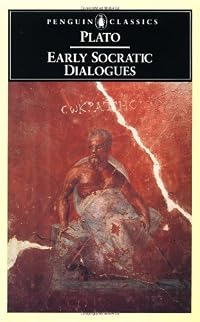
Early Socratic Dialogues
by Plato
On This Page
Description
Rich in drama and humour, they include the controversial Ion, a debate on poetic inspiration; Laches, in which Socrates seeks to define bravery; and Euthydemus, which considers the relationship between philosophy and politics. Together, these dialogues provide a definitive portrait of the real Socrates and raise issues still keenly debated by philosophers, forming an incisive overview of Plato's philosophy.Tags
Recommendations






Member Reviews
Commentary in this Penguin edition is maddening. Constantly interrupting and pre-empting the dialogue while managing to bring relatively little to the table, it's the equivalent of watching a film with someone who's constantly gabbing on about 'oh! I love this bit - this is where they...' until you just want to smother them.
Ratings
Members
- Recently Added By
Lists

In Our Time books
4,934 works; 2 members
Author Information

2,711+ Works 100,287 Members
Plato was born c. 427 B.C. in Athens, Greece, to an aristocratic family very much involved in political government. Pericles, famous ruler of Athens during its golden age, was Plato's stepfather. Plato was well educated and studied under Socrates, with whom he developed a close friendship. When Socrates was publically executed in 399 B.C., Plato show more finally distanced himself from a career in Athenian politics, instead becoming one of the greatest philosophers of Western civilization. Plato extended Socrates's inquiries to his students, one of the most famous being Aristotle. Plato's The Republic is an enduring work, discussing justice, the importance of education, and the qualities needed for rulers to succeed. Plato felt governors must be philosophers so they may govern wisely and effectively. Plato founded the Academy, an educational institution dedicated to pursuing philosophic truth. The Academy lasted well into the 6th century A.D., and is the model for all western universities. Its formation is along the lines Plato laid out in The Republic. Many of Plato's essays and writings survive to this day. Plato died in 347 B.C. at the age of 80. (Bowker Author Biography) show less
Some Editions
Series
Belongs to Publisher Series
Common Knowledge
- Canonical title
- Early Socratic Dialogues
- Original publication date
- 1987
- People/Characters
- Socrates; Aristotle, 384-322; Homer; Xenophon; Plato; Ion (show all 23); Lysimachus (in Plato's "Laches"); Melesias; Nicias; Laches; Ctesippus; Hippothales; Lysis; Menexenus; Chaerephon; Charmides; Critias; Hippias; Eudicus; Crito; Cleinas; Euthydemus; Dionysodorus
- Important places
- Athens, (Ancient) Greece (Ancient)
- Dedication
- TO THE MEMORY OF
BETTY RADICE - First words
- EDITOR'S PREFACE
Each contributor to this volume has attempted to translate Plato's subtle and elusive Greek into clear and idiomatic English; beyond this minimum requirement I have not sought to impose any uniformity of s... (show all)tyle.
INTRODUCTION TO SOCRATES
I. Childish Questions
'Mummy, why can't we have yesterday again?'
'Mummy, would I be me if Daddy had married somebody else?'
'Daddy, will you go and fetch the moon for me?' - Original language
- Greek (Classical) (Classical)
Classifications
Statistics
- Members
- 406
- Popularity
- 75,885
- Reviews
- 1
- Rating
- (4.02)
- Languages
- English
- Media
- Paper, Ebook
- ISBNs
- 4
- ASINs
- 3