On This Page
Description
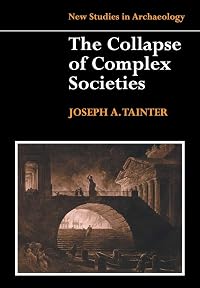
Political disintegration is a persistent feature of world history. The Collapse of Complex Societies, though written by an archaeologist, will therefore strike a chord throughout the social sciences. Any explanation of societal collapse carries lessons not just for the study of ancient societies, but for the members of all such societies in both the present and future. Dr. Tainter describes nearly two dozen cases of collapse and reviews more than 2,000 years of explanations. He then develops show more a new and far-reaching theory that accounts for collapse among diverse kinds of societies, evaluating his model and clarifying the processes of disintegration by detailed studies of the Roman, Mayan, and Chacoan collapses. ©1988 Cambridge University Press. Produced and published by Echo Point Books & Media, an independent bookseller in Brattleboro, Vermont. show lessTags
Recommendations
























Member Reviews
"Collapse, if and when it comes again, will this time be global." Tainter, with all the lessons of history to back him up, was cynical about complex societies having the capability to decelerate intentionally and live within their means once diminishing returns set in on energy sources and other resources. It's hard to quarrel with him about that, looking around us now. And he also saw that, as of the 20th century, all industrialized societies had arrived at a level of parity and interdependence that would make it impossible for any of them to collapse in isolation. So from here on in, if we're going to go down, we're all going down together. The most revelatory thing about this work for me was the realization that collapse, decline, or show more overthrow are really the norm, not the exception, in the history of complex, hierarchical human societies. But of course when you think of it, it's obvious, since not one single civilization has endured the whole ten thousand years since civilizations began. And Tainter takes pains to show that the same behaviors that can cause collapse are all at work in contemporary industrialized societies, destroying exceptionalism. It's a somewhat mechanistic approach, but these are systems, after all, not individuals or social groups. He removes all the unscientific nostalgia about "decadence" that other historians have succumbed to, and just synthesizes the facts to derive the overarching pattern. Probably what makes this a masterwork. show less
This is a tough book to summarize, both because it's so dense and well-sourced it reminds me of grad school, and because it tackles a bunch of big, abstract questions, like what makes societies fail. What does it mean for societies to fail? Here Tainter analyzes many of the ways that groups of people can completely fail to maintain the complicated but fragile webs of interaction that separate us from animals (trade, governance, food production, resource extraction), with examples from the Mayans, Romans, Hittites, Babylonians, and many more. His basic thesis is that human societies are really problem-solving organizations (e.g. the wheel reduces travel time, agriculture reduces vulnerability to famine, steam power increases mechanical show more capability, sewer systems reduce plagues), and civilization is nothing more than overlapping layers of complex problem-solving networks, skills, and technologies. At low complexity, adding more layers of doers, thinkers, and paper-shufflers makes society more productive and everyone better off, but each additional layer takes energy, and eventually you run into the law of diminishing marginal returns, meaning that after a certain point society becomes paralyzed under the weight of its own corporate and governmental bureaucracies and can no longer adapt to changing conditions like resource shortage, environmental change, economic shifts, or external threats. The implications for modern society are many and thought-provoking. I really can't do this book justice in terms of its scope and analysis, but if you liked Jared Diamond's works (Collapse cites this a bunch), check this out pronto. show less
With greatest detail about Rome and the Mayans, the core argument is that societies collapse because there is a declining marginal productivity of most things—the 1000th unit of food/energy/education etc. costs more to produce than the first and benefits society less. At a certain point, those costs aren’t worth bearing any more and the society goes to a much lower level of complexity, which means fewer differentiated roles, smaller geographic scope, and fewer people. Collapse may not be inevitable, but the declining marginal utility of investment means that complex societies are likely to use up their surpluses as they get bigger and more complex, unless they can sustain themselves by adding new resources, usually by conquest. And show more if there are noncollapsed neighbors, then those neighbors might simply absorb units at the edge, so it’s also relative. I didn’t think it did a great job of handling the role of innovation (the shift to coal involved more investment but also created a lot of new things that were more valuable). show less
Diminishing marginal returns lead to collapse when there is power vacuum because parts of the society are less motivated to support the system rather than detach from it or even sabotage it.
It's a believable idea. But it's hard for me to grasp the reasons for the inevitability of diminishing marginal returns.
Tainter explains that people grasp for the lower hanging fruit first so what's left after that is harder to get fruit - so you move from high marginal return to lower marginal return. But as a general metaphor for all kinds of processes it's hard to swallow.
- Oil companies develop easier to get oil wells first.
- Education provides general knowledge first which has a higher marginal return than specialized knowledge because it can show more be applied to more situations.
- Scientists discover easier knowledge first.
- Socio-political structure of a society is less complex first.
I can sense that there is truth to these examples. Over time those processes do seem to become more complicated and brittle. But i also feel like there could be counter examples. What about the notion of critical mass or breakthroughs? Like when you move from coal to oil, isn't there a big spike in marginal utility? I don't know. Perhaps Tainter accounts for such local spikes and talks more about the big picture where the trend is for diminishing.
Besides this complication with diminishing returns I learned a lot from this book. A glimpse into how and why societies are born and collapse. show less
It's a believable idea. But it's hard for me to grasp the reasons for the inevitability of diminishing marginal returns.
Tainter explains that people grasp for the lower hanging fruit first so what's left after that is harder to get fruit - so you move from high marginal return to lower marginal return. But as a general metaphor for all kinds of processes it's hard to swallow.
- Oil companies develop easier to get oil wells first.
- Education provides general knowledge first which has a higher marginal return than specialized knowledge because it can show more be applied to more situations.
- Scientists discover easier knowledge first.
- Socio-political structure of a society is less complex first.
I can sense that there is truth to these examples. Over time those processes do seem to become more complicated and brittle. But i also feel like there could be counter examples. What about the notion of critical mass or breakthroughs? Like when you move from coal to oil, isn't there a big spike in marginal utility? I don't know. Perhaps Tainter accounts for such local spikes and talks more about the big picture where the trend is for diminishing.
Besides this complication with diminishing returns I learned a lot from this book. A glimpse into how and why societies are born and collapse. show less
A really detailed analysis of the reasons for the collapse of complex societies. For my own purposes, as a general reader, perhaps it is a bit too detailed in places (lots of references to other people's work, for example). It felt a bit like reading someone's PhD submission, to be honest.
Having said that, it was very interesting to see the intersection of archaeology with economics that Tainter presents in this work and I particularly enjoyed the last chapter where he looks at the implications of his findings for the complex societies we inhabit today.
Tainter urges us to identify another source of energy to avoid the inevitable problems that will be associated with the exhaustion of fossil fuels and inexorable growth of the human population. show less
Having said that, it was very interesting to see the intersection of archaeology with economics that Tainter presents in this work and I particularly enjoyed the last chapter where he looks at the implications of his findings for the complex societies we inhabit today.
However much we like to think of ourselves as something special in world history, in fact industrial societies are subject to the same principles that caused earlier societies toshow more
collapse.
Collapse, if and when it comes again, will this time be global.Another aspect I appreciated was the way Tainter takes earlier writers to task for assuming that civilisations are automatically A Good Thing and for coming up with completely unjustifiable reasons for their decay.
Tainter urges us to identify another source of energy to avoid the inevitable problems that will be associated with the exhaustion of fossil fuels and inexorable growth of the human population. show less
I bought this book as it is mentioned favorably in much of the peak oil/collapse literature that has been popular in the last few years. While CoCS is a scholarly, academic monograph, rather than a popular work in the style of Jared Diamond, it is nonetheless highly readable and highly informative.
The premise behind CoCS is that previous attempts to explain collapse (here defined as a shift from a higher state of social complexity to a lower one) have relied on a post hoc approach to collapse rather than a comprehensive systems-theory approach. For example, traditional approaches have appraised the collapse of Rome as a result of decadence, barbarian invasions, Christianity, and so on. But to Tainter, "decadence" is undefinable (and show more therefore useless), barbarian invasions were easily shrugged off during the early Empire, and the Eastern Empire embrace Christianity for centuries without collapsing.
Instead, Tainter proposes that the collapse of Rome (and the Maya and the pre-Columbian Chacoan society of New Mexico) was the result of a declining marginal return in social investment. In the case of Rome, the Republic and early Empire had established a large energy surplus (in the form of booty from conquered neighbors) that was able to fund Rome's administration without putting an undue burden on the population. However, as the low-hanging fruit of wealthy neighbors began to diminish, Rome was unable to extract enough energy from its military conquests, provinces or trade to maintain the growing costs of maintaining the Empire.
This curve of decreasing marginal returns is amply illustrated with references to agricultural output, research and development output, and education. Although Tainter does not have data for the Mayan and Chacoan societies, his appraisal of the archaeological evidence does suggest that these two societies also suffered from decreasing marginal returns on investment.
Tainter's thesis makes sense, and his logical development of the idea makes it one of those "of course everyone knows that" elucidations of what seems obvious in retrospect. Where Tainter falls short is the absence of a unifying measure of marginal returns across all aspects of a complex society such as ours. The implication is that it would be energy (in whatever form--cash, petroleum, wheat), but Tainter leaves it to others to develop this aspect of his theory. show less
The premise behind CoCS is that previous attempts to explain collapse (here defined as a shift from a higher state of social complexity to a lower one) have relied on a post hoc approach to collapse rather than a comprehensive systems-theory approach. For example, traditional approaches have appraised the collapse of Rome as a result of decadence, barbarian invasions, Christianity, and so on. But to Tainter, "decadence" is undefinable (and show more therefore useless), barbarian invasions were easily shrugged off during the early Empire, and the Eastern Empire embrace Christianity for centuries without collapsing.
Instead, Tainter proposes that the collapse of Rome (and the Maya and the pre-Columbian Chacoan society of New Mexico) was the result of a declining marginal return in social investment. In the case of Rome, the Republic and early Empire had established a large energy surplus (in the form of booty from conquered neighbors) that was able to fund Rome's administration without putting an undue burden on the population. However, as the low-hanging fruit of wealthy neighbors began to diminish, Rome was unable to extract enough energy from its military conquests, provinces or trade to maintain the growing costs of maintaining the Empire.
This curve of decreasing marginal returns is amply illustrated with references to agricultural output, research and development output, and education. Although Tainter does not have data for the Mayan and Chacoan societies, his appraisal of the archaeological evidence does suggest that these two societies also suffered from decreasing marginal returns on investment.
Tainter's thesis makes sense, and his logical development of the idea makes it one of those "of course everyone knows that" elucidations of what seems obvious in retrospect. Where Tainter falls short is the absence of a unifying measure of marginal returns across all aspects of a complex society such as ours. The implication is that it would be energy (in whatever form--cash, petroleum, wheat), but Tainter leaves it to others to develop this aspect of his theory. show less
Tainter examines several major cultures that show a rise in complexity and expansion in territory followed by a collapse and decline. Rome is, of course, a primary example, with Mayan culture, Chaco Canyon, and Chou China other major collapses. The author summarizes the major theories about collapse, then proposes that declining marginal returns as a major cause. The cost of maintaining a military establishment, large and complex bureaucracies and systems of internal control come to exceed the benefits.
Members
- Recently Added By
Lists

The Venus Project Recommended Books - Contemporary sources
53 works; 2 members
Author Information

6+ Works 776 Members
Series

Common Knowledge
- Canonical title
- The Collapse of Complex Societies
- Original publication date
- 1988
Classifications
- Genres
- Anthropology, Nonfiction, History, General Nonfiction, Sociology, Science & Nature
- DDC/MDS
- 930 — History & geography History of ancient world (to ca. 499) Ancient History: China, Egypt, Rome, Greece
- LCC
- CB311 .T245 — Auxiliary Sciences of History History of Civilization History of Civilization By period
- BISAC
Statistics
- Members
- 744
- Popularity
- 37,972
- Reviews
- 9
- Rating
- (4.10)
- Languages
- Czech, English, Finnish, French
- Media
- Paper, Audiobook, Ebook
- ISBNs
- 10
- ASINs
- 5