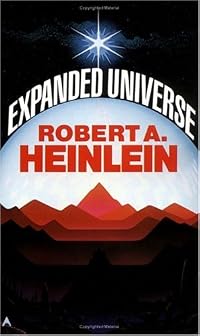
Expanded Universe
by Robert A. Heinlein
Robert Heinlein's Expanded Universe (Collections and Selections — complete)
On This Page
Description
"The Wit and Wisdom of Robert A. Heinlein, author of multiple New York Times best sellers, on subjects ranging from Crime and Punishment to the Love life of the American Teenager; from Nuclear Power to the Pragmatics of Patriotism; from Prophecy to Destiny; from Geopolitics to Post-Holocaust America; from the Nature of Courage to the Nature of Reality; it's all here and it's all great - straight from the mind of the finest science fiction writer of them all."--BOOK JACKET.Tags
Recommendations















Member Reviews
I remember loving this book in my teens, and I still consider Robert A Heinlein one of my favorite authors, but if you’re not a fan already, I wouldn’t recommend this book to begin with. This contains 27 of Heinlein’s short pieces, of which about half are essays, but it’s not a collection of his best, nor one that say pulls together all his “Future History” stories such as The Past Through Tomorrow, which would make a good introduction. There are a few strong stories here. For a work published in 1940, “Solution Unsatisfactory” is an incredibly prescient story about the dilemmas of the nuclear era. Heinlein at one point says that, "Unless you were already adult in August 1945 it is almost impossible for me to convey show more emotionally to you how most people felt about the A-bomb, how many different ways they felt about it, how nearly totally ignorant 99.9% of our citizens were on the subject.” Nuclear war and its aftermath is a theme that takes up almost the entire first half of this book which is organized chronologically from his first published story from 1939, “Life-Line,” up to the date of publication in 1980.
As someone who decidedly was not an adult in 1945 and reading this well after the year 2000 beyond which Heinlein was skeptical we'd survive, it’s hard to read such essays as “How to Be a Survivor” and not feel I’m reading a paranoid crank. But I loved “Pravda Means Truth” and “Inside Intourist” based on his own travels in the Soviet Union, was saddened by his pleas for a strong space program given what it has dwindled to, and his piece on the decline of education in “The Happy Days Ahead” is, alas, even more relevant today. Most of his essays are thought-provoking and wise--with an emphasis on provoke--as he puts it at the end, he lived to kick sacred cows. If you are politically correct, self-righteous, close-minded and without a sense of humor, this isn’t the book for you. Otherwise, especially if you already love Heinlein, enjoy. show less
As someone who decidedly was not an adult in 1945 and reading this well after the year 2000 beyond which Heinlein was skeptical we'd survive, it’s hard to read such essays as “How to Be a Survivor” and not feel I’m reading a paranoid crank. But I loved “Pravda Means Truth” and “Inside Intourist” based on his own travels in the Soviet Union, was saddened by his pleas for a strong space program given what it has dwindled to, and his piece on the decline of education in “The Happy Days Ahead” is, alas, even more relevant today. Most of his essays are thought-provoking and wise--with an emphasis on provoke--as he puts it at the end, he lived to kick sacred cows. If you are politically correct, self-righteous, close-minded and without a sense of humor, this isn’t the book for you. Otherwise, especially if you already love Heinlein, enjoy. show less
“Pico review” written for the SF fanzine OtherRealms (SF review zine by Chuq Von Rospach, Jan. 1991): Expanded Universe is a large collection of stories and articles from the '40's and '50's through 1980. Most of the fiction is in the oldest section, some familiar, some less so - I'm not a Heinlein expert. The second half is nonfiction, predictions and political diatribe. Future predictions made in 1950 are updated twice, once for the 1966 collection and again in 1980. Heinlein sounded surprised in the 1966 revisions that World War III hadn't happened yet and almost disappointed in 1980 that we *still* hadn't been invaded by Russia, he was so sure it was going to happen. I only wish he had lived through 1989, his political show more predictions get farther off base all the time. His economic predictions, however, are spot on (and that was by 1980, before the Reagan deficit years), as are his dismal statements about education in the US. Lest this sound like a political review - all the predictions are stated in SF terms, sometimes as near future fiction, others as "life in the year 2000" type articles. There is a wonderful article from 1979 testimony to a House committee on NASA spinoffs - if only it could be required reading in Congress now. My favorite fiction piece was "Over the Rainbow ...". I had read it before but I still love the punch lines. It is the story of a vice president, added to the ticket only to get votes from certain special interest groups, that unexpectedly (to those who engineered the election anyway) becomes a great president. From the fiction I also especially liked "Nothing Ever Happens on the Moon", one of his Boy Scout juveniles, and "They do it with Mirrors - an Edison Hill Crime Case", a pulp mystery from 1945 that was too risque to print as written at that time (after reading it I still haven't a clue as to why, times have changed a lot since then). show less
What if generations had been living within the confines of a spaceship so huge that it seemed like a world in its own? After a mutiny generations ago, society has de-evolved so much that the current residents have forgotten their origins. It was a really original idea for its time, and a great part of the Future History collection.
Some of the material in here I already knew. There were a few good stories that I hadn't read before. There were a good many opinion pieces that were interesting to read once.
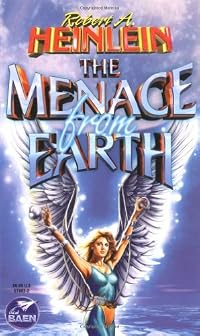
My first real Heinlein book, back in high school. I'd read Menace From Earth and part of The Puppet Masters in grade school, but I didn't pay attention to author names then. A good intro, shows Heinlein on a range of topics. I re-read this sometimes to refresh my memory and to see how my own thinking and attitudes have changed.
If you've read the book 'Past Through Tomorrow' by the same author, you will recognize some of the stories in here. However, some of these stories have been tweaked, and some of the entries in here are actually essays on various things such as the future or politics. Overall this is definitely a good addition to any Heinlein collection.
Short stories and essays presented chronologically. A couple of short stories are hard to find elsewhere, but the best ones can be found in other volumes. The book is filled out with Heinlein's essays, which seem to get more and more out of touch as both he and the twentieth century age.
Members
- Recently Added By
Lists

Top Five Books of 2014
1,064 works; 398 members

Summer Reads 2014
207 works; 70 members

Speculative Fiction to Read
706 works; 32 members
Author Information

458+ Works 173,815 Members
Robert Anson Heinlein was born on July 7, 1907 in Butler, Mo. The son of Rex Ivar and Bam Lyle Heinlein, Robert Heinlein had two older brothers, one younger brother, and three younger sisters. Moving to Kansas City, Mo., at a young age, Heinlein graduated from Central High School in 1924 and attended one year of college at Kansas City Community show more College. Following in his older brother's footsteps, Heinlein entered the Navel Academy in 1925. After contracting pulmonary tuberculosis, of which he was later cured, Heinlein retired from the Navy and married Leslyn MacDonald. Heinlein was said to have held jobs in real estate and photography, before he began working as a staff writer for Upton Sinclair's EPIC News in 1938. Still needing money desperately, Heinlein entered a writing contest sponsored by the science fiction magazine Thrilling Wonder Stories. Heinlein wrote and submitted the story "Life-Line," which went on to win the contest. This guaranteed Heinlein a future in writing. Using his real name and the pen names Caleb Saunders, Anson MacDonald, Lyle Monroe, John Riverside, and Simon York, Heinlein wrote numerous novels including For Us the Living, Methuselah's Children, and Starship Troopers, which was adapted into a big-budget film for Tri-Star Pictures in 1997. The Science Fiction Writers of America named Heinlein its first Grand Master in 1974, presented 1975. Officers and past presidents of the Association select a living writer for lifetime achievement. Also, the Science Fiction and Fantasy Hall of Fame inducted Heinlein in 1998. Heinlein died in 1988 from emphysema and other related health problems. Heinlein's remains were scattered from the stern of a Navy warship off the coast of California. (Bowker Author Biography) show less
Series

Robert Heinlein's Expanded Universe (Collections and Selections — complete)
Belongs to Publisher Series
Work Relationships
Contains
Common Knowledge
- Canonical title
- Expanded Universe
- Original title
- Expanded Universe
- Original publication date
- 1980
- Dedication
- To William Targ
- First words
- Forward:
Warning!
Truth in advertising requires me to tell you that this volume contains THE WORLDS OF ROBERT A HEINLEIN, published 1966. But this new volume is about 3 times as long and contains fiction stories that ha... (show all)ve never before appeared in book form.
Lifeline:
The chairman rapped loudly for order. - Last words
- (Click to show. Warning: May contain spoilers.)The Happy Days Ahead:
1So, unless I'm hit by a taxicab while swerving on my cane to ogle pretty girls, I'll be back: - Original language
- English
Classifications
Statistics
- Members
- 2,056
- Popularity
- 10,001
- Reviews
- 12
- Rating
- (3.77)
- Languages
- English
- Media
- Paper
- ISBNs
- 10
- UPCs
- 1
- ASINs
- 13