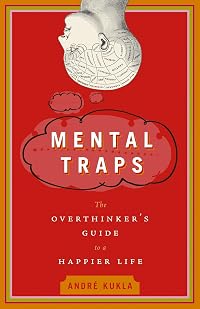
Mental Traps: The Overthinker's Guide to a Happier Life
by Andre Kukla
On This Page
Description
From an acclaimed academic working in both philosophy and psychology The elegant and thoughtful prose will appeal to fans of bestselling books like On Bullsoot, Crimes Against Logic, and Blink Aging Baby Boomers who want to increase their mental acuity will embrace the book's high-concept strategiesTags
Recommendations











Member Reviews
The content of this book is drawn from many sources, including philosophy, psychology, religion, science, and most importantly, the self. And, the lessons learned from those sources are synthesized well to produce something that has practical uses/applications for developing the self. The book contains sound and practical lessons on learning to recognize "mental traps" that so burden the modern man. There are eleven mental traps outlined and discussed in great detail. Some of the mental traps are familiar to us: anticipation, resistance, and procrastination (my favorite!) Others aren't so well-recognized, and it would do well to learn and recognize all of 'em. I almost procrastinated in writing this review, but being mindful of that show more particular trap enabled me to write the review without further delay!
The book doesn't discuss "tips/strategies" for dealing with mental traps, for doing so would have defeated the very purpose of writing it. The point is not to treat ourselves as automaton that is fed a set of prescriptive rules, which, if followed, supposedly would liberate us from mental traps. Toward the end of the book, there is a chapter on why such a prescription would, in fact, lead us into mental traps and not away from them. I won't spoil the fun. You will have to read the book yourself to know what I mean.
This book has the potential to change lives radically. All in all, a must read. show less
The book doesn't discuss "tips/strategies" for dealing with mental traps, for doing so would have defeated the very purpose of writing it. The point is not to treat ourselves as automaton that is fed a set of prescriptive rules, which, if followed, supposedly would liberate us from mental traps. Toward the end of the book, there is a chapter on why such a prescription would, in fact, lead us into mental traps and not away from them. I won't spoil the fun. You will have to read the book yourself to know what I mean.
This book has the potential to change lives radically. All in all, a must read. show less
Very entertaining read. Explores two handfuls of mental schemes we fall for... for instance, why do we keep playing a game “just to get it over with“ even though the game lost its fun 20 minutes ago? How can we lose so much energy forecasting events and replaying old battles?
Gets to the bottom of each trap while keeping a neutral point-of-view; does not preach values but pushes the reader to simply _notice_ when caught in a trap. Concludes with tricks (meditation!) as a way to free up our minds from the traps.
Gets to the bottom of each trap while keeping a neutral point-of-view; does not preach values but pushes the reader to simply _notice_ when caught in a trap. Concludes with tricks (meditation!) as a way to free up our minds from the traps.
This was an interesting book, describing the bad mental habits that are slowing us down and stopping us from being happy. Kukla uses fun examples to make the material come alive - and that made the difference between this book being enjoyable and being a dry piece. Most of the traps are so easy to fall into that you don't even notice you are doing them! But this book will help you make an effort to avoid those traps and be more productive.
I don't think I'm an overthinker, really. And I would have organized the book into chapters that presented the problem, then the proposed solution, rather than describing all the problems and having one 'solution' chapter at the end.
Книга рассматривает "ментальные ловушки" - устойчивые схемы, по которым работает наше мышление, создавая зачастую проблемы (ментальные) там, где их нет. Решение сводится к тому, что можно назвать медитацией - наблюдение за ходом своих мыслей. Книга представляется полезной, т.к. мотивирует разобраться в своих установках, а значит и в образе действий.
Nov 12, 2015Russian
Ratings
Members
- Recently Added By
Author Information
8+ Works 247 Members
Andre Kukla, PH.D., is a professor emeritus at the University of Toronto
Common Knowledge
- Original publication date
- 2007
- First words
- Mental traps are habitual modes of thinking that disturb our ease, take up enormous amounts of our time, and deplete our energy, without accomplishing anything of value for us or anyone else in return.
- Last words
- (Click to show. Warning: May contain spoilers.)Is it any wonder that we needlessly complicate our work when there is something to be done?
- Blurbers
- Holloway, Richard; Whyte, Jamie
Classifications
Statistics
- Members
- 151
- Popularity
- 217,760
- Reviews
- 5
- Rating
- (3.35)
- Languages
- English, Italian, Russian
- Media
- Paper, Ebook
- ISBNs
- 7
- ASINs
- 3