
On This Page
Description
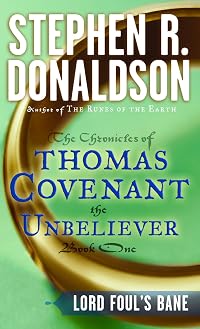
Thomas Covenant is a leper, a bitter and solitary pariah who is mystically transported to another Earth where time moves differently than ours, one in which magic takes many forms. The Land is threatened by many evils, the most immediate of which is a maddened Cavewight whose subterranean excavations have unearthed the ancient and puissant Staff of Law. More dangerous to the free people of the Land is the Gray Slayer, Lord Foul, the Despiser, who intends to destroy the actual foundations of show more the Earth that he might wage war against the universe's Creator. And Foul's intended weapon in this conflict? None other than Thomas Covenant himself. show lessTags
Recommendations













Member Recommendations

Member Reviews
OMG that was a rather difficult book to get into. I mean, most of the time I had keep re-shifting the gears in my head to see what might be valuable and good about this book, and for a great 200 pages I was wondering if I had stumbled into another Eddings slogfest full of completely predictable situations and heroes, with only the main character being a bit out of the ordinary.
And then I had to remind myself that this came out in 1977 and the cult fantasy favourite (as opposed to the mainstream fantasy favourite) was LOTR. We've been inundated with Lewis and Beagle and who knows what else in the fantasy field. The time was ripe for a change, and all the big fantasy fans have all declared this fantasy cycle as a major turning point with show more a textual breakaway into new territory that has stuck with us all the way to modern fantasy, (which I have to say, I now adore).
But did I really get into this book? Is it even possible? The answer is yes, with a pretty huge caveat.
It's pretty obvious that the entire book is an exploration of a quote by John Milton in Paradise Lost: "The mind is its own place, and in itself can make a heaven of hell, a hell of heaven."
Putting that firmly in mind, now read our self-hating Thomas Covenant in his American home being treated as a Leper, because he is one, and see America as Mordor. He's in hell. And then he gets sent to heaven.
The magical land is just that. It's magical, people CAN live on beauty, alone, and there are honourable seafaring giants reminiscent of the Ents, horse riders with much more magic in the horses, just like Rohan, only more like Valdemar, and the Council, who are mages who have lost much lore over the centuries.
Covenant is skeptical of everything he sees, now, for although he used to be a best-selling author, he's now given up on all things imaginative in the wake of the hell of being diagnosed as a Leper and to learn he has no hope whatsoever. So when he is miraculously cured, and the wedding ring of his divorced wife has turned into the receptacle of the mystical Wild Magic that could either restore or destroy this wonderful fantasy world, he just Can Not Believe any of it. He's hallucinating. He's dreaming.
Too bad for him, it's all too real to his senses, and even his nerves have regenerated, which he knows is impossible. Oh Dear.
Honestly, the ideas come across as much more interesting than the execution. Like I said, it was a slogfest.
It's also too bad, because he's rather an asshole.
After reading so much modern fantasy, I ALMOST wish he'd done something other than rape the wide-eyed girl that was doing her damnedest to help him, like murder a cute puppy or an innocent child. Maybe he'd have had an easier time making me believe he really did regret the act later, or even right after the passion had been spent. Jesus. What a fucking prick.
Okay. Moving along. And that's another thing. It was just a very, very long travelogue. At least LOTR had it in service of excellent secondary or tertiary goals. The most we can say about Covenant is his gradual slide into belief and eventual realization that he's been a major asshole.
At least there was lots of dancing! And the initial metaphor and how it changed each time was not lost upon me. That was one of the nicer aspects of the novel, other than the realizations of Covenant, himself.
Okay, now here's my biggest nut and bolt complaint: Lord Foul is both a pretty damn interesting strategist and uber-powerful magical villain. I wish it hadn't taken so damn long for us as readers to GET THAT POINT. Practically anything else would have been a better introduction to Drool and Foul. They came across as an actual snivelling idiot and a minor house lord, and not the wielder of a staff fashioned by the Creator, himself, to right the corruption being spread throughout the fabric of reality, or the source of that corruption, itself: Lord Foul. It was all properly epic and I loved the ideas once I was finally INTRODUCED to them.
I saw the influence of Zelazny's Amber series right away, and I've always loved it when authors did that. You know. Uber Reality and the lesser realms, with Earth being one of many minor realms. It was a nice addition to the book.
And oddly enough, I got a lot more out of the novel's spoken-aloud tales, campfire style, than I did with the entire "let's go get that damn Staff" storyline.
It's not a bad novel. Don't get me wrong. I'm not jumping off the deep end and slamming this as I would with a modern fantasy that tried to pull this off. I'm trying to respect it as a product of it's time and place, and as such, I'd probably give it a 5 star rating, too, or perhaps a 4 because Zelazny's was better. Or at least I remember it more fondly, and since I haven't read the other Covenant novels, I really shouldn't judge just yet.
But the language in this novel wasn't up to Tolkien's high standards, and the worldbuilding didn't leave all that much impression on me, either. Maybe that's a personal failing, and the fact that I couldn't get into the groove and kept falling out of whatever groove I eventually got... well, it certainly didn't help.
I'll keep going, because once I invest in a thing, I like to maintain the investment, especially when others tell me it only gets a lot better, but as of right this moment, I'm a bit weary. Maybe a few novels before I sink into the next might be best.
*sigh* show less
And then I had to remind myself that this came out in 1977 and the cult fantasy favourite (as opposed to the mainstream fantasy favourite) was LOTR. We've been inundated with Lewis and Beagle and who knows what else in the fantasy field. The time was ripe for a change, and all the big fantasy fans have all declared this fantasy cycle as a major turning point with show more a textual breakaway into new territory that has stuck with us all the way to modern fantasy, (which I have to say, I now adore).
But did I really get into this book? Is it even possible? The answer is yes, with a pretty huge caveat.
It's pretty obvious that the entire book is an exploration of a quote by John Milton in Paradise Lost: "The mind is its own place, and in itself can make a heaven of hell, a hell of heaven."
Putting that firmly in mind, now read our self-hating Thomas Covenant in his American home being treated as a Leper, because he is one, and see America as Mordor. He's in hell. And then he gets sent to heaven.
The magical land is just that. It's magical, people CAN live on beauty, alone, and there are honourable seafaring giants reminiscent of the Ents, horse riders with much more magic in the horses, just like Rohan, only more like Valdemar, and the Council, who are mages who have lost much lore over the centuries.
Covenant is skeptical of everything he sees, now, for although he used to be a best-selling author, he's now given up on all things imaginative in the wake of the hell of being diagnosed as a Leper and to learn he has no hope whatsoever. So when he is miraculously cured, and the wedding ring of his divorced wife has turned into the receptacle of the mystical Wild Magic that could either restore or destroy this wonderful fantasy world, he just Can Not Believe any of it. He's hallucinating. He's dreaming.
Too bad for him, it's all too real to his senses, and even his nerves have regenerated, which he knows is impossible. Oh Dear.
Honestly, the ideas come across as much more interesting than the execution. Like I said, it was a slogfest.
It's also too bad, because he's rather an asshole.
After reading so much modern fantasy, I ALMOST wish he'd done something other than rape the wide-eyed girl that was doing her damnedest to help him, like murder a cute puppy or an innocent child. Maybe he'd have had an easier time making me believe he really did regret the act later, or even right after the passion had been spent. Jesus. What a fucking prick.
Okay. Moving along. And that's another thing. It was just a very, very long travelogue. At least LOTR had it in service of excellent secondary or tertiary goals. The most we can say about Covenant is his gradual slide into belief and eventual realization that he's been a major asshole.
At least there was lots of dancing! And the initial metaphor and how it changed each time was not lost upon me. That was one of the nicer aspects of the novel, other than the realizations of Covenant, himself.
Okay, now here's my biggest nut and bolt complaint: Lord Foul is both a pretty damn interesting strategist and uber-powerful magical villain. I wish it hadn't taken so damn long for us as readers to GET THAT POINT. Practically anything else would have been a better introduction to Drool and Foul. They came across as an actual snivelling idiot and a minor house lord, and not the wielder of a staff fashioned by the Creator, himself, to right the corruption being spread throughout the fabric of reality, or the source of that corruption, itself: Lord Foul. It was all properly epic and I loved the ideas once I was finally INTRODUCED to them.
I saw the influence of Zelazny's Amber series right away, and I've always loved it when authors did that. You know. Uber Reality and the lesser realms, with Earth being one of many minor realms. It was a nice addition to the book.
And oddly enough, I got a lot more out of the novel's spoken-aloud tales, campfire style, than I did with the entire "let's go get that damn Staff" storyline.
It's not a bad novel. Don't get me wrong. I'm not jumping off the deep end and slamming this as I would with a modern fantasy that tried to pull this off. I'm trying to respect it as a product of it's time and place, and as such, I'd probably give it a 5 star rating, too, or perhaps a 4 because Zelazny's was better. Or at least I remember it more fondly, and since I haven't read the other Covenant novels, I really shouldn't judge just yet.
But the language in this novel wasn't up to Tolkien's high standards, and the worldbuilding didn't leave all that much impression on me, either. Maybe that's a personal failing, and the fact that I couldn't get into the groove and kept falling out of whatever groove I eventually got... well, it certainly didn't help.
I'll keep going, because once I invest in a thing, I like to maintain the investment, especially when others tell me it only gets a lot better, but as of right this moment, I'm a bit weary. Maybe a few novels before I sink into the next might be best.
*sigh* show less
I've come to many of these famous and celebrated series late in life, having missed them in my youth. Some suffer from the tardiness, but others stand the test of time - Thomas Covenant is one that stands the test of time. Sure, it's hard resist the inclination toward comparison with [[Tolkien]], but Donaldson's world building doesn't owe much to Middle Earth. He's created a unique and diverse world in which to deposit Thomas, one that is internally and externally complete, even if the ending of this first book leaves ambiguous the question of reality vs. dream.
Thomas, a leper, is transfigured into a new realm, one which it isn't clear is in the past or future, but which has it's own rules and customs which Thomas must learn to survive. show more He's immediately dropped into a battle with the evil entity, Lord Foul, and left to wonder how he fits into the coming battle - either as a force for good or ill. The choice, it turns out again and again, is up to him and the story is richer for his choices against good along the way.
The world around Thomas is colorfully diverse - from stone-based conjurers to wood-based tree-dwellers to sentient horses and their servants.
Definitely continuing this series.
5 bones!!!!!
Highly recommended! show less
Thomas, a leper, is transfigured into a new realm, one which it isn't clear is in the past or future, but which has it's own rules and customs which Thomas must learn to survive. show more He's immediately dropped into a battle with the evil entity, Lord Foul, and left to wonder how he fits into the coming battle - either as a force for good or ill. The choice, it turns out again and again, is up to him and the story is richer for his choices against good along the way.
The world around Thomas is colorfully diverse - from stone-based conjurers to wood-based tree-dwellers to sentient horses and their servants.
Definitely continuing this series.
5 bones!!!!!
Highly recommended! show less
A man finds out that he has leprosy and then proceeds to act completely selfishly and horridly self-centeredly across two worlds and throughout the remainder of the novel. The main character has absolutely no redeeming qualities at all, and the story reads like bad D&D fic gone completely off the rails. The only way this book could hold any interest at all to me is if it's read as happening wholly in the MC's mind, and even then I don't think I can muster up enough bother to care. How this is considered a keystone of fantasy lit, I have absolutely no idea.
Different, novel. Disclaimer: Aside from the novelty aspect, I didn't especially care for this series.
The hero is a depressed and self-absorbed character who suffers from a true affliction- leprosy- and is either in a coma dream or literally transported to the Land, where allegory is more-or-less literal. The eponymous villain, Lord Foul, is a mixture of a Manichean devil figure imprisoned "inside the Arch of Time by the Creator" and an infection of Despair and Despite.
I had the following impressions after reading this novel:
1) Donaldson either has depressive tendencies or fundamentally a nihilistic outlook
2) He wanted to write something different- the villain is the embodiment of depression itself, infecting the otherwise healthy Land show more populated with hopeful, bright personalities that lack subtlety, so he is winning. His hero is something of a villain himself- a negative personality, but one accustomed to despair and therefore not vulnerable before it.
How he does it is personally a bit distasteful to me. I realize that's a personal moral judgment; from a technical standpoint the writing is concise and excellently executed, descriptions are quick but vivid, and there are many memorable moments. However, this is perhaps best suited for those who are tired of Tolkien imitation, found the violence in Game of Thrones excessive but the dark and depressing moments perhaps a bit not enough.
I know many who adore these books. They are unique, and this first outing into the Land is an excellent introduction to the setting and the contrast between ur-Lord Thomas Covenant and the people of the Land in their struggle against Lord Foul the Despoiler, Covenant's perhaps metaphoric internalizing of the leprosy that is killing his otherwise healthy body and optimism- but for myself, I am glad I read them for their impact, do not mind discussing them with fans, but they are not generally on my re-read list. I find myself feeling depressed, and not cathartically cleansed of same, and I think it's where you fall on that line that determines where you stand on these works. show less
The hero is a depressed and self-absorbed character who suffers from a true affliction- leprosy- and is either in a coma dream or literally transported to the Land, where allegory is more-or-less literal. The eponymous villain, Lord Foul, is a mixture of a Manichean devil figure imprisoned "inside the Arch of Time by the Creator" and an infection of Despair and Despite.
I had the following impressions after reading this novel:
1) Donaldson either has depressive tendencies or fundamentally a nihilistic outlook
2) He wanted to write something different- the villain is the embodiment of depression itself, infecting the otherwise healthy Land show more populated with hopeful, bright personalities that lack subtlety, so he is winning. His hero is something of a villain himself- a negative personality, but one accustomed to despair and therefore not vulnerable before it.
How he does it is personally a bit distasteful to me. I realize that's a personal moral judgment; from a technical standpoint the writing is concise and excellently executed, descriptions are quick but vivid, and there are many memorable moments. However, this is perhaps best suited for those who are tired of Tolkien imitation, found the violence in Game of Thrones excessive but the dark and depressing moments perhaps a bit not enough.
I know many who adore these books. They are unique, and this first outing into the Land is an excellent introduction to the setting and the contrast between ur-Lord Thomas Covenant and the people of the Land in their struggle against Lord Foul the Despoiler, Covenant's perhaps metaphoric internalizing of the leprosy that is killing his otherwise healthy body and optimism- but for myself, I am glad I read them for their impact, do not mind discussing them with fans, but they are not generally on my re-read list. I find myself feeling depressed, and not cathartically cleansed of same, and I think it's where you fall on that line that determines where you stand on these works. show less
I was turned off by Thomas raping the young girl who had been helping him. It is his night in the "Land" and he suddenly turns on her and rapes her. It came out of no where. Ii have no interest in following someone who would do that. Perhaps he will be redeemed, I just don't care. Abusing a young girl is no way to have your "hero" act. I don't care if he is an "anti-hero". Or that he doesn't think any of this reals. I have plenty of other books in by TBR pile. I don't need something that starts out with this callus treatment of women.
I first saw these books in Crown Books and Walden Books back in the mid-1980s when I would cruise the mall looking at the various DragonLance books and occasionally shelling out the $8 to buy one. I always saw these books and thought they looked interesting, but I never actually read them until I was 33... which is probably for the best because the whole series is dark and oppressive and uses complex, opaque, challenging language. On most pages, I would have been well-served to have had a copy of Webster's beside me. Accepting those things, the series, and this book in particular, is amazing. I've never been as emotionally drained by a book (or series of books) as I was by these books. I just seemed that every obstacle avoided lead to show more another, more disastrous obstacle and just continued to spiral further and further down...
This particular volume tells the story of the recently divorced Thomas Covenant, a novelist who has lost his family, his standing within the community and his will to live because he's contracted leprosy. He's come to accept this fate, but in order to cope he's had to adopt a very fatalistic view of life and to accept his own limitations. A bump on the head lands him in "The Land", a place that appears to be able to heal him. For most people this would be a blessing, but Covenant believes that if he succumbs to the appeal of the Land, then in the real world he'll lose his nerve and will begin to be truly affected by the leprosy. So he fights against the Land and refuses to accept the bounty that the land freely provides. Unfortunately, the white gold of his wedding band is viewed as a symbol of power by the inhabitants of the Land, and, indeed, Covenant is able to unleash enormous power, but only when his subconscious takes over... He's unable and unwilling to use the White Gold otherwise...
And so the story goes into it's oppressive, draining depths...
Read 2/2004 show less
This particular volume tells the story of the recently divorced Thomas Covenant, a novelist who has lost his family, his standing within the community and his will to live because he's contracted leprosy. He's come to accept this fate, but in order to cope he's had to adopt a very fatalistic view of life and to accept his own limitations. A bump on the head lands him in "The Land", a place that appears to be able to heal him. For most people this would be a blessing, but Covenant believes that if he succumbs to the appeal of the Land, then in the real world he'll lose his nerve and will begin to be truly affected by the leprosy. So he fights against the Land and refuses to accept the bounty that the land freely provides. Unfortunately, the white gold of his wedding band is viewed as a symbol of power by the inhabitants of the Land, and, indeed, Covenant is able to unleash enormous power, but only when his subconscious takes over... He's unable and unwilling to use the White Gold otherwise...
And so the story goes into it's oppressive, draining depths...
Read 2/2004 show less
This book is problematic. It's one of those books that has some great elements that you really want to celebrate. Like fantastic world-building and creative uses of magic. It was clearly written as an answer to The Lord of the Rings, challenging fans of that series to imagine a more flawed hero. Great ideas all around.
And then there's Covenant himself. It's not that he does terrible things, and he often does. And it's not even that he's kind of a wimp. I actually liked that. I liked the idea that a fish out of water is not going to go around swinging swords like a pro or even be that brave. I'll tell you what did truly make me hate him. He's one of those guys that will say the worst thing at the absolute worst time. Maybe this is a show more weird reason to hate a character, but just when I thought I was starting to understand him, starting to empathize, he'd turn around on someone and say something so thoughtless, something they had every right to skewer him over, and then just shrug and act affronted when they got offended. So... he's not just an anti-hero. He's an IRRITATING anti-hero.
Also, I'd like to address the fact that this challenging-the-Lord-of-the-Rings idea is great but flawed. Firstly because it's so derivative of Tolkien that it's painfully noticeable. And secondly because... Let me break it down for you:
Imagine if Frodo raped Rosie Cotton. But Sam couldn't get revenge, because Frodo is THE CHOSEN ONE. So Sam is forced to carry a whining, pissy, angry, offensive Frodo everywhere, knowing he harmed Rosie beyond all repair and unable to do a thing about it. And Frodo doesn't even feel bad about it. In fact, HE acts like a victim. I basically just summed up what I consider to be a very faulty part of this book's story. A lot of stories employ rape for a lot of different reasons. I think in this particular case, it was so ill-handled that it killed my ability to enjoy the majority of the book.
One thing this book does have over LOTR is character development. The problem here being that all the development is with Covenant, not any of the other characters. People I wanted to know more about, like Prothall and Mhoram, we're left mostly in the dark about aside a few tidbits from Covenant's perspective. Give me a book with more Mhoram, who was kind of the genius in a group of people carrying the idiot ball. Then we'll talk. show less
And then there's Covenant himself. It's not that he does terrible things, and he often does. And it's not even that he's kind of a wimp. I actually liked that. I liked the idea that a fish out of water is not going to go around swinging swords like a pro or even be that brave. I'll tell you what did truly make me hate him. He's one of those guys that will say the worst thing at the absolute worst time. Maybe this is a show more weird reason to hate a character, but just when I thought I was starting to understand him, starting to empathize, he'd turn around on someone and say something so thoughtless, something they had every right to skewer him over, and then just shrug and act affronted when they got offended. So... he's not just an anti-hero. He's an IRRITATING anti-hero.
Also, I'd like to address the fact that this challenging-the-Lord-of-the-Rings idea is great but flawed. Firstly because it's so derivative of Tolkien that it's painfully noticeable. And secondly because... Let me break it down for you:
Imagine if Frodo raped Rosie Cotton. But Sam couldn't get revenge, because Frodo is THE CHOSEN ONE. So Sam is forced to carry a whining, pissy, angry, offensive Frodo everywhere, knowing he harmed Rosie beyond all repair and unable to do a thing about it. And Frodo doesn't even feel bad about it. In fact, HE acts like a victim. I basically just summed up what I consider to be a very faulty part of this book's story. A lot of stories employ rape for a lot of different reasons. I think in this particular case, it was so ill-handled that it killed my ability to enjoy the majority of the book.
One thing this book does have over LOTR is character development. The problem here being that all the development is with Covenant, not any of the other characters. People I wanted to know more about, like Prothall and Mhoram, we're left mostly in the dark about aside a few tidbits from Covenant's perspective. Give me a book with more Mhoram, who was kind of the genius in a group of people carrying the idiot ball. Then we'll talk. show less
Members
- Recently Added By
Lists

NPRs your picks: top 100 Sci-Fi/Fantasy books
297 works; 80 members

Bibliography for Among Others
159 works; 15 members

Amazon's 100 Science Fiction & Fantasy Books to Read in a Lifetime
87 works; 23 members

Unread books
1,063 works; 82 members

Jean's Sci Fi/Fantasy Reading list
189 works; 12 members

KayStJ's to-read list
1,616 works; 11 members

Blue Pyramid 1,276 Best Books of All Time
1,248 works; 32 members

Best Antiheroes and Antiheroines
119 works; 7 members

Novels that you shouldn't waste your time on
94 works; 52 members

al.vick-series
381 works; 2 members

Stephen King Danse Macabre Appendix Starred List
53 works; 1 member
Stephen King's Danse Macabre Full Appendix List
110 works; 2 members
Author Information

93+ Works 54,802 Members
Stephen Donaldson, 1947 - Novelist Stephen Donaldson was born on May 13, 1947 in Cleveland, Ohio to James R. Donaldson, a medical missionary, and Mary Ruth Reeder, a prosthetist. His father was an orthopedic surgeon that worked with lepers in India. He lived in India between the ages of three to sixteen and while listening to one of his father's show more lectures on leprosy, he conceived the legendary Thomas Covenant. Donaldson attended the College of Wooster, Ohio and graduated in 1968. Afterwards, he spent two years being a conscientious objector doing hospital work in Akron and then attended Kent University where he received an M.A. in English. Donaldson's publishing debut was with "Lord Foul's Bane" (1977), which was the first book in the fantasy trilogy entitled The Chronicles of Thomas Covenant, the Unbeliever. It was named best novel of the year by the British Fantasy Society and received the John W. Campbell Award for Best New Writer, in 1979. He followed with the sequel series The Second Chronicles of Thomas Covenant, also set in The Land, starting with "Daughter of Regals," and then the Mordant's Need series with "The Mirror of Her Dreams" and "A Man Rides Through." Donaldson is also the author of the Gap Into series of science fiction adventure that began with "The Real Story" and followed with "Forbidden Knowledge," "A Dark and Hungry God Arises," and "Chaos and Order." In addition to the awards he received for his first novel/series, Donaldson has also received the Balrog Fantasy Award for Best Novel for "The Wounded Land" in 1981 and for "The One Tree" in 1983, the Saturn Award for Best Fantasy Novel for "The One Tree" in 1983, the Balrog Fantasy Award for Best Collection for "Daughter of Regals and Other Tales" in 1985, and the Science Fiction Book Club Award for Best Book of the Year for "The Mirror of Her Dreams" in 1988 and "A Man Rides Through" in 1989. He also received The College of Wooster Distinguished Alumni Award in 1989, the WIN/WIN Popular Fiction Readers Choice Award for Favorite Fantasy Author in 1991, the Atlanta Fantasy Fair Award for Outstanding Achievement in 1992 and the President's Award, The International Association for the Fantastic in the Arts in 1997. (Bowker Author Biography) show less

17 Works 13,740 Members
Some Editions
Awards and Honors
Series

The First Chronicles of Thomas Covenant, The Unbeliever
3 works (1)

The Complete Chronicles of Thomas Covenant
10 works (1)
Belongs to Publisher Series
Heyne Science Fiction & Fantasy (06/3740)
Work Relationships
Is contained in
Has as a student's study guide
Common Knowledge
- Canonical title
- Lord Foul's Bane
- Original title
- Lord Foul's Bane
- Alternate titles*
- The First Chronicles of Thomas Covenant, the Unbeliever Volume 1: Lord Foul's Bane; Der Fluch des Verächters
- Original publication date
- 1977
- People/Characters
- Thomas Covenant; Mhoram; Saltheart Foamfollower; Joan Covenant; Roger Covenant; Drool Rockworm (show all 22); Lord Foul (The Despiser); Lena, daughter of Atiaran; Berek Halfhand; Atiaran; High Lord Prothall; Lord Osondrea; Lord Tamarantha; Lord Variol; Triock; Trell; Bannor; Tuvor; Garth; Llaura; Warhaft Quaan; Birinair
- Important places
- Revelstone; Mithil Stonedown; The Land; Kevin's Watch; Hills of Andelain; Mount Thunder (show all 8); Plains of Ra; Arch of Time
- Related movies
- Fantasy Bedtime Hour (television series)
- Epigraph
- Something there is in beauty
- Dedication
- For James R. Donaldson, M.D., whose life expressed compassion and commitment more eloquently than any words
- First words
- She came out of the store just in time to see her young son playing on the sidewalk directly in the path of the gray, gaunt man who strode down the center of the walk like a mechanical derelict.
- Quotations
- A real man - real in all the ways that we recognise as real - finds himself suddenly abstracted from the world and deposited in a physical situation which could not possibly exist~: sounds have aroma, smells have colour and d... (show all)epth, sights have texture, touches have pitch and timbre. There he is informed by a disembodied voice that he has been brought to that place as a champion for his world. He must fight to the death in single combat against a champion from another world. If he is defeated, he will die, and his world – the real world – will be destroyed because it lacks the inner strength to survive.
The man refuses to believe that what he is told is true. He asserts that he is either dreaming or hallucinating, and declines to be put in the false position of fighting to the death where no ‘real’ danger exists. He is implacable in his determination to disbelieve his apparent situation, and does not defend himself when he is attacked by the champion of the other world.
Question: Is the man’s behaviour courageous or cowardly? This is the fundamental question of ethics.
He could not bear the alternative. If he were dreaming, he might still be able to save his sanity, survive, endure. But if the Land were real, actual – ah, then the long anguish of his leprosy was a dream, and he was mad already, beyond hope - Last words
- (Click to show. Warning: May contain spoilers.)He walked up the long driveway to his house as if that were his only hope.
- Original language
- English
- Canonical DDC/MDS
- 813.087661
*Some information comes from Common Knowledge in other languages. Click "Edit" for more information.
Classifications
- Genres
- Fantasy, Fiction and Literature
- DDC/MDS
- 813.087661 — Literature & rhetoric American literature in English American fiction in English By type Genre fiction Adventure fiction Speculative fiction Fantasy High fantasy
- LCC
- PS3554 .O469 .L6 — Language and Literature American literature American literature Individual authors 1961-
- BISAC
Statistics
- Members
- 6,757
- Popularity
- 1,780
- Reviews
- 99
- Rating
- (3.54)
- Languages
- 12 — Czech, Dutch, English, Finnish, French, German, Hungarian, Italian, Norwegian (Bokmål), Polish, Spanish, Swedish
- Media
- Paper, Audiobook, Ebook
- ISBNs
- 54
- ASINs
- 42