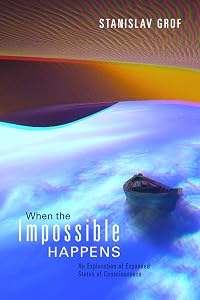
When the Impossible Happens: Adventures in Non-Ordinary Reality
by Stanislav Grof
On This Page
Description
Feelings of oneness with other people, nature, and the universe. Encounters with extraterrestrials, deities, and demons. Out-of-body experiences and past-life memories. Science casts a skeptical eye. But Dr. Stanislav Grof--the psychiatric researcher who cofounded transpersonal psychology--believes otherwise. When the Impossible Happens presents Dr. Grof 's mesmerizing firsthand account of over 50 years of inquiry into waters uncharted by classical psychology, one that will leave readers show more questioning the very fabric of our existence. From his first LSD session that gave him a glimpse of cosmic consciousness to his latest work with Holotropic Breathwork, When the Impossible Happens will amaze readers with vivid explorations of topics such as: Temptations of a Non-Local Universe--experiments in astral projection* Praying Mantis in Manhattan and other tales of synchronicity* Trailing Clouds of Glory--remembering birth and prenatal life * Dying and Beyond--survival of consciousness after deathWhen the Impossible Happens is an incredible opportunity to journey beyond ordinary consciousness, guaranteed to shake the foundations of what we assume to be reality, and sure to offer a new vision of our human potential. show lessTags
Recommendations
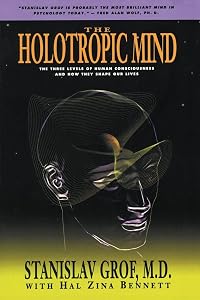
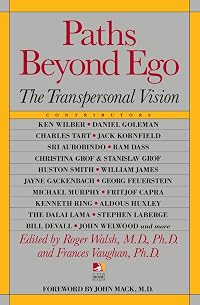
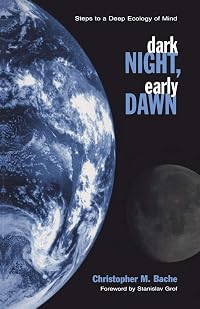

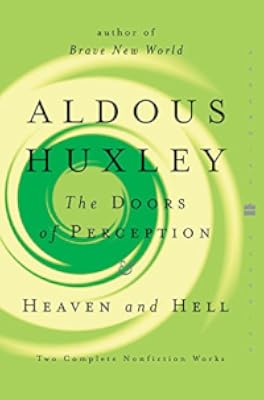










Member Reviews
This is a truly infuriating book – on the one side, there are some serious insights into the therapeutic value of non-rationalist interpretations of the human condition.
On the other, there is the worst sort of gullible and naive wide-eyed New Age nonsense. Patience started to be strained with the cultish adoration of an Indian guru near the beginning.
Patience threatened to run out completely by the time we got to the crystal skulls. This is a shame because what is good is very, very good.
I am glad that I stuck to my rule of finishing a book unless it is truly beyond redemption.
There was wisdom to be had in the final sections even if the book ended with the standard Californian eco-nonsense that Adam Curtis has recently and so show more effectively undermined in his recent BBC documentaries.
The book is a form of anecdotal biography by a significant figure in the Esalen circle.
Grof uses incidents in his life to ‘demonstrate’ that there are more things in heaven and hell than are dreamt of in our analytical and positivist philosophies.
The problem is that a serious investigation of anomalies is being discredited here by an over-enthusiastic acceptance of what people say and of what is perceived by the author to be true.
For example, the experience of universal consciousness is a widespread one but this merely means that there is widespread experience of a universal consciousness.
It does not mean that there is a universal consciousness at all! This elementary analytical truth gets thrown out with the bath water of positivism.
Grof cannot decide whether he lives in a land of faith - and faith in some pretty daft as well as reasonable things – or in the land of thought.
The latter is not necessarily a land of pure reason or analysis but it is a land of open attitudes to possibilities and of a critical view of the evidence.
He is desperately keen to prove his ideological position but this really comes down to a lazy liberal eco-hippy belief system.
He piles one incident on another without realising that some of the uncritically accepted absurdities are discrediting the very real anomalous phenomena that he identifies elsewhere.
This is why his self-indulgence makes me a little angry.
The self-indulgence of American New Agers creates the conditions for the majority to reject open inquiry on the basis of absurdities and so puts back real enquiry by decades.
Worse, the indulgence of nonsense by figures with undoubted expertise and talent results in a democracy of idiocy, culminating in a world of simplistic ecologism.
There is thus an inability to develop viable alternatives to our current busted system and populist rhetoric. Weak minds are not equal to strong minds and Grof’s tolerance goes too far.
And yet, when he gets off his high New Age high horse, he does have something important to say and no doubt has said these things better in more serious forums.
I am not necessarily persuaded by his interpretations of the perinatal effects on trauma but I do think it is a very fruitful line of inquiry.
While his ‘strong’ transpersonal position seems to be un-evidenced, a ‘weak’ version that takes account of instincts and non verbal signals as well as common unconscious reactions, strikes me as very plausible and worthy of more research.
Similarly, while I disagree profoundly that altered states represent a deeper reality (as opposed to a differently experienced reality), consciousness studies that involve exploration of altered states for therapeutic purposes strikes me as one of the most important research issues of our time.
I also profoundly agree that altered states and shifts of consciousness cannot be seen in analytical or positivist terms.
The role of irrationalism and of performance in permitting individuation is profound and is something that our still rigid social structures and forms have not taken full account of.
Secular rationalists loathe religion while political liberals position myth in the world of Eliade’s radical conservatism.
Yet, moments of madness, of faith and of loss of self in the all can take a person from sclerosis and anxiety into growth and life - and it is not for anyone to define the destiny of another.
Similarly, consciousness-altering drugs and religion as well as such tools as Second Life or ‘safe’ BDSM are almost certainly far more therapeutic than the endless and expensive process of the ‘talking cure’ for most people most of the time.
Alongside CBT as the distillation of behaviourism into decency in dealing pragmatically with acute issues, radical consciousness-altering interventions, such as those experimented with by Grof, strike me as the pathway to dealing with chronic conditions and psychic logjams.
Grof refers to these logjams as ‘spiritual emergencies’ (or we might call them existential crises) but the evidence is growing that, under the protection of those able to look out for the descent into madness or suicide, there are radical, experimental means of transforming one’s relationship to the world.
This repositions the clinician as half-way between scientist (where CBT and pharmaceutical intervention sits) and priest (who seeks to impose social demands on a private crisis).
The nearest analogy is the shaman who also mixes effective intervention with a degree of possibly self-delusion. We need to take the risk of allowing more people like Grof to experiment.
Perhaps there is a way between open acceptance of what individuals say they are and need (even as reincarnated Egyptian princesses) and a cool responsibility for helping those individuals move from one state to another.
Research must continue into the commonalties that Jung interpreted as the collective unconscious.
It is not that we have to accept either a species consciousness or some universal consciousness but that there is a phenomenon here that needs a plausible theory.
What we have to understand is what mechanisms make us believe in these things.
Instead of breeding them out as irrationalism within our species, we must ask how we can accept and come to terms with them as important facets of humanity, alongside psychopathic personalities, radical rationalism and autism.
The outcome of such a programme of research – in which Governments and corporations must have minimal say – should be a population in which persons were no longer required to be rational but could choose the expression of their own inner nature and needs.
The risk, of course, is that individuating loons would take over mighty warrior States and empires and drive them into new structural irrationalities.
These might end up causing serious damage to the human species. The idea of eco-warriors in charge of drones and the US Navy should scare us shitless.
We are already suffering from the idiocy of liberals who think that the military-industrial complex is a toy to be used to restructure the lives of tens of millions of people, along lines developed from their armchairs.
Giving such a toy to New Age eco-populists would be a very, very dumb idea.
Our current structures, as a result, seem designed to impose a cold, detached and deeply anxious elite control over a population that is resentful.
Yet some of us may accept the truth (exemplified by the Nazi experiment) that manipulative control by the relatively benign may be preferable to populist lunacy.
Grof worries me because his book is an unintended argument for continued elite control by the back door.
I would be really scared if nutters who believed in crystal skulls and the existential reality of Gaia and universal consciousness seized control of the massively powerful state systems we have developed.
And yet I would argue against Grof only in order to save his real insights. I suspect Grof is a child of his personal reaction against living under Soviet control until his twenties
Decentralisation of power and a new respect for individuation strategies have a place for irrationalism, altered states of consciousness, madness in the community, deviance, transgression and spiritual crises.
What we need is a structure that recreates society as a network of safe spaces for individuation that is still run rationally and pragmatically by the most qualified to do so.
So, sadly, this is not an important book and yet it bears reading.
Some of the case studies are plausible accounts of the distressed mind that do move beyond materialist interpretations based on the five observable senses.
Things are going on within and between brains that require open minds to investigate further. Transpersonal psychology must be taken seriously as part of that investigation.
Grof’s account of his dealings with Carl Sagan (if reported fairly) shows the degree to which scientific materialism can degenerate into a religion of its own.
It was at this point that I saw that Grof was still capable of thinking like a scientist should think, questioning everything where Sagan could not.
Grof also refers to spiritual intelligence. I think he is on to something here but not what he thinks he is on to. He is taking universal consciousness at face value.
Then he extrapolates anomalous experiences outwards, taking the symptoms (including the world religions) to imply a cause.
What he may really be looking at is brain functioning within a holistic system that includes perceptual capabilities operating at rates far faster than the mind can usually cope with.
Intense physical responsiveness to the environment need not be conscious and internal mental self-organising principles can re-order perception into total realities that appear as real as social reality.
It is perfectly possible for the mind to re-craft reality outside the social.
From there, the error is made by Grof that the construction of individual reality in opposition to social reality MUST be universal simply because it is total.
It is equally (I believe, more) likely that the human mind can totalise reality for itself under certain conditions.
Furthermore, this totalising of perception into a plausible reality includes a belief in its truth that is in-built into the species’ brain as a potentiality.
Brain chemistry can kick start such total perception. It may even be able to link with other minds to do so in certain circumstances.
I would also concede the possibility (no more) that minds, operating at a level of physics beyond our current understanding, might connect with minds in the past or the future (though this is surmise).
The assumption that there is a universal consciousness into which minds tap is simply a bridge too far. The case of synchronicity which plays a major role in the book is a case in point.
‘Official’ science simply refuses to take it seriously as a phenomenon and yet it is demonstrable in many people’s lives and, furthermore, tends to happen at certain key points of receptiveness.
Grof is persuasive that it exists – Jung was equally fascinated by it.
However, Grof leaps to massive universal consciousness conclusions without considering more material explanations.
These would be based on the ability of human minds to process and order more data than we currently think it can and on the operation of unconscious willing and management of perception and action.
Telepathy, OBEs, astral projection, precognition, clairvoyance, psychometry, psychokinesis and even survival of consciousness after death are not to be dismissed.
They can all be conceived of within monist materialist terms if we reasonably see the phenomena as linked to unknown physics without bringing in God or some ordering consciousness.
To be blunt, we can have evolved what Grof has called ‘spiritual intelligence’ as might creatures on other planets.
Such evolution might reach proportions of which we can currently know nothing (as implied in trans-human thought) but there is no justification whatsoever for claiming that this ‘essence’ preceded our existence.
Existentialism and monist materialism thus remain secure even amidst acceptance of anomalies and even if what we include within monist materialism is expanded to include phenomena that are beyond the understanding of the plodding materialist of today.
Grof has to decide whether he is a scientist (in which case there is nothing anomalous that is forbidden to him for study) or a religious thinker (in which case he inhabits an entirely unproven community of belief).
This book demonstrates that he has let his science become infected by belief.
In doing so, he has unthinkingly placed the scientific study of anomalous phenomena and the experimental altered states approach to therapy at threat from mindless materialist reactionaries. show less
On the other, there is the worst sort of gullible and naive wide-eyed New Age nonsense. Patience started to be strained with the cultish adoration of an Indian guru near the beginning.
Patience threatened to run out completely by the time we got to the crystal skulls. This is a shame because what is good is very, very good.
I am glad that I stuck to my rule of finishing a book unless it is truly beyond redemption.
There was wisdom to be had in the final sections even if the book ended with the standard Californian eco-nonsense that Adam Curtis has recently and so show more effectively undermined in his recent BBC documentaries.
The book is a form of anecdotal biography by a significant figure in the Esalen circle.
Grof uses incidents in his life to ‘demonstrate’ that there are more things in heaven and hell than are dreamt of in our analytical and positivist philosophies.
The problem is that a serious investigation of anomalies is being discredited here by an over-enthusiastic acceptance of what people say and of what is perceived by the author to be true.
For example, the experience of universal consciousness is a widespread one but this merely means that there is widespread experience of a universal consciousness.
It does not mean that there is a universal consciousness at all! This elementary analytical truth gets thrown out with the bath water of positivism.
Grof cannot decide whether he lives in a land of faith - and faith in some pretty daft as well as reasonable things – or in the land of thought.
The latter is not necessarily a land of pure reason or analysis but it is a land of open attitudes to possibilities and of a critical view of the evidence.
He is desperately keen to prove his ideological position but this really comes down to a lazy liberal eco-hippy belief system.
He piles one incident on another without realising that some of the uncritically accepted absurdities are discrediting the very real anomalous phenomena that he identifies elsewhere.
This is why his self-indulgence makes me a little angry.
The self-indulgence of American New Agers creates the conditions for the majority to reject open inquiry on the basis of absurdities and so puts back real enquiry by decades.
Worse, the indulgence of nonsense by figures with undoubted expertise and talent results in a democracy of idiocy, culminating in a world of simplistic ecologism.
There is thus an inability to develop viable alternatives to our current busted system and populist rhetoric. Weak minds are not equal to strong minds and Grof’s tolerance goes too far.
And yet, when he gets off his high New Age high horse, he does have something important to say and no doubt has said these things better in more serious forums.
I am not necessarily persuaded by his interpretations of the perinatal effects on trauma but I do think it is a very fruitful line of inquiry.
While his ‘strong’ transpersonal position seems to be un-evidenced, a ‘weak’ version that takes account of instincts and non verbal signals as well as common unconscious reactions, strikes me as very plausible and worthy of more research.
Similarly, while I disagree profoundly that altered states represent a deeper reality (as opposed to a differently experienced reality), consciousness studies that involve exploration of altered states for therapeutic purposes strikes me as one of the most important research issues of our time.
I also profoundly agree that altered states and shifts of consciousness cannot be seen in analytical or positivist terms.
The role of irrationalism and of performance in permitting individuation is profound and is something that our still rigid social structures and forms have not taken full account of.
Secular rationalists loathe religion while political liberals position myth in the world of Eliade’s radical conservatism.
Yet, moments of madness, of faith and of loss of self in the all can take a person from sclerosis and anxiety into growth and life - and it is not for anyone to define the destiny of another.
Similarly, consciousness-altering drugs and religion as well as such tools as Second Life or ‘safe’ BDSM are almost certainly far more therapeutic than the endless and expensive process of the ‘talking cure’ for most people most of the time.
Alongside CBT as the distillation of behaviourism into decency in dealing pragmatically with acute issues, radical consciousness-altering interventions, such as those experimented with by Grof, strike me as the pathway to dealing with chronic conditions and psychic logjams.
Grof refers to these logjams as ‘spiritual emergencies’ (or we might call them existential crises) but the evidence is growing that, under the protection of those able to look out for the descent into madness or suicide, there are radical, experimental means of transforming one’s relationship to the world.
This repositions the clinician as half-way between scientist (where CBT and pharmaceutical intervention sits) and priest (who seeks to impose social demands on a private crisis).
The nearest analogy is the shaman who also mixes effective intervention with a degree of possibly self-delusion. We need to take the risk of allowing more people like Grof to experiment.
Perhaps there is a way between open acceptance of what individuals say they are and need (even as reincarnated Egyptian princesses) and a cool responsibility for helping those individuals move from one state to another.
Research must continue into the commonalties that Jung interpreted as the collective unconscious.
It is not that we have to accept either a species consciousness or some universal consciousness but that there is a phenomenon here that needs a plausible theory.
What we have to understand is what mechanisms make us believe in these things.
Instead of breeding them out as irrationalism within our species, we must ask how we can accept and come to terms with them as important facets of humanity, alongside psychopathic personalities, radical rationalism and autism.
The outcome of such a programme of research – in which Governments and corporations must have minimal say – should be a population in which persons were no longer required to be rational but could choose the expression of their own inner nature and needs.
The risk, of course, is that individuating loons would take over mighty warrior States and empires and drive them into new structural irrationalities.
These might end up causing serious damage to the human species. The idea of eco-warriors in charge of drones and the US Navy should scare us shitless.
We are already suffering from the idiocy of liberals who think that the military-industrial complex is a toy to be used to restructure the lives of tens of millions of people, along lines developed from their armchairs.
Giving such a toy to New Age eco-populists would be a very, very dumb idea.
Our current structures, as a result, seem designed to impose a cold, detached and deeply anxious elite control over a population that is resentful.
Yet some of us may accept the truth (exemplified by the Nazi experiment) that manipulative control by the relatively benign may be preferable to populist lunacy.
Grof worries me because his book is an unintended argument for continued elite control by the back door.
I would be really scared if nutters who believed in crystal skulls and the existential reality of Gaia and universal consciousness seized control of the massively powerful state systems we have developed.
And yet I would argue against Grof only in order to save his real insights. I suspect Grof is a child of his personal reaction against living under Soviet control until his twenties
Decentralisation of power and a new respect for individuation strategies have a place for irrationalism, altered states of consciousness, madness in the community, deviance, transgression and spiritual crises.
What we need is a structure that recreates society as a network of safe spaces for individuation that is still run rationally and pragmatically by the most qualified to do so.
So, sadly, this is not an important book and yet it bears reading.
Some of the case studies are plausible accounts of the distressed mind that do move beyond materialist interpretations based on the five observable senses.
Things are going on within and between brains that require open minds to investigate further. Transpersonal psychology must be taken seriously as part of that investigation.
Grof’s account of his dealings with Carl Sagan (if reported fairly) shows the degree to which scientific materialism can degenerate into a religion of its own.
It was at this point that I saw that Grof was still capable of thinking like a scientist should think, questioning everything where Sagan could not.
Grof also refers to spiritual intelligence. I think he is on to something here but not what he thinks he is on to. He is taking universal consciousness at face value.
Then he extrapolates anomalous experiences outwards, taking the symptoms (including the world religions) to imply a cause.
What he may really be looking at is brain functioning within a holistic system that includes perceptual capabilities operating at rates far faster than the mind can usually cope with.
Intense physical responsiveness to the environment need not be conscious and internal mental self-organising principles can re-order perception into total realities that appear as real as social reality.
It is perfectly possible for the mind to re-craft reality outside the social.
From there, the error is made by Grof that the construction of individual reality in opposition to social reality MUST be universal simply because it is total.
It is equally (I believe, more) likely that the human mind can totalise reality for itself under certain conditions.
Furthermore, this totalising of perception into a plausible reality includes a belief in its truth that is in-built into the species’ brain as a potentiality.
Brain chemistry can kick start such total perception. It may even be able to link with other minds to do so in certain circumstances.
I would also concede the possibility (no more) that minds, operating at a level of physics beyond our current understanding, might connect with minds in the past or the future (though this is surmise).
The assumption that there is a universal consciousness into which minds tap is simply a bridge too far. The case of synchronicity which plays a major role in the book is a case in point.
‘Official’ science simply refuses to take it seriously as a phenomenon and yet it is demonstrable in many people’s lives and, furthermore, tends to happen at certain key points of receptiveness.
Grof is persuasive that it exists – Jung was equally fascinated by it.
However, Grof leaps to massive universal consciousness conclusions without considering more material explanations.
These would be based on the ability of human minds to process and order more data than we currently think it can and on the operation of unconscious willing and management of perception and action.
Telepathy, OBEs, astral projection, precognition, clairvoyance, psychometry, psychokinesis and even survival of consciousness after death are not to be dismissed.
They can all be conceived of within monist materialist terms if we reasonably see the phenomena as linked to unknown physics without bringing in God or some ordering consciousness.
To be blunt, we can have evolved what Grof has called ‘spiritual intelligence’ as might creatures on other planets.
Such evolution might reach proportions of which we can currently know nothing (as implied in trans-human thought) but there is no justification whatsoever for claiming that this ‘essence’ preceded our existence.
Existentialism and monist materialism thus remain secure even amidst acceptance of anomalies and even if what we include within monist materialism is expanded to include phenomena that are beyond the understanding of the plodding materialist of today.
Grof has to decide whether he is a scientist (in which case there is nothing anomalous that is forbidden to him for study) or a religious thinker (in which case he inhabits an entirely unproven community of belief).
This book demonstrates that he has let his science become infected by belief.
In doing so, he has unthinkingly placed the scientific study of anomalous phenomena and the experimental altered states approach to therapy at threat from mindless materialist reactionaries. show less
> Par Le Figaroscope : Quand l'impossible arrive de Stanislav Grof, Olivier Clerc
16 janv. 2018 ... Souvenirs de vies antérieures, expériences de décorporation, mystères de la synchronicité, survie de la conscience après la mort... Si la science considère généralement tout cela d'un œil pour le moins sceptique, le Dr Stanislav Grof - sommité internationale, chercheur en psychiatrie et l'un des fondateurs de la psychologie transpersonnelle - nous invite dans cet ouvrage passionnant à porter un nouveau regard sur notre Univers, bousculant nos perspectives.
D'une grande lisibilité, très accessible et captivant, ce livre exceptionnel nous offre le fruit des cinquante années d'explorations menées par l'auteur sur ces show more dimensions de la conscience qui n'avaient jusque-là jamais été répertoriées par la psychologie classique - une succession de recherches, d'expériences et de découvertes qui viennent bouleverser notre compréhension de la réalité, de l'homme et de l'Univers, et qui remettent en question les fondements mêmes de l'existence ... show less
16 janv. 2018 ... Souvenirs de vies antérieures, expériences de décorporation, mystères de la synchronicité, survie de la conscience après la mort... Si la science considère généralement tout cela d'un œil pour le moins sceptique, le Dr Stanislav Grof - sommité internationale, chercheur en psychiatrie et l'un des fondateurs de la psychologie transpersonnelle - nous invite dans cet ouvrage passionnant à porter un nouveau regard sur notre Univers, bousculant nos perspectives.
D'une grande lisibilité, très accessible et captivant, ce livre exceptionnel nous offre le fruit des cinquante années d'explorations menées par l'auteur sur ces show more dimensions de la conscience qui n'avaient jusque-là jamais été répertoriées par la psychologie classique - une succession de recherches, d'expériences et de découvertes qui viennent bouleverser notre compréhension de la réalité, de l'homme et de l'Univers, et qui remettent en question les fondements mêmes de l'existence ... show less
Dec 11, 2018 (Edited)French
Ratings
Members
- Recently Added By
Lists

Seeking the Soul
46 works; 1 member
Author Information

89+ Works 2,673 Members
Stanislav Grof, M.D., is a psychiatrist who has been principal investigator at the Psychiatric Research Institute in Prague. Chief of Psychedelic Research at the Maryland Psychiatric Research Center, and assistant professor of psychiatry at Johns Hopkins University. He is now professor of psychology at the California Institute of Integral Studies. show more His 20 books include Beyond the Brain, Psychology of the Future, The Cosmic Genius, and Spiritual Emergency. He live in California. show less
Awards and Honors
Awards
Common Knowledge
- Original title
- When the Impossible Happens: Adventures in Non-ordinary Realities
- Original publication date
- 2006
- Original language
- English
Classifications
- Genres
- Nonfiction, General Nonfiction, Religion & Spirituality, Biography & Memoir
- DDC/MDS
- 133.8 — Philosophy & psychology Parapsychology & occultism Specific topics in parapsychology and occultism Psychic phenomena
- LCC
- BF1027 .G74 .A3 — Philosophy, Psychology and Religion Psychology Parapsychology Psychic research. Psychology of the conscious
- BISAC
Statistics
- Members
- 161
- Popularity
- 202,806
- Reviews
- 2
- Rating
- (3.75)
- Languages
- 5 — English, Estonian, French, German, Italian
- Media
- Paper, Ebook
- ISBNs
- 9
- UPCs
- 1
- ASINs
- 1