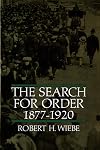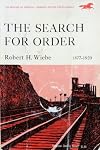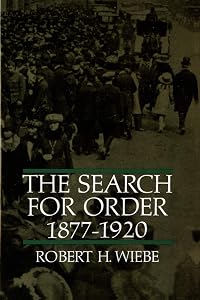
The Search for Order, 1877-1920
by Robert H. Wiebe, David Herbert Donald
The Making of America [Hill & Wang] (1877 - 1920)
On This Page
Description
"Wiebe sees the Progressive era of Theordore Roosevelt and Woodrow Wilson as a search for organizing principles around which a viable social order could be constructed in a new, largely impersonal world."--Back coverTags
Recommendations






Member Reviews
The end of the nineteenth century saw a restructuring of American society. The process of industrialization disrupted the ideal of independent communities and created a more bureaucratic society on a larger scale. For instance, large scale farming required capital not available to many family farms, making them dependent on banks or else forcing them to sell to someone with that capital, most like a corporation. Railroads also disrupted local society, making communities dependent on them but giving those communities no influence in their operation.
Initially populists sought to reverse the erosion of independent communities, but their attempts at reform worked in the opposite manner. They were successful in establishing a sort of order, show more but it took the form of a central bureaucracy. Wiebe argues that bureaucratic values replaced traditional moral ones as efficiency became the standard for good practice.
He ends the analysis in 1920, not because the process was complete, but because WWI demonstrated the application of the new efficiency in society in mobilizing for the war. Nevertheless, the new bureaucratization was not well-applied to the armed forces, which entered the war in an amateurish manner.
This is an excellent book to describe a sea change in the structure of American society. Wiebe does an excellent job in explaining how the United States became a more centralize state in between Reconstruction and WWI. show less
Initially populists sought to reverse the erosion of independent communities, but their attempts at reform worked in the opposite manner. They were successful in establishing a sort of order, show more but it took the form of a central bureaucracy. Wiebe argues that bureaucratic values replaced traditional moral ones as efficiency became the standard for good practice.
He ends the analysis in 1920, not because the process was complete, but because WWI demonstrated the application of the new efficiency in society in mobilizing for the war. Nevertheless, the new bureaucratization was not well-applied to the armed forces, which entered the war in an amateurish manner.
This is an excellent book to describe a sea change in the structure of American society. Wiebe does an excellent job in explaining how the United States became a more centralize state in between Reconstruction and WWI. show less
A true classic. Though many of Wiebe's broad conclusions have been challenged, his interpretation of the origins of modern America must still must be reckoned with by any serious student of U.S. history.
4354. The Search for Order 1877-1920, by Robert H. Wiebe (read 26 Aug 2007) This is an analytic account of the efforts during the period named to determine an order for American life. While described on the cover as "a subtle and sophisticated study" which combines the virtues of historical narrative, sociological analysis, and social criticism, I found it usually dry and only occasionally exciting my interest. Much that he says is insightful and accurate so far as I could tell, but I admit I was glad when I reached the last page.
Excellent overview of the Populist and Progressive Eras and syncs well with Richard Hofstadter's Age of Reform.
an oldie but a goodie
香港大學歷史系
香港大學歷史系
Jul 2, 2025Chinese, traditional
Members
- Recently Added By
Lists

r/AskHistorians' Recommended Books
1,068 works; 18 members
Author Information
8 Works 647 Members
Robert H. Wiebe, who died in 2000, was Professor Emeritus of History at Northwestern University
2 Works 481 Members
All Editions
Series

Common Knowledge
- Canonical title
- The Search for Order, 1877-1920
- Original publication date
- 1967
- People/Characters
- Edward Bellamy; Theodore Roosevelt; Woodrow Wilson; William McKinley; Grover Cleveland; Washington Gladden (show all 11); Henry Demarest Lloyd; Richard T. Ely; Henry Cabot Lodge; J. P. Morgan; William Howard Taft
- Important places
- Washington, D.C., USA; Chicago, Illinois, USA
- Important events
- World War I; Panic of 1873
- Dedication
- For my mother and father
- First words
- The outlines of depression in the 1870's were simple and severe.
- Last words
- (Click to show. Warning: May contain spoilers.)The future for a time would belong to them.
Classifications
- Genres
- History, Nonfiction, General Nonfiction
- DDC/MDS
- 973.8 — History & geography History of North America United States The Gilded Age, Reconstruction, Spanish American War (1865-1901)
- LCC
- E661 .W58 — History of the United States United States Late nineteenth century, 1865-1900 Diplomatic history. Foreign and general
- BISAC
Statistics
- Members
- 482
- Popularity
- 62,891
- Reviews
- 7
- Rating
- (3.78)
- Languages
- English
- Media
- Paper, Ebook
- ISBNs
- 2
- ASINs
- 6