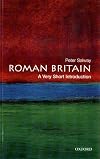
Roman Britain: A Very Short Introduction
by Peter Salway
On This Page
Description
Weaving together the results of archaeological investigation and historical scholarship in a readable, concise account, this text charts life in Roman Britain from the first Roman invasion to the final collapse of the Roman Empire, around 500 AD.Tags
Recommendations









Member Reviews
I didn’t find this short account of Roman Britain as interesting as expected. This is partly owing to the lack of solid information available, partly through the absence of any famous personages - not counting well-known Romans - of the times, but mainly because I didn’t take to the writing style.
Regarding my first point, I realise that much of Britain’s early history lies in obscurity, thus the information covered in this account is bound to be scanty. With little written documentation from the fifth century and earlier, historians rely heavily on archaeological finds to help build pictures of these bygone times.
Regarding the absence of any famous personages, we do have Boudicca, but she’s pretty much glanced over here. It’s show more unfortunate that such a lack of written records prevents us knowing more about specific Britons during the first five centuries AD, as even in non-fiction a hero and heroine makes the narrative more engaging.
As for the writing style, I found it lacking vibrancy. It didn’t draw me in. Many sentences were long-winded, bogged-down with commas, semi-colons, colons, dashes, and brackets. Take this 43-word sentence for an example:
>Other trades, working in more perishable materials, perhaps operated in similar fashion—for example fresco-painters (of whose work just enough survives to demonstrate its importance and the quality it could reach); furniture-makers; and other suppliers of major items for the well-to-do household. show less
Regarding my first point, I realise that much of Britain’s early history lies in obscurity, thus the information covered in this account is bound to be scanty. With little written documentation from the fifth century and earlier, historians rely heavily on archaeological finds to help build pictures of these bygone times.
Regarding the absence of any famous personages, we do have Boudicca, but she’s pretty much glanced over here. It’s show more unfortunate that such a lack of written records prevents us knowing more about specific Britons during the first five centuries AD, as even in non-fiction a hero and heroine makes the narrative more engaging.
As for the writing style, I found it lacking vibrancy. It didn’t draw me in. Many sentences were long-winded, bogged-down with commas, semi-colons, colons, dashes, and brackets. Take this 43-word sentence for an example:
>Other trades, working in more perishable materials, perhaps operated in similar fashion—for example fresco-painters (of whose work just enough survives to demonstrate its importance and the quality it could reach); furniture-makers; and other suppliers of major items for the well-to-do household. show less
This book is certainly short: 67 pages plus a bibliography (2 pages), chronology (3 pages) and index (4 pages).
The book is basically chronological in focus, taking us from Julius Caesar's expeditions down to the end of Roman rule. Along the way Britain is placed firmly in the context of what was happening elsewhere in the Empire, and the differences and similarities with the situation in Gaul in particular are nicely brought out.
The book is basically chronological in focus, taking us from Julius Caesar's expeditions down to the end of Roman rule. Along the way Britain is placed firmly in the context of what was happening elsewhere in the Empire, and the differences and similarities with the situation in Gaul in particular are nicely brought out.
Britain was within the orbit of Graeco-Roman civilization for at least half a millennium, and for over 350 years part of the political union created by the Roman Empire that encompassed most of Europe and all the countries of the Mediterranean. First published as part of the best-selling Oxford Illustrated History of Britain, Peter Salway's Very Short Introduction to Roman Britain weaves together the results of archaeological investigation and historical scholarship in a rounded and highly readable concise account. He charts life in Roman Britain from the first Roman invasion under Julius Caesar to the final collapse of the Roman Empire in the West around AD 500.
Peter Salway, formerly a Fellow of Sidney Sussex College, Cambridge, and show more subsequently of All Souls College, Oxford, is an Emeritus Professor of the Open University and Chairman of the Oxford Archaeological Unit. His publications include The Oxford Illustrated History of Roman Britain, published by OUP in 1993 (reissued in paperback by OUP in 1997 as A History of Roman Britain). He has served as a Member of Council of the National Trust (appointed by the Society of Antiquaries), and was one of the editors of The Remains of Distant Times: Archaeology and the National Trust (Boydell, 1996). He has also published a substantial number of articles and reviews in learned journals and publications for the general reader, mostly on Roman Britain and Classical Antiquity in general, a few on medieval and later British archaeology and architectural history. show less
Peter Salway, formerly a Fellow of Sidney Sussex College, Cambridge, and show more subsequently of All Souls College, Oxford, is an Emeritus Professor of the Open University and Chairman of the Oxford Archaeological Unit. His publications include The Oxford Illustrated History of Roman Britain, published by OUP in 1993 (reissued in paperback by OUP in 1997 as A History of Roman Britain). He has served as a Member of Council of the National Trust (appointed by the Society of Antiquaries), and was one of the editors of The Remains of Distant Times: Archaeology and the National Trust (Boydell, 1996). He has also published a substantial number of articles and reviews in learned journals and publications for the general reader, mostly on Roman Britain and Classical Antiquity in general, a few on medieval and later British archaeology and architectural history. show less
Blackwells 2nd edition $10.67 - a dollar less than Powells
Ratings
Members
- Recently Added By
Lists

Roman Britain
42 works; 12 members
Author Information

7+ Works 999 Members
Series
Belongs to Publisher Series
Work Relationships
Is contained in
Common Knowledge
- Canonical title
- Roman Britain: A Very Short Introduction
- Important places
- Roman Britain
- Important events
- Roman occupation of Britain
- First words
- In Roman times Britain had as many people as at its peak in the Middle Ages.
- Last words
- (Click to show. Warning: May contain spoilers.)At least until the 440s, therefore, something survived in Britain that was very like 'post-Roman' or 'post-imperial' life elsewhere in the West.
- Original language
- English
Classifications
- Genres
- History, Nonfiction, General Nonfiction
- DDC/MDS
- 936.104 — History & geography History of ancient world (to ca. 499) Europe north and west of Italian Peninsula to ca. 499 British Isles to 410
- LCC
- DA145 .S263 — History of Europe, Asia, Africa and Oceania Great Britain History of Great Britain England History By period Early and medieval to 1485 Celts. Romans. Saxons. Danes. Normans
- BISAC
Statistics
- Members
- 245
- Popularity
- 133,211
- Reviews
- 4
- Rating
- (3.29)
- Languages
- English
- Media
- Paper, Ebook
- ISBNs
- 7
- ASINs
- 4