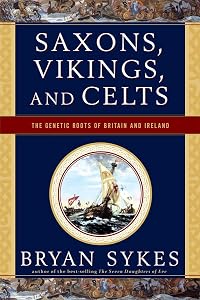
Saxons, Vikings, and Celts: The Genetic Roots of Britain and Ireland
by Bryan Sykes
On This Page
Description
A study based on a decade-long DNA survey traces the genetic makeup of British Islanders and their descendants, ranging from prehistoric times to the genetic heritage of Americans of British descent.Tags
Recommendations
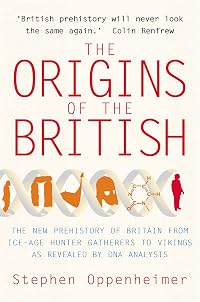
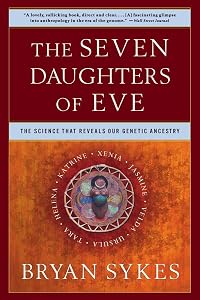
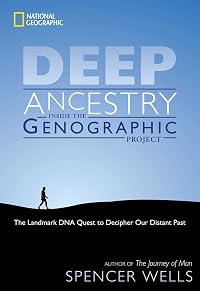
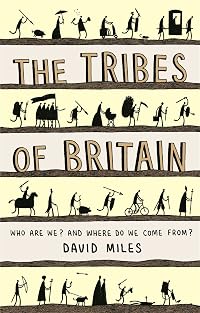






Member Recommendations
Member Reviews
An enjoyable read. Should be of interest to anyone of significant British, Irish, Norman, Scandinavian, or northern German heritage. About 70% of the book recounts the (non-genetic) history of these peoples as may relate to their current genetic contribution and its distribution in the British Isles.
The author is a genetic anthropologist but takes care to avoid technicalities about the genetics where possible. That is excellent for the general reader but may annoy those with expertise in genetics, though they may still enjoy the book for the history and its varied correlations with the genetic evidence.
Most Brits should enjoy this. It is titled "Blood of the Isles" over there. Don't be surprised to learn that John Bull is largely Celtic.
The author is a genetic anthropologist but takes care to avoid technicalities about the genetics where possible. That is excellent for the general reader but may annoy those with expertise in genetics, though they may still enjoy the book for the history and its varied correlations with the genetic evidence.
Most Brits should enjoy this. It is titled "Blood of the Isles" over there. Don't be surprised to learn that John Bull is largely Celtic.
A fascinating read, but I was left feeling a little short-changed. The book is better in its description of the process of collecting and analysing modern British DNA, than it is in linking those samples to earlier peoples of the British Isles. That accurately reflects the scientific reality, but I couldn't help feeling a little short-changed - I think the blurb and the hoopla raised my expectations too far.
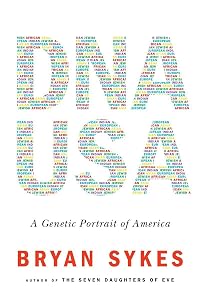
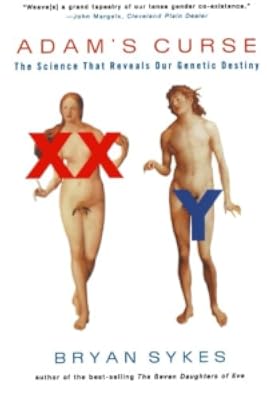
Bryan Sykes is a respected DNA researcher who started his string of popular books with The Seven Daughters of Eve and Adam’s Curse. Recently I finally got around to reading DNA USA and Saxons, Vikings and Celts. In the latter book, he has a fascinating dissection of the many different areas of England and Scotland with some interesting conclusions about the probable history of human settlement in the region. He traced Scots lineage as well as the Irish, English and Celts and compares “Viking” DNA to European DNA. In particular, I found his conclusions on the MacDonald clan fascinating. It is always interesting when we can extrapolate probable history from scientific fact.
Saxons, Vikings and Celts is a little dated in that Sykes show more mentions that there has been no Neanderthal DNA discovered in humans yet, a discovery that was just a few short years in the future from the time of publication. Toward the end of the book, Sykes writes “For every fact I have shown you, I have a hundred more in reserve.” I wish he had given me more facts and less travelogue. While it is somewhat interesting to learn the methods of collection and challenges, he goes on and on at length about the people in the clinics and quaint little towns and there is a very long and eye-glazing narrative on the earliest kings, despots and rulers. The discussion of maternal clans that he mentions would have been helped greatly with more information in the table and at least a summary discussion on haplogroups even though he covered this subject in detail in his earlier books.
I found the appendix and maps to be the most interesting part of the book. Sykes might just do two books instead of one next time, one for those of us more interested in the facts and research, the meat of his work, even if it a shorter book without the folksy filler. He could do the other book for those who want the travelogue which I found to be tedious. Sykes has also been looking into Bigfoot DNA and there are those that disparage this use of his time and talent. I admire his intrepid spirit and willingness to look into any subject that pertains to DNA for the answers to age-old questions. I am always willing to give his publications a look. show less
Saxons, Vikings and Celts is a little dated in that Sykes show more mentions that there has been no Neanderthal DNA discovered in humans yet, a discovery that was just a few short years in the future from the time of publication. Toward the end of the book, Sykes writes “For every fact I have shown you, I have a hundred more in reserve.” I wish he had given me more facts and less travelogue. While it is somewhat interesting to learn the methods of collection and challenges, he goes on and on at length about the people in the clinics and quaint little towns and there is a very long and eye-glazing narrative on the earliest kings, despots and rulers. The discussion of maternal clans that he mentions would have been helped greatly with more information in the table and at least a summary discussion on haplogroups even though he covered this subject in detail in his earlier books.
I found the appendix and maps to be the most interesting part of the book. Sykes might just do two books instead of one next time, one for those of us more interested in the facts and research, the meat of his work, even if it a shorter book without the folksy filler. He could do the other book for those who want the travelogue which I found to be tedious. Sykes has also been looking into Bigfoot DNA and there are those that disparage this use of his time and talent. I admire his intrepid spirit and willingness to look into any subject that pertains to DNA for the answers to age-old questions. I am always willing to give his publications a look. show less
Bryan Sykes has a way of taking the science behind genetic roots and making it more understandable. He does this once again in "Saxons, Vikings, and Celts". In this book Sykes combines the story of the early days of genetic genealogy with the history of the Isles, which he divides into Ireland, Scotland, Wales and England. He uses the history of the areas as the blueprint for the genetics for the different populations in each division of the Isles. I found this book especially interesting as this is the area of my ancestry. Of course, I wanted to know more and the book does refer to a website if the reader wants more information. Unfortunately, the website is no longer in operation.
Fascinating look not only at the genetic makeup of the Isles, but also how they relate to current and historic ideas of 'ethnicity.' I especially enjoyed how it related mythologies about the groups that came to the Isles with the archaeological and genetic evidence we've uncovered.
Best part of the book was the mythology and ancient histories of origin and settlement and then the comparison of more verifiable history. The genetic history was a little thin and relied a little too much on the author's other works.
A fascinating book about the genetic history of the British Isles as seen through our mitochondrial DNA and Y-chromosomes. The author spends a long time talking about our history as seen through fable, story and oral history, the kind of thing you might think was just pie in the sky made up by our ancestors to sound good (or bad as desired). I found these history lessons a little longwinded but it was enthralling when they were linked up with the evidence from our genes.
Members
- Recently Added By
Lists

For Science!
39 works; 5 members

Books Read in 2023
5,547 works; 145 members

Works Cited in The History of White People by Nell Irvin Painter
321 works; 2 members
Author Information

8 Works 3,769 Members
Bryan Sykes is professor of genetics at the Institute of Molecular Medicine at Oxford University & was the editor of "The Human Inheritance: Genes, Language, & Evolution". (Bowker Author Biography)
Common Knowledge
- Original title
- Blood of the Isles : Exploring the Genetic Roots of Our Tribal History
- Original publication date
- 2006 (copyright) (copyright)
- People/Characters
- Arthur, King of the Britons; John Beddoe; Edward I, King of England; Tacitus, historian
- Important places
- United Kingdom; Ireland; Scotland, UK; Wales, UK; Argyll and Bute, Scotland, UK (as Argyll, Scotland); Cornwall, England, UK (show all 9); Hebrides, Scotland, UK; Orkney, Scotland, UK; Shetland, Scotland, UK
- Important events
- Mesolithic Period
- Dedication
- To my son Richard, companion on very many journeys
- First words
- Prologue
This is the very first book to be written about the genetic history of Britain and Ireland using DNA as its main source of information.
1
TWELVE THOUSAND YEARS OF SOLITUDE
Everything was ready. - Last words
- (Click to show. Warning: May contain spoilers.)This really is the history of the people, by the people.
- Disambiguation notice
- Original title: Blood of the Isles : Exploring the Genetic Roots of Our Tribal History
Classifications
- Genres
- Anthropology, Science & Nature, Nonfiction, History, General Nonfiction
- DDC/MDS
- 599.9350941 — Natural sciences & mathematics Animals Mammals Homo sapiens Genetics, sex and age characteristics, evolution Genetics
- LCC
- GN290 .G7 .S95 — Geography, Anthropology and Recreation Anthropology Anthropology Physical anthropology. Somatology
- BISAC
Statistics
- Members
- 881
- Popularity
- 30,732
- Reviews
- 14
- Rating
- (3.66)
- Languages
- English
- Media
- Paper, Audiobook, Ebook
- ISBNs
- 13
- ASINs
- 5