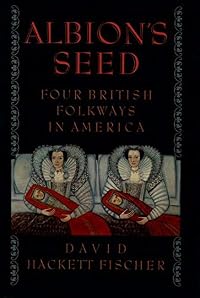
Albion's Seed: Four British Folkways in America
by David Hackett Fischer
On This Page
Description
Discusses the transplanting of British folkways to America during four waves of immigration between 1629 and 1775.Tags
Recommendations











Member Recommendations
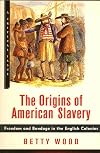
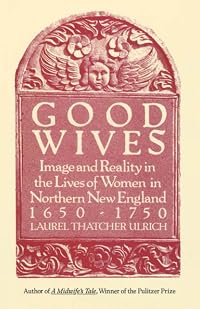
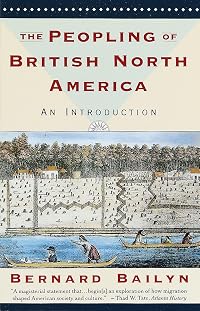
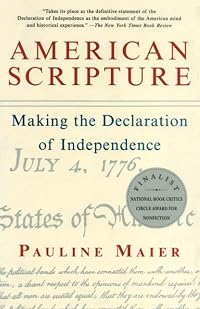
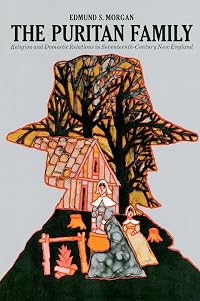
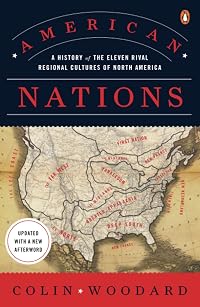
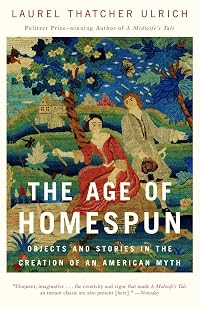
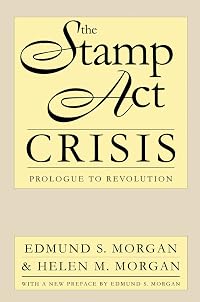
cbl_tn This would be a nice companion reading since it takes a similar regional approach and looks at the issue of slavery in more depth.

Member Reviews
So fascinating you don't notice the 900 pages. Tidbits from the section on the Puritans in 17th-c. New England: It was illegal to be single. Tithingmen regularly barged in and inspected every family. Bachelors were rounded up and forced to live with a family. Teenage males could be executed for not obeying their parents.
Courting couples were allowed to spend the night together in their parent's house, but the girl was fitted into a tight bag called a bundling stocking up to the hips so that the boy had no access to her groin but she was allowed to be naked from the waist up. Masturbation was punishable by death (more of a warning; it was rarely carried out). If someone was accused of bestiality, and you were observed joking or making show more light of it, just for that you could be permanently banished from the town.
Children were kicked out of the house (“sent out”) when they became prepubescent or adolescent since with so many family members (avg. 8-10 children) the likelihood of incest increased. The sent-out children were usually put with a smaller family (where they would also be taught manners).
The Puritans didn’t have churches but rather “meeting halls.” Sunday service was compulsory and sermons lasted 5-6 hours. In winter they were deliberately unheated inside, on the excuse that stoves might set off the munitions and explosives regularly stored there!
Some males were given bizarre first names at birth like “Notwithstanding”, “Maybe”, and “Increase”. Know how they got them? One of the parents would put their finger on a random word in the Bible. show less
Courting couples were allowed to spend the night together in their parent's house, but the girl was fitted into a tight bag called a bundling stocking up to the hips so that the boy had no access to her groin but she was allowed to be naked from the waist up. Masturbation was punishable by death (more of a warning; it was rarely carried out). If someone was accused of bestiality, and you were observed joking or making show more light of it, just for that you could be permanently banished from the town.
Children were kicked out of the house (“sent out”) when they became prepubescent or adolescent since with so many family members (avg. 8-10 children) the likelihood of incest increased. The sent-out children were usually put with a smaller family (where they would also be taught manners).
The Puritans didn’t have churches but rather “meeting halls.” Sunday service was compulsory and sermons lasted 5-6 hours. In winter they were deliberately unheated inside, on the excuse that stoves might set off the munitions and explosives regularly stored there!
Some males were given bizarre first names at birth like “Notwithstanding”, “Maybe”, and “Increase”. Know how they got them? One of the parents would put their finger on a random word in the Bible. show less
"Albion 19s Seed" by David Hackett Fischer is a terrific history of the various groups of British people who settled in the colonies that later became the United States. Fischer writes clearly, interestingly and with a balance between three elements of historical analysis: blending the stories of the famous with those of the obscure and with a use of statistics that is unexpectedly lively 14a feat in itself. (Too many historians see these three elements as being in competition and use them singly or with overemphasis on one of them over the others.)
Fischer 19s thesis is this: each colony that made up British America was settled by people who tended to come from particular regions of Britain. For example, the characteristically 1Cr 1D show more dropping New Englanders from whom I myself spring, tended to come from the counties in the eastern part of England where, to this day, people tend to drop their 1Cr 1Ds in much the same way. This is not to say that there were not exceptions to this narrow origin. The area around Rowley, Massachusetts, was settled by people whose origins in England were a bit further north from those of the people who tended to settle the rest of Massachusetts. Indeed, while the majority of those who initially settled the colony were either clergymen, craftsmen, farmers, or fishermen according to their trades in eastern England, the people who settled in Rowley had been millers and, unsurprisingly, given that fact, built the first mills in New England.
My own ancestry reflects further exceptions: one of my ancestors was from southeastern England, a little further south of the majority of Massachusetts Bay colonists, and another direct ancestor came from a suburb of London. However, religion, more than geography, united the colonists of Massachusetts. Most of them were Puritans, and even the settlers of Rowley had been members of a Puritan church in a part of England where Puritans had been less common than in the part of East Anglia where most of the New England colonists came from. Similarly, my own ancestors, though not from the expected region of England, show up in colonial records as members in good standing of the Congregational church that developed out of the Puritan rule. (Although one of my second generation New England ancestors was punished for 1Cconsorting with Baptists. 1D)
Similarly, each other colony 19s history is that of people whose majority tended to come from certain counties in Britain, certain classes of the social order, and certain religions. Virginia, where I now dwell, was settled by people from the southwestern counties of England, both gentlemen (or cavaliers, as they were called) and, eventually, the less than desirable class, including pickpockets and prostitutes. Most of the gentlemen were second sons who did not expect to inherit anything from their wealthy fathers who were entitled and expected under British law to leave their estates entirety to their eldest sons. Nominally adherents of the Church of England (nowadays called Episcopal in the United States), the settlers of Virginia tended to be far less religious than the colonists in Massachusetts who arrived with the intention of establishing a spiritual utopia. However, to all of these people, the New World promised great danger but also a chance of success and relative liberty that was almost impossible back in England.
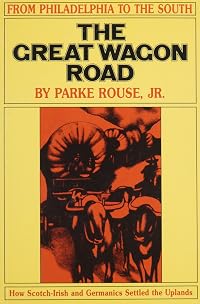
In each colony, different groups of people arrived in successive waves, each with a different point of arrival in terms both of geography and calendar date. The older settlers often looked down on the newcomers but to varying degrees, and newcomers who had to pass through the cities and towns of earlier settlers tended to continue on to new territories that were as yet less settled. So it was that the last group of settlers to arrive before the American Revolution 14the people from northern England, southern Scotland, and northern Ireland, whom Fischer calls 1CBorderers 1D because they came from border areas within the British Isles 14were regarded as very low indeed by the established American colonists. These newcomers pushed west to the frontiers of several states, including Pennsylvania, where they later participated in the Whiskey Rebellion that President George Washington personally put down at the head of the nation 19s newly minted professional army. Of course, Washington had a personal bone to pick with Borderers because they often squatted on lands that were already legally claimed by wealthy landowners including Washington himself.
This is a very long book. It might please most American readers to read those chapters that deal with their own ancestors, if they are of English or Scots ancestry, or with the region where they happen to live if they are Easterners. But other readers might enjoy this book, too, if they are interested enough in the nitty-gritty of American history to enjoy a well written account of how colonial America was settled by different groups with different backgrounds and intentions, and how these differences determined the various characters of the colonies and perhaps contributed to the diversity of temperament and ethos enjoyed today by the different states that these colonies became. show less
Fischer 19s thesis is this: each colony that made up British America was settled by people who tended to come from particular regions of Britain. For example, the characteristically 1Cr 1D show more dropping New Englanders from whom I myself spring, tended to come from the counties in the eastern part of England where, to this day, people tend to drop their 1Cr 1Ds in much the same way. This is not to say that there were not exceptions to this narrow origin. The area around Rowley, Massachusetts, was settled by people whose origins in England were a bit further north from those of the people who tended to settle the rest of Massachusetts. Indeed, while the majority of those who initially settled the colony were either clergymen, craftsmen, farmers, or fishermen according to their trades in eastern England, the people who settled in Rowley had been millers and, unsurprisingly, given that fact, built the first mills in New England.
My own ancestry reflects further exceptions: one of my ancestors was from southeastern England, a little further south of the majority of Massachusetts Bay colonists, and another direct ancestor came from a suburb of London. However, religion, more than geography, united the colonists of Massachusetts. Most of them were Puritans, and even the settlers of Rowley had been members of a Puritan church in a part of England where Puritans had been less common than in the part of East Anglia where most of the New England colonists came from. Similarly, my own ancestors, though not from the expected region of England, show up in colonial records as members in good standing of the Congregational church that developed out of the Puritan rule. (Although one of my second generation New England ancestors was punished for 1Cconsorting with Baptists. 1D)
Similarly, each other colony 19s history is that of people whose majority tended to come from certain counties in Britain, certain classes of the social order, and certain religions. Virginia, where I now dwell, was settled by people from the southwestern counties of England, both gentlemen (or cavaliers, as they were called) and, eventually, the less than desirable class, including pickpockets and prostitutes. Most of the gentlemen were second sons who did not expect to inherit anything from their wealthy fathers who were entitled and expected under British law to leave their estates entirety to their eldest sons. Nominally adherents of the Church of England (nowadays called Episcopal in the United States), the settlers of Virginia tended to be far less religious than the colonists in Massachusetts who arrived with the intention of establishing a spiritual utopia. However, to all of these people, the New World promised great danger but also a chance of success and relative liberty that was almost impossible back in England.
In each colony, different groups of people arrived in successive waves, each with a different point of arrival in terms both of geography and calendar date. The older settlers often looked down on the newcomers but to varying degrees, and newcomers who had to pass through the cities and towns of earlier settlers tended to continue on to new territories that were as yet less settled. So it was that the last group of settlers to arrive before the American Revolution 14the people from northern England, southern Scotland, and northern Ireland, whom Fischer calls 1CBorderers 1D because they came from border areas within the British Isles 14were regarded as very low indeed by the established American colonists. These newcomers pushed west to the frontiers of several states, including Pennsylvania, where they later participated in the Whiskey Rebellion that President George Washington personally put down at the head of the nation 19s newly minted professional army. Of course, Washington had a personal bone to pick with Borderers because they often squatted on lands that were already legally claimed by wealthy landowners including Washington himself.
This is a very long book. It might please most American readers to read those chapters that deal with their own ancestors, if they are of English or Scots ancestry, or with the region where they happen to live if they are Easterners. But other readers might enjoy this book, too, if they are interested enough in the nitty-gritty of American history to enjoy a well written account of how colonial America was settled by different groups with different backgrounds and intentions, and how these differences determined the various characters of the colonies and perhaps contributed to the diversity of temperament and ethos enjoyed today by the different states that these colonies became. show less
Albion's Seed posits the existence of at least 11 distinct regional cultures in America and focuses on the first and largest 4, these were the founding cultures. They are New England, Virginia and the coastal south, the Mid Atlantic (PA, NJ, part of MD), and the "backcountry" which is basically Appalachia from PA southward. These regions were settled from different parts of England, respectively: East Anglia, southern and central England (Wessex and Mercia). the English midlands, and the border regions of England-Scotland-northern Ireland. Fischer contends the 17th and early 18th century established the cultural patterns in these regions that still exist today. He provides extensive evidence which is very convincing. I learned as much show more about English culture as American. Although published in 1989 it is just as relevant today, it's a classic. It will change how I view the US and UK forever, a perspective mind shift. It goes a long way to explaining our current problems and is a reminder that the US has always had internal conflict between cultures. Fischer says each culture has different ideas of what it means to be American, what freedom means. These competing cultures have been its strength over time even when they sometimes appear to be at each other's throats. show less
This is the kind of book the word "magisterial" was made for. Fischer's synthesis of British and American folkways is stunningly illustrated and argued. It lags a bit in the concluding section where he struggles a bit in tying everything together, but the sheer weight of the research and Fischer's breadth of knowledge is overwhelming. I have a master's degree in history, a work like this one is why I never went any further - I feared not reaching work this outstanding. This book has changed how I view my own country, and what more can one ask from a work of scholarship? I hope that Fischer will be able to complete his planned second volume.
Tracing four American folkways from the English settlers who first established them, Fisher argues that many practices we now deem characteristically American were actually transplants from English cultures, preserved in immigrants’ practices longer than they survived in the mother country. He covers the Puritans, Virginia Cavaliers and the poorer people they brought along, the Quakers, and the Scotch-Irish back-country folks. It’s hard not to see the Quakers coming off best here—the Cavaliers and the back-country traditions involve a lot of violence and indifference to education/fetishization of hierarchy, and the Puritans are really protective if you’re one of them and really not if you’re not. A fascinating read. Whether show more Fisher’s repeated claims that “these practices persist today almost unchanged” are true, however, seems a bit dubious, though it is probably worth noting that Puritan Massachusetts kept trying to punish people for reading porn long into the twentieth century, after most of the country had given up. show less
This is a mammoth book. It's over 900 pages long, with footnotes on every single page, full of charts, diagrams, illustrations, pedigree charts, and more. It's the size of a phone book.
And I loved it.
As a work of research, it's incredibly impressive. The amount of time it must have taken to compile such a book is truly staggering. As a source of information, it's fantastic. The footnotes, plus a bibliography in the back, directs you where to find out more information on just about any subject covered in the book. As a handy reference, it's superb. The book is organized so well that the reader knows just where to go to find what information he or she wants, and can skip right over any irrelevant material.
As light reading, maybe not so show more much.
But what can I say? I just loved this book.
Fischer's basic premise is that America today is largely the result of four separate, very different emigrations of English settlers during colonial times. He takes each of the four groups - Puritans, Virginians, Quaker, and border folks - and describes their origins, their customs, and their relationships in great detail. He debunks several myths and backs up everything he says with solid research. And he manages to make it all an interesting read.
There's so much in here, I really can't begin to tell you what I learned. But a couple of things really stand out to me now that I've finished.
First, is that as I was reading about the four different groups, I was able to place my own ancestors in each of the four groups. My mom's family contains both Puritan ancestors and while there are no Quakers, there are those who settled among them and picked up their ways. My dad's family is solidly on the Virginian and border folks side. I found myself understanding why different ancestors had done things in a certain way, and why there was some conflict over traditions.
Second, I could clearly see how these four very different sets of people would come to disagree. The roots of the American Civil War were sown before America was even a country. The Puritans and Quakers were bound to view slavery as a moral issue, and to clearly support the cause of abolition, the one by force of arms, and the other by assisting runaways. The Virginians and the border folks (you can call them rednecks if you like - apparently the term came from England along with them, and isn't American at all) were bound to stick up for individual liberty, the Virginians contending that they in fact had liberty to enslave and the rednecks firm that no one had the right to tell them what they could do, especially the government. The real wonder here is not that Civil War happened, but that it took so long and that the country was every able to heal back together afterwards.
The last thing that struck me was about the history of my own faith, the Mormons or Latter-day Saints. Joseph Smith, Brigham Young, my LDS ancestors and others, all came from the Puritan roots. They were Yankees, well steeped in the traditions of having a religious duty to fulfill, and the firm commitment to community and to God. They also picked up from the Quaker community a little of the family ways, the idea of rearing children in love, and seeking the Individual Light.
Then they came in contact with the border folks, who were very closed to outsiders, especially ones that arrived as a close-knit group already, intolerant of any dissent, and more than ready to fight anyone they saw as a threat. Of course they were going to be ready to respond with violence against any group that tried to settle among them, and to force them out any way they could. And the Latter-day Saints were bound to respond by drawing even closer together and defending themselves. But the idea of moving on, of settling down wherever they were planted, and making do with the rough environment, that was something that they picked up to a degree from the very border folks who were so set on forcing them out. So when the Saints arrived in the West and had some freedom to move around without interference, they were able to spread out from Canada to Mexico and establish small tight-knit communities that thrived in the harshest environment.
Would I recommend this book? Maybe. Certainly if you want a quick, easy read, this is not for you. But if you are interested in American history, this is a fascinating book. Don't be put off by the size. A lot of it is in footnotes that you can easily skip and charts and diagrams that are likewise easy to skip. And if you aren't interested in one particular section or group of settlers, although I recommend reading something about all of them, it is organized so that you can find just what you want and pass over what you don't want. It certainly gave me a lot to think about, and while it took me a little while to read, it was worth taking my time and enjoying the book. 5 stars. show less
And I loved it.
As a work of research, it's incredibly impressive. The amount of time it must have taken to compile such a book is truly staggering. As a source of information, it's fantastic. The footnotes, plus a bibliography in the back, directs you where to find out more information on just about any subject covered in the book. As a handy reference, it's superb. The book is organized so well that the reader knows just where to go to find what information he or she wants, and can skip right over any irrelevant material.
As light reading, maybe not so show more much.
But what can I say? I just loved this book.
Fischer's basic premise is that America today is largely the result of four separate, very different emigrations of English settlers during colonial times. He takes each of the four groups - Puritans, Virginians, Quaker, and border folks - and describes their origins, their customs, and their relationships in great detail. He debunks several myths and backs up everything he says with solid research. And he manages to make it all an interesting read.
There's so much in here, I really can't begin to tell you what I learned. But a couple of things really stand out to me now that I've finished.
First, is that as I was reading about the four different groups, I was able to place my own ancestors in each of the four groups. My mom's family contains both Puritan ancestors and while there are no Quakers, there are those who settled among them and picked up their ways. My dad's family is solidly on the Virginian and border folks side. I found myself understanding why different ancestors had done things in a certain way, and why there was some conflict over traditions.
Second, I could clearly see how these four very different sets of people would come to disagree. The roots of the American Civil War were sown before America was even a country. The Puritans and Quakers were bound to view slavery as a moral issue, and to clearly support the cause of abolition, the one by force of arms, and the other by assisting runaways. The Virginians and the border folks (you can call them rednecks if you like - apparently the term came from England along with them, and isn't American at all) were bound to stick up for individual liberty, the Virginians contending that they in fact had liberty to enslave and the rednecks firm that no one had the right to tell them what they could do, especially the government. The real wonder here is not that Civil War happened, but that it took so long and that the country was every able to heal back together afterwards.
The last thing that struck me was about the history of my own faith, the Mormons or Latter-day Saints. Joseph Smith, Brigham Young, my LDS ancestors and others, all came from the Puritan roots. They were Yankees, well steeped in the traditions of having a religious duty to fulfill, and the firm commitment to community and to God. They also picked up from the Quaker community a little of the family ways, the idea of rearing children in love, and seeking the Individual Light.
Then they came in contact with the border folks, who were very closed to outsiders, especially ones that arrived as a close-knit group already, intolerant of any dissent, and more than ready to fight anyone they saw as a threat. Of course they were going to be ready to respond with violence against any group that tried to settle among them, and to force them out any way they could. And the Latter-day Saints were bound to respond by drawing even closer together and defending themselves. But the idea of moving on, of settling down wherever they were planted, and making do with the rough environment, that was something that they picked up to a degree from the very border folks who were so set on forcing them out. So when the Saints arrived in the West and had some freedom to move around without interference, they were able to spread out from Canada to Mexico and establish small tight-knit communities that thrived in the harshest environment.
Would I recommend this book? Maybe. Certainly if you want a quick, easy read, this is not for you. But if you are interested in American history, this is a fascinating book. Don't be put off by the size. A lot of it is in footnotes that you can easily skip and charts and diagrams that are likewise easy to skip. And if you aren't interested in one particular section or group of settlers, although I recommend reading something about all of them, it is organized so that you can find just what you want and pass over what you don't want. It certainly gave me a lot to think about, and while it took me a little while to read, it was worth taking my time and enjoying the book. 5 stars. show less
I had been meaning to read this through for years and I finally made it. Nearly 1000 pages of detailed, documented and entertaining history. Surprisingly easy to read, and exceptionally eye opening. If you want to understand the United States today, read this book about it's beginnings. My only minor ding is that the conclusion got a bit redundant, I have a feeling the author wrote it that way because he felt lots of folks would skip to it rather than wade into the depths. Take the wade - it's worth it.
Members
- Recently Added By
Lists

Ten books that most shaped your view of history
91 works; 12 members

My Genealogy Library
91 works; 9 members

Books Read in 2011
684 works; 20 members
Author Information

15+ Works 8,892 Members
David Hackett Fischer is University Professor and Warren Professor of History at Brandeis University in Massachusetts. He is the author of numerous books, including Washington's Crossing, which won the Pulitzer Prize in history.
Some Editions
Series
Belongs to Publisher Series
Work Relationships
Is contained in
Has as a student's study guide
Common Knowledge
- Canonical title
- Albion's Seed: Four British Folkways in America
- Original publication date
- 1989
- Important places
- USA; United Kingdom
- Dedication
- For Robert and Patricia Blake
- First words
- On a blustery March morning in the year 1630, a great ship was riding restlessly at anchor in the Solent, near the Isle of Wight.
- Last words
- (Click to show. Warning: May contain spoilers.)In time, this plurality of freedoms may prove to be that nation's most enduring legacy to the world.
Classifications
Statistics
- Members
- 2,202
- Popularity
- 9,209
- Reviews
- 36
- Rating
- (4.45)
- Languages
- Chinese, English
- Media
- Paper, Audiobook, Ebook
- ISBNs
- 6
- UPCs
- 1
- ASINs
- 19