On This Page
Description
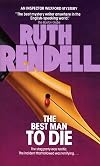
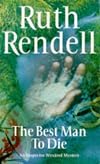
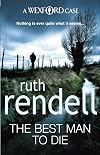
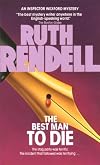
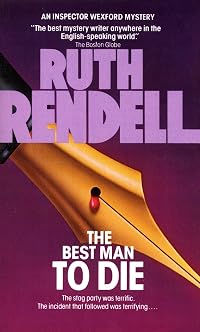
Charlie Hatton wanted fast money and conspicuous success, and he was prepared to cut any corners to get them. But before he could realize a single ambition, he was found dead at the edge of a river.Tags
Recommendations










Member Recommendations
by alguita
Member Reviews
I'm never quite sure whether I have read an earlier Wexford or not. With 23 titles in the series I guess I can be forgiven. Anyway, I have no memory of this story.
I was taken by the description of Wexford in the early pages, because it is so unlike my George Baker (TV) image. I've never thought of Reg Wexford as ugly.
All he needed, he sometimes thought, was a trunk to make him look exactly like an elephant. His body was huge and ponderous, his skin pachydermatous, wrinkled and grey, and his three-cornered ears stuck out absurdly under the sparse fringe of colourless hair. When he went to the zoo he passed the elephant house quickly lest some irreverent onlooker should make comparisons.
This is early in the Wexford series and I think show more Ruth Rendell is still finding her way, establishing her style. There are passages in THE BEST MAN TO DIE that are a bit floral, over-descriptive, and she still hasn't got to that economy of words that characterises her later books. There's a wry humour though, and what will become a typical ambiguity in the meaning of the title.
Wexford is in his fifties, and already working with Mike Burden. His elder daughter is married and his younger one living at home, still happy to pass her dental bills and other responsibilities on to Pop. There are nice snippets of the tensions of family life.
A lift is installed in the Kingsmarkham police station and Wexford, ever mistrustful of new gadgets, and very conscious of his weight, is of course in it on his own when it gets stuck between floors. Two hours in an airless lift nearly cuts short his career, but typically he sits on the floor and comes up with the solution to the crime.
In this novel Rendell seems to be toying with the idea of expanding the detective duo. Wexford's doctor, Dr. Crocker is a childhood friend, although six years his junior, and Wexford makes use of him a couple of times. I don't remember Crocker having much of a role in other books.
Altogether a nice read, proving for me that the early Rendell novels still have great appeal. show less
I was taken by the description of Wexford in the early pages, because it is so unlike my George Baker (TV) image. I've never thought of Reg Wexford as ugly.
All he needed, he sometimes thought, was a trunk to make him look exactly like an elephant. His body was huge and ponderous, his skin pachydermatous, wrinkled and grey, and his three-cornered ears stuck out absurdly under the sparse fringe of colourless hair. When he went to the zoo he passed the elephant house quickly lest some irreverent onlooker should make comparisons.
This is early in the Wexford series and I think show more Ruth Rendell is still finding her way, establishing her style. There are passages in THE BEST MAN TO DIE that are a bit floral, over-descriptive, and she still hasn't got to that economy of words that characterises her later books. There's a wry humour though, and what will become a typical ambiguity in the meaning of the title.
Wexford is in his fifties, and already working with Mike Burden. His elder daughter is married and his younger one living at home, still happy to pass her dental bills and other responsibilities on to Pop. There are nice snippets of the tensions of family life.
A lift is installed in the Kingsmarkham police station and Wexford, ever mistrustful of new gadgets, and very conscious of his weight, is of course in it on his own when it gets stuck between floors. Two hours in an airless lift nearly cuts short his career, but typically he sits on the floor and comes up with the solution to the crime.
In this novel Rendell seems to be toying with the idea of expanding the detective duo. Wexford's doctor, Dr. Crocker is a childhood friend, although six years his junior, and Wexford makes use of him a couple of times. I don't remember Crocker having much of a role in other books.
Altogether a nice read, proving for me that the early Rendell novels still have great appeal. show less
Even though this was published in 1969 and the fourth in the series, it still feels dated. That Wexford is scared of elevators gives an indication of the early stage of their common use. And he is informed by his daughter that people no longer wait to have toothache before visiting the dentist but go for regular checkups, not a new practice but certainly a novel idea for Wexford. An enjoyable mystery but workaday, not great. Rendell improved in later works.
After Jack's stag night in the local pub, Jack Pertwee and Charlie Hatton, his best man, go their separate ways. The next morning Charlie is found in the river with his head bashed in and the large sum of money he was carrying missing.
This novel dates from 1969 and both author and the characters are very keen to impress on us that although Jack and Charlie are very close friends they are not gay. It was a satisfying solution to the mystery but nevertheless, I think prefer the later Wexford novels, where although he seems to be about the same age, Wexford has mellowed a bit. Still, I'lll continue reading some of the earlier ones to see how his character develops.
This novel dates from 1969 and both author and the characters are very keen to impress on us that although Jack and Charlie are very close friends they are not gay. It was a satisfying solution to the mystery but nevertheless, I think prefer the later Wexford novels, where although he seems to be about the same age, Wexford has mellowed a bit. Still, I'lll continue reading some of the earlier ones to see how his character develops.
The Best Man to Die (1969) is the fourth novel in what would turn out to be Ruth Rendell’s twenty-four book Inspector Wexford series. The twenty-four novels were written between the years 1964 and 2003. Rendell, who died in 2015, may be best known for the Wexford novels, but the prolific author also wrote numerous standalones and short story collections under her own name or using her Barbara Vine pseudonym. All told, Rendell produced near eighty books.
The Best Man to Die begins with a stag party held in the Kingsmarkham and Districts Dart Club, one of the pubs in Inspector Wexford’s own stomping grounds. A small group of friends has gathered to boozily celebrate the next-day marriage of one of the men. They have been there for a show more while — and it shows — when the last of the group finally shows up and starts flashing a wad of cash around as he buys several make-up rounds for the others. The men only stop celebrating, and drinking, when the pub closes down for the night.
The next morning, while walking a dog his adult daughter has brought with her on a visit to her parents, Wexford himself discovers the dead body of the man who had been bragging about all the cash in his wallet. It all appears simple enough. The man has been bashed in the back of the head, stripped of his cash, and tossed into the river…a typical mugging of a man with too big a mouth for his own sake. Wexford, however, will soon learn that this is not just a mugging gone bad. Charlie Hatton’s is, in fact, just one murder in a string of murders that, according to the book’s jacket, involve “small-time gangsters, cheating husbands, and loose women.”
So where does Charlie Hatton fit in, and who wanted him dead?
Bottom Line: The Best Man to Die is a solid murder mystery, one that gets surprisingly complicated considering that it is barely 200 pages long. But what surprised me most about it is how different this 1969 novel is in style from the style Rendell later developed. This one has a rather old-fashioned feel to it that is exaggerated by the period in which it is set. Looking back, the 1960s do not seem all that long ago, but this novel is a reminder that, for many, life was still much as it had been in the 1940s and 1950s. It is also a reminder of how rapidly the world was already changing. show less
The Best Man to Die begins with a stag party held in the Kingsmarkham and Districts Dart Club, one of the pubs in Inspector Wexford’s own stomping grounds. A small group of friends has gathered to boozily celebrate the next-day marriage of one of the men. They have been there for a show more while — and it shows — when the last of the group finally shows up and starts flashing a wad of cash around as he buys several make-up rounds for the others. The men only stop celebrating, and drinking, when the pub closes down for the night.
The next morning, while walking a dog his adult daughter has brought with her on a visit to her parents, Wexford himself discovers the dead body of the man who had been bragging about all the cash in his wallet. It all appears simple enough. The man has been bashed in the back of the head, stripped of his cash, and tossed into the river…a typical mugging of a man with too big a mouth for his own sake. Wexford, however, will soon learn that this is not just a mugging gone bad. Charlie Hatton’s is, in fact, just one murder in a string of murders that, according to the book’s jacket, involve “small-time gangsters, cheating husbands, and loose women.”
So where does Charlie Hatton fit in, and who wanted him dead?
Bottom Line: The Best Man to Die is a solid murder mystery, one that gets surprisingly complicated considering that it is barely 200 pages long. But what surprised me most about it is how different this 1969 novel is in style from the style Rendell later developed. This one has a rather old-fashioned feel to it that is exaggerated by the period in which it is set. Looking back, the 1960s do not seem all that long ago, but this novel is a reminder that, for many, life was still much as it had been in the 1940s and 1950s. It is also a reminder of how rapidly the world was already changing. show less
What a nice surprise. This was a series I'd started, then stopped for reasons I've already written about and won't go into again. Don't know what prompted me to pick it up again except that I suspected that she would get better. And she does.
Wexford is an interesting twist to the kind of inspector I usually read. He's competent, successfully married, adjusted. He's a bit grumpy, but generally likable. My complaints really had to do with the quality of the plots, sorta important, but lacking in the first three books. This one read more like an Agatha Christie novel, an English cozy but in the crime genre. Gather a group of people, kill one off, and have the detective figure it out. Straightforward, and this one is no groundbreaking show more novel, but it was fun. It had sufficient information that the reader could figure it out ( I did ) but enough interesting things going on that if you figured it out, you still wanted to see how it turned out.
All in all, a good read from an author that had previously thrilled and disappointed me. Perhaps she has righted the ship for good. show less
Wexford is an interesting twist to the kind of inspector I usually read. He's competent, successfully married, adjusted. He's a bit grumpy, but generally likable. My complaints really had to do with the quality of the plots, sorta important, but lacking in the first three books. This one read more like an Agatha Christie novel, an English cozy but in the crime genre. Gather a group of people, kill one off, and have the detective figure it out. Straightforward, and this one is no groundbreaking show more novel, but it was fun. It had sufficient information that the reader could figure it out ( I did ) but enough interesting things going on that if you figured it out, you still wanted to see how it turned out.
All in all, a good read from an author that had previously thrilled and disappointed me. Perhaps she has righted the ship for good. show less
Charlie Hatton, the best man for his friend's wedding, never makes it home from the bachelor party. Unusually for a police procedural, Inspector Wexford discovers the body, with a little help from the dog Wexford's daughter is watching for a friend. (Naturally Wexford, who is not a dog lover, ends up getting stuck caring for the dog.) The dead man's recent lifestyle doesn't match his income. Might the unknown source of Hatton's extra income have something to do with his death?
The relationships between Wexford and his colleagues, the witnesses, his family, and the dog, are more interesting than the case, which is rather dated. There's nothing particularly wrong with the writing or the plot, but it's probably not one of Rendell's best. I show more listened to the audio version read by Davina Porter, and I think I would have preferred a male reader for a book with mainly male characters. show less
The relationships between Wexford and his colleagues, the witnesses, his family, and the dog, are more interesting than the case, which is rather dated. There's nothing particularly wrong with the writing or the plot, but it's probably not one of Rendell's best. I show more listened to the audio version read by Davina Porter, and I think I would have preferred a male reader for a book with mainly male characters. show less
Wasn't expecting too much from an early Wexford - the only one in the series I've read is From Doon With Death which didn't do too much for me - but I've been on a Rendell kick so I thought I would give this one a go. ~200 pages, complex but not convoluted puzzle at the center, solid read with a great stinger at the end. Shame it took place in the summer time.
Members
- Recently Added By
Lists

British Mystery
469 works; 14 members

Next in Series
85 works; 1 member

Books Read in 2022
5,168 works; 114 members
Author Information

318+ Works 51,282 Members
Ruth Rendell (1930-2015) Ruth Rendell was born in Essex, England on February 17, 1930. She was educated at Loughton County High School. Rendell began her career as a journalist. She wrote six novels before sending her work in to a publisher. She writes crime novels and psychological thrillers, and is best known for her Inspector Wexford books. show more Rendell also writes under the pseudonym Barbara Vine. Rendell has received many awards for her writing, including the Silver, Gold, and Cartier Diamond Daggers from the Crime Writers' Association, three Edgars from the Mystery Writers of America, The Arts Council National Book Awards, and The Sunday Times Literary Award. She is a fellow of the Royal Society of Literature. Many of her titles have been made into films and made-for-tv movies. Rendell died on May 2, 2015. She was 85 years old. (Bowker Author Biography) show less
Some Editions
Series

Belongs to Publisher Series
Work Relationships
Is contained in
Common Knowledge
- Canonical title
- The Best Man to Die
- Original title
- The Best Man to Die
- Original publication date
- 1969; 1969-06
- People/Characters
- Charlie Hatton; Reginald Wexford (Chief Inspector); Jack Pertwee; Inspector Mike Burden
- Important places
- Kingsmarkham, West Sussex, England, UK
- Related movies
- Ruth Rendell Mysteries: The Best Man to Die: Part One (1990 | IMDb); Ruth Rendell Mysteries: The Best Man to Die: Part Two (1990 | IMDb); Ruth Rendell Mysteries: The Best Man to Die: Part Three (1990 | IMDb)
- Epigraph
- [None]
- Dedication
- For George and Dora Herbert,
in gratitude for their
helpful advice - First words
- Jack Pertwee was getting married in the morning and the Kingsmarkham and District Darts Club were in the Dragon to give him what George Carter called a send-off.
- Last words
- (Click to show. Warning: May contain spoilers.)He tried to say it again but great agonised sobs tore away the name.
Classifications
Statistics
- Members
- 738
- Popularity
- 38,245
- Reviews
- 33
- Rating
- (3.58)
- Languages
- 10 — Danish, Dutch, English, Finnish, French, German, Italian, Norwegian (Bokmål), Portuguese, Spanish
- Media
- Paper, Audiobook, Ebook
- ISBNs
- 52
- ASINs
- 14