Beyond the Ridge
by Paul Goble
On This Page
Description
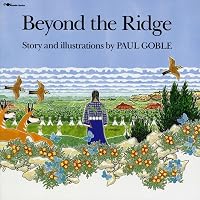
At her death an elderly Plains Indian woman experiences the afterlife believed in by her people, while the surviving family members prepare her body according to their custom.Tags
Recommendations





Member Reviews
When I read this story I was getting mix feelings about it. At first, is that it is a great story to introduce Native American cultural. I The illustrations on the novel are fantastic. It is filled with lots of colors. As well, It depicts the traditions, clothing, homes, and animals during the time of Native Americans. This would be a helpful book to show students the environment this cultural lived in. Furthermore, the language of the story is pretty interesting because it is told as a prayer to the dead grandmother. Why I didn't like the book is that at first I did not know it was told in a prayer way that it was jumping around the story, consistent one minute and next page its random. Other than that this book can be used in the show more classroom to express culture and to have children build connects of family deaths. It also creates a world of imagination with the cool art. I would recommend this book to be 3-5th grade. show less
BEYOND THE RIDGE, written and illustrated by Paul Goble, is a picture book that is based on the customs and beliefs of the Plains Indian people regarding death and the after-life. The story follows an elderly woman who is dying and is called away from this world by the distant voice of her deceased mother. The voice leads her farther from her tipi where her family is mourning her death, towards a ridge. Once she has reached the top, the woman peers out over a land more beautiful than anything she has seen before. Intermingled with this story are pages of italicized text that are, as the author explains, words "spoken by Indian people". These particular pages of the book are very eloquent, and explain a bit more deeply how the Plains show more Indians view death, or rather, a "change of worlds". I liked the way Goble focused on the journey of the old woman but also returned to the mourning family and described their emotions during this time. It sends the message that it is ok to be sad and full of emotions when someone dies. But also that death is natural and we need to accept that. The illustrations for this book, done in watercolor and ink, are interesting because they are very detailed in all aspects but one. When it comes to the people's faces, Goble leaves them almost completely featureless and without expression. In his author's note, he implies that his purpose for doing this is to allow the reader to imagine their own "personality" for the characters. Although the vocabulary in this book is rather simple, I would use it in a slightly older classroom, perhaps second or third grade, because of the subject matter and discussion that should follow this reading. Although the topic of death is sad, it is something important to talk about with kids because they will all experience it at some point in their lives, if they haven't already. This book depicts death as happening at the end of a long life, but it is also important to talk to students about how this isn't always the case. Then, on a lighter note, I could turn to the subject of Native American traditions and beliefs. I could ask students about any traditions or beliefs that they and their families may have that are similar or different to those described in the book. show less
This is a Native American legend of what happens when we die It is about a grandmother who is very old, ill and dying. The story is a beautiful way to explain death. The lines of the illustrations give the story depth. The colors are neutral and show how beautiful the landscape is.
A Plains Indian grandmother leaves this earthly life and journeys to the Spirit World beyond.
Cultural
Case 3
Shelf 4
Cultural
Case 3
Shelf 4
Cultural
Ratings
Members
- Recently Added By
Published Reviews
ThingScore 100
This sensitive treatment of death and the afterlife is based on a Plains Indian view of the Spirit World, a fertile and beautiful land of buffalo, birds, and butterflies. The author/illustrator cites sources for the ideas presented and the material culture depicted. ...
added by CourtyardSchool
Author Information

52+ Works 9,311 Members
Paul Goble was born in Haslemere, Surrey, England on September 27, 1933. He was a sharpshooter in the British military from 1951 to 1953. In 1959, he received a National Diploma in Design, with honors, from the Central School of Arts and Crafts in London. While working in freelance industrial design and teaching at Ravensbourne College of Art and show more Design, he and his first wife Dorothy Lee wrote four picture books. In 1977, he decided to become a full-time author and illustrator and accepted a position as the artist-in-residence at Mount Rushmore National Memorial. He and Lee divorced in 1978. He was best known for his picture books inspired by Native American culture and lore including Buffalo Woman, Iktomi and the Boulder: A Plains Indian Story, and Crow Chief: A Plains Indian Story. He received the Caldecott Medal in 1979 for The Girl Who Loved Wild Horses. He died from Parkinson's disease on January 5, 2017 at the age of 83. (Bowker Author Biography) show less
Awards and Honors
Classifications
Statistics
- Members
- 262
- Popularity
- 122,690
- Reviews
- 5
- Rating
- (4.73)
- Languages
- English
- Media
- Paper
- ISBNs
- 7