On This Page
Description
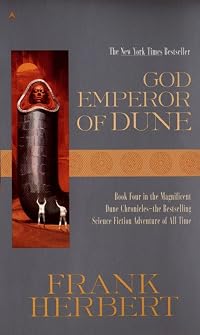
More than three thousand years have passed since the first events recorded in Frank Herbert's DUNE. Only one link survives with those tumultuous times: the grotesque figure of Leto Atreides, son of the prophet Paul Muad'Dib, and now the virtually immortal God Emperor of Dune. He alone understands the future, and he knows with a terrible certainty that the evolution of his race is at an end unless he can breed new qualities into his species. But to achieve his final victory, Leto Atreides show more must also bring about his own downfall . . .. show less
Tags
Recommendations















Member Reviews
Don't pick up this book expecting the action and excitement of the first Dune novel. While it does have those, this is a much more reflective, thoughtful book, where many of the really important events are quiet conversations between just two or three people. And one of them is thousands of years old, with access to nearly all the accumulated knowledge and experience of the human race. How do you write that person? How do you make their insights revelatory, their historical analyses sufficiently cogent. Well, you can't, I think. But damn if Herbert didn't get pretty close.
In my endeavor to read all the Frank Herbert Dune series, I've finally reached the volume that is not a re-read from my teen years. This is a bizarre little tale, with plenty of ruminations on politics, philosophy, religion, and also one of the more bizarre characters I've ever encountered (in the person/sandworm of Leto II). When it felt like Herbert's own political views were bleeding through the story, I felt pretty sure that we wouldn't have agreed on much (and the strange comments on gender/sexual orientation were just troubling), but I have a feeling that the story, and Leto's glimmers of the humanity he lost, will stick with me.
I read this fourth book of the Dune series when it was first published in my early teens. Returning to it more than forty years later, I find that I hardly remembered anything about it except for its broadest gestures. Given the resolution of the previous volume, it is unsurprising that this one is set millennia afterward with the same main character, and there is a sense in which this is the second half of the story of Leto II from Children of Dune, just as Dune Messiah was the second half of the story of Paul Muad'Dib from Dune. But Herbert ups the ante on his documentary conceit by supplying a frame story of archeological work taking place many thousands of years later still, when the Dune that had become a green Arrakis had returned show more to desert Dune and then been greened once more to Rakis. The chapter epigrams are nearly all from a text called "The Stolen Journals" of Leto II.
In my recent re-read of Children of Dune, I had complained that the principal characters were all exotic and transhuman to the point that I had difficulty sympathizing with any of them. Considering the nature of the God Emperor Leto II and his transformation of human society, one might expect that trouble to be even greater in this book, but it wasn't. A very large portion of the book gives omniscient perspective on the God Emperor's thoughts, and Herbert does an impressive job of making him seem like a superhuman mind still intelligible to the reader. It helps that he has actual memory of our terrestrial cultures and civilizations.
The countlessly reiterated ghola Duncan Idaho supplies an anchoring perspective of sorts, by reproducing a character as he existed in the very first book of the series, but dropping him into this remote context. The relationship between Duncan and Leto II reminded me a little of the relationship between Ben and Mike in the final portion of Heinlein's Stranger in a Strange Land. There is even a moment when Duncan like Ben is made into an object lesson in homophobia.*
The pacing of this book is decidedly sedate compared to the preceding volumes. Evidently, this style shift is a function of having been originally drafted in the first person with Leto as the speaker. Even when centering on other characters like the majordomo Moneo Atreides and the rebel Siona Atreides, the prose tends toward a high degree of interiority. A conspicuous exception to this trend is the Ixian ambassador Hwi Noree, who is very much an object in many senses.
Although there is opposition to the God Emperor, the sort of active scheming of conspirators that had tended to figure as antagonism in this series is muted here. For all the passage of time and the changes that have been wrought by Leto's reign, the key factions still include the Spacing Guild, Bene Gesserit, Bene Tleilax, and Ixian technologists. Leto's own human breeding program seems to have exceeded that of the Bene Gesserit in scope and ambition.
The liturgical element of God Emperor of Dune is trained on the ceremony of Siaynoq, a melange-assisted eucharist exclusive to Leto's priestess army of Fish Speakers. There is also a process of ritual initiation and ordeal (albeit not very ceremonial) that the God Emperor uses to instill consciousness of the Golden Path in the line of Atreides descendants.
The 2019 Ace Premium edition I just read carried a largely useless introduction by Brian Herbert, consisting mostly of hagiography regarding his dad.
*Edited to add: In Herbert's case, this may be a penance for having used homosexuality to emphasize the depravity of Baron Harkonnen in Dune. If Heinlein was similarly atoning for homophobia in his earlier work, I'm not aware of the particular instance. show less
In my recent re-read of Children of Dune, I had complained that the principal characters were all exotic and transhuman to the point that I had difficulty sympathizing with any of them. Considering the nature of the God Emperor Leto II and his transformation of human society, one might expect that trouble to be even greater in this book, but it wasn't. A very large portion of the book gives omniscient perspective on the God Emperor's thoughts, and Herbert does an impressive job of making him seem like a superhuman mind still intelligible to the reader. It helps that he has actual memory of our terrestrial cultures and civilizations.
The countlessly reiterated ghola Duncan Idaho supplies an anchoring perspective of sorts, by reproducing a character as he existed in the very first book of the series, but dropping him into this remote context. The relationship between Duncan and Leto II reminded me a little of the relationship between Ben and Mike in the final portion of Heinlein's Stranger in a Strange Land. There is even a moment when Duncan like Ben is made into an object lesson in homophobia.*
The pacing of this book is decidedly sedate compared to the preceding volumes. Evidently, this style shift is a function of having been originally drafted in the first person with Leto as the speaker. Even when centering on other characters like the majordomo Moneo Atreides and the rebel Siona Atreides, the prose tends toward a high degree of interiority. A conspicuous exception to this trend is the Ixian ambassador Hwi Noree, who is very much an object in many senses.
Although there is opposition to the God Emperor, the sort of active scheming of conspirators that had tended to figure as antagonism in this series is muted here. For all the passage of time and the changes that have been wrought by Leto's reign, the key factions still include the Spacing Guild, Bene Gesserit, Bene Tleilax, and Ixian technologists. Leto's own human breeding program seems to have exceeded that of the Bene Gesserit in scope and ambition.
The liturgical element of God Emperor of Dune is trained on the ceremony of Siaynoq, a melange-assisted eucharist exclusive to Leto's priestess army of Fish Speakers. There is also a process of ritual initiation and ordeal (albeit not very ceremonial) that the God Emperor uses to instill consciousness of the Golden Path in the line of Atreides descendants.
The 2019 Ace Premium edition I just read carried a largely useless introduction by Brian Herbert, consisting mostly of hagiography regarding his dad.
*Edited to add: In Herbert's case, this may be a penance for having used homosexuality to emphasize the depravity of Baron Harkonnen in Dune. If Heinlein was similarly atoning for homophobia in his earlier work, I'm not aware of the particular instance. show less
This review is written with a GPL 4.0 license and the rights contained therein shall supersede all TOS by any and all websites in regards to copying and sharing without proper authorization and permissions. Crossposted at WordPress, Blogspot, Librarything & Tumblr by Bookstooge’s Exalted Permission
Title: God Emperor of Dune
Series: Dune Chronicles #4
Author: Frank Herbert
Rating: 4.5 of 5 Stars
Genre: SF
Pages: 436
Format: Digital Edition
Synopsis:
Dune is transformed. The worms are gone. The Spice is a dwindling product handed out each decade by the God Emperor from his private stores. Leto is now a pre-worm and 3500 years old. Mentats are outlawed and gone. The Fremen no longer really exist. The Tleilaxu grow Duncan Idahoes for Leto. Leto show more has taken control of Bene Geserit breeding program. The Ixians supply Leto with technology while experimenting on their own.
There is peace. The Great Houses are gone. Populations reside on their own planets and enjoy a level of living that has been unheard of before. Leto's Fish Speakers, an all female army, provide whatever force is needed should a situation arise.
Leto is fermenting humanity. Trying to change it from the inside out. He sees the glimmer of this in Siona Atreides, who is currently leading the rebellion against him. She can fade from his pre-sight, which means that her descendants will free humanity from the curse of prescience and prophecy.
Of course, Leto has enemies. The Tleilaxu plot his overthrow with their face dancers. The Ixians are breeding a human who is the perfect fit for Leto, and who they will control. Siona co-opts the current Duncan and they are figuring out how to kill Leto.
Leto knows.
Leto also knows that when he dies, his body will release sand trout that will begin the desertification of Dune once again and bring back the worms and the spice in a couple of hundred years.
My Thoughts:
This version that I read had an introduction by Frank's son, Brian. While I normally hold my nose at the travesty he and that son of a goat Anderson created with the Dune prequels, I did find this introduction extremely enlightening and helpful. It prepared me for the kind of book this would be.
This felt like a play, with Leto II being front and center and soloquizing for most of the book. A lot of action happens, a lot of information is told, but it is all off stage, as it were. Leto talks. A lot. With his Major Domo, Moneo Atriedes [Siona's father], with The Duncan, with Siona, with the love of his life Hwi.
Hwi. Now there is pathos. To have someone built to love you and to have them built so as to attract you. It is redeemed from pablum by Hwi knowing all of this and still choosing Leto over her Ixian masters. She does love Leto, willingly and unwillingly.
I thoroughly enjoyed this read, yet again.
However. If someone were to read this book and call it boring, dialogue heavy or unenjoyable, I would not try to correct them. Leto constantly tries to push other characters into understanding by asking them questions instead of answering their questions. Leto does that a lot and it can be frustrating. There were a couple of times that I wanted to shake him and shout “Just answer his question, you gigantic jerk!”. This was an idea book but those ideas were not all nicely queued up like bowling pins in an alley. They were disguised, hidden, scattered. It was frustrating and I will not deny that. I don't think it is a weakness of the book or the writing though. It was deliberate. Herbert wanted his readers to think and thinking can be hard work at times.
This was a re-read book, like all the other Dune Chronicles books I'm reading. My first recorded instance of reading it was only back in '12. However, I know I read it in highschool and in Bibleschool at least 3 times. So this is my fifth time? The fact that I'm still frustrated with it and yet enjoying it so much says a lot about the quality of the writing.
★★★★ ½ show less
Title: God Emperor of Dune
Series: Dune Chronicles #4
Author: Frank Herbert
Rating: 4.5 of 5 Stars
Genre: SF
Pages: 436
Format: Digital Edition
Synopsis:
Dune is transformed. The worms are gone. The Spice is a dwindling product handed out each decade by the God Emperor from his private stores. Leto is now a pre-worm and 3500 years old. Mentats are outlawed and gone. The Fremen no longer really exist. The Tleilaxu grow Duncan Idahoes for Leto. Leto show more has taken control of Bene Geserit breeding program. The Ixians supply Leto with technology while experimenting on their own.
There is peace. The Great Houses are gone. Populations reside on their own planets and enjoy a level of living that has been unheard of before. Leto's Fish Speakers, an all female army, provide whatever force is needed should a situation arise.
Leto is fermenting humanity. Trying to change it from the inside out. He sees the glimmer of this in Siona Atreides, who is currently leading the rebellion against him. She can fade from his pre-sight, which means that her descendants will free humanity from the curse of prescience and prophecy.
Of course, Leto has enemies. The Tleilaxu plot his overthrow with their face dancers. The Ixians are breeding a human who is the perfect fit for Leto, and who they will control. Siona co-opts the current Duncan and they are figuring out how to kill Leto.
Leto knows.
Leto also knows that when he dies, his body will release sand trout that will begin the desertification of Dune once again and bring back the worms and the spice in a couple of hundred years.
My Thoughts:
This version that I read had an introduction by Frank's son, Brian. While I normally hold my nose at the travesty he and that son of a goat Anderson created with the Dune prequels, I did find this introduction extremely enlightening and helpful. It prepared me for the kind of book this would be.
This felt like a play, with Leto II being front and center and soloquizing for most of the book. A lot of action happens, a lot of information is told, but it is all off stage, as it were. Leto talks. A lot. With his Major Domo, Moneo Atriedes [Siona's father], with The Duncan, with Siona, with the love of his life Hwi.
Hwi. Now there is pathos. To have someone built to love you and to have them built so as to attract you. It is redeemed from pablum by Hwi knowing all of this and still choosing Leto over her Ixian masters. She does love Leto, willingly and unwillingly.
I thoroughly enjoyed this read, yet again.
However. If someone were to read this book and call it boring, dialogue heavy or unenjoyable, I would not try to correct them. Leto constantly tries to push other characters into understanding by asking them questions instead of answering their questions. Leto does that a lot and it can be frustrating. There were a couple of times that I wanted to shake him and shout “Just answer his question, you gigantic jerk!”. This was an idea book but those ideas were not all nicely queued up like bowling pins in an alley. They were disguised, hidden, scattered. It was frustrating and I will not deny that. I don't think it is a weakness of the book or the writing though. It was deliberate. Herbert wanted his readers to think and thinking can be hard work at times.
This was a re-read book, like all the other Dune Chronicles books I'm reading. My first recorded instance of reading it was only back in '12. However, I know I read it in highschool and in Bibleschool at least 3 times. So this is my fifth time? The fact that I'm still frustrated with it and yet enjoying it so much says a lot about the quality of the writing.
★★★★ ½ show less
There's a lot of things I'm feeling after finishing this WILD-ass book but mostly I am just in awe of Mr. Herbert's mind. From the structure of the world to the geography and science to just the way things are named, this man is an absolute crackpot genius. There is SO much going on at all times, the smallest movement feels like the difference between life and death, but it also feels like absolutely nothing, because all people ever do is talk about what they're going to do and talk about what's going to happen and what other people have said to them and talk and talk and talk. All the action happens off the page. It's a bore, a mess, a waste, an exploration, an exercise in endurance, a true romance, a wonderful fucking book. I don't know.
The saga has definitely taken some major twists but the overall themes are the same. The evils of power for one, our reliance on technology – or leaders, or prophets – to do our thinking for us is another. This volume also deals with the desire for freedom while being unwilling to accept the cost of it. There are also many examples of that very human quality of believing one set of ideas when literally every single thing in the universe proves otherwise.
My wife asked me if I thought the female characters were well-written or not. Firstly, I do NOT subscribe to the notion so popular today that “only people who are
My wife asked me if I thought the female characters were well-written or not. Firstly, I do NOT subscribe to the notion so popular today that “only people who are
God Emperor of Dune is most notable for how radically different it is from every other book in the Dune saga. Simply put, it is extremely strange; to some, it is offputting and too great of a departure from what came before, but, to me and many others, it is one of the best books in the series and could even rival the first for the title of the greatest entry overall. It focuses on philosophy to an even greater extent than Children of Dune and holds essentially none of the dynamism and action of every previous entry, but what God Emperor of Dune offers is a visceral exploration of the personality and thoughts of Leto II, one of the most fascinating characters in science fiction, and a thoughtful reflection on how many horrible acts can show more be committed in service of the greater good before all morals are shattered. God Emperor of Dune takes many risks, as it centers around Leto II even more than Dune centers around Paul while also sacrificing the prominence of many of the series' most memorable factions, but it achieves something truly special as a result and makes readers contemplative and immersed in a way that practically no other Dune book, or piece of literature in general, can. show less
Members
- Recently Added By
Lists

NPRs your picks: top 100 Sci-Fi/Fantasy books
297 works; 80 members

Epic Science Fiction
15 works; 4 members

Books 2021
2 works; 1 member
Books Read in 2021
3 works; 1 member

Unread books
1,063 works; 85 members

Space Colonization
100 works; 26 members

Tagged by Tim or Meh!
91 works; 8 members

1980s
356 works; 22 members

Books with Noble Titles
179 works; 11 members
Speculative Fiction to Read
706 works; 32 members

Books Read in 2011
684 works; 20 members

Books Read in 2022
5,166 works; 112 members
Science Fiction and Fantasy
63 works; 4 members

"would you still love me if i was a worm?"
2 works; 1 member

Books Read in 2024
4,623 works; 126 members

Favourite Books
1,819 works; 316 members
Author Information

Frank Herbert was born Franklin Patrick Herbert, Jr. in Tacoma, Washington on October 8, 1920. He worked originally as a journalist, but then turned to science fiction. His Dune series has had a major impact on that genre. Some critics assert that Herbert is responsible for bringing in a new branch of ecological science fiction. He had a personal show more interest in world ecology, and consulted with the governments of Vietnam and Pakistan about ecological issues. The length of some of Herbert's novels also helped make it acceptable for science fiction authors to write longer books. It is clear that, if the reader is engaged by the story---and Herbert certainly has the ability to engage his readers---length is not important. As is usually the case with popular fiction, it comes down to whether or not the reader is entertained, and Herbert is, above all, an entertaining and often compelling writer. His greatest talent is his ability to create new worlds that are plausible to readers, in spite of their alien nature, such as the planet Arrakis in the Dune series. Frank Herbert died of complications from pancreatic cancer on February, 11, 1986, in Madison, Wisconsin. He was 65. (Bowker Author Biography) show less
Some Editions
Awards and Honors
Awards
Distinctions
Series

Belongs to Publisher Series
Pocket (5245)
Work Relationships
Common Knowledge
- Canonical title
- God Emperor of Dune
- Original title
- God Emperor Of Dune; God Emperor of Dune
- Original publication date
- 1981-05
- People/Characters
- Leto Atreides II; Duncan Idaho; Siona Atreides; Hwi Noree; Moneo Atreides; Nayla (show all 12); Tertius Eileen Anteac; Luyseyal; Paul Atreides (mentioned); Ghanima Atreides (mentioned); Farad'n Corrino; Malky
- Important places
- Arrakis (Dune); Rakis; Dune; Idaho River, Rakis; Babylon; Arrakeen, Arrakis
- Important events
- Butlerian Jihad (mentioned)
- Epigraph
- This morning I was born in a yurt at the edge of a horse-plain in a land of a planet which no longer exists.
Tomorrow I will be born someone else in another place. I have not yet chosen. This morning, though - ahhh. t... (show all)his life!
When my eyes had learned to focus, I looked out at sunshine on trampled grass and I saw vigorous people going about the sweet activities of their lives.
Where ... oh where has all of that vigor gone?
~ The Stolen Journals - Dedication
- To Peggy Rowntree with love and admiration and deep appreciation
- First words
- It not only is my pleasure to announce to you this morning our discovery of this marvelous storehouse containing, among other things, a monumental collection of manuscripts inscribed on ridulian crystal paper, but I also take... (show all) pride in giving you our arguments for the authenticity of our discoveries, to tell you why we believe we have uncovered the original journals of Leto II, the God Emperor.
The three people running northward through moon shadows in the Forbidden Forest were strung out along almost half a kilometer. - Last words
- (Click to show. Warning: May contain spoilers.)As the poet, Lon Bramlis, has said: "We are the fountain of surprises!"
- Original language
- English
- Canonical DDC/MDS
- 813.087625
Classifications
- Genres
- Science Fiction, Fiction and Literature
- DDC/MDS
- 813.087625 — Literature & rhetoric American literature in English American fiction in English By type Genre fiction Adventure fiction Speculative fiction Science fiction Space opera
- LCC
- PS3558 .E63 .G6 — Language and Literature American literature American literature Individual authors 1961-
- BISAC
Statistics
- Members
- 12,675
- Popularity
- 647
- Reviews
- 104
- Rating
- (3.70)
- Languages
- 16 — Chinese, Czech, Dutch, English, Estonian, French, German, Hungarian, Italian, Polish, Romanian, Russian, Spanish, Turkish, Ukrainian, Portuguese (Brazil)
- Media
- Paper, Audiobook, Ebook
- ISBNs
- 116
- UPCs
- 2
- ASINs
- 65