On This Page
Description
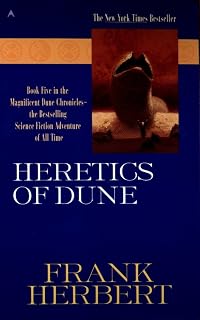
Thousands of years after the death of God Emperor Leto II, the Bene Gesserit and the Bene Tleilax struggle to direct the future of Dune, while the great sandworms are dying and the planet is returning to desert.Tags
Recommendations















Member Reviews
To be fair to this, I think it suffers more from being read after reading some of the Brian Herbert and Kevin J. Anderson prequels than it does on its own merits (or lack thereof). Unfortunately I can't turn back the clock and unread those books, so what I imagine would have been fascinating reveals and fun POVs back when this was only the fifth novel in the series are kind of uninteresting, leaving the characters, worlds, and plots to stand on their own. And they do not stand well at all.
For instance, I imagine a reincarnated Duke Leto POV would be more interesting if there wasn't at least one prequel already from the ACTUAL Duke Leto's POV, before and after he became the duke. That's not to say Miles Teg is boring... but he kind of show more is. And a reincarnated Lady Jessica would be more interesting if, well... same reasons. Duncan is honestly just a barebones Paul - he even admits it to himself - crossed with "God Emperor of Dune" Duncan. But he's not Paul, fighting a revolution and preparing for jihad. He's just a whiny baby who's typically trapped in a room practicing things or trying to sneak past his guards. And that's hardly interesting.
The rest of the cast are boring plotters who simultaneously don't care but also do care greatly about things that mostly happen off-page. This leaves you in a general disinterested state, wondering why you're meant to care about literally anyone or anything happening. And then there's Sheanna. Who is... there. And another whiny kid. But good on her for tearing down the patriarchal establishment, I suppose.
The big reveals were also ruined if you've read any stories about how the Tleilaxu came about, because you know that reveal before it happens. It was honestly just as gross as in the prequel, and here it's like... well. Other reveals are characters being like "and now we shall enact the secret plan to change the universe that we never discussed until now because secret" and then screen wipe. It's... it's not great.
This book also contains some of the creepiest and most unimaginative descriptions of sex that I've seen, even from Herbert. I honestly wish the man could come back from the dead to read a good erotica story. Seriously. Get some imagination in there. We're meant to believe we're seeing something impressive, but it's never described, and the most we get is vague references to characters experiencing an orgasm and losing control of their bodies, which is... basically just how sex works.
All in all, it was better than "God Emperor of Dune", mostly because things actually happened and the cast was at least slightly more compelling, and its aping of both "Dune" and "Children of Dune" in terms of plot and writing style gets you through more of it, but that's a low bar. It was largely a joyless slog of a book with a meh cast of characters, uninteresting politics, a weird obsession with joyless orgasms and the power of the orgasm (which, in the hands of a better writer, I wouldn't be averse to, but Herbert can't write erotica, so), societal sexism, and people calling women whores. Unless you're really invested in the story universe, skip this. show less
For instance, I imagine a reincarnated Duke Leto POV would be more interesting if there wasn't at least one prequel already from the ACTUAL Duke Leto's POV, before and after he became the duke. That's not to say Miles Teg is boring... but he kind of show more is. And a reincarnated Lady Jessica would be more interesting if, well... same reasons. Duncan is honestly just a barebones Paul - he even admits it to himself - crossed with "God Emperor of Dune" Duncan. But he's not Paul, fighting a revolution and preparing for jihad. He's just a whiny baby who's typically trapped in a room practicing things or trying to sneak past his guards. And that's hardly interesting.
The rest of the cast are boring plotters who simultaneously don't care but also do care greatly about things that mostly happen off-page. This leaves you in a general disinterested state, wondering why you're meant to care about literally anyone or anything happening. And then there's Sheanna. Who is... there. And another whiny kid. But good on her for tearing down the patriarchal establishment, I suppose.
The big reveals were also ruined if you've read any stories about how the Tleilaxu came about, because you know that reveal before it happens. It was honestly just as gross as in the prequel, and here it's like... well. Other reveals are characters being like "and now we shall enact the secret plan to change the universe that we never discussed until now because secret" and then screen wipe. It's... it's not great.
This book also contains some of the creepiest and most unimaginative descriptions of sex that I've seen, even from Herbert. I honestly wish the man could come back from the dead to read a good erotica story. Seriously. Get some imagination in there. We're meant to believe we're seeing something impressive, but it's never described, and the most we get is vague references to characters experiencing an orgasm and losing control of their bodies, which is... basically just how sex works.
All in all, it was better than "God Emperor of Dune", mostly because things actually happened and the cast was at least slightly more compelling, and its aping of both "Dune" and "Children of Dune" in terms of plot and writing style gets you through more of it, but that's a low bar. It was largely a joyless slog of a book with a meh cast of characters, uninteresting politics, a weird obsession with joyless orgasms and the power of the orgasm (which, in the hands of a better writer, I wouldn't be averse to, but Herbert can't write erotica, so), societal sexism, and people calling women whores. Unless you're really invested in the story universe, skip this. show less
This year I re-read the first four of Frank Herbert's Dune novels, which were the only ones extant when I originally read them as a teenager. Heretics of Dune is the fifth, and was thus new to me. It is set more than a millennium after the conclusion of the prior book God Emperor of Dune.
As I progressed through the early chapters, I was struck by a similarity of "feel" to the other odd-numbered Dune books, particularly Children of Dune. It occurred to me that the first two books charted the rise and fall of Paul Muad'Dib, and the next two did the same for Leto II Atreides. Imagining that the pattern might hold, I was nevertheless kept in suspense for the entire book about just whose ascension was being narrated in the course of events. show more There was a great deal of mystery about who would have the upper hand at the story's end, and various parties offered different possibilities of surpassing the prior run of God-Emperor-cultivated humanity.
Would a new force arise in the person of the mentat Bashar Teg with his Atreides bloodline and Bene Gesserit training? Would it be his precocious daughter Odrade, herself a member of the Sisterhood? Or the young girl Sheeana who talks to sandworms and rides them bareback? The latest Duncan Idaho ghola, whose composition is supposed to involve a Tleilaxu innovation? Waff, the Tleilaxu Master of Masters himself? Or would a novel power arrive from outside among those returning to the old Imperial core from the Scattering that spread humanity to other galaxies or even universes? These "recent" arrivals (they have been present for at least a century) include a new order of space witches: the Honored Matres, whose different drug makes their eyes orange instead of blue. Because this question of eventual supremacy is kept open until the last thirty pages or so of the book, the end telescopes a lot of action into a very quick recounting, and in this respect I thought it reflected the rhythm of the original Dune, even though that first book seemed to offer up Paul as an obvious protagonist and destined victor.
For most of Heretics of Dune, two main story strands develop in parallel on the worlds of Rakis (f.k.a. Arrakis) and Gammu (f.k.a. Giedi Prime). The Honored Matres are teased throughout, but there is little firsthand detail about them until very late in the novel. There is a lot of new information about the Bene Tleilax, and the intrigues between them and the Bene Gesserit are chief drivers of the plot. The Ixians, the Spacing Guild, CHOAM, and the Fish Speakers are all peripheral to the action, with little more than passing acknowledgment of their existence. But the fact that all of these contending powers still persist so long after the reign of the Tyrant Leto II demonstrates the terrible stability that he had been able to foster--a stability that seems to be finally coming to an end in the late pages of this book. show less
As I progressed through the early chapters, I was struck by a similarity of "feel" to the other odd-numbered Dune books, particularly Children of Dune. It occurred to me that the first two books charted the rise and fall of Paul Muad'Dib, and the next two did the same for Leto II Atreides. Imagining that the pattern might hold, I was nevertheless kept in suspense for the entire book about just whose ascension was being narrated in the course of events. show more There was a great deal of mystery about who would have the upper hand at the story's end, and various parties offered different possibilities of surpassing the prior run of God-Emperor-cultivated humanity.
Would a new force arise in the person of the mentat Bashar Teg with his Atreides bloodline and Bene Gesserit training? Would it be his precocious daughter Odrade, herself a member of the Sisterhood? Or the young girl Sheeana who talks to sandworms and rides them bareback? The latest Duncan Idaho ghola, whose composition is supposed to involve a Tleilaxu innovation? Waff, the Tleilaxu Master of Masters himself? Or would a novel power arrive from outside among those returning to the old Imperial core from the Scattering that spread humanity to other galaxies or even universes? These "recent" arrivals (they have been present for at least a century) include a new order of space witches: the Honored Matres, whose different drug makes their eyes orange instead of blue. Because this question of eventual supremacy is kept open until the last thirty pages or so of the book, the end telescopes a lot of action into a very quick recounting, and in this respect I thought it reflected the rhythm of the original Dune, even though that first book seemed to offer up Paul as an obvious protagonist and destined victor.
For most of Heretics of Dune, two main story strands develop in parallel on the worlds of Rakis (f.k.a. Arrakis) and Gammu (f.k.a. Giedi Prime). The Honored Matres are teased throughout, but there is little firsthand detail about them until very late in the novel. There is a lot of new information about the Bene Tleilax, and the intrigues between them and the Bene Gesserit are chief drivers of the plot. The Ixians, the Spacing Guild, CHOAM, and the Fish Speakers are all peripheral to the action, with little more than passing acknowledgment of their existence. But the fact that all of these contending powers still persist so long after the reign of the Tyrant Leto II demonstrates the terrible stability that he had been able to foster--a stability that seems to be finally coming to an end in the late pages of this book. show less
“Some people never observe anything. Life just happens to them. They get by on little more than a kind of dumb persistence, and they resist with anger and resentment anything that might lift them out of that false serenity.”
— Mother Superior Taraza
This quote could be applied to much of this installment in the Dune story. In it there are many forces, factions, individuals, and groups who are very very secure knowing that they and they alone are in the right, and as the action unfolds we witness the various ways they react when it turns out they’re not. A number of them are also revealed to have serious spiritual/religious undertones in their megalomania beyond the standard obsessions with wealth and power (i.e., not just “we show more want wealth and power,” but “it is Just and Right that we should have the wealth and power and not those other people”). Hence the “Heretics” moniker. This volume feels a bit more like the first book in that Shakespearian, Game of Thrones, great houses at war, sort of way. In the end, some learn to adjust accordingly, some die.
Like book 4, this one takes place after another massive time jump; fifteen hundred years have passed, so we get a new set of characters to get to know. By this point in the Dune-iverse, the majority of the power players are women or groups run by women, particularly the Bene Gesserit and a new faction known as the Honored Matres. I know it’s a popular culture-war pastime to imagine what a world ruled by women would be like, and would we be better off as a species or not, yadda yadda yadda…. all I can say is that it depends on the women in question, because those Honored Matres are some scary bishes.
One of the few men we meet in the story is Miles Teg, who after a slow burn turns out to be quite a heroic and admirable character. Unusually, he’s a bit on the older side too; he had been looking forward to retirement when the story starts. This is definitely not like one of those Netflix shows where every important character is under 30. So, novelty points there... show less
— Mother Superior Taraza
This quote could be applied to much of this installment in the Dune story. In it there are many forces, factions, individuals, and groups who are very very secure knowing that they and they alone are in the right, and as the action unfolds we witness the various ways they react when it turns out they’re not. A number of them are also revealed to have serious spiritual/religious undertones in their megalomania beyond the standard obsessions with wealth and power (i.e., not just “we show more want wealth and power,” but “it is Just and Right that we should have the wealth and power and not those other people”). Hence the “Heretics” moniker. This volume feels a bit more like the first book in that Shakespearian, Game of Thrones, great houses at war, sort of way. In the end, some learn to adjust accordingly, some die.
Like book 4, this one takes place after another massive time jump; fifteen hundred years have passed, so we get a new set of characters to get to know. By this point in the Dune-iverse, the majority of the power players are women or groups run by women, particularly the Bene Gesserit and a new faction known as the Honored Matres. I know it’s a popular culture-war pastime to imagine what a world ruled by women would be like, and would we be better off as a species or not, yadda yadda yadda…. all I can say is that it depends on the women in question, because those Honored Matres are some scary bishes.
One of the few men we meet in the story is Miles Teg, who after a slow burn turns out to be quite a heroic and admirable character. Unusually, he’s a bit on the older side too; he had been looking forward to retirement when the story starts. This is definitely not like one of those Netflix shows where every important character is under 30. So, novelty points there... show less
This book by Frank Herbert was all over the place, I thought. In my opinion, by the time he reached the end of his series, he seemed to struggle for coherence.
The scene shifts 1,500 years after the death of Leto II, the God Emperor. Leto II, and the galaxy has changed, after Leto II reshaped the known universe.
Humanity is scattered, and various streams are now returning, each seeking dominance. One of these is the faction of ‘witches,’ called the Bene Gesserit, who wish to establish their dominance. Another faction – the Honored Matres, a group of cruel, powerful, and sexually manipulative women, challenge them. Then there are the Tleilaxu, secretive masters of genetic engineering, and the Ixians who push machine intelligence. show more Then, there is Duncan Idaho, a ghola (clone) who has lived many lives, and Sheena, a young girl who can control sandworms.
The novel’s central theme is power and control, whether through violence, sexual manipulation, or other means. Genetic manipulation is another key theme, as is humanity’s evolution and adaptation; however, I believe that this theme got lost in the mix. Gender and sexual politics feature highly in this book, even though this is a warped aspect of the book.
The book is philosophical and dense, and the narrative is confusing. Halfway through the book, I lost the plot, wondering what he wished to communicate to the readers.
The book examines the consequences of Leto II’s ‘Golden Path’ for humanity’s survival, exploring the impact of enforced stagnation and chaos. I, however, consider this aspect to be one of the book’s weakest points, and I could not figure out what the Golden Path was all about.
To me, the book was much mumbo-jumbo, with forced philosophy, something that could have been shorter and easier to comprehend. I consider this book to be Frank’s weakest yet. show less
The scene shifts 1,500 years after the death of Leto II, the God Emperor. Leto II, and the galaxy has changed, after Leto II reshaped the known universe.
Humanity is scattered, and various streams are now returning, each seeking dominance. One of these is the faction of ‘witches,’ called the Bene Gesserit, who wish to establish their dominance. Another faction – the Honored Matres, a group of cruel, powerful, and sexually manipulative women, challenge them. Then there are the Tleilaxu, secretive masters of genetic engineering, and the Ixians who push machine intelligence. show more Then, there is Duncan Idaho, a ghola (clone) who has lived many lives, and Sheena, a young girl who can control sandworms.
The novel’s central theme is power and control, whether through violence, sexual manipulation, or other means. Genetic manipulation is another key theme, as is humanity’s evolution and adaptation; however, I believe that this theme got lost in the mix. Gender and sexual politics feature highly in this book, even though this is a warped aspect of the book.
The book is philosophical and dense, and the narrative is confusing. Halfway through the book, I lost the plot, wondering what he wished to communicate to the readers.
The book examines the consequences of Leto II’s ‘Golden Path’ for humanity’s survival, exploring the impact of enforced stagnation and chaos. I, however, consider this aspect to be one of the book’s weakest points, and I could not figure out what the Golden Path was all about.
To me, the book was much mumbo-jumbo, with forced philosophy, something that could have been shorter and easier to comprehend. I consider this book to be Frank’s weakest yet. show less
I am happy to report that the fifth book in the Dune series has pulled me back into the Duneiverse after the slog of God Emperor of Dune left me less than excited to carry on. 1,500 years after the dramatic demise of the Leto/worm (the best part of the fourth book), the descendants of the people of The Scattering -- the great dispersal of people out into the universe as part of Leto's Golden Path to the survival of humanity, are returning with lots of money, lots of weird new inventions, and a bizarro version of the familiar social structures of the old civilization that continues with their old tricks. This book is heavy on the female characters, which is part of why I liked it. Who could resist the Bene Gesserit (the all-female order show more that has hacked their minds, bodies, and breeding system)! Lady Jessica is still one of my favorite characters of all time show less
I liked Heretics of Dune on my second reread. I had forgotten how much action there is in this novel. Not as good as Dune but better than Dune Messiah, Children of Dune, and God Emperor of Dune. My sense is that FH struck gold with the first Dune and then Dune Messiah slipped a little bit then each subsequent novel got better. I enjoyed spending time with the Bene Gesserit in Heretics of Dune and really enjoyed the Miles Teg character.
There is always a point somewhere about a quarter through any one of the books in this series (yes, including the first) when I think, "Why am I reading this? I feel more than a little lost...and am I really interested?" And yet, I am always glad I persist, even though I can't define exactly what engages me and what the "payoff" is. Something about capturing the intersection of politics, religion, economics, social systems, human nature, and trying to capture a long view of life. And there are always quotable pieces from the chapter introductions that take me by surprise with their disturbing relevance to our present political climate:
Law always chooses sides on the basis of enforcement power. Morality and legal niceties have little to show more do with it when the real question is: Who has the clout? show less
Law always chooses sides on the basis of enforcement power. Morality and legal niceties have little to show more do with it when the real question is: Who has the clout? show less
Members
- Recently Added By
Lists

NPRs your picks: top 100 Sci-Fi/Fantasy books
297 works; 80 members

Science fiction novels with a female protagonist
105 works; 30 members

Epic Science Fiction
15 works; 4 members

Unread books
1,063 works; 87 members

Mind Expanding Books by hackerkid
581 works; 8 members

Books Read in 2022
5,226 works; 112 members

Science Fiction and Fantasy
63 works; 4 members

Books Read in 2024
4,727 works; 128 members
Author Information

Frank Herbert was born Franklin Patrick Herbert, Jr. in Tacoma, Washington on October 8, 1920. He worked originally as a journalist, but then turned to science fiction. His Dune series has had a major impact on that genre. Some critics assert that Herbert is responsible for bringing in a new branch of ecological science fiction. He had a personal show more interest in world ecology, and consulted with the governments of Vietnam and Pakistan about ecological issues. The length of some of Herbert's novels also helped make it acceptable for science fiction authors to write longer books. It is clear that, if the reader is engaged by the story---and Herbert certainly has the ability to engage his readers---length is not important. As is usually the case with popular fiction, it comes down to whether or not the reader is entertained, and Herbert is, above all, an entertaining and often compelling writer. His greatest talent is his ability to create new worlds that are plausible to readers, in spite of their alien nature, such as the planet Arrakis in the Dune series. Frank Herbert died of complications from pancreatic cancer on February, 11, 1986, in Madison, Wisconsin. He was 65. (Bowker Author Biography) show less
Some Editions
Awards and Honors
Awards
Distinctions
Series

Belongs to Publisher Series
Work Relationships
Common Knowledge
- Canonical title*
- Ketters van Duin
- Original title
- Heretics of Dune
- Original publication date
- 1984-04; 1984
- People/Characters
- Miles Teg; Duncan Idaho; Darwi Odrade; Sheeana; Taraza; Schwangyu (show all 15); Lucilla; Waff (Tleilaxu Master); Shaitan; Shai-hulud; Patrin; Tuek; Stiros; Burzmali; Murbella
- Important places
- Arrakis (Dune); Giedi Prime (Gammu); Caladan (Dan); Tleilax; Chapterhouse; Rakis (show all 10); Dune; Gammu (Geidi Prime); Keen, Rakis (Arrakeen, Arrakis); Arrakeen, Arrakis (Keen, Rakis)
- Important events
- The Scattering
- Epigraph
- Most discipline is a hidden discipline, designed not to liberate but to limit. Do not ask Why ? Be cautious with How? Why? leads inexorably to paradox. How? traps you in a universe of cause and effect. Both deny the infinite.... (show all)
~The Apocrypha of Arrakis - First words
- "Taraza told you, did she not, that we have gone through eleven of these Duncan Idaho gholas? ..."
- Last words
- (Click to show. Warning: May contain spoilers.)There was no answer but then she had not really expected an answer.
- Original language
- English
- Canonical DDC/MDS
- 813.087625
*Some information comes from Common Knowledge in other languages. Click "Edit" for more information.
Classifications
- Genres
- Science Fiction, Fiction and Literature
- DDC/MDS
- 813.087625 — Literature & rhetoric American literature in English American fiction in English By type Genre fiction Adventure fiction Speculative fiction Science fiction Space opera
- LCC
- PS3558 .E63 .H4 — Language and Literature American literature American literature Individual authors 1961-
- BISAC
Statistics
- Members
- 10,047
- Popularity
- 995
- Reviews
- 71
- Rating
- (3.68)
- Languages
- 15 — Chinese, Czech, Dutch, English, Estonian, French, German, Hebrew, Hungarian, Italian, Polish, Romanian, Spanish, Turkish, Portuguese (Brazil)
- Media
- Paper, Audiobook, Ebook
- ISBNs
- 115
- ASINs
- 41