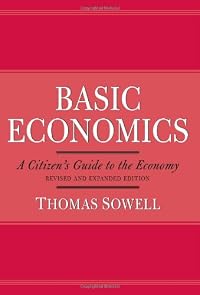
Basic Economics: A Citizen's Guide to the Economy
by Thomas Sowell
On This Page
Description
In this fifth edition of Basic Economics, Thomas Sowell revises and updates his popular book on commonsense economics, bringing the world into clearer focus through a basic understanding of the fundamental economic principles and how they explain our lives. Drawing on lively examples from around the world and from centuries of history, Sowell explains basic economic principles for the general public in plain English. Basic Economics, which has now been translated into six languages and has show more additional material online, remains true to its core principle: that the fundamental facts and principles of economics do not require jargon, graphs, or equations and can be learned in a relaxed and even enjoyable way. show lessTags
Recommendations







Member Recommendations
by anonymous user
themulhern An early chapter of "Economism" is a masterly exposition of economists' ideas of supply and demand curves. The first chapter of "Basic Economics" uses supply and demand curves,without ever mentioning them. Without "Economism"'s explanation I would not have been able to construct a sensible understanding of Sowell's dairy products example. With it, it all made sense.
Funny thing is that I think the authors of these two books are in vehement disagreement about economics itself; but they both happen to be excellent writeres.
JacoboBaggins Compact but deeply insightful. Somewhat abstract and almost axiomatic but in a good way.
Member Reviews
"Basic Economics" is generally smart and engaging, but it's often intellectually dishonest.
Thomas Sowell does a great job of explaining the basic principles of economics with salient examples. There are multiple "aha" moments while reading, because the author captures the dynamics of the field so well. Unfortunately, Sowell manifests a strongly libertarian perspective throughout the book, to the point that some sections read more like propaganda than a textbook.
For example, Sowell attributes US gasoline shortages during the 1970s to motorist hoarding—without even mentioning OPEC's oil embargo in 1973—to support his repeated argument that price controls are always bad. The book doesn't seem to evaluate the successes and failures of show more a free market, but it assumes instead that the market is always more effective than government.
To learn more about basic economics, I have put this book aside. Instead, I will be reading "Naked Economics" by Charles Wheelan. show less
Thomas Sowell does a great job of explaining the basic principles of economics with salient examples. There are multiple "aha" moments while reading, because the author captures the dynamics of the field so well. Unfortunately, Sowell manifests a strongly libertarian perspective throughout the book, to the point that some sections read more like propaganda than a textbook.
For example, Sowell attributes US gasoline shortages during the 1970s to motorist hoarding—without even mentioning OPEC's oil embargo in 1973—to support his repeated argument that price controls are always bad. The book doesn't seem to evaluate the successes and failures of show more a free market, but it assumes instead that the market is always more effective than government.
To learn more about basic economics, I have put this book aside. Instead, I will be reading "Naked Economics" by Charles Wheelan. show less
Thomas Sowell's Basic Economics is an immensely adequate refresher course in economics.
Admittedly, as a work of popular non-fiction, the author’s viewpoint shines through, and lends Basic Economics something in the nature of a conservative political slant. E.g., it’s only in Chapter 17 that Sowell finally admits that it’s possible for government intervention to do anything besides screw up the economy. Likewise, he tends to gloss over circumstances that might give rise to inefficient markets (barriers to entry, small markets), and wholly fails to address results from behavioral economics suggesting that it may be too much to assume rational self-interest on the part of individual market participants.
On these facts, it would be show more easy—much too easy—to dismiss Sowell as a “conservative,” or as lacking in “compassion.” I don’t think it would be fair to dismiss this work in that way though. Instead, I want to truly entertain the possibility that the majority of misguided economic policies arise from the left end of the political spectrum. And as someone who leans left, I recognized many of the fallacies that Sowell scrutinizes here, and saw too that I have swallowed them on many a prior occasion. Sowell’s book reminded me that I know better. That in itself was worth the price of admission.
It’s not a particularly well-written book. Frankly, Basic Economics is over 500 pages of barren sentences. It contains not a single turn of phrase that would prompt you to turn to your couchmate and say, “Listen to this.” That’s a problem for me. I don’t know if I have ever read another work of popular non-fiction that was as thoroughgoing in its stylistic dullness as this one is.
I also have a bit of a complaint about this book’s billing as an introduction to economics that eschews charts, graphs, and equations. A good friend of mine—who, if I recall, is the one who first recommended Basic Economics to me—has placed a quote from Lord Kelvin on his Facebook profile: “When you can measure what you are speaking about, and express it in numbers, you know something about it; but when you cannot measure it, when you cannot express it in numbers, your knowledge is of a meager and unsatisfactory kind: it may be the beginning of knowledge, but you have scarcely, in your thoughts, advanced to the state of science.” I don’t mean to suggest that Sowell has dumbed down a course in economics for presentation to the general public. On the contrary, the only way I was sure that I was keeping up with some of the more difficult concepts here was by referring to my vague recollection of the charts and graphs that appeared in my Intro to Econ textbook—and to the text itself on a few occasions. Maybe I’m just a visual learner, or maybe the subject matter of economics actually is most effectively presented alongside demand curves, supply curves, and marginal revenue curves.
Finally—and I hate to bring this up, but it was a huge distraction to me during my reading—this hardbound third edition contains some truly abysmal typesetting. Blockquotes are spaced unevenly above and below; the names of newspapers are printed in bold italics; quotation marks alternate between smart-quotes and straight-quotes without rhyme or reason. If a fourth edition is released, the text deserves a good once-over by an experienced copy editor. show less
Admittedly, as a work of popular non-fiction, the author’s viewpoint shines through, and lends Basic Economics something in the nature of a conservative political slant. E.g., it’s only in Chapter 17 that Sowell finally admits that it’s possible for government intervention to do anything besides screw up the economy. Likewise, he tends to gloss over circumstances that might give rise to inefficient markets (barriers to entry, small markets), and wholly fails to address results from behavioral economics suggesting that it may be too much to assume rational self-interest on the part of individual market participants.
On these facts, it would be show more easy—much too easy—to dismiss Sowell as a “conservative,” or as lacking in “compassion.” I don’t think it would be fair to dismiss this work in that way though. Instead, I want to truly entertain the possibility that the majority of misguided economic policies arise from the left end of the political spectrum. And as someone who leans left, I recognized many of the fallacies that Sowell scrutinizes here, and saw too that I have swallowed them on many a prior occasion. Sowell’s book reminded me that I know better. That in itself was worth the price of admission.
It’s not a particularly well-written book. Frankly, Basic Economics is over 500 pages of barren sentences. It contains not a single turn of phrase that would prompt you to turn to your couchmate and say, “Listen to this.” That’s a problem for me. I don’t know if I have ever read another work of popular non-fiction that was as thoroughgoing in its stylistic dullness as this one is.
I also have a bit of a complaint about this book’s billing as an introduction to economics that eschews charts, graphs, and equations. A good friend of mine—who, if I recall, is the one who first recommended Basic Economics to me—has placed a quote from Lord Kelvin on his Facebook profile: “When you can measure what you are speaking about, and express it in numbers, you know something about it; but when you cannot measure it, when you cannot express it in numbers, your knowledge is of a meager and unsatisfactory kind: it may be the beginning of knowledge, but you have scarcely, in your thoughts, advanced to the state of science.” I don’t mean to suggest that Sowell has dumbed down a course in economics for presentation to the general public. On the contrary, the only way I was sure that I was keeping up with some of the more difficult concepts here was by referring to my vague recollection of the charts and graphs that appeared in my Intro to Econ textbook—and to the text itself on a few occasions. Maybe I’m just a visual learner, or maybe the subject matter of economics actually is most effectively presented alongside demand curves, supply curves, and marginal revenue curves.
Finally—and I hate to bring this up, but it was a huge distraction to me during my reading—this hardbound third edition contains some truly abysmal typesetting. Blockquotes are spaced unevenly above and below; the names of newspapers are printed in bold italics; quotation marks alternate between smart-quotes and straight-quotes without rhyme or reason. If a fourth edition is released, the text deserves a good once-over by an experienced copy editor. show less
Very useful introduction to basic economic principles and their implications. I picked this book up to remedy what I expected was a hole in my education; I'm glad I did. Although it took me about 80% of the book to finally buy into the idea that international trade is not a zero-sum game, coming to terms with that in itself is worth the price of entry.
That said, there's something eerily religious about economics. This book implicitly asks readers to stop being in-group-centered beings and instead focus on the improvement of humanity as a whole. The underlying principle that "the good of the many outweighs the good of the few" comes through particularly strongly in the book's negative discussion of unionization. I was slightly surprised show more (but keen) to see the moral philosophical screed between its lines. This illustrates, like much good fiction, how mature belief systems become inevitably self-reinforcing.
Everyone should be familiar with fundamental economic principles. This book is a very reasonable place to start. show less
That said, there's something eerily religious about economics. This book implicitly asks readers to stop being in-group-centered beings and instead focus on the improvement of humanity as a whole. The underlying principle that "the good of the many outweighs the good of the few" comes through particularly strongly in the book's negative discussion of unionization. I was slightly surprised show more (but keen) to see the moral philosophical screed between its lines. This illustrates, like much good fiction, how mature belief systems become inevitably self-reinforcing.
Everyone should be familiar with fundamental economic principles. This book is a very reasonable place to start. show less
I’ve enjoyed Thomas Sowell’s work for years. In particular, his recent book on the subprime mortgage crisis is excellent.
I’ve found Sowell congenial for a couple of reasons. First, he’s a solid conservative, like me. And second, he writes clear, jargon-free prose that, unusually for a contemporary economist, does not fall back on complex mathematical explanations or graphical depictions.
I therefore thought it was time to shore up my economics knowledge by working through what is perhaps Sowell’s best-known book, Basic Economics.
And what a good choice that was. This book distills the essence of Sowell’s approach: there is not a single equation or graph or figure or diagram in the entire work. There’s just page after page, show more chapter after chapter, of crisply-explained, vividly-illustrated economic concepts and applications.
Sowell begins with the most basic of the basics, supply and demand, and he holds tight to this fundamental, irrefutable theme throughout the rest of the book, as he ranges over micro topics such as pricing and profits and on to macro topics such as balance of trade. He shows, over and over again, how economics is all about studying the use of scarce resources that have alternative uses. He keeps one of (to me) the great insights of economics – i.e. opportunity cost – in constant view. This is in stark contrast to the mishmash of economic idiocy one receives from the mass media and politicians.
Sowell also does a tremendous job taking on common economic fallacies such rent and price controls. Using examples from many countries, he shows how such policies always backfire, no matter how well-intentioned they might be.
I would recommend this book to any general readers like me who are interested simply in becoming more literate and conversant in basic economics, and perhaps especially to college or even high school students who are interested in how the world of business and money actually works. show less
I’ve found Sowell congenial for a couple of reasons. First, he’s a solid conservative, like me. And second, he writes clear, jargon-free prose that, unusually for a contemporary economist, does not fall back on complex mathematical explanations or graphical depictions.
I therefore thought it was time to shore up my economics knowledge by working through what is perhaps Sowell’s best-known book, Basic Economics.
And what a good choice that was. This book distills the essence of Sowell’s approach: there is not a single equation or graph or figure or diagram in the entire work. There’s just page after page, show more chapter after chapter, of crisply-explained, vividly-illustrated economic concepts and applications.
Sowell begins with the most basic of the basics, supply and demand, and he holds tight to this fundamental, irrefutable theme throughout the rest of the book, as he ranges over micro topics such as pricing and profits and on to macro topics such as balance of trade. He shows, over and over again, how economics is all about studying the use of scarce resources that have alternative uses. He keeps one of (to me) the great insights of economics – i.e. opportunity cost – in constant view. This is in stark contrast to the mishmash of economic idiocy one receives from the mass media and politicians.
Sowell also does a tremendous job taking on common economic fallacies such rent and price controls. Using examples from many countries, he shows how such policies always backfire, no matter how well-intentioned they might be.
I would recommend this book to any general readers like me who are interested simply in becoming more literate and conversant in basic economics, and perhaps especially to college or even high school students who are interested in how the world of business and money actually works. show less
While this book has a wealth of information about economics and helped me understand some of the reasoning behind various economic activities going on in our world, I have 2 huge problems with this book that prevent me from recommending it to other people:
1. It is very biased and takes on the capitalist agenda completely, never missing a single opportunity to comment on the futility and ineffectiveness of socialist economies and the MAGICAL powers of capitalist economies to regulate itself and be efficient. I did not appreciate this one-minded approach.
2. It is very repetitive. It explains a concept or an idea followed by an example followed by a re-explanation followed by another example then another re-explanation and so on. Every show more chapter in the book more ore less follows that formula. I know this is used to hammer the point, but this is just a bit too much hammering. show less
1. It is very biased and takes on the capitalist agenda completely, never missing a single opportunity to comment on the futility and ineffectiveness of socialist economies and the MAGICAL powers of capitalist economies to regulate itself and be efficient. I did not appreciate this one-minded approach.
2. It is very repetitive. It explains a concept or an idea followed by an example followed by a re-explanation followed by another example then another re-explanation and so on. Every show more chapter in the book more ore less follows that formula. I know this is used to hammer the point, but this is just a bit too much hammering. show less
A dogmatic, repetitive and occasionally pedantic outline of the principles of economics. While clearly illustrating the dangers of skewed incentive structures (pulling from politically attractive policies such as rent control and minimum wage) this overview is devoid of nuance or complexity and looks especially naïve in the wake of the last three years. Thomas Sowell clearly hammers home that every decision involving a scarce resource (with alternative uses) is a trade-off, but fails to mention that the trade-off of complete laissez-faire capitalism is market volatility -- a rather dangerous condition in a global integrated economy, as it turns out.
A dogmatic, repetitive and occasionally pedantic outline of the principles of economics. While clearly illustrating the dangers of skewed incentive structures (pulling from politically attractive policies such as rent control and minimum wage) this overview is devoid of nuance or complexity and looks especially naïve in the wake of the last three years. Thomas Sowell clearly hammers home that every decision involving a scarce resource (with alternative uses) is a trade-off, but fails to mention that the trade-off of complete laissez-faire capitalism is market volatility -- a rather dangerous condition in a global integrated economy, as it turns out.
Members
- Recently Added By
Lists


Author Information

76+ Works 15,297 Members
Thomas Sowell is the Rose and Milton Friedman Senior Fellow on Public Policy at the Hoover Institution, Stanford University.
Work Relationships
Common Knowledge
- Canonical title
- Basic Economics: A Citizen's Guide to the Economy
- Original publication date
- 2001
- First words
- Preface: This is an introduction to economics for the general public. The growing sophistication of professional economists has not been accompanied by any greater spread of knowledge about basic economic principles among t... (show all)he population at large.
Text: To know what economics is, we must first know what an economy is. - Last words
- (Click to show. Warning: May contain spoilers.)For those who are willing to stop and think, basic economics provides the tools for evaluating policies and proposals in terms of logical implications and empirical evidence. If this book has contributed to that end, then it has succeeded in its mission.
Classifications
Statistics
- Members
- 2,347
- Popularity
- 8,327
- Reviews
- 31
- Rating
- (4.16)
- Languages
- English, Polish, Spanish, Swedish
- Media
- Paper, Audiobook, Ebook
- ISBNs
- 48
- ASINs
- 26